 How to resolve AdBlock issue?
News
- Details
- Written by: Lake County News Reports
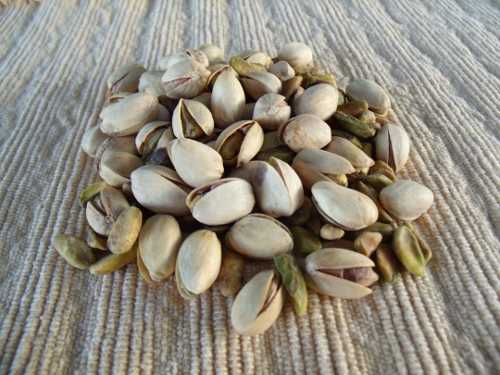
When I was a little girl, a treat of immense proportions was to be taken with my brother to the soda fountain that was tucked into the corner of the local drugstore.
Light meals were served there, but more importantly, an occasional dish of ice cream could be had when my mother felt my brother and I deserved a goody.
In those days, chocolate, vanilla and strawberry ice creams were standard fare at such places, but this particular drug store also had a flavor that seemed outlandish to me: pistachio.
And that’s the one I always chose.
I had no idea what pistachios were (nor could I efficiently pronounce the name), but the peregrine nature of such a frozen concoction intrigued me.
As we have ice cream in nearly every flavor now, I rarely choose pistachio when I indulge, but my fascination with the nut remains.
When my husband and I celebrated our wedding anniversary recently and the waitress placed my pistachio-crusted salmon in front of me, I felt like a kid again, spoon poised above a metal dish of green ice cream between spins on my drug store counter stool.
Pistachios, native to Persia (modern day Iran and part of Iraq) and a sometime denizen of the hanging gardens of Babylon, grow in grape-like clusters on trees. The shells are formed first on female trees, and if there is a male tree nearby for pollination, the empty shells will fill with green pistachio nuts.
One male tree produces enough pollen for eight to twelve female nut-bearing trees.
A fleshy outer skin that’s removed during processing covers the hard shells in which the green nuts form. It changes color as the nut ripens, from green to yellowish-red, adding to pistachios’ grape-like look when on the tree.
Pistachios, technically the seed of a fruit, are considered a culinary nut, rather than a true botanical nut. They’re related to cashews (another culinary nut), and the cashew family also includes mangoes, the spice sumac, and poison ivy.
Other than in Australia where February is the harvest month, pistachios are gathered in September. A particularly hot summer might make them ready the last week of August.
When ripe, the nuts split open with a pop. In some places in the Middle East, one would be considered lucky if sitting under a pistachio tree when they snap open.
In those countries the nuts are sometimes called “smiling pistachios,” possibly because the broad opening makes the nut look like it’s in the midst of a big grin.
Because the shells are open with the nuts exposed during harvest, it’s important that they’re kept from falling on the ground to avoid contamination.
In California’s San Joaquin Valley, where fully 98 percent of pistachios consumed in the U.S. are grown, elaborate machines that prevent the nuts from touching the ground are employed during the harvest.
The specially designed contraptions shake the trees while surrounding the trunk with tilted platforms from which the nuts roll onto a conveyor belt that carries them to a pull-along trailer.
A link is below for any uber curious folks who wish to see the machines in action. It really is pretty amazing.
A more primitive, but effective, method of protecting the inner nut is to line the ground surrounding the trees with tarps to catch hand-harvested nuts.
Pistachios like hot, dry conditions, and New Mexico and Nevada are two other states where pistachios are cultivated. Iran is the largest worldwide producer, with most nuts exported to Europe and Asia.
Thankfully, tasty pistachios are considered a beneficial food.
The health benefits of tree nuts have been demonstrated in a variety of scientific studies, and pistachios specifically contain an impressive array of nutrients per serving.
Full of fiber and protein, pistachios also contain healthy monounsaturated and polyunsaturated fats, phytosterols for heart health, stores of potassium, vitamin B6, and lutein, which promotes eye wellness.
They have more antioxidants pound-for-pound than antioxidant power houses blueberries, blackberries, garlic, and pomegranate juice.
Because they originated in the Middle East, they’re a typical ingredient in foods there, including in the ground lamb kebabs known as gyros and in desserts like baklava.
Do you remember when pistachios were dyed a ghastly pinkish red? That was mostly to cover shell discoloration on lower grade nuts. Thankfully, it’s not done much anymore; I can’t remember when I last spotted some.
Because of their high oil and low water content, pistachios have been known to self-combust in bulk container shipments.
Such an event would belie their Chinese nickname, the “happy nut.”
Like other nuts, there is a near endless variety of ways pistachios can be used in cuisine. And, of course, they’re wonderful when eaten out of hand.
Some favorite pairings are with apricots or peaches, cheeses such as goat, Parmesan, brie, or ricotta, chicken and dishes that accompany fowl (think stuffing or rice), white or dark chocolate, honey, and lemon.
Because of the strong taste of pistachios, they work well with meats such as lamb and pork, both as a crust or as a component in a sauce, chutney, or accompanying dish.
For a treat on your morning toast, try combining softened butter, pistachios, and a bit of honey in a food processor or blender. A pinch of cinnamon may also be added.
As to today’s recipe, the citrus-pistachio couscous salad below is especially good as a bed for grilled salmon, but is also nice on its own.
And below is the video on the harvest.
Enjoy, and happy Sunday!
Citrus-pistachio couscous salad
Juice of two oranges
1 cup reduced-sodium chicken or vegetable broth
½ teaspoon sea salt
1 cup couscous
1 cucumber, peeled, seeded and diced small
½ cup chopped red bell pepper
½ cup shelled pistachios, chopped
Dressing:
1 tablespoon white wine vinegar
2 tablespoons extra virgin olive oil
4 scallions, chopped
1 tablespoon chopped fresh mint
Freshly ground pepper to taste
Juice of 1 lemon
Cook couscous according to directions on box, using broth in place of water. Once cooked, add orange juice and salt and mix well. Fold in cucumber, red bell pepper and pistachios.
For dressing:
Mix all ingredients for dressing in bowl and whisk. Pour over salad to taste.
This recipe serves four and is courtesy of the American Pistachio Growers Web site, www.americanpistachios.org .
Esther Oertel, a freelance writer, cooking teacher, and speaker, is passionate about local produce and all foods in the vegetable kingdom. She welcomes your questions and comments and may be reached at
- Details
- Written by: Elizabeth Larson
LAKEPORT, Calif. – Shepherd, poodle and heeler mixes are waiting for new homes this week at Lake County’s animal shelter.
Dogs young and old, big and little, are ready to get out of their cages and into new families.
Thanks to Lake County Animal Care and Control’s new veterinary clinic, many of the animals offered for adoption already are spayed or neutered and ready to go home with their new families.
Dogs that are adopted from Lake County Animal Care and Control are either neutered or spayed, microchipped and, if old enough, given a rabies shot and county license before being released to their new owner. License fees do not apply to residents of the cities of Lakeport or Clearlake.
If you're looking for a new companion, visit the shelter. There are many great pets hoping you'll choose them.
The following dogs at the Lake County Animal Care and Control shelter have been cleared for adoption (additional dogs on the animal control Web site not listed are still “on hold”).

Male pit bull mix
This male pit bull mix is 3 years old.
He has a long brown and white coat, weighs 62 pounds and has not been neutered.
Shelter staff said he may have a case of mange.
Find him in kennel No. 3, ID No. 33777.

‘Budah’
“Budah” is an 8-year-old male Rottweiler-Australian Shepherd mix.
He’s got a short black and tan coat, weighs 70 pounds and has been neutered.
He’s in kennel No. 4, ID No. 33848.
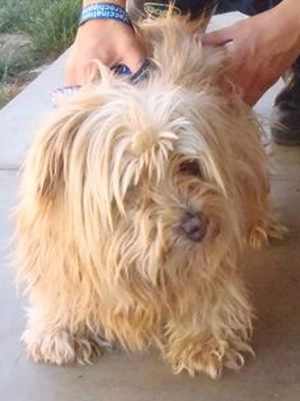
‘Lucy’
“Lucy” is a 13-year-old female terrier-poodle mix.
She has a long curly coat, weighs nearly 16 pounds and has been spayed.
Find her in kennel No. 5a, ID No. 33868.

‘Terrace’
“Terrace” is a 6-year-old male American Eskimo Dog mix.
He has a long coat, weighs nearly 18 pounds and has not been altered.
He’s in kennel No. 5b, ID No. 33869.

Male poodle mix
This male poodle mix is 2 years old.
He has a short white coat and weighs just under 9 pounds.
Find him in kennel No. 7, ID No. 33894.
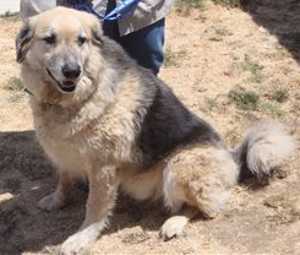
‘Fuego’
“Fuego” is a 4-year-old male shepherd mix.
He’s neutered, weighs nearly 94 pounds and has a long tricolor coat.
He’s in kennel No. 15, ID No. 33660.
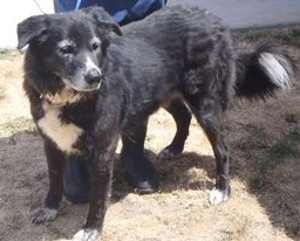
‘Madi’
“Madi” is a 5-year-old female shepherd mix.
She weighs 76 pounds, has a long black and white coat, and has been spayed.
Find her in kennel No. 15, ID No. 33658.
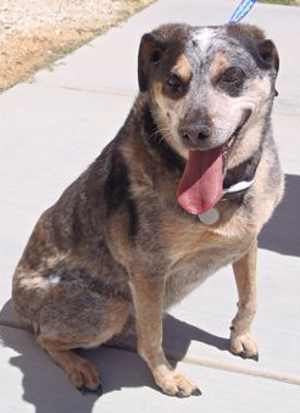
‘Tacoma’
“Tacoma” is a 9-year-old female blue heeler mix.
She has a short blue merle coat, weighs 62 pounds and has been spayed.
She’s in kennel No. 20, ID No. 33744.
Adoptable dogs also can be seen at http://www.co.lake.ca.us/Government/Directory/Animal_Care_And_Control/Adopt/Dogs_and_Puppies.htm or at www.petfinder.com .
Please note: Dogs listed at the shelter's Web page that are said to be “on hold” are not yet cleared for adoption.
To fill out an adoption application online visit http://www.co.lake.ca.us/Government/Directory/Animal_Care_And_Control/Adopt/Dog___Cat_Adoption_Application.htm .
Lake County Animal Care and Control is located at 4949 Helbush in Lakeport, next to the Hill Road Correctional Facility.
Office hours are Monday through Friday, 8 a.m. to 5 p.m., and 1 p.m. to 3 p.m., Saturday. The shelter is open from 10:30 a.m. to 4:30 p.m. Monday through Friday and on Saturday from 1 p.m. to 3 p.m.
Visit the shelter online at http://www.co.lake.ca.us/Government/Directory/Animal_Care_And_Control.htm .
For more information call Lake County Animal Care and Control at 707-263-0278.
Email Elizabeth Larson at
- Details
- Written by: Dauna Coulter
By now it’s old news that NASA’s new Mars rover Curiosity is resting safely on the surface of Red Planet after a daredevil landing that had the nation holding its breath.
Now, mission scientists are anxious to start moving.
With such a sweet set of wheels at their disposal and the “open road” before them, just where will they go first?
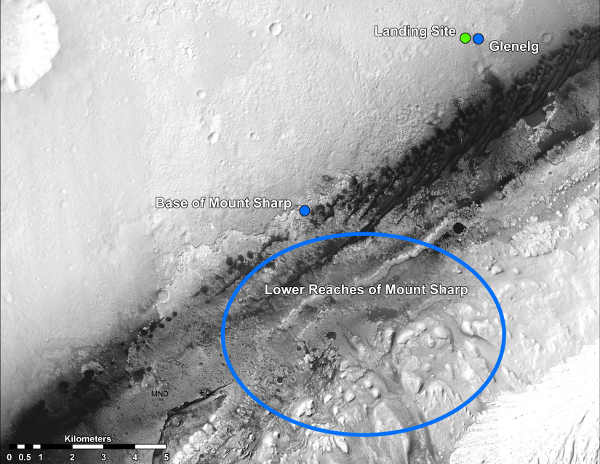
“We won’t have to travel far for excitement,” said project scientist John Grotzinger. “We landed in the best possible place within the landing ellipse – the bottom of an alluvial fan.”
An alluvial fan is a pattern of sedimentary rocks, dirt and sand deposited by flowing water – in this case, perhaps an ancient Martian river.
Since life as we know it requires liquid water, this is an excellent first place to search for clues of a Mars that was once hospitable to life.
“The alluvial fan indicates that water flowed across the surface, so we’ll head downhill to where water might have collected,” said Grotzinger. “We’ll be looking for minerals like salts that might tell us where water has been. It’s kind of like a scavenger hunt with minerals as clues.”
After that, Grotzinger said it’s “full-speed ahead” to the base of Mount Sharp, a 5,000-meter-tall mountain that holds within its ancient layers possible clues to life on the Red Planet.
“We’ll have to make a deal with ourselves not to stop too often along the way,” he said. “Mount Sharp is the reason we chose this landing site, so we need to high-tail it on over there.”
Deputy Program Manager Richard Cook described the temptation to stop along the way: “It’ll be like taking a family vacation, but instead of the family you have 400 scientists who want to stop and look at every sight.”
Curiosity is bristling with instruments custom-made to look for the chemical building blocks of life.
A laser on Curiosity’s mast can take aim at interesting rocks and vaporize small spots on them from up to seven meters away.
The micro-blasts produce plasma clouds, and the scientists can examine the light reflected off these clouds to learn what the rocks are made of.
The mast also sports a high-resolution camera called Mastcam, which has already begun observing and photographing the rover’s surroundings.
The rover’s robotic arm wields its own array of instruments.
The Alpha Particle X-Ray Spectrometer will measure the abundance of chemical elements in the dust, soils, rocks, and samples the rover gathers.
The Mars Hand Lens Imager acts like a geologist’s magnifying lens that can take its own color photos.
Ultimately samples will be delivered to a pair of onboard laboratory instruments. One of them, SAM, short for Sample Analysis at Mars, will explore the Red Planet by “sniffing” the air, bird-dog style.
It has vents that open to the atmosphere to detect gases like methane. SAM can also “sniff” the gases released by rock or soil samples it heats in its own oven.
Can 400 scientists gripped by the thrill of the greatest “family vacation” ever really rush to their destination without stopping to savor every sight?
Grotzinger made just one guarantee: “In the coming months and years, Curiosity will tell us an incredible story.”
Dauna Coulter works for the National Aeronautics and Space Administration.
- Details
- Written by: Elizabeth Larson
NORTH COAST, Calif. – A complex of fires that began early Saturday in northern Mendocino County had burned hundreds of acres by nightfall.
The Pass Complex was reported at around 2:47 a.m. Saturday in Williams Valley, 10 miles northeast of Covelo, according to a report issued by Cal Fire Mendocino Unit spokesperson Julie Cooley.
By 8 p.m. Saturday, the two-fire complex – consisting of the Pass 1 and Pass 2 – had reached 510 acres, with containment at 10 percent, according to Cooley.
Personnel assigned to the complex Saturday totaled 255, with 13 fire engines, eight fire crews, four bulldozers, two airtankers, two helicopters and two water tenders, Cooley said.
The area’s hot, dry, windy weather is anticipated to lead to significant growth on the Pass 1 Fire, Cooley reported. The Pass 2 was holding at 10 acres.
The fires are burning in heavy timber with limited access for firefighters, said Cooley. Other challenges include crowning, torching and long range spotting.
Cooley reported that no structures have been destroyed and no evacuations were ordered, but three injuries were reported.
Cooperating agencies on the complex include Cal Fire, Covelo Fire Department, U.S. Forest Service, Bureau of Indian Affairs, California Department of Corrections & Rehabilitation and the California National Guard.
Email Elizabeth Larson at