 How to resolve AdBlock issue?
News
- Details
- Written by: Lake County News Reports
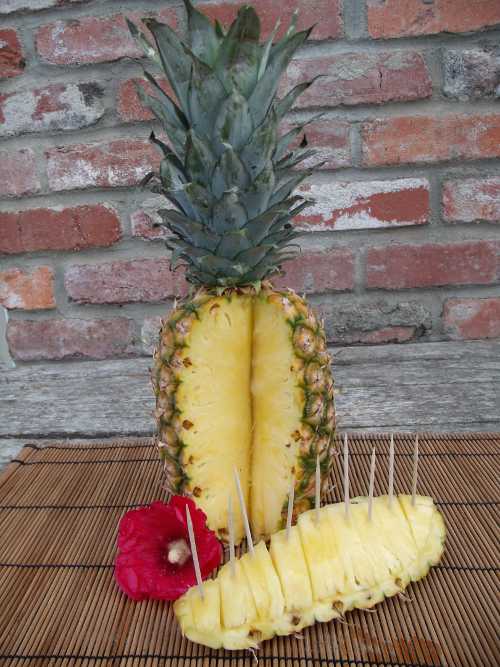
On an unseasonably overcast day, a pineapple brought the sun’s rays.
As I glanced in the direction of the large knobby fruit I had just purchased, a trade wind emitted from its spiky-leaved cap, gently brushing my cheek.
Grains of warm white sand were pleasantly rough against my hand as I reached for it.
And when I cut into it, oh my! Azure waves came rushing forward, overtaking me in their salty froth.
Suddenly I wasn’t in northern California, but in the tropics where golden pineapples bask in the glow of the sultry summer sun.
The fruit’s association with the tropics is no doubt one reason why it’s a symbol of hospitality.
Another is its popular status in American Colonial days when elaborate fruit displays welcomed visitors. Having a rare pineapple as the centerpiece was a grand coup.
Highly expensive because of the difficulty in transporting them fresh over sea, pineapples were sometimes rented from confectioners for the day to impress guests.
So blessed are we with the easy presence of this succulent sweet-tart fruit, its novelty is hard to imagine as we enjoy their every day availability in supermarket produce departments.
While we typically associate pineapples with our 50th state, the truth is that the fruit isn’t native to the Hawaiian Islands.
Neither are they indigenous to volcanic Caribbean isle Guadeloupe, where the first Europeans encountered them during Christopher Columbus’s landing there in 1493.
Historians believe pineapples originated in South American lowlands in areas now occupied by Brazil and Paraguay, making their way to the Caribbean through centuries of Indian maritime exploration and trade.
The Tupi Indians who lived where pineapples evolved called it “nana” or “anana,” meaning excellent fruit. Highly prized for its sweetness, this “excellent fruit” was a staple at Indian feasts and was used to make wine.
The English word pineapple comes from its resemblance to a pine cone in shape and texture and the general use of the term apple for any fruit.
And what of its relationship to Hawaii?
Pineapples were brought to those islands by Captain Cook in 1777, where native Hawaiians called them “halakahiki,” which means foreign fruit.
There was some cultivation of pineapples in Hawaii in ensuing years, but large scale production of the crop by U.S. companies didn’t begin until the early 1900s.
Pineapple is delicious in sweet applications, of course (cakes, toppings, muffins, fruit salad and the like), but its flavor also marries well with chicken, pork and fish.
Think of a baked ham with pineapple glaze, Asian chicken or pork stir-fries with chunks of the fruit, or fish or pork chops with pineapple salsa.
My grandmother loved to run thick slices of ham topped with rings of pineapple under the broiler, sometimes adding cheddar cheese to her old-fashioned fare.
Wedges of pineapple may be tossed on the grill, sweetness intensifying in the process.
These delicious, grill-marked discs are wonderful on their own, but also go well with chicken or burgers. They’re especially good when combined with grilled red pepper.
I like to dice the leftovers for use in salads the following day. My favorite is a tropical rice and bean salad, but you can also get creative with chicken, tuna or pasta.
While Costa Rica is the biggest exporter of pineapple, the bulk of pineapples are grown in Southeast Asia, where the fruit is popular in the cuisines of those lands.
Botanically speaking, the pineapple is an edible, domesticated bromeliad, meaning a tropical fruit with fleshy leaves that form water-catching receptacles.
When creating its fruit, the plant produces up to 200 flowers. Once this occurs, the individual fruits of the flowers join together, creating a pineapple.
Thus, a mature pineapple is composed of many berry-like fruitlets that fuse together around a central fibrous core.
Conventional growers of pineapples control flowering and fruit set with hormones so that harvest is staggered throughout the year, but organic growers (of which there are a growing number, thankfully) harvest their untreated plants in spring and summer.
Speaking of organic pineapple, buy it if you can find it, both for your own health and the health of others.
Farm workers in Costa Rica, for example, are at risk because of the chemicals used in conventionally farmed pineapple, as is their water supply.
In addition, because so many are used, the chemicals render the soil ecologically barren.
Pineapples contain a protein-digesting enzyme called bromelain, the reason pineapple juice may be employed as a marinade for meat.
It’s this enzyme that disrupts the setting of gelatin desserts; however, since cooking deactivates it, using canned pineapple doesn’t have the same effect.
The enzyme is so strong that pineapple workers have to wear gloves to prevent it from digesting the skin of their hands during constant contact.
One of my favorite ways to serve pineapple is to cut it in quarters lengthwise (including the leafy top so a portion is attached to each quarter) and serve wedges of the fruit in these pineapple boats.
To create the wedges, run a sharp knife under the flesh in each quarter close to the skin, and then cut the long triangle of fruit into slices. Add a toothpick to each slice and arrange the quarters (with their leaves attached) on a tray for presentation.
This healthy fruit provides a whooping 131 percent of our daily allowance of vitamin C in just one cup of it.
In addition, pineapple has plenty of manganese (good for bone strength), and provides fiber, vitamins B6 and B1, copper and folate.
The beta carotene in pineapple is great for eye health.
A sweet, sumptuous smell will alert us to a pineapple’s ripeness, as will a bright yellow color in the spaces between the scales on its skin.
Today’s recipes are refreshing pineapple popsicles (perfect for summer!) and a vibrant pineapple salsa that’s equally good with corn chips, fish, pork, and chicken. (Try it with fish tacos.)
If you’d like to know how to grow pineapples at home or receive a lesson in a great way to cut fresh pineapple slices, check out the links below.
Oh, and be sure to get your beach umbrella out before you bring that pineapple home.
Pineapple popsicles
3 cups chopped fresh pineapple, about 14 ounces
2/3 cup water
½ cup sugar (or sweeten as desired)
4 ½ tablespoons fresh lemon juice
Fine sea salt to taste (start with a small pinch)
Equipment needed:
4 to 8 popsicle molds (or plastic or paper cups)
Wooden sticks
In a blender, puree all ingredients. Adjust seasoning, if necessary, and pour into desired molds.
Freeze until slushy, about an hour, then insert sticks and freeze until firm, about 7 hours.
Popsicles may be made up to two days in advance. Flavor diminishes if made any earlier.
Recipe courtesy of www.lacucinaitalianamagazine.com .
Pineapple salsa
2 cups chopped pineapple (fresh preferred)
½ medium sweet onion, chopped
½ red bell pepper, chopped
1 small jalapeno pepper, seeds removed and chopped finely
¼ cup chopped fresh cilantro
Fresh squeezed juice from one lime
Salt to taste
Mix all ingredients except salt in a medium bowl until evenly distributed. Season to taste with a pinch of salt.
Cover the bowl and refrigerate for at least an hour until serving so flavors can blend.
Recipe courtesy of www.savorysweetlife.com .
How to cut a pineapple: http://www.howtocutapineapple.com/ .
How to grow a pineapple: http://www.rickswoodshopcreations.com/pineapple/pineapple.htm .
Esther Oertel, a freelance writer, cooking teacher, and speaker, is passionate about local produce and all foods in the vegetable kingdom. She welcomes your questions and comments and may be reached at
- Details
- Written by: Elizabeth Larson
LAKE COUNTY, Calif. – Lake County got a bit of a break from the heat on Saturday thanks to a summer rainstorm that moved over the area.
The National Weather Service had warned of dry thunderstorms over Lake County and other areas of Northern California due to a low pressure system.
After a cool, overcast afternoon, rain was reported throughout most of the county Saturday evening, with some areas also reporting thunder and lightning.
Dozens of people reported weather conditions in their neck of the woods on Lake County News’s Facebook page, https://www.facebook.com/pages/Lake-County-News/143156775604 , and through Twitter.
Lightning was reported in areas including Hidden Valley Lake, Clearlake, Spring Valley, Upper Lake and Lakeport.
The Lakeport Speedway’s Saturday night racing at the Lake County Fairgrounds was halted early due to the shower, according to McKenzie Paine of Velocity Video, who does videography for the races.
Roger Kinney of Clearlake Oaks reported lightning started around 9 p.m. in his area, with six lightning strikes to the north followed by a light rain that lasted more than two hours.
Rick Hamilton reported rain on and off in Loch Lomond between 7:30 p.m. and 10 p.m., varying from sprinkles to heavy rainfall.
The National Weather Service said Lake County will remain under a red flag warning – issued as a result of critical fire weather conditions – until 11 a.m. Sunday due to the possibility of additional thunderstorms.
The agency said the threat of thunderstorms will diminish Sunday from south to north as the low pressure area moves north.
The county’s seven day forecast doesn’t include any more rain, but hot weather is due to return. Daytime temperatures over the coming week are expected to be in the mid to high 90s, hitting the century mark next weekend.
Email Elizabeth Larson at
- Details
- Written by: Elizabeth Larson
LAKEPORT, Calif. – A new group of dogs – including a variety of working breeds – are waiting for new home at the county's animal shelter this week.
Labrador Retriever, shepherd, boxer and kelpie mixes are among the breeds available.
Thanks to Lake County Animal Care and Control’s new veterinary clinic, many of the animals offered for adoption already are spayed or neutered and ready to go home with their new families.
Dogs that are adopted from Lake County Animal Care and Control are either neutered or spayed, microchipped and, if old enough, given a rabies shot and county license before being released to their new owner. License fees do not apply to residents of the cities of Lakeport or Clearlake.
If you're looking for a new companion, visit the shelter. There are many great pets hoping you'll choose them.
The following dogs at the Lake County Animal Care and Control shelter have been cleared for adoption (additional dogs on the animal control Web site not listed are still “on hold”).

Male pit bull mix
This male pit bull mix is 3 years old.
He has a long brown and white coat, weighs 62 pounds and has not been neutered.
Shelter staff said he may have a case of mange.
Find him in kennel No. 3, ID No. 33777.
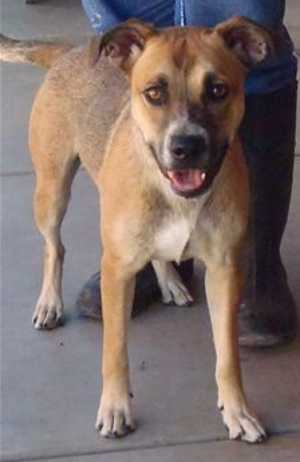
'Valentine'
“Valentine” is a 1 year old female shepherd mix.
She has a short black and brown coat, weighs about 40 pounds and has been spayed.
She is in kennel No. 8, ID No. 33775.
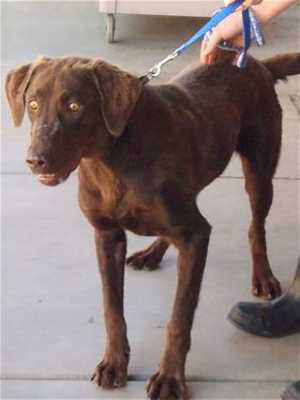
'Coco'
“Coco” is a 10 month old female Labrador Retriever mix.
She has a short chocolate-colored coat, weighs 62 pound and has been spayed.
She's in kennel No. 13, ID No. 33780.

'Slick'
“Slick” is a 3 year old Australian Kelpie mix.
He weighs 42 pounds and has a short coat.
He's in kennel No. 22, ID No. 33397.

Male boxer
This male boxer mix is 2 years old.
He has a short brown coat and a short tail.
He's in kennel No. 23, ID No. 33691.
Adoptable dogs also can be seen at http://www.co.lake.ca.us/Government/Directory/Animal_Care_And_Control/Adopt/Dogs_and_Puppies.htm or at www.petfinder.com .
Please note: Dogs listed at the shelter's Web page that are said to be “on hold” are not yet cleared for adoption.
To fill out an adoption application online visit http://www.co.lake.ca.us/Government/Directory/Animal_Care_And_Control/Adopt/Dog___Cat_Adoption_Application.htm .
Lake County Animal Care and Control is located at 4949 Helbush in Lakeport, next to the Hill Road Correctional Facility.
Office hours are Monday through Friday, 8 a.m. to 5 p.m., and 1 p.m. to 3 p.m., Saturday. The shelter is open from 10:30 a.m. to 4:30 p.m. Monday through Friday and on Saturday from 1 p.m. to 3 p.m.
Visit the shelter online at http://www.co.lake.ca.us/Government/Directory/Animal_Care_And_Control.htm .
For more information call Lake County Animal Care and Control at 707-263-0278.
Email Elizabeth Larson at
- Details
- Written by: Dr. Tony Phillips
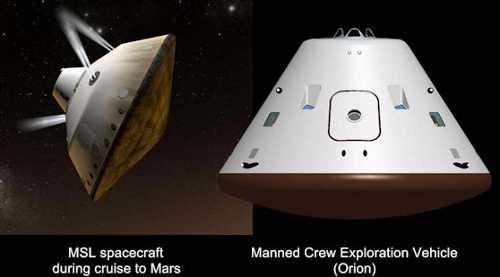
When Curiosity enters the Martian atmosphere on Monday, Aug. 6 – setting in motion “the seven minutes of terror” that people around the world have anticipated since launch a year ago – the intrepid rover will actually be performing the mission’s second daredevil stunt.
The first was completed in July.
For the past nine months, Curiosity has been acting as a stunt double for astronauts, exposing itself to the same cosmic radiation humans would experience following the same route to Mars.
“Curiosity has been hit by five major flares and solar particle events in the Earth-Mars expanse,” said Don Hassler of the Southwest Research Institute in Boulder, Colorado. “The rover is safe, and it has been beaming back invaluable data.”
Unlike previous Mars rovers, Curiosity is equipped with an instrument that measures space radiation. The Radiation Assessment Detector, nicknamed “RAD,” counts cosmic rays, neutrons, protons and other particles over a wide range of biologically-interesting energies.
RADs prime mission is to investigate the radiation environment on the surface of Mars, but NASA turned it on during the cruise phase so that it could sense radiation en route to Mars as well.
Curiosity’s location inside the spacecraft is key to the experiment.
“Curiosity is riding to Mars in the belly of the spacecraft, similar to where an astronaut would be,” explained Hassler, RAD’s principal investigator. “This means the rover absorbs deep-space radiation storms the same way a real astronaut would.”
Even supercomputers have trouble calculating exactly what happens when high-energy cosmic rays and solar energetic particles hit the walls of a spacecraft. One particle hits another; fragments fly; the fragments themselves crash into other molecules.
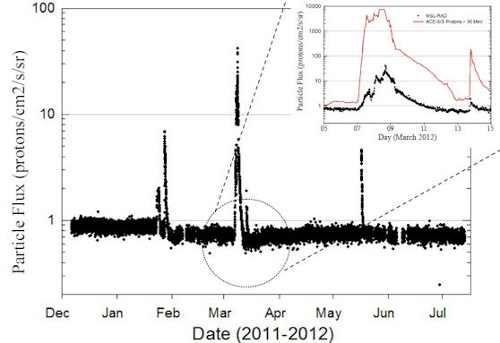
“It’s very complicated,” said Hassler. “Curiosity has given us a chance to measure what happens in a real-life situation.”
Hassler says the walls of the Mars Science Lab spacecraft have performed as expected: Only the strongest radiation storms have made it inside.
Moreover, charged particles penetrating the hull have been slowed down and fragmented by their interaction with the spacecraft’s metal skin.
“It’s not only the walls that matter, however,” he pointed out. “The spacecraft’s hydrazine tanks and other components contribute some protection, too.”
Data from Curiosity will help sort out how different subsystems block and respond to cosmic rays and solar radiation. This is information designers of human-crewed spacecraft urgently need to know.
“We plan to publish results in a refereed journal later this year,” said Hassler.
RAD was turned off July 13 in preparation for landing. Mission controllers will turn it on again after Curiosity sets down in Gale crater. Then researchers will learn what radiation awaits astronauts on the surface of Mars itself.
“No one has ever before measured this kind of radiation from the surface of another planet,” said Hassler. “We’re just getting started.”
Dr. Tony Phillips works for the National Aeronautics and Space Administration.