 How to resolve AdBlock issue?
News
- Details
- Written by: Lake County News Reports
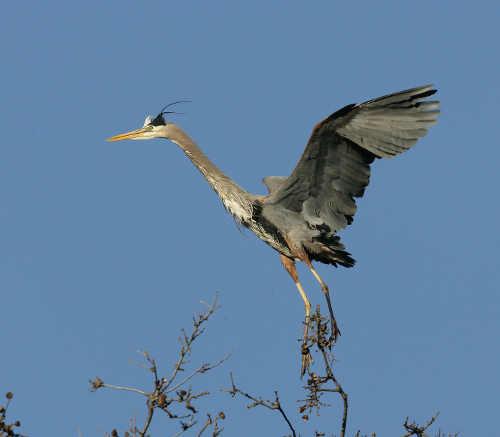
CLEARLAKE, Calif. – The 18th Annual Heron Festival, presented by the Redbud Audubon Society will be held at Redbud Park in Clearlake this Saturday, May 5, from 8 a.m. until 4 p.m.
The festival will feature nature booths, fascinating programs and children’s activities.
It is free and open to the public.
Pontoon boat rides will leave from Redbud Park to view the Great Blue Heron Rookery in Anderson Marsh; however tickets for the boat rides are now almost sold out although some may be available the day of the event.
The keynote speaker is internationally-honored nature photographer Philip L. Greene from Point Reyes.
Greene has studied and photographed herons and egrets for over two decades. His spectacular photos and delightful lecture focus on the nesting cycle of herons and egrets, with special emphasis on mating behaviors, nest building, and fledging.
Greene will present his program at 11 a.m. in the event tent at the park.
The very popular live owls and raptors show will be offered at 1 p.m. and repeated at 2 p.m. This special talk and demonstration by Native Bird Connections is one of the activities designed especially for families with children.
Dr. Harry Lyons again offers his “Myths and Music of Clear Lake,” combining an entertaining mix of music, science, and humor to tell the story of Clear Lake. Dr. Lyons will speak at 9 a.m.
Redbud Audubon will show a video and slide presentation on the amazing courtship “dancing” behaviors of the beloved grebes that frequent Clear Lake by the thousands every year during the breeding season.
Exhibit booths highlight educational displays and information from nature-related government agencies, local environmental nonprofit groups, and a wide range of nature-related artists and crafts vendors.
A wide range of fun educational activities for children will be presented, helping children to learn about nature. There is also a Children’s Heron Art Show where local school children’s creative gifts to the festival will be displayed in the Children’s Activities Area.
Food vendors will also be on hand, providing soft tacos, pulled-pork sandwiches, sodas, lemonade, cookies and desserts.
For photos and details on all festival events and to purchase tickets for the pontoon boat tours, please visit www.heronfestival.org or call 707-263-8030.
- Details
- Written by: Lake County News reports
Manual and electronic readings taken on Tuesday as part of the year's final snow survey showed that California’s drier than usual mountain snowpack is steadily melting with warming spring weather.
Statewide, snowpack water content is only 40 percent of normal for the date, and was only 55 percent of normal the first of April, the time of year when it is historically at its peak.
"The fact that we just had a dry winter right after an unusually wet season last year shows that we must be prepared for all types of weather,” said California Department of Water Resources Director Mark Cowin. “Reservoir storage will mitigate the impact of dry conditions on water supply this summer, but we have to plan for the possibility of a consecutive dry year in 2013, both by practicing conservation, continuing to develop alternative local water supplies, and working toward improved water storage and conveyance.”
The Department of Water Resources will analyze Tuesday's snow survey results to forecast runoff into the state’s streams and reservoirs as the snowpack continues to melt through spring and into summer. The winter snowpack – often called California’s “frozen reservoir” – normally provides about a third of our water supply.
Snowpack runoff this year obviously will be less than normal, but above average reservoir storage due to wet conditions last winter will mitigate the impact on water supply.
With Lake Oroville in Butte County – the State Water Project’s principal storage reservoir 97 percent full (116 percent of average for the date), Department of Water Resources expects to be able to deliver 60 percent of the slightly more than 4 million acre-feet of State Water Project water requested this year.
This is not an unusually low delivery projection, or allocation. Wet conditions last year allowed the Department of Water Resources to deliver 80 percent of amounts requested by the 29 public agencies that supply State Water Project water to more than 25 million Californians and nearly a million acres of irrigated agriculture.
The final allocation was 50 percent in 2010, 40 percent in 2009, 35 percent in 2008, and 60 percent in 2007.
The last 100 percent allocation – difficult to achieve even in wet years because of pumping restrictions to protect threatened and endangered fish – was in 2006.
Tuesday's manual snow survey was the fifth and last of the year. Surveyors from the Department of Water Resources and cooperating agencies trek into the mountains on or about the first of the month from January to May to take the vital water content measurements that signal how much runoff will be available for hydropower, homes, farms, industry and other uses.
Manual snow surveys complement and check the accuracy of real-time electronic sensors placed up and down the state’s mountain ranges.
These results, combined with readings from other locations, will produce the accuracy-checked water content readings as well as forecast spring and summer runoff.
Electronic readings indicate that water content in the northern mountains is 70 percent of normal for the date. Electronic readings for the central Sierra are 35 percent of normal. The number for the southern Sierra is 20 percent. The statewide number is 40 percent.
On May 1 last year, after an unusually wet winter, water content in the statewide snowpack was 190 percent of normal. It was 217 percent or normal in the north, 180 percent in the central Sierra, and 177 percent in the southern Sierra.
Electronic snowpack readings are available on the Internet at http://cdec.water.ca.gov/cgi-progs/snow/DLYSWEQ .
Electronic reservoir level readings may be found at http://cdec.water.ca.gov/cdecapp/resapp/getResGraphsMain.action .
See DWR’s Water Conditions page at http://www.water.ca.gov/waterconditions/ .
- Details
- Written by: Lake County News reports
The Center for Biological Diversity, Willits Environmental Center, Redwood Chapter of the Sierra Club and Environmental Protection Information Center (EPIC) filed a lawsuit in federal court Tuesday challenging the approvals and environmental review for the Willits Bypass, a proposed four-lane freeway around the community of Willits in Mendocino County.
The groups allege that the project would hurt wetlands, salmon-bearing streams and endangered plants.
“Bulldozing a freeway the size of Interstate 5 through precious wetlands would be wasteful and destructive – a four-lane road is just not needed for the traffic volumes through Willits on Highway 101,” said Jeff Miller with the Center for Biological Diversity.
“This is a wake-up call for Caltrans, which should be building efficient public transit and maintaining existing roads, rather than wasting our money and resources clinging to outdated visions of new freeways,” said Ellen Drell, board member of the Willits Environmental Center. “Global climate change, threatened ecosystems and the end of cheap oil are warning signs that we need to change course. The change needs to happen in every community, including here in Willits.”
For decades, Caltrans and the Federal Highway Administration have pursued a bypass on Highway 101 around Willits to ease traffic congestion.
The groups allege that the agencies are insisting on a four-lane freeway and refuse to consider or analyze equally effective two-lane alternatives or in-town solutions.
The current project is a six-mile, four-lane freeway bypass, including several bridges over creeks and local roads, a viaduct spanning the regulatory floodway and two interchanges.
The suit alleges that construction would damage wildlife habitat and biological resources in Little Lake Valley, including nearly 100 acres of wetlands, and would require the largest wetlands fill permit in Northern California in the past 50 years.
It's also alleged that the project would affect stream and riparian habitat for Chinook and coho salmon and steelhead trout in three streams converging into Outlet Creek, harm state-protected endangered plants – such as Baker’s meadowfoam – and destroy oak woodlands.
“In a time of devastating budget cuts to health, education, social services and the state park system, Caltrans proposes to spend nearly $200 million on an unnecessary project that will seriously degrade the headwaters of the Eel River,” said Gary Graham Hughes, executive director at EPIC. “This project is completely out of touch with the needs of the natural and human communities on the North Coast.”
“For three decades the Sierra Cub has promoted responsible transportation planning in Mendocino County, but requests to consider a two-lane alternative have been ignored by Caltrans,” said Mary Walsh with the Redwood Chapter of the Sierra Club. “We’re proud to challenge this wasteful and destructive highway project.”
The lawsuit is against Caltrans, the Federal Highway Administration and U.S. Army Corps of Engineers for violations of the National Environmental Policy Act and Clean Water Act.
It seeks a court order requiring the agencies to prepare a supplemental “environmental impact statement” that considers two-lane alternatives and addresses substantial design changes and new information about traffic volumes and environmental impacts.
For more than half a century, Caltrans has promoted turning Highway 101 into a four-lane freeway from San Diego to the Oregon border, with a four-lane freeway bypass around Willits.
Caltrans first discussed potential bypass designs and routes through Willits in 1988, but by 1995 had unilaterally discarded all non-freeway or two-lane alternatives. An environmental review for a four-lane freeway was finalized in 2006.
The California Transportation Commission, the state funding authority, has repeatedly refused to fund a four-lane freeway, so Caltrans proposes to proceed in “phases,” grading for four lanes and constructing two lanes with available funds, then allegedly constructing two additional lanes when additional funding becomes available, a dubious prospect.
Caltrans and the Federal Highway Administration did not draft a supplemental “environmental impact statement” to look at impacts of this changed design or consider two-lane alternatives.
A 1998 Caltrans study found that 70 percent to 80 percent of traffic causing congestion in downtown Willits was local, and Caltrans internally conceded that the volume of traffic projected to use the bypass was not enough to warrant a four-lane freeway. Agency data showed the volume of traffic that would use the bypass did not increase from 1992 to 2005.
New information shows actual traffic volumes are below what the agencies projected when they determined only a four-lane freeway will provide the desired level of service, and that a two-lane bypass will provide a better level of service than projected.
Phase I of the project will discharge fill into more than 86 acres of wetlands and federal jurisdiction waters.
Caltrans purchased approximately 2,000 acres of ranchland in Little Lake Valley to “mitigate” for loss of wetlands, but the properties already had established existing wetlands, with no ability for Caltrans to “create” new wetlands.
To obtain the required wetlands fill permit under the Clean Water Act, the state and federal agencies submitted a significantly deficient “mitigation and monitoring plan” to the Army Corps to “enhance” wetlands.
This plan itself alters existing wetlands and causes significant new impacts to wetlands, endangered species and grazing lands, and makes design changes that were not analyzed or disclosed in the 2006 environmental review. The Corps improperly issued the permit in February 2012.
- Details
- Written by: Elizabeth Larson
LOCH LOMOND, Calif. – Early on Tuesday afternoon firefighters were continuing to work on cleaning up a small wildland fire that began early in the morning as the result of a downed tree and fallen power lines.
The Ridge Incident was first reported at 1:55 a.m. at 12200 Shen Road in Loch Lomond, according to a report from South Lake County Fire Protection District.
“A pine uprooted and took out the power lines out there and started a fire,” said South Lake County Fire Chief Scott Upton.
The fire burned approximately five acres. It was under control by 6:23 a.m., South Lake Fire reported.
The fire district said 36 firefighters, three engine companies, a water tender, two crews and a chief officer responded.
Pacific Gas & Electric reported that a small power outage remained in effect Tuesday afternoon as repairs were being made to the lines and pole.
Upton said area residents need to be aware of the increasing fire danger with this time of year.
“The season is upon us,” he said. “It's going to get nothing but drier.”
He urged community members to clear space around their homes in order to protect their property and to aid firefighters if they need to respond to an incident.
Email Elizabeth Larson at