How to resolve AdBlock issue?
News
- Details
- Written by: Dauna Coulter and Dr. Tony Phillips
NASA's Kepler spacecraft is discovering a veritable avalanche of alien worlds.
Recent finds include planets with double suns, massive "super-Earths" and "hot Jupiters," and a miniature solar system.
The variety of planets circling distant suns is as wonderful as it is surprising.
As the numbers mount, it seems to be just a matter of time before Kepler finds what astronomers are really looking for: an Earth-like planet orbiting its star in the "Goldilocks zone" – that is, at just the right distance for liquid water and life.
"I believe Kepler will find a 'Goldilocks planet' within the next two years," said Shawn Domagal-Goldman, a researcher at NASA HQ who specializes in exoplanet biology. "We'll be able to point at a specific star in the night sky and say 'There it is – a planet that could support life!'"
Kepler has already located a few Earth-sized planets, but they are too close for comfort to their parent stars. These recent finds have heightened the sense that a big discovery is just around the corner.
But finding a Goldilocks planet is just the first step. Getting to know it is much more difficult.
The problem is that, in the cosmic scheme of things, Earth-sized planets are relatively small, and the ones Kepler is finding are staggeringly far away. Most are hundreds, or even thousands, of light years away from Earth. Almost completely hidden by the glare of their parent stars, these distant pinpricks are very difficult to study.
Fortunately, NASA has a plan.
"The reflected light of an exoplanet tells its story," explains Kepler Program Scientist Doug Hudgins, also at NASA HQ. "To get at that story and learn about the planet's atmosphere and composition, we can use a technique called transit spectroscopy."
The basic idea is simple: When a planet reflects the light of its parent star, the atmosphere of the planet leaves a subtle imprint on the reflection – a sort of spectral "fingerprint" that astronomers can study to learn what the planet's atmosphere is made of.
One new mission under consideration by NASA, named FINESSE, is a fingerprint specialist. Short for "Fast INfrared Exoplanet Spectroscopy Survey Explorer," FINESSE would measure the spectra of stars and their planets in two situations: once when the planet is in view, and again when the planet is hiding out behind its star. In this way, FINESSE can separate the planet's dim light from the stellar glare and reveal the composition of the planet's atmosphere.
NASA is also considering an observatory named "TESS"--the Transiting Exoplanet Survey Satellite. Supported in part by Google, the MIT-led mission is specifically designed to find exoplanets in the local galactic neighborhood. TESS would study hundreds of stars within 50 light years of Earth, close enough to study in some detail.
"With better detectors and instruments designed to block the glare of the parent stars, these next-generation telescopes could not only find a Goldilocks planet, but also tell us what its atmosphere is made of, what sort of cloud cover graces its skies, and maybe even what the surface is like – whether oceans cover part of the globe, how much land there is, and so on," says Hudgins.
Domagal-Goldman expects big surprises: "We've found so many unexpected things about planets that now I expect to be amazed. When we can study a Goldilocks planet, I believe we'll discover something revolutionary about how life interacts with a planetary environment. Nature is so much more diverse than we anticipated."
"The possibilities," he believes, "are limitless."
Dauna Coulter and Dr. Tony Phillips work for the National Aeronautics and Space Administration.
- Details
- Written by: Elizabeth Larson

UPPER LAKE, Calif. – The inaugural “Lake County CAN!” food drive entered its final phase on Friday, when volunteers gathered to prepare food and supplies at a packing event at the Upper Lake United Methodist Church.
Close to 200 volunteers – clad in bright red Lake County CAN! t-shirts – created a swirling bustle of perpetual motion as they sorted and packed food.
Other community members stopped in to donate bags of canned goods and prepared meals.
The effort Friday night gave rise to several “loaves and fishes” moments, as it became clear how generous the community had been in its donations for those in need both here and overseas.
One group of volunteers used the donations to rapidly fill boxes, backpacks and hygiene bags in the church sanctuary.
The food they sorted and boxed will be used to stock the seven Methodist Church food pantries around Lake County, supply backpacks to local schoolchildren who don’t have access to food on the weekends and provide women at Freedom House domestic violence shelter with hygiene items.
A large group in another part of the church packed 10,000 meals to ship overseas.
It took the second group of volunteers about a half hour to pack the first 1,000 meals, with a gong ringing out to announce the achievement.
It took half that time to prepare the second 1,000, with the process moving ever faster, to the point that the gong was being heard in five minute increments.
Pastor Shannon Kimbell-Auth of United Christian Parish Church in Lakeport said the 10,000 meals packed to go overseas on Friday will be combined with another 10,000 to be packed at Clearlake Methodist Church on Saturday.
Those meals are then going to be shipped to Afghanistan, one of the world’s poorest countries with one of the lowest standards of living, according to The World Factbook.
Kimbell-Auth said the meals will be distributed at schools in an effort to entice parents to send their children for food and education.
Lake County CAN! has attempted to take on the dual issue of hunger at home and abroad. Kimbell-Auth said the effort illustrated that people have the ability to address both.
Community members are invited to drop off food donations at the meal packing to take place in Clearlake on Saturday.
Food, backpacks and hygiene bags will be prepared from 1 p.m. to 4 p.m. Saturday at Clearlake United Methodist Church, 14521 Pearl Ave., Clearlake.
For more information visit www.lakecountycan.org .
Email Elizabeth Larson at

- Details
- Written by: Elizabeth Larson
LAKE COUNTY, Calif. – A Pacific storm moving over interior Northern California is predicted to bring rain to much of the region – including Lake County – plus snow in higher elevations.
The National Weather Service issued a hazardous weather outlook on Friday for Lake County.
National Weather Service forecasters reported that the storm's main impact is expected to hit Saturday and into Sunday,
In Lake County, rain is expected on Saturday, with about an inch possible throughout the day, according to the forecast. The county could also see hail and thunderstorms.
Winds are expected to develop into Saturday, with gusts as high as 31 miles per hour in the evening.
The hazardous weather outlook warned that Northern California – specifically in the Sierra Nevada – could see heavy mountain snow on Saturday.
The forecast calls for sunny weather on Sunday, with a slight chance of rain returning Tuesday through the remainder of the week.
Daytime temperatures on Saturday and Sunday are expected to be in the 50s, dipping into the 30s at night.
Email Elizabeth Larson at
- Details
- Written by: Lake County News reports
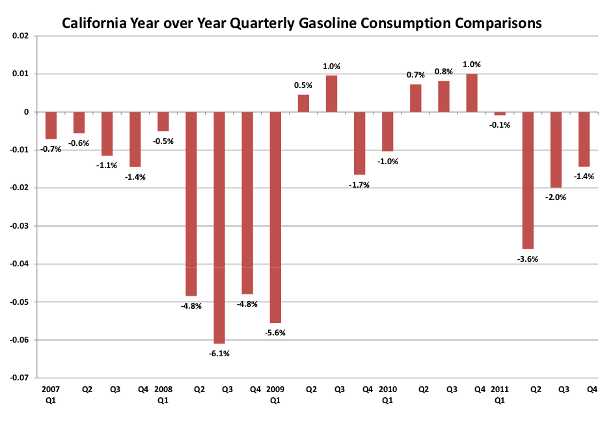
California gasoline prices jumped 23 percent in 2011 to an average of $3.86 as consumer consumption dropped 1.8 percent, according to a report released Friday by the California State Board of Equalization.
“Many Californians are straining to pay the increasing price of gasoline and seeking ways to reduce their consumption such as driving vehicles that consume less gas or using alternative methods of transportation,” said First District Member Betty T. Yee.
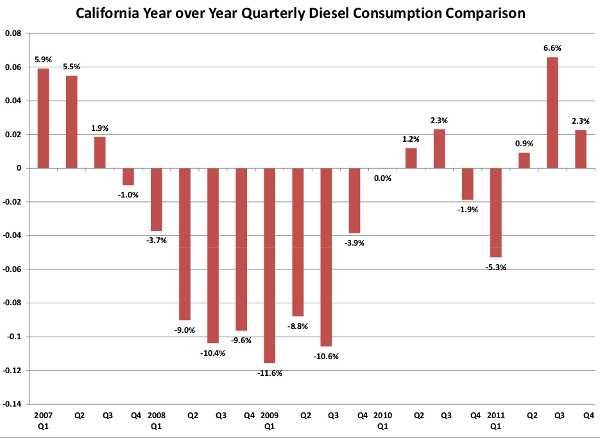
Diesel fuel prices in California went up 25 percent in the fourth quarter of 2011 to $4.13 as consumption increased 2.3 percent.
According to the Board of Equalization Economic Perspective, the overwhelming majority of diesel fuel sold for use on California roads is for commercial trucks.
The diesel market is affected by the economy, imports and exports through California ports, and supply and demand conditions in residential and nonresidential construction, and agriculture.
The decline in gasoline consumption began in 2005 and has continued since then as consumers, struggling with high prices, take steps to reduce their gasoline purchases, including driving fuel-efficient and hybrid vehicles, and taking alternative forms of transportation such as buses, light rail, and trains.
California is a leader in promoting these methods to support conservation and reduce our dependence on foreign oil.
In addition, consumers may be using less gasoline because of the national fuel economy standards that have increased the miles per gallon required for new cars.
The decline in gasoline use in California has also been affected by the high unemployment rates caused by the recession, which have reduced the number of drivers on the highways and the number of long commutes.
The national average price of a gallon of gasoline was up 17 percent in the fourth quarter of 2011 to $3.43, while diesel prices increased 23 percent to $3.87.
According to the Energy Information Administration, the cost of crude oil, which is set on the world market, determines about 72 percent of the price of gasoline.
Some energy experts agree that the way to reduce gasoline price spikes is to decrease the dependence on oil, regardless of where the oil comes from.
Energy economist Severin Borenstein with U.C. Berkeley's Haas School of Business explained that oil prices drive gasoline prices and current oil prices are high.
Global factors, such as high demand in India, China and elsewhere in the developing world, largely determine the price of oil.
As a result, cut backs on gas purchases by Californians have only a minor impact on worldwide demand.
Similarly, U.S. oil production has only a small impact on the world supply. U.S. oil production was up 13 percent in 2011 over 2008, but still remains less than one-tenth of the world oil market.
California gasoline and diesel fuel figures are net consumption, including audit assessments, refunds, amended and late tax returns, and the State Controller’s Office refunds.
BOE is able to monitor gallons through tax receipts paid by fuel distributors in California. Board of Equalization updates the fuel reports at the end of each month.