How to resolve AdBlock issue?
News
- Details
- Written by: Lake County News Reports
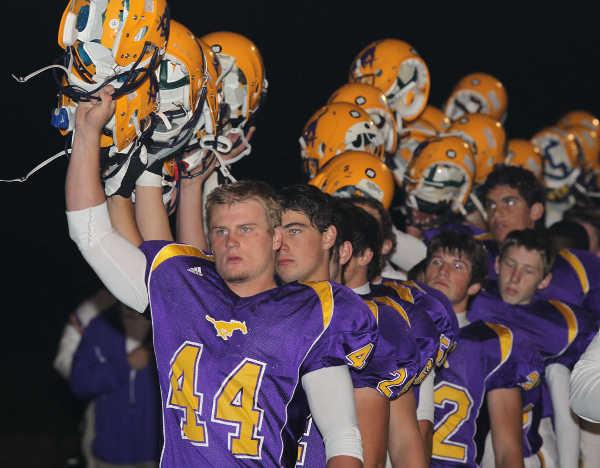
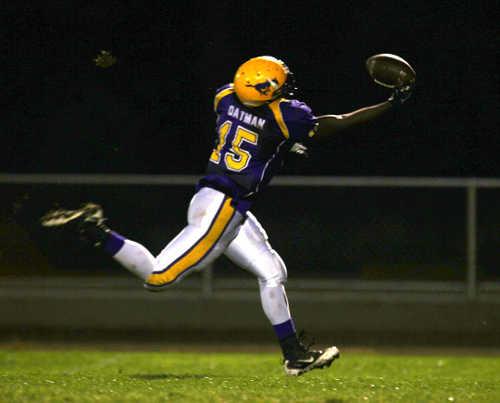
MIDDLETOWN, Calif. – The Middletown Mustangs football team overwhelmed an injury-plagued Willits Wolverines squad 49-0 in Middletown Friday night, finishing their regular season as undefeated North Central I North league champions for the third year in a row.
The weekend victory ensures a playoff berth for the Mustangs in the upcoming North Coast Section Division IV tournament, while the battered Wolverines – who suited just 14 players Friday night – will sit out the post-season due to extensive injuries.
Also for the third straight year, the Mustangs finish the year with an overall 9-1 record, putting them tied for first place with St. Patrick/St. Vincent and Fort Bragg in the Division IV football standings.
“I think this is probably my best overall team of the last three years,” longtime coach Bill Foltmer said before the game.
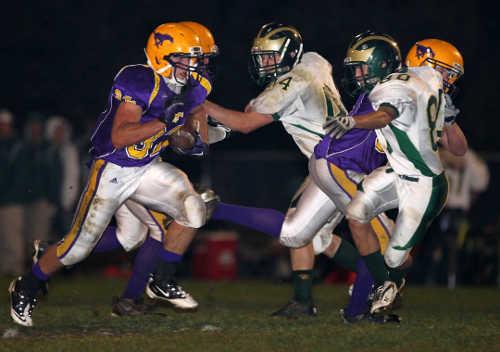
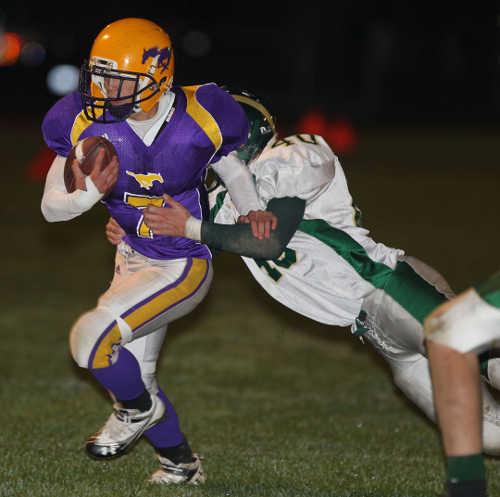
After a failed attempt by the Wolverines to open the game with an onside kick, the Mustangs quickly took control, needing just four offensive plays before running back David Pike scored on an eight-yard dash.
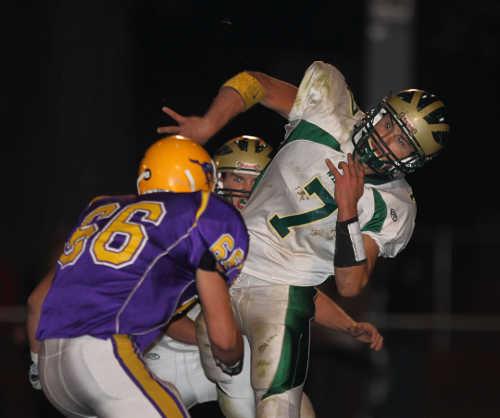
After both teams traded interceptions, Middletown struck again on a nine-yard end zone pass from quarterback Kyle Brown to wide receiver Connor Chick, and the Mustangs went ahead 14-0.
Middletown put one more score on the board before the first quarter ended when Pike carried the ball three consecutive plays, capping the drive with a seven-yard touchdown run to bring the score to 21-0.
Pike scored twice more in the second quarter – on carries of 38 yards and 8 yards – breaking Lake County’s all-time record for most touchdowns scored in a single season at 29.
Jereomy Hoefer scored Middletown’s next touchdown on a three-yard scamper, and defensive back Andres Fernandez posted the Mustangs’ final score of the night when he intercepted an errant Willits pass and ran it all the way back to the Wolverine end zone to bring the score to 49-0.
The Friday night win is Middletown’s third consecutive shutout victory – and their six of the season – and extends Middletown’s current winning streak to nine games.
“They’re a class act,” Willits head coach Nat Collicott said of the Mustangs. “It’s an honor to play Coach Foltmer on his field and hey, they’re good. I wish them the best in the playoffs.”
Collicott said of his team, “We’re pretty beat up. We had some very key injuries. We lost all of our running backs and some starting defensive players.”
Foltmer noted the Wolverine injuries and said, “It wasn’t the same Willits team that it was earlier in the season.”
Willits finished the game with just 64 yards total offense on 21 carries, while Middletown had 255 yards total offense on 31 carries.
Kyle Brown completed three of four passes for 67 yards and Pike carried the ball 13 times for 131 yards for the Mustangs.
Looking ahead to the playoffs, Foltmer sounded upbeat about his team’s prospects.
Foltmer specifically cited star defensive linebacker Jake Davis – who was last year’s All North Central I League Most Valuable Defensive Player and sat out the first half of this season with a broken jaw – calling him “my best player, and arguably one of the better players I’ve ever had.”
“We’ve got a pretty strong defense, and I think defense is what will help you go a little bit deeper in the playoffs,” Foltmer said.
He added, “There’s an old saying in football: ‘Offenses put butts in the stands, but defenses win championships.’”
In JV action, the Mustangs beat Willits 38-6, finishing their season with an 8-2 record, while the Wolverine loss to Middletown brought their JV team record to 1-9 for the year.
Middletown’s next game – their first of the post-season – will be determined by North Coast Section Division IV tournament directors on Sunday, Nov. 14.
Follow Lake County News on Twitter at http://twitter.com/LakeCoNews , on Facebook at http://www.facebook.com/pages/Lake-County-News/143156775604?ref=mf and on YouTube at http://www.youtube.com/user/LakeCoNews .
- Details
- Written by: Lake County News Reports
In just over 10 days, most of us will be celebrating the quintessential American holiday, Thanksgiving.
Roasted turkey with stuffing, bowls of sweet and white potatoes, gravy, cranberry sauce and pumpkin pies will fill our tables.
While we consider this delicious fare traditional for the Thanksgiving feast, the truth is that what we serve on this day has evolved over time. What the Pilgrims and Indians ate in 1621 New England bears little resemblance to what we serve today.
In 1841, more than 200 years after what we now refer to as “the first Thanksgiving,” New England historian Alexander Young discovered a letter from Edward Winslow, one of the original colonists, mentioning the 1621 feast. It was Young that gave that feast the moniker mentioned above.
Winslow describes four hunters killing enough fowl to feed the camp for a week. While turkey was plentiful in North America – and eaten by the colonists and Wampanoag Indians – it’s speculated that the “fowl” mentioned in the letter consisted of seasonal waterfowl such as ducks and geese.
Turkey eventually became the fowl of choice on Thanksgiving menus, but not right away.
A menu for a New England Thanksgiving dinner circa 1779 mentions roast turkey, but only as one of the meats offered at the meal, not as the star. Also listed are venison, pork, pigeon and goose.
In contrast, this year more than 240 million turkeys will have been raised as the mainstay of our Thanksgiving dinners.
What about the stuffing? Historians tell us that the practice of stuffing the cavities of fowl and other animals with mixtures of breads, spices and other items is ancient. Romans and Arabs employed this cooking technique. The terms “stuffing” and “dressing” as they relate to cookery derive from Medieval European culinary practices.
The English settlers and Wampanoag did occasionally stuff birds and fish, but if stuffing was used, it likely consisted of herbs and onions, rather than bread.
Any cranberries served at the harvest celebration were likely only in Wampanoag dishes. They enjoyed them raw or sweetened with maple sugar.
It would be 50 years before an Englishman mentioned boiling this New England berry with sugar for a “sauce to be eaten with … meat.” Since sugar was expensive in England in 1621, it’s quite possible that there was not any of this imported sweet in New Plymouth at that time.
Today turkey and cranberries are a much-loved food marriage.
The tradition of serving fruit with meat, particularly citrus fruit with fatty meat, goes back thousands of years, likely originating in the Middle East. Examples are found in many cultures and cuisines. The acid in the fruit cuts the fat in the meat. In the case of lean meats such as turkey and chicken, cranberries add flavor to what is generally considered a bland food.
Other classic meat and fruit combos include pork and applesauce, goose and cherry sauce, fish and lemon, and duck l’orange.
It’s hard to imagine Thanksgiving without mashed potatoes, but the original feast didn’t include them.
Potatoes, which originated in South America, had made their way across the Atlantic to Europe, but had not been generally adopted into the English diet. The potato was virtually unknown there in the 17th century. At that point they were not included in the diet of the Wampanoag Indians, either (though they did eat other varieties of local tubers).
Today’s Thanksgiving meals typically include a version of a sweet potato (or yam) dish, but that wouldn’t have been included in the original harvest meal.
The sweet potato, which originated in the Caribbean, also had made its way to Europe, but was rare and available only to the wealthy. King Ferdinand and Queen Isabella of Spain liked them and had them planted in their court gardens. Their son-in-law, King Henry VIII of England, liked them as well, and considered them to be an aphrodisiac.
Yams are native to Africa and are often confused with sweet potatoes. Most sweet potato dishes – pies included – are just as successfully made with yams.
Like the white potato, neither yams nor sweet potatoes were part of the diet of the Wampanoag Indians or, for the most part, the English at the time of the first feast.
Have you ever wondered why marshmallows are so often paired with sweet potatoes on the Thanksgiving table?
During the late 19th and early 20th centuries, marshmallows were very trendy. They were mass produced, plentiful and very inexpensive, and were aggressively marketed by the companies that manufactured them.
The earliest recipes found pairing marshmallows and sweet potatoes date to the 1920s. There were typically casseroles where marshmallows were layered with the potatoes. To a lesser extent, they were also paired with candied yams.
Often signature dishes from the 1920s were very sweet, and some historians speculate that this is a reaction to Prohibition.
Pumpkin, native to the New World, was likely available as part of the harvest feast, but not in the form of pie. It may have been baked, possibly by placing it in the ashes of a dying fire, then mixed with animal fat, maple syrup or honey, and made into a soup, a common way of using it by American Indians.
As for our beloved Thanksgiving pumpkin pie, recipes for stewed pumpkin tempered with sugar, spices and cream wrapped in pastry have roots in Medieval times, when similar pies were made with squash and gourds.
Corn was part of the earliest Thanksgiving feast, though it was hard Indian corn, unlike the corn we know today.
American Indians were cooking with corn long before European settlers arrived, and the English colonists learned to grind it for use in breads, pancakes, porridge and puddings as a substitute for the grains they were used to.
While we don’t know exactly what was served at the first Thanksgiving, historians can be pretty certain that it included at least some of the bounty available to them, such as cultivated parsnips, carrots, collards, turnips, parsley, spinach, cabbage, sage, thyme, onions and marjoram, as well as native cranberries, pumpkin, nuts, grapes, lobster, oysters and other seafood.
In the spirit of the colonial U.S., I’ll leave you with a modern interpretation of Abigail Adams’ pumpkin pie, courtesy of The Thirteen Colonies Cookbook by Mary Donovan, et al.
Enjoy!
Abigail Adams' pumpkin pie
1 1/2 cups pumpkin
3/4 cup brown sugar, firmly packed
1/2 teaspoon fresh ginger root, grated
1 teaspoon freshly grated nutmeg
1/2 teaspoon salt
1 cup heavy cream
3/4 cup milk
1/4 cup dark rum or brandy
3 eggs, lightly beaten
Pecans
Whipped cream
10-inch pie shell, unbaked
Mix all ingredients together and pour into the prepared pastry shell.
Bake at 425 degrees F for 10 minutes. Reduce heat to 350 degrees F and bake for 40 minutes more, or until a knife inserted in center comes out clean.
Garnish with pecans and whipped cream flavored with rum or brandy.
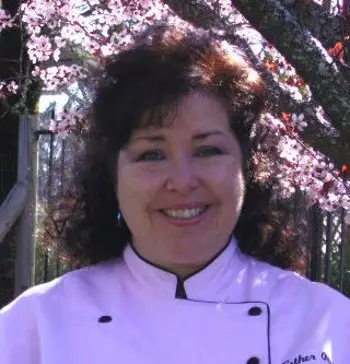
Esther Oertel, the "Veggie Girl," is a personal chef and culinary coach and is passionate about local produce. Oertel owns The SageCoach Personal Chef Service and teaches culinary classes at Chic Le Chef in Hidden Valley Lake, Calif., and The Kitchen Gallery in Lakeport, Calif. She welcomes your questions and comments; e-mail her at
Follow Lake County News on Twitter at http://twitter.com/LakeCoNews and on Facebook at http://www.facebook.com/pages/Lake-County-News/143156775604?ref=mf .
- Details
- Written by: Kathy Windrem
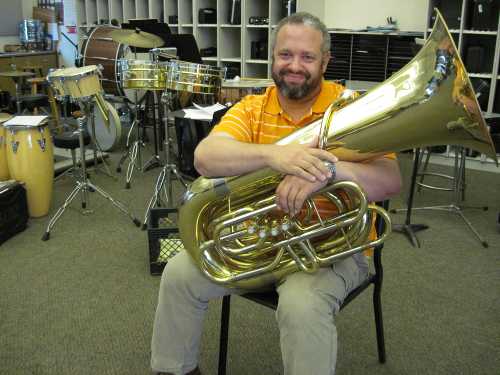
KELSEYVILLE, Calif. – Kelseyville Unified School District’s commitment to its music program was one of the big draws for new Kelseyville High School music teacher Ted Foreman.
Foreman was hired following the retirement in June of longtime music teacher Tom Aiken.
Foreman grew up in Detroit, where he began playing music in sixth grade.
His first instrument – which continues to be his primary instrument – was trombone, because it was “the loudest instrument that fit on the bus,” he reported.
At age 16 Foreman attended a music camp which fueled a lifetime passion for music, and led to a full ride scholarship to attend boarding school to focus on his music.
After graduation from Southern Methodist University in Texas, with a double major in music and anthropology, Foreman began several years performing music in a variety of venues.
Foreman played trombone with the New Mexico Symphony, taught at University of Colorado, did graduate work at The Julliard School in New York City, and toured with the plays “Les Miserables” and “The Lion King.”
He also toured with the Singapore Symphony, the rock band YES and Moody Blues. One of the high points was to perform with the orchestra of famed tenor Luciano Pavarotti.
Foreman’s desire to share his love for music led him to earn a teaching credential through Project Pipeline’s Fortune School of Education.
His first teaching job was at John Swett High School in Crockett, Calif. He received the honor of District Teacher of the Year in Crockett in his fourth year there.
A desire for a new and unique experience led Foreman to Hoonah, Alaska. The largest Tlingit Village in Alaska gave Foreman yet another opportunity to share his musical talents and ideas.
Following a year in Alaska, Foreman began the search for a small school district in California with a commitment to music.
This search led Foreman to discover Kelseyville Unified School District.
Foreman was hired and began his job with the new school year in September after Tom Aiken’s retirement.
Foreman said of Aiken, “Tom left behind an amazing program. He has been available to answer any questions I have asked of him. I appreciate his – and the district’s – confidence in me.”
Foreman will continue to offer jazz band, concert band, choir and some junior high music classes. He plans to start a “Contemporary Music Workshop” class, which is a “rock band class” where the students will write and perform original music.
Every aspect of producing music – including writing music, sound engineering, album designers, band manager and performer – will be covered in this class. Live shows will be presented by the students.
Foreman expects the many contacts he has made in his previous years in the music industry will be called upon for assistance with the Contemporary Music Workshop class.
Beth Aiken is the music teacher for fifth and sixth grade students in the district. Between Aiken and Foreman, Kelseyville’s music program will continue to offer the “highest quality music education possible,” according to school board member Gary Olson.
Follow Lake County News on Twitter at http://twitter.com/LakeCoNews , on Facebook at http://www.facebook.com/pages/Lake-County-News/143156775604?ref=mf and on YouTube at http://www.youtube.com/user/LakeCoNews .
- Details
- Written by: Dauna Coulter

Did you know that the Earth has a dust tail? The Spitzer Space Telescope sailed right through it a few months ago, giving researchers a clear idea of what it looks like. That could be a big help to planet hunters trying to track down alien worlds.
“Planets in distant solar systems probably have similar dust tails,” said Spitzer project scientist Mike Werner. “And in some circumstances these dust features may be easier to see than the planets themselves. So we need to know how to recognize them.”
It's extremely challenging – and usually impossible – to directly image exoplanets. They're relatively small and faint, hiding in the glare of the stars they orbit.
“A dust tail like Earth's could produce a bigger signal than a planet does. And it could alert researchers to a planet too small to see otherwise,” Werner said.
Earth has a dust tail not because the planet itself is particularly dusty, but rather because the whole solar system is.
Interplanetary space is littered with dusty fragments of comets and colliding asteroids. When Earth orbits through this dusty environment, a tail forms in the rear, akin to swaths of fallen leaves swirling up behind a streetsweeper.
“As Earth orbits the sun, it creates a sort of shell or depression that dust particles fall into, creating a thickening of dust – the tail – that Earth pulls along via gravity,” explained Werner. “In fact, the tail trails our planet all the way around the sun, forming a large dusty ring.”
Spitzer's recent observations have helped astronomers map the structure of Earth's dust tail and figure out what similar “tell-tale tails” attached to alien planets might look like.
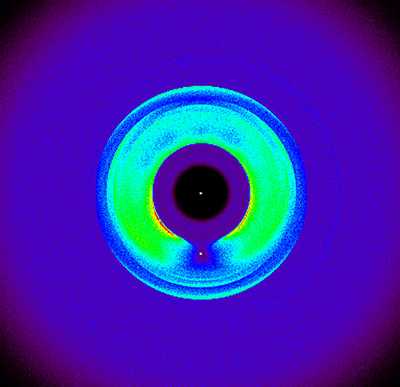
Like our own solar system, other planetary systems are infused with dust that forms a dusty disk encircling the central star. And like Earth, exoplanets interact with their dust disk gravitationally, channeling and drawing strange features into it.
“In some stars' dust disks there are bumps, warps, rings, and offsets telling us that planets are interacting with the dust,” said Mark Clampin of NASA's Goddard Space Flight Center. “So we can 'follow the dust' to the planets. So far, we've seen about 20 dust disks in other solar systems. And in some of those cases, following the dust has already paid off.”
Clampin, Paul Kalas and colleagues were looking for a planet around the bright southern star Fomalhaut when they unexpectedly found a dust ring. The shape of that ring led them to their goal.
“We suspected that the ring's sharp inner edge was formed by a planet gravitationally clearing out the surrounding debris,” said Clampin. “We tracked the planet by this 'footprint' in the dust.”
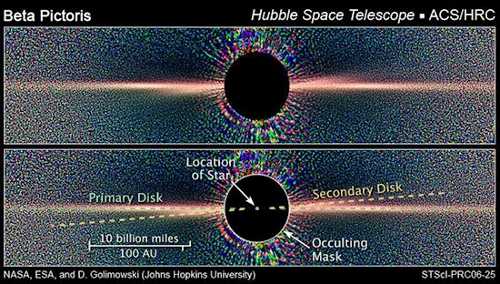
Another Hubble image shows a dusty disk around Beta Pictoris, a star in the constellation Pictor, or “Painter's Easel.”
“Note the smaller dust ring that's tilted with respect to the larger dust disk,” said Clampin. “Like Earth, this planet is shepherding the dust into its orbital plane.”
Clampin explained why it's hard to see the Earth's dust tail from within our solar system: “Imagine looking at fog on the Golden gate from above where you can clearly see the structure. If, on the other hand, you are standing on the bridge, it's a lot harder to discern the shape of the cloud.”
Clampin and Werner said Spitzer's observation of Earth's dust tail and these initial observations of dust structures in distant solar systems set the stage for the planet hunting debut of the James Webb Space Telescope. The telescope, targeted to launch in 2014, is a large, infrared-optimized space telescope. For more information, see www.jwst.nasa.gov/ .
They fully expect the huge and powerful new telescope to spot many tell-tale tails ... of the alien variety.
Follow Lake County News on Twitter at http://twitter.com/LakeCoNews , on Facebook at http://www.facebook.com/pages/Lake-County-News/143156775604?ref=mf and on YouTube at http://www.youtube.com/user/LakeCoNews .