How to resolve AdBlock issue?
News
- Details
- Written by: Lake County News reports
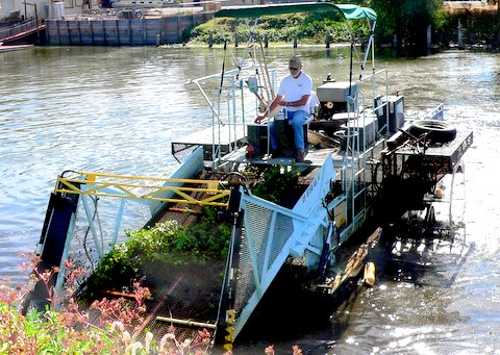
CLEARLAKE OAKS, Calif. – It was a day of lots of hard work and activity at Clarks Island in Clearlake Oaks on Saturday.
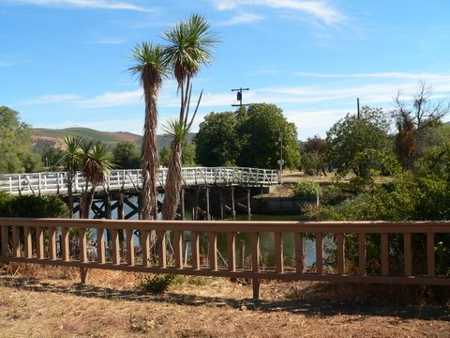
The Clarks Island Sustainability Initiative sponsored and promoted a cleanup day at the island, which is located between Tower Mart and the Clearlake Oaks Boat Launch, near Island Drive on East Highway 20.
Following the county redevelopment agency's purchase in 2008 of the former trailer park, the redevelopment agency has relocated the dozen mobile home residents, removed debris and rezoned Clarks Island as open space, as Lake County News has reported.
The community-based Clarks Island Sustainability Initiative formed earlier this year under the direction of District 3 Supervisor Denise Rushing to begin the process of rehabilitating the island.
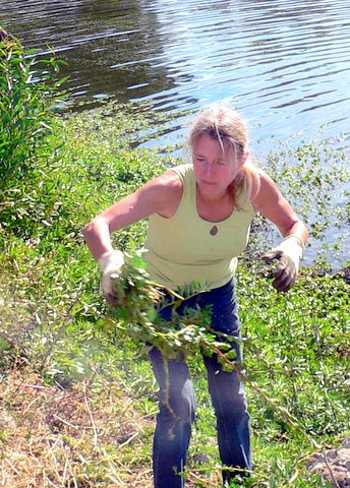
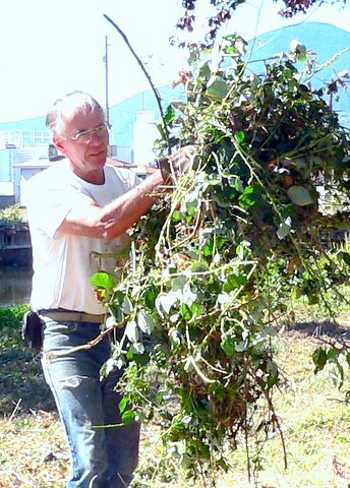
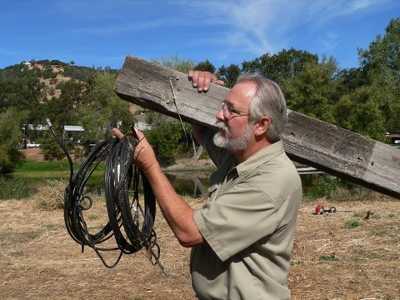
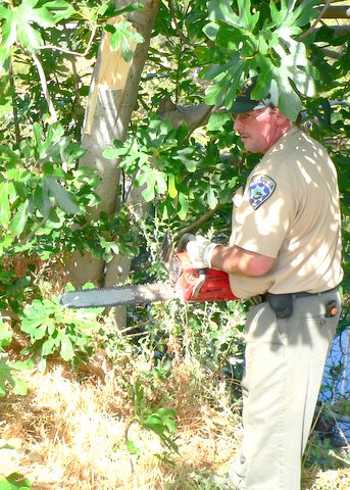
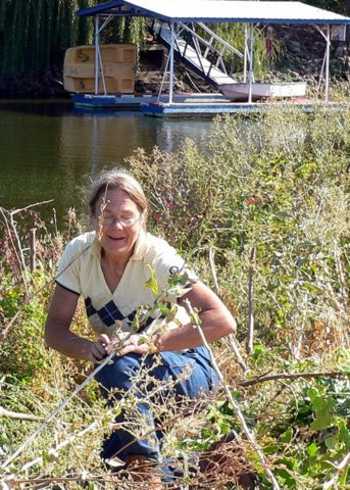
On Saturday the group of volunteers cleaned up debris and mowed, and hauled some invasive weeds out of the water.
When Clarks Island was a trailer park, locals planted many plants and trees which have been left in place for now, including apricots, black and green figs, persimmons, many verities of hollyhocks, choke cherries, crab apple and blackberries.
Still head, the county has hired a contractor to remove and replace a crumbling break wall on the island's Highway 20 side.
The group also is looking for a contractor who will donate time to pulling the many rotting piers left behind from the days when the island was a trailer park.
Plans for the island include creating floating islands to help control algae blooms in the area.
A natural building project is set to start soon, with volunteers needed to help make adobe bricks, and build walls, roofing and other details.
Call 707-263-2580 for a schedule or more information.
Miguel Lanigan contributed to this report.
Follow Lake County News on Twitter at http://twitter.com/LakeCoNews and on Facebook at http://www.facebook.com/pages/Lake-County-News/143156775604?ref=mf .
- Details
- Written by: Lake County News Reports
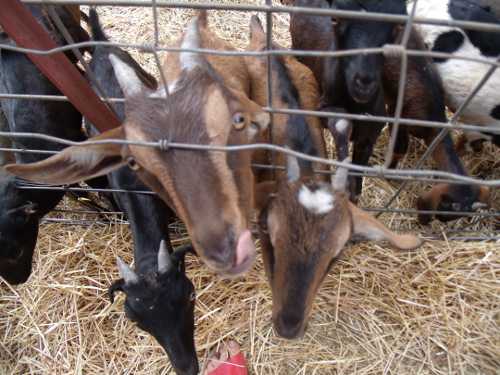
Lake County’s only commercial dairy lies outside Lakeport on picturesque Scotts Valley Road. Named for the herb that grows wild in nearby hills, Yerba Santa Goat Dairy is run by cheese-making brothers Javier and Daniel Salmon.
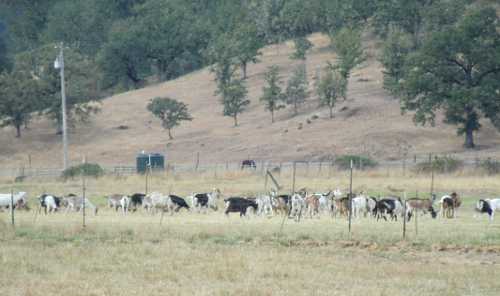
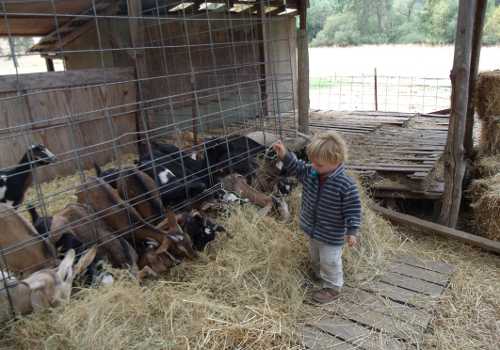
The only access into the dairy is via a rustic bridge slung over a shallow gorge in which a swollen creek flows after the winter rains. Three low-lying meadows are home to 87 milk goats, and a couple dozen yearlings – milk goats in waiting, so to speak – make their home in a fenced area at the edge of the meadow.
It is here that the brothers from Lima, Peru create the cheeses that are sought after locally, as well as throughout much of the San Francisco Bay Area.
This is the time of year that cheese production slows, as the milk goats have been carrying young since mid-September. Two very busy bucks have impregnated the entire herd, and the twice-a-day milking cycle has dwindled to one.
Come November, the does will not be milked at all. Instead, they’ll spend the winter wandering the hills, eating brush and the coveted Yerba Santa herb. Their babies will arrive in late February and early March, and after they’ve had a month or so to nurse, milking and cheese production will once again begin.
The Salmons also produce cheeses under the Bodega label, carried over from the dairy’s former location in Sonoma County. Generally their cheeses are available from April through October, though some locations may have a supply they can sell beyond October.
Milking more than 80 goats is a three-hour process, which means that in the peak of season, a full six hours of each day is spent coaxing milk from the does. Milking begins on machines (they have four in their milking barn) and is finished by hand.
The milk is pumped directly to a bulk tank, where it’s stored for a day at 38 degrees. The tank can hold up to 250 gallons, but peak-of-season production is generally about 80 gallons a day.
After a brief storage in the bulk tank, the milk is pumped into a neighboring room where handcrafted French and Spanish style cheeses are created. Both raw and pasteurized cheeses are made at the dairy.
Younger brother Daniel handles making the raw cheeses, which include a hard shepherd’s cheese, wonderful for grating; chevito, a semisoft cheese; and cabrello, which is similar to manchego, the historic sheep’s milk cheese made in Spain.
Raw cheeses are aged and allowed to mature for 60 days, while the pasteurized cheeses are sold fresh to stores, restaurants and the public.
Older brother Javier is in charge of pasteurized cheese production, which is generally a two-day process. After the milk is pasteurized, a culture is added. Once the cheese reaches the desired acidity, vegetarian rennet is thrown into the mix, causing the cheese to “clabber” or thicken.
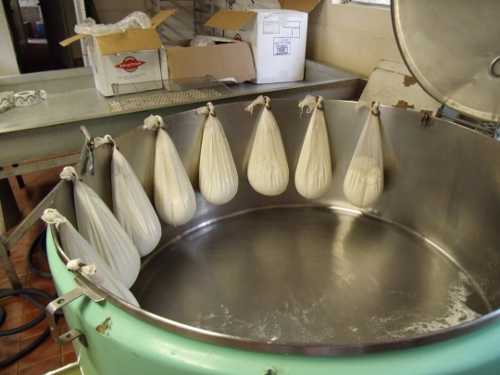
The thickened product is put into cheesecloth bags and left to hang overnight, allowing the whey to drain from the cheese. The Salmons feed the resulting whey, a yellow liquid, to their goats. I was told by Javier that goat’s whey is traditionally drunk in Russia for longevity of life.
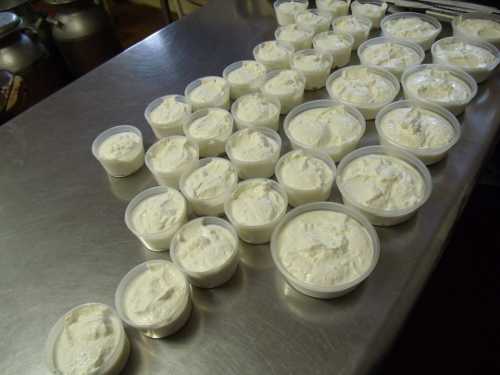
By morning, the content of the hanging bags is ready to process into fromage blanc, a creamy, spreadable cheese in tubs; chevre, fresh cheese shaped in soft balls; or fresco, a feta-like cheese with a short shelf life sold in tall wedges.
While many of the cheeses are flavored only with natural sea salt, others have ranch-grown herbs or peppers added. While I was there, a bowl of roasted Serrano peppers, bright green with blackened skin, stood ready to be mixed in with a batch of fromage blanc.
Goat’s milk doesn’t have to be homogenized. Unlike cow’s milk, which separates with cream rising to the top, the fat molecules in goats’ milk remain suspended in the liquid.
Goat’s milk is lower in fat than cow’s milk, and because the fat molecules are much smaller, it’s easier to digest. Its molecular makeup is closer to that of human milk, in fact, which gives many unable to tolerate cow’s milk an alternative for dairy products.
Cheese has been made from goat’s milk for thousands of years, and is likely one of the earliest made dairy products. While cow’s milk cheese has dominated the scene in the U.S., most of the world eats more cheese made from goat’s milk than from cow’s.
Like cow’s milk, goat’s milk is a very good source of calcium and the amino acid tryptophan. It is also a good source of protein, phosphorus, riboflavin (vitamin B2) and potassium.
- Details
- Written by: Tony Phillips
“During YSS, we'll see triple the [usual] number of launches, flybys and orbital insertions,” said Jim Green, director of Planetary Science at the National Aeronautics and Space Administration headquarters. “There hasn't been anything quite like it in the history of the Space Age.”
Naturally, it's a Martian year.
“These events will unfold over the next 23 months, the length of a year on the Red Planet,” explained Green. “History will remember the period October 2010 through August 2012 as a golden age of planetary exploration.”
The action begins near the end of October with a visit to Comet Hartley 2.
On Oct. 20, Hartley 2 will have a close encounter with Earth; only 11 million miles away, it will be faintly visible to the naked eye and become a splendid target for backyard telescopes.
Amateur astronomers can watch the comet as NASA's Deep Impact/EPOXI spacecraft dives into its vast green atmosphere and plunges toward the icy core. On Nov. 4 EPOXI will fly a mere 435 miles from Hartley's nucleus, mapping the surface and studying outbursts of gas at close-range.
Later in November, NASA astrobiologists will launch O/OREOS, a shoebox-sized satellite designed to test the durability of life in space.
Short for “Organism/ORganic Exposure to Orbital Stresses,” O/OREOS will expose a collection of organic molecules and microbes to solar and cosmic radiation. Could space be a natural habitat for these “micronauts?” O/OREOS may provide some answers.
Bonus: The same rocket that delivers O/OREOS to space will carry an experimental solar sail.
NanoSail-D will unfurl in Earth orbit and circle our planet for months. Occasionally, the sail will catch a sunbeam and redirect it harmlessly to the ground below where sky watchers can witness history's first “solar sail flares.”
On Dec. 7, Japan's Akatsuki (Venus Climate Orbiter) spacecraft grabs the spotlight when it enters orbit around Venus.
The mission aims to understand how a planet so similar to Earth in size and orbit went so terribly wrong.
Venus is bone-dry, shrouded by acid clouds and beset by a case of global warming hot enough to melt lead.
Instruments on Akatsuki will probe Venus from the top of its super-cloudy atmosphere all the way to the volcano-pocked surface below, providing the kind of detailed information researchers need for comparative planetary.
“Take a deep breath,” said Green, “because that was just the first three months of YSS!”
The action continues in 2011 as Stardust NExT encounters comet Tempel 1 (Feb. 14), MESSENGER enters orbit around Mercury (March 18), and Dawn begins its approach to asteroid Vesta (May).
“For a full month Dawn will be able to see Vesta even more clearly than Hubble can,” said Green. “The only way to top that would be to go into orbit.”
And that is exactly what Dawn will do in July 2011: insert itself into orbit for a full-year study of the second-most massive body in the asteroid belt. Although Vesta is not classified as a planet, it is a full-fledged alien world that is expected to mesmerize researchers as it reveals itself to Dawn's cameras.
Next comes the launch of the Juno spacecraft to Jupiter (August), the launch of GRAIL to map the gravitational field of the Moon (September), and the launch of a roving science lab named “Curiosity” to Mars (November).
“The second half of 2011 will be as busy as some entire decades of the Space Age,” said Green.
Even then, YSS has months to go.
The year 2012 opens with Mars rover Opportunity running the first-ever Martian marathon. The dogged rover is trundling toward the heart of Endeavour Crater, a city-sized impact basin almost two dozen miles from Opportunity's original landing site.
“Opportunity is already under the influence of the crater,” said Green. “The ground beneath the rover's wheels is sloping gently down toward its destination – a welcome feeling for any marathoner.”
Sometime in mid-2012, Opportunity will reach Endeavour's lip and look over the edge deeper into the heart of Mars than any previous robotic explorer.
The only thing more marvelous than the view will be the rover itself. Originally designed to travel no more than 0.6 miles, Opportunity's rest stop at Endeavour will put it just miles away from finishing the kind of epic Greek run that athletes on Earth can only dream about.
Meanwhile, halfway across the solar system, Dawn will fire up its ion engines and prepare to leave Vesta. For the first time in space history, a spacecraft orbiting one alien world will break orbit and take off for another. Dawn's next target is dwarf planet Ceres, nearly spherical, rich in water ice, and totally unexplored.
The Year of the Solar System concludes in August 2012 when Curiosity lands on Mars. The roving nuclear-powered science lab will take off across the red sands sniffing the air for methane (a possible sign of life) and sampling rocks and soil for organic molecules. Curiosity's advanced sensors and unprecedented mobility are expected to open a new chapter in exploration of the Red Planet.
“So the end,” said Green, “is just the beginning. These missions will keep us busy long after YSS is history.”
Dr. Tony Phillips works for the National Aeronautics and Space Administration.
Follow Lake County News on Twitter at http://twitter.com/LakeCoNews and on Facebook at http://www.facebook.com/pages/Lake-County-News/143156775604?ref=mf .
- Details
- Written by: Elizabeth Larson
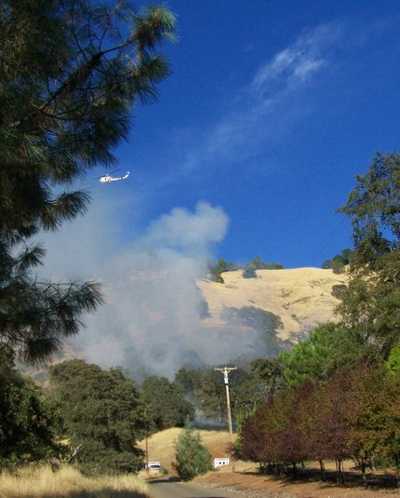
NICE, Calif. – A four-wheel all-terrain vehicle is believed to be the cause of a Friday afternoon fire in Nice.
The fire, dispatched at around 4:30 p.m., was located on the hillside above Lakeview Drive and Dodge Road, according to Northshore Fire Battalion Chief Steve Hart.
Hart said the fire burned about three to five acres of vegetation, and did not threaten any structures.
Northshore Fire sent Hart, four engines and two medic units, with Cal Fire sending multiple engines, a dozer and aircraft, he said. The US Forest Service also sent resources to the fire.
Firefighters contained the fire after about an hour, he said.
Nice resident Deb Clarke lives near the scene of the fire and witnessed the suppression efforts.
“The good news is my neighbor on the hill caught the blaze and the Northshore firefighters showed up quick,” she said.
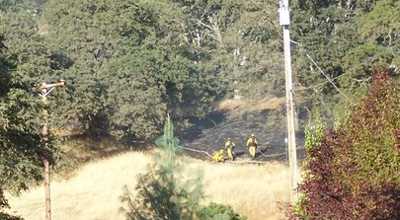
Clarke watched as firefighters dug a fire line, cleared downed trees and used a spotter plane and a helicopter with a bucket to drop water on the blaze.
Hart said the fire was attributed to a quad runner, which firefighters found at the scene.
“We still have not been able to find the owner,” he said.
Firefighters were remaining on scene overnight to mop up, Hart said.
Clarke said she's been worried about what she called “the deadly combo of dry grass and motorcycles” for awhile.
“Every time I see them going up the private property trails, I cringe,” she said.
While her stepson is a semi-pro motorcycle racer, sparks that can come from the vehicles are particularly dangerous right now, she said.
Also on Friday evening, a fire was reported in Clearlake Park, although additional information wasn't immediately available.
A third fire, reported just after 7 p.m. in Clover Valley, burned a pump house, Hart said.
E-mail Elizabeth Larson at