 How to resolve AdBlock issue?
News
- Details
- Written by: Lake County News reports
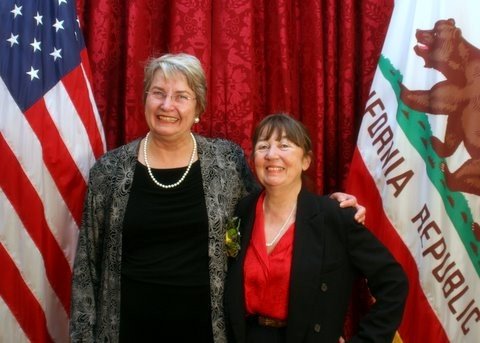
LOWER LAKE – North Coast State Senator Patricia Wiggins (D-Santa Rosa) on Monday honored Lake County resident Victoria Brandon as the 2008 “Woman of the Year” for California’s 2nd Senate District.
Brandon, who is being recognized for her involvement and leadership in a range of environmental and conservation efforts, was among the honorees at a special ceremony held Monday at the State Capitol.
The “Woman of the Year” commemoration is an annual event recognizing outstanding women in each of California’s 40 Senate districts.
“Victoria Brandon epitomizes the kind of person we seek to recognize as a Woman of the Year,” said Wiggins, who is one of 10 female state senators. “She has been an activist and leader in preserving some of our most precious natural resources and thus protecting the quality of life on the North Coast.”
A longtime resident of Lake County, Brandon serves as chair of the Sierra Club Lake Group and political chair of the Sierra Club’s 11,000-member Redwood Chapter.
A chapter delegate to the Sierra Club’s California-Nevada Regional Conservation Committee, she has also consolidated Lake County support for the federal Wilderness Bill and for the 2005 state law naming Cache Creek a Wild and Scenic River, and has been involved with local growth management and watershed health issues on an ongoing basis.
Among Brandon’s current projects are working on the passage of federal legislation creating a Blue Ridge Berryessa National Conservation Area, preserving open space on Mt. Konocti and, she says, “keeping Lake County the greenest place in California.”
The 2nd Senate District represented by Wiggins includes portions or all of six counties: Humboldt, Lake, Mendocino, Napa, Solano and Sonoma.

{mos_sb_discuss:3}
- Details
- Written by: Elizabeth Larson
Northshore Fire Chief Jim Robbins said Monday that his firefighters responded to a report of a car on fire on Dunstan Road, located in the paper subdivision above Lucerne, at about 6:30 a.m. last Friday, March 7.
The car had been reported stolen out of Clearlake Oaks, said Robbins. Firefighters arrived on scene to find it fully involved.
Then on Saturday at about 9:30 p.m. firefighters again responded to the area, where another car also was ablaze. Robbins said that car appeared to have been previously abandoned and, again, was engulfed in flames by the time firefighters got there.
Robbins said whoever is dumping the cars is taking the license plates before setting them on fire.
The Dunstan Road area has become a trouble spot, said Robbins. “In last three months we've had three car fires up in there.”
The area is one of several slated to be gated off with redevelopment funds in the coming months, said Robbins.
The county is undertaking the gating project in order to try to stop illegal dumping, as Lake County News has reported.
Northshore Fire has forwarded a report to the California Highway Patrol on the stolen car fire, Robbins said.
In other fire news over the weekend, Northshore Fire responded to a fire at WorldMark in Nice, where a fire deployed some sprinkler heads in a room on Saturday. Only water damage was reported, said Robbins.
Kelseyville Fire reported a chimney fire occurred on Sunday night, but the fire was out by the time firefighters arrived.
No other districts reported any weekend incidents.
E-mail Elizabeth Larson at
{mos_sb_discuss:2}
- Details
- Written by: Elizabeth Larson
For the second year in a row, Lake County's marijuana seizures led the state's Campaign Against Marijuana Program (CAMP), according to Capt. Dennis Cullen, who oversees U.S. Forest Service law enforcement activities in the Mendocino and El Dorado National Forests.
The California Attorney General's Office reported that the marijuana-growing season starts in mid-April, with harvests ending in late September or early October.
During the 2007 marijuana eradication season, there were about 507,000 plants seized in Lake County – a number which included private and public lands, and indoor and outdoor grows, according to Cullen.
Other counties in the top five for 2007 are Humboldt (271,056 plants); Shasta (270,728 plants); Mendocino (220,436 plants); and Tulare (160,591 plants).
Along with the plant seizures in Lake County, Sheriff Rod Mitchell said there 24 firearms seized, along with 898.5 pounds of processed marijuana. Seven arrests also were made.
In comparison, in 2006, the county had 344,241 plants seized, with 10 firearms, 704 pounds of processed marijuana and 10 arrests, officials reported.
Statewide, 2007 was another record-breaking year for CAMP, the Attorney General's Office told Lake County News.
“We've seen an increase each year,” said Gareth Lacy, an Attorney General's Office spokesman.
In 2007, CAMP eradicated 2,905,021 plants, which had a street value of $11.6 billion, the Attorney General's Office reported.
Of those seized plants, 75 percent (2,168,223 plants) were on public lands with the remaining 25 percent (736,798) on private lands. CAMP conducted 472 raids, made 53 arrests and seized 41 shotguns, handguns, assault rifles, and other firearms.
One reason for the increase in seizures in 2007, said Lacy, was increased, full-time use of helicopters, which made remote areas accessible for law enforcement.
Most of the arrests linked with illegal marijuana grows took place without incident or had short foot pursuits, said Mitchell.
“The dangerous work is sizing up the garden on land before you go in and do a raid,” said Mithcell. “That's when my staff is at the greatest risk.”
Mitchell said it's pure speculation as to why the plant seizures have continued to rise, however, like Lacy, he credited equipment – in this case, enhanced technology used in overflights that allow officers to more readily identify pot gardens.
“I'm also of the impression that some of the lenient interpretations of marijuana laws in different places in the state led some to believe that it's going to be more lenient than the law allows everywhere,” said Mitchell.
However, perhaps more important is the increasing number of people using remote public lands for growing illegal drugs, said Mitchell, a practice that poses dangers to humans, animals and the environment.
Mitchell said one of his lead deputies in tracking illicit marijuana, Steve Brooks, guessed that there is enough black plastic tubing used for drip line still left in the forest to stretch from the Oregon border to Mexico.
Also left behind, said Mitchell, are dangerous chemicals. To clean up and restore one acre of land where these grows have taken place can cost $12,000.
Mitchell said the destruction of public lands is a major concern. “This can't be compared to any other agriculture enterprise,” he said.
Cullen said his agency works closely with the sheriff's office on the eradications.
“It's one big cooperative effort,” he said.
Cullen said he agrees with Mitchell's thoughts about why marijuana growing activity is increasing, especially the desire for remote areas, which he said are a favorite target of growers – not just in Lake County.
“Lake County is symptomatic of many areas in Northern California,” said Cullen, adding that the problem of illicit marijuana growing is present around the western United States.
Cullen said that marijuana growing is a year-round activity. “They are in a business,” he said of growers, explaining that, when it's not growing season, they're refurbishing water lines and getting young plants started.
He said the National Forest has an accelerated effort for detection and eradication, with different enforcement techniques to disrupt growing activity and identify who is running supplies and drugs. In doing so, “We're finding a lot of supplies moving in and out of the area.”
Mitchell said Mexican crime rings are believed to be behind the remote grows, a belief he said that was reinforced through arrestee interviews.
The profits, he said, allow the groups to buy cheap, black-market materials with which to manufacture methamphetamine.
The Attorney General's Office also pointed to the Mexican drug trafficking organizations as being responsible for the gardens, reporting that, in 2006, 80 percent of the eradicated gardens were being operated on public land by Mexican drug trafficking organizations. The gardens were reportedly protected by armed guards, contained booby traps and clandestine escape routes.
On the increasing numbers of people moving into the forest to grow marijuana, Cullen said, “I don't think it's an anomaly, I think it's a transition.”
E-mail Elizabeth Larson at
{mos_sb_discuss:2}
- Details
- Written by: Elizabeth Larson
The 3.0 quake was recorded at 11:30 p.m. Saturday at a depth of 5.2 miles, according to the US Geological Survey.
The quake was centered eight miles southeast of Lake Pillsbury, 12 miles north northeast of Upper Lake and 14 miles north of Nice.
Earlier on Saturday, a 3.0 quake was recorded near Anderson Springs.
The Pillsbury area was hit by a series of earthquakes last spring.
The largest, a 4.8 quake that hit in the early morning hours of April 18, 2007, was the largest to hit the Lake Pillsbury area since 1977, according to US Geological Survey seismologist David Oppenheimer, as Lake County News reported last spring.
E-mail Elizabeth Larson at
{mos_sb_discuss:2}




