 How to resolve AdBlock issue?
News
- Details
- Written by: Elizabeth Larson
Berg, who will be termed out this year, offered her support to Chesbro's candidacy at a press conference held at the Humboldt County Democratic Party headquarters in Eureka on Friday morning.
The defeat earlier this week of Proposition 93 meant that Berg cannot seek reelection, which opens the door for Chesbro.
“I was supportive of Proposition 93, in large part because I was hoping Patty Berg could run for reelection,” Chesbro told Lake County News Friday afternoon.
But with no change to term limits, Chesbro said he's seeking the Assembly with Berg's “blessing and support.”
Berg said she's worked with Chesbro on many local issues and added he will do an excellent job representing the people of the North Coast. Chesbro, in turn, said he respected Berg and was grateful for her support.
A Humboldt State graduate, Chesbro founded the area’s first recycling center in 1971, was elected to the Arcata City Council in 1974 and served as Humboldt County Supervisor from 1980 to 1991.
Chesbro spent eight years in the state Senate for the Second District before he was termed out in 2006 and succeeded by Sen. Patricia Wiggins.
Since then he was appointed to two state boards: the Mental Health Oversight and Accountability Commission, created by Proposition 63; and the Integrated Waste Management Board, which regulates solid waste facilities.
The appointments have required that Chesbro spend about half his time in Sacramento, but he said he's nevertheless has more time at home with family.
Chesbro said he's calling his Assembly campaign “First District First,” to highlight his commitment to put the needs of First Assembly District residents ahead of all else.
The North Coast, Chesbro added, “is in for challenging times,” and he said he believes his experience is needed in the Assembly.
“The single biggest challenge we face right now is the continuing and growing budget deficit,” said Chesbro, who in the Senate chaired the Budget Committee.
The “urban powers” tend to gang up on rural communities, who tend to suffer most when it's time for cuts, said Chesbro.
His three areas of greatest concern – which he said are the same as those he had while in the Senate – are environmental protection, health care and education.
Chesbro said he plans to file the paperwork to run for the Assembly on Feb. 11, the first day of filing.
He'll appear on the primary ballot in June and, if he doesn't win by 51 percent or more, Chesbro will go before voters for a final November decision.
If elected, term limits will allow Chesbro to serve three, two-year Assembly terms.
Wanda Harris, chair of the Lake County Democratic Central Committee, said Chesbro has strong support among the county's Democrats.
Harris said Chesbro attended the local Democrats' holiday gathering, and she pledged to help raise funds for his campaign.
“I have no doubt that he can win,” she said Friday evening. “He's got a great record.”
Congressman Mike Thompson also offered his endorsement of Chesbro's First District candidacy, as did North Coast state Sen. Patricia Wiggins; District 3 Supervisor Denise Rushing; District 4 Supervisor Anthony Farrington; District 1 supervisorial candidate Susanne La Faver and her husband, Lyle; former Lake County Superintendent of Schools Bill Cornelison; and the South Lake County Democratic Club, among many others.
E-mail Elizabeth Larson at
{mos_sb_discuss:3}
- Details
- Written by: Sophie Annan Jensen
LAKE COUNTY – Communities that want to maintain their public access channels must stay ahead of the curve in becoming familiar with the new law, says franchise consultant John Risk of Communications Support Group in Costa Mesa, who formerly worked in Northern California.
Risk has prepared an advice memo which notes that certain aspects of the statewide law make life more difficult for Local Franchise Authorities (LFA).
Those include definition for gross revenues, an LFA's authority to require that cable/other franchised video providers allow LFAs to access these providers’ systems for the transmission of emergency announcements, an LFA’s authority to negotiate for Institutional Networks (“I-Nets”) in cable franchises, and several aspects of public, educational and government access (“PEG Access”) programming and funding.
He recommends that the LFA evaluate the value of PEG support it gets from the incumbent cable operator and compare that with the amount of support that might arise with a surcharge of 1 percent of gross revenues.
Sue Buske, another nationally-known consultant based in Sacramento, recommends enforcing federally required audits of the cable provider, which is part of the franchise renewal process. Last month she was working in Columbia, Mo., with an access station based at Stephens College.
There, the Columbia Missourian reported on Jan. 4, “Court documents show Mediacom failed to pay $93,105 in franchise fees between Jan. 1, 2001, and Sept. 30, 2004. The debt is even higher now, because city code allows it to charge 10 percent interest per year.
“Most of the time they find something,” Buske said of the audits. “It’s not that uncommon.”
Jeff Rein, deputy county administrator for Lake County, said he had unsuccessfully urged hiring a franchise consultant and getting an audit two or three years ago. He also wanted the county to negotiate for an I-net, connecting all public facilities. “That would have saved us $100,000 a year,” he said.
While the county now is involved in a Joint Public Authority for public access, Rein said previous boards of supervisors have not been interested in public access because they didn't want to be involved in issues of content and control.
Although municipalities are entitled to enact a 1-percent surcharge on gross cable franchise fees to be used specifically for public access operations, local governments have not done so. Another funding solution used by many public access systems is a paid membership program, which often includes training in making videos for broadcast.
PEG Committee member Hiram Dukes said he believes local programming could fill three channels with contributions from students. He noted video training programs exist at both Carlé and Konocti high schools, and said he's had Upper Lake High School students offer programs. “The kids are interested in getting their activities on, football games and so forth.”
It's common in many communities which have both public access and a community college to develop a partnership in which students get training and course credit for video production. Often, the training and use of equipment are open to non-students.
Although Federal Communications Commission (FCC) rules prohibit censorship, the local committee has had frequent disputes about what can be shown. The FCC rules say: "Cable operators may not control the content of programming on public access channels with the exception that the cable operator may refuse to transmit a public access program, or a portion of the program, which the cable operator reasonably believes contains obscenity."
Past PEG boards have objected to religious programming and antiwar programming.
For a while, Channel 8 originated “Backroads,” an occasional tour of the city by Frank Cammarata, a former PEG Committee member and David Lane, former Clearlake city administrator.
At one point, the committee decided to institute a $100 fee to show a contributed video; it's common practice among community cable stations to freely trade programs which might be of wide interest.
Raymond, NH, a coastal town with a population of fewer than 3,000, has an active public access channel with production facilities based at the local high school.
During floods last year, a member of the Raymond PEG committee “went out to various roads and checked with the police and fire chiefs to find out information regarding road closings, safety measures, and other flood related coverage. They were then able to post this information on Channel 22,” according to Seacoastonline.com at www.seacoastonline.com/apps/pbcs.dll/article?AID=/20080125/NEWS/801250382.
Tomorrow: Powerful interests persuade politicians to enact statewide video franchise laws.
E-mail Sophie Annan Jensen at
{mos_sb_discuss:2}
- Details
- Written by: Elizabeth Larson
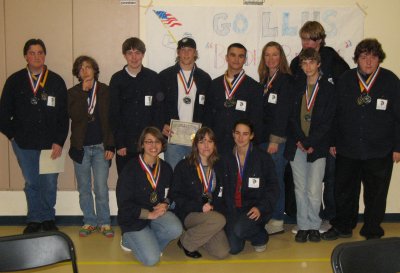
LOWER LAKE – When Upper Lake High School's championship Academic Decathlon team journeys to Sacramento for the state competition next month, they'll have some local company.
Lower Lake High School's Academic Decathlon team, which finished second to Upper Lake at last Saturday's county competition, has been invited to the state competition as well, according to Lower Lake Coach Nancy Harby.
Harby reported on Wednesday that Lower Lake received a special invitation to participate at the state-level competition.
“It's because we're the top-scoring No. 2 team in our division, outscoring some other counties' winners,” Harby said.
Upper Lake's overall winning score at the Feb. 2 county Academic Decathlon competition was 34,939 out of a possible 60,000 points to take the win. Lower Lake High School scored 32,205 in their silver-winning performance.
Harby added, “We were also told that we are being included due to our sportsmanship.”
Instilling respect in her students for their opponents is key, Harby told Lake County News in a weekend interview.
Both Harby and Upper Lake Coach Christina Moore said over the weekend that the county's Academic Decathlon teams have achieved a very high level of competition.
Under Moore's guidance the team enjoyed an eight-year winning streak, including a 2004 state championship in Division 3 and a second-place state finish in 2005. Last year, Harby's team handed Upper Lake it's first loss in nearly a decade, which interrupted Upper Lake's longtime dominance.
In 2006, Lower Lake – which that year also had placed second to Upper Lake in the county competition – was invited to the state competition as part of its new 55-team format and thanks to its high score.
Moore's team already has begun the work of preparing for the state meet, which also will have the Civil War as its theme. Harby's students also will now dive back into the topic.
E-mail Elizabeth Larson at

{mos_sb_discuss:2}
- Details
- Written by: Lake County News reports
Sgt. Chris Chwialkowski said the checkpoint will be a joint effort among the Lake County Sheriff’s Office, Clearlake Police and the California Highway Patrol.
The checkpoint will be staffed by deputies and officers who are trained in the detection of alcohol and/or drug impaired drivers, said Chwialkowski. Drug Recognition Experts, certified by the National Highway Traffic Safety Administration, will be on site to provide on the spot assessments of drivers suspected of drug use.
The officers also will be equipped with state-of-the-art, handheld breath devices which provide an accurate measure of blood alcohol concentrations of suspected drunk drivers, Chwialkowski reproted.
Calrans employees will be on site providing traffic control in order to ensure the safety of officers and motorists alike, he reported.
“Traffic volume permitting, all vehicles will be checked and drivers who are under the influence of alcohol and/or drugs, or unlicensed, can be expected to be arrested,” Chwialkowski said.
{mos_sb_discuss:2}




