 How to resolve AdBlock issue?
News
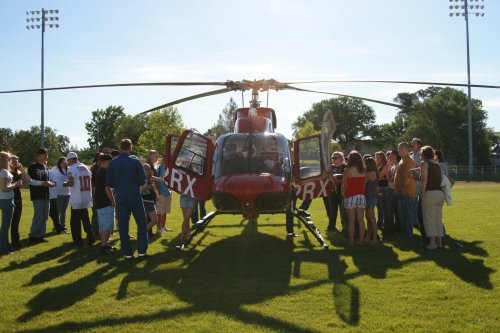
LOWER LAKE – The early morning air was quiet and cool only moments before the distinctive sound of the 830 horsepower turbine engine could be detected.
Flying into the Lower Lake High School football and track field was REACH Air Ambulance's familiar Red Bell 407 helicopter, which circled the field before gently touching down in front of the home team seats.
Twenty-two students from Doug DeSoto’s Public Safety Program recently were treated to an up-close look at one element of what are known as “First Responders” in the Public Safety and Law Enforcement community.
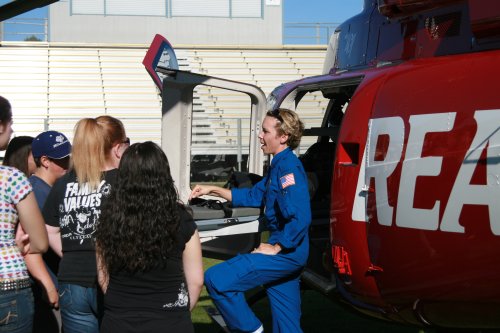
On board the REACH copter is a host of cutting-edge technologies. Literally anything that is found in a hospital emergency room is crammed into the $3 million aircraft. Also on board were Nurse Anna Blair, paramedic and crew chief Terry Gowen and pilot Dennis Smith.
The three crew members each spoke of their respective duties as well as their educational backgrounds. Students were invited to sit in the pilot’s seat and otherwise examine the workings in fine detail.
The 40-minute visit was, fortunately, uninterrupted by more serious matters and the group was treated to a take-off and fly-around that showed off the pilot's considerable skill.
The REACH Air Ambulance services have transported thousands of patients and celebrates its 20 anniversary on Thursday, May 24 at Lampson Field, 4615 Highland Springs Road. The event takes place from 11 a.m. to 2 p.m. The public is invited.
{mos_sb_discuss:2}
- Details
- Written by: Lake County News Reports
LAKE COUNTY – The US Department of Agriculture has designated Lake and 12 other California counties as primary natural disaster areas due to extreme weather conditions.
The USDA reported that the designations were made on May 9.
Lake County Agricultural Commissioner Stave Hajik said Lake has been designated a disaster area both for drought conditions last fall and for freeze conditions earlier this year.
“The only reason we're a freeze-listed county is we're an adjacent county to a county that has freeze damage,” he said.
Two local strawberry growers and one vegetable grower are believed to have had serious affects from the freeze, said Hajik, but the damage was mostly to equipment, like sprinklers, rather than crops.
Hajik said he applied for the disaster designation for the county in March, after Tim Strong, a local veterinarian and president of the county's cattlemen's association, told him about concerns for the county's rangelands due to the dry fall and winter weather.
Hajik said he did a survey of the county after speaking with Strong, and found that the area's rangelands had indeed been damaged by lack of rain during the period of Dec. 11 through Feb. 7.
Although rain did eventually arrive, it was too late to alleviate the rangelands' dry conditions, said Hajik.
He estimated $661,000 in damage to county ranchers because of the dry weather: of that, $151,000 is for rangelands, $340,000 for damage to hay crops and $170,000 for permanent pasture.
The declarations make Lake County farmers and ranchers eligible to receive low-interest emergency loans, said Erica Szlosek, spokesperson for the USDA Farm Services Agency.
Szlosek said those who intend to apply for assistance have eight months from the May 9 declaration to do so. She said applicants must have had a 30-percent loss to their operation to qualify for the 3.75-percent loans.
Hajik said a “major” dry period in the state in 2002 made it possible for farmers to receive free assistance that they weren't required to pay back.
Strong said effects of the drier conditions can be seen around the county.
For cattlemen like him, the biggest issue is lack of grass.
“We had that real cold weather in January and we didn't have very much rain,” he said.
The last few rains helped a little, said Strong, but he added, “the damage was really already done.”
He estimated that more than 50 percent of the county's grasslands were affected.
Cattlemen who put their cattle on winter range usually pull the cows off a little early to leave some feed behind for the fall, said Strong. Less rain meant ranchers were having to pull their cows off the range even earlier, with even less residual feed left behind. Winter range depends on water for seasonal streams and ponds, as well, said Strong.
The end result is that cattlemen are cutting their grazing season much shorter and having to supplement with more hay, which means a bigger cut out of farmers' bottom lines.
Strong said he believes the full effect of the drier weather will become more apparent next fall, when he expects to see less grass.
In addition to Lake, the counties listed as primary natural disaster areas due to drought and freeze conditions last fall and this spring are Contra Costa, Fresno, Kern, Kings, Mariposa, Merced, San Benito, San Luis Obispo, San Joaquin, Santa Barbara, Stanislaus and Tulare.
Counties contiguous to the 13 primary natural disaster areas also are eligible for assistance. Those counties are Alameda, Amador, Calaveras, Colusa, Glenn, Inyo, Los Angeles, Madera, Mendocino, Mono, Monterey, Napa, Sacramento, San Bernardino, Santa Clara, Santa Cruz Stanislaus, Solano, Sonoma, Tuolumne, Yolo and Ventura.
Lake County farmers and ranchers can call the Farm Services Agency office in Mendocino County in Ukiah, 468-9223, for more information, or go online for forms and information at www.fsa.usda.gov.
E-mail Elizabeth Larson at
{mos_sb_discuss:2}
- Details
- Written by: Elizabeth Larson
CLEARLAKE OAKS – What's the biggest fish you've ever caught?
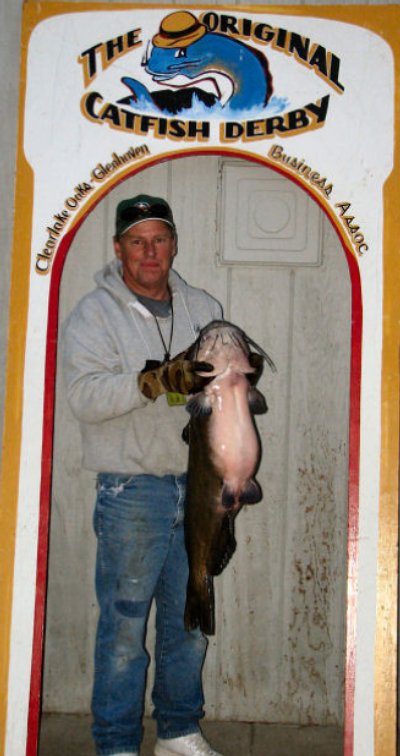
Chances are, not too many of us have reeled in a 28-pound catfish. But that's just what James Paschke of Woodland did on Friday evening, a feat which helped him win the 26th annual Clearlake Oaks Catfish Derby this weekend.
The Clearlake Oaks derby is billed as the largest catfish derby west of the Mississippi. It's hosted by the Clearlake Oaks-Glenhaven Business Association, said Gail Jonas, the event's chair.
This weekend's derby also had the biggest field in its history, said Dennis Locke, another of the dedicated team of volunteers who organize the derby.
In all, the derby welcomed 487 adult fishermen – and women – along with 96 children, said Jonas.
The event offered a Kids Derby for ages 16 and under. Locke said they set out to attract more kids entries, and as a result got almost twice the normal number of young competitors.
Paschke's 28.23-pound winner helped him land a grand prize of a new boat, trailer and motor.
“That's a nice fish,” said Jonas. “We've had bigger, but that's fairly good-sized.”
Many of the fish brought in for the tournament were caught near M&M Campground on the Peninsula, near Rattlesnake Island and Indian Island, near the mouth of Cache Creek, Jonas said.
Other top finishers in the adult derby were: second place, William Bhader III of San Jose, 26.15-pound fish; third place, James Champlin, San Jose, 24.63 pounds; fourth place, Josh Gouker, Marysville, 24.57; fifth place, Sheila Bird, Oroville, 24.41 pounds; sixth place, Pamela Woods, Clearlake, 24.18 pounds; seventh place, Justin Lane, Hood River, Ore., 24.05 pounds; eighth place, Donnell Thompson, Pittsburg, 23.82 pounds; ninth place, Michael Reed, Greenville, 23.19 pounds; 10th place, Joshua Lane, Hood River, 23.18 pounds; 11th place, Tommy Wheeler, Sutter, 22.85 pounds; 12th place, Steve Johnson, Oceanside, 22.51 pounds; 13th place, Gary Moore, Clearlake, 21.56 pounds; 14th place, Kerry Hamilton, Boron, 21.48 pounds; 15th place, Lee Harris, Oakland, 21.39 pounds; 16th place, Matthew Ross, Clearlake, 21.10 pounds; 17th place, John Willis Jr., Lakeport, 21.00 pounds; 18th place, Gene Shogren, Yuba City, 20.31 pounds; 19th place, Colin Johnson, Santa Rosa, 19.33 pounds; 20th place, Brad Zazzetti, Forestville, 19.26 pounds; 21st place, Ricky Williamson, Clearlake, 18.43 pounds.
Locke said everyone had a great time in spite of the high winds, which affected fishing conditions. People fished both from the shorelines and from boats, Jonas added.
She said about 70 percent of the tournament participants came from outside the county, with visitors from as far away as Maryland, Oregon, Nebraska and Montana.
The Catfish Derby is the association's major fundraiser of the year, said Jonas, helping the group fund the community's Fourth of July fireworks, assist the senior center and local schools, and contribute to the community's new park at The Plaza.
“We try to spend it where it's going to help people the most in our community,” she said.
Jonas, who estimated she has worked on about six or seven of the tournaments, said it's inspiring to see everyone pull together to make the event happen.
“Everybody just pitches in and it makes you feel really good,” she said.
The process of organizing the derbies take about nine months, Jonas said. “We start in September and we work all year.”
Which means, of course, that they have a few months of rest before the team of volunteers – which includes about 40 community members, according to Jonas – gets started on next year's event. The effort will include mailers to fisherman from recent derbies and other outreach.
More photos will be posted Monday at www.clearlakeoaks.org.
E-mail Elizabeth Larson at

{mos_sb_discuss:2}
- Details
- Written by: Elizabeth Larson
LAKE COUNTY – As the state Legislature prepares to begin hearings on the governor's updated budget, there are concerns about what the proposed budget changes will do to counties, especially rural areas such as Lake County.
Gov. Arnold Schwarzenegger released his May budget revision on May 14. The $145.9 billion budget calls for $103.9 billion from the state's General Fund alone.
A report from the state Senate's Committee on Budget & Fiscal Review identified “significant changes” from the budget originally proposed in January.
In her overview of the May revision, Elizabeth G. Hill, the state's legislative analyst, estimates that under Schwarzenegger's budget, state expenditures will exceed revenues by $3 billion in the 2007-08 budget year.
Among the changes, the General Fund reserve was estimated at $2.1 billion in January, a number which since has declined to $500 million.
The shortfall comes from a variety of sources including a decline in major tax sources such as personal and corporate taxes which are expected to be down by $806 million this coming year, with sales and use taxes revised down by $500 million due to a weaker economy, Hill reported.
In addition, proposed tribal gaming revenues of $314 million in the next budget year, which are $192 million lower than anticipated.
To make up some of the shortfalls, the governor made several controversial proposals, including selling the state's EdFund, which administers federal student loan programs for both in-state and out-of-state students in higher education, eliminating a cost of living increase for Social Security and eliminating the Williamson Act subvention for counties.
Hill wrote that she believes Schwarzenegger is overestimating his budget reserves, which will result in a “significant challenge” for the Legislature as it develops a budget “that realistically reflects revenues and spending while maintaining a prudent reserve.”
At the same time, some General Fund expenditures are expected to go up significantly. Hill's report notes that Schwarzenegger has added $624 million in budget expenditures in the May revision, including money to pay Proposition 98 obligations for education.
Modest economic growth is predicted in the budget, though Hill notes there are uncertainties due to the housing market – lighter sales, dramatically increased foreclosure rates along with lowered selling prices – and gasoline prices.
North Coast legislators Assembly member Patty Berg (D-Eureka) and Sen. Patricia Wiggins (D-Santa Rosa) both criticized Schwarzenegger's May budget revision.
“California deserves a government that puts people first, a government that protects the environment, plans for the future and takes care of our families and our children,” said Berg, chair of the Budget Subcommittee on Health and Human Services. “The budget the governor gave us falls short of that goal.”
Wiggins cited several concerns, among them social programs.
“What I heard was a message that it would be OK for us to again cut services and assistance to seniors, the disabled, the homeless and the mentally ill – not something I had hoped to hear during a time of ‘bipartisan cooperation,’” she said.
Social programs could be hit hard
Schwarzenegger proposes to help offset that, Hill reported, with the $185 million in savings from suspending the cost of living increase for the elderly and disabled Social Security Income and State Supplementary Program recipients.
That proposal could affect the more than 10,000 people in Lake County over the age of 65, according to US Census numbers.
David Miller, Wiggins' spokesman, said Schwarzenegger “prefers that we repay $3.1 billion to Wall Street, about double what we have to, instead of ensuring that we are able to provide for the needs of poor kids, the disabled or the elderly. Or for that matter, instead of ensuring that that cities, counties and school districts have the resources they need to serve the people in their communities.”
Kelly Cox, the county's administrative officer, is a veteran of dealing with county budgets and how they're affected by the overall state budget. He said it's still too early to know the full impact of Schwarzenegger's proposals on Lake County's fiscal picture for 2007-08, especially the actual dollar impact.
However, he did say Social Services, Child Support Services, health and mental health services, and other county services could stand to be affected by Schwarzenegger's proposals.
Williamson Act proposed for cuts
The governor also expects to save $40 million by cutting the Williamson Act program, another area that could immediately affect the county.
The Williamson Act was created by the state Legislature in 1965 to help preserve agricultural and open space by discouraging “premature and unnecessary conversion to urban uses,” according to the state Department of Conservation.
The act helps protect nearly 16.9 million of the state's 29 million acres of farm and ranch land through 10-year contracts, which result in landowners saving an estimated 20 to 75 percent in property tax each year. In order to enter into a Williamson Act contract, a landowner must have an “agricultural preserve” of 100 acres or more – which can be a number of smaller parcels combined, the Department of Conservation reported.
Cox said the Williamson Act would be one of the first areas of impact.
“We would immediately lose approximately $70,000 per year in general fund revenue from discontinuance of the Williamson Act/Open Space subvention and future Williamson Act contracts would certainly be at jeopardy,” said Cox. “In fact we could be forced to initiate proceedings to cancel some of the existing contracts.”
According to the state's Division of Land Resource Protection, Lake County has 49,504 acres enrolled in the California Conservation (Williamson) Act. Of that number, 5,866 acres are listed as prime agricultural land.
Wiggins, who was been working to redefine and expand the Williamson Act through her bill, SB 562, was also critical of this part of the governor's budget.
“The governor has received a lot of press for his efforts on behalf of the environment, but his budget shows that when it comes to spending a small amount of money to preserve our agricultural land from being converted to golf courses or Super Wal-Marts, he doesn’t put his money where his mouth is,” she said.
She added that Schwarzenegger's plan shows “he clearly wants local governments to pay the tab for the entire {Williamson Act] program.”
Presidential primary a costly addition
One area where Cox expressed concern was the proposal to delay state reimbursement of the cost of the early presidential primary election to fiscal year 08/09. That proposal, while farther out, could have ramifications on the 2007-08 budget, he said.
“This will be a costly additional election the county will be required to conduct which is entirely due to action recently taken by the governor and state legislature,” he said. “It is being proposed that the county cover the entire cost of that election and not receive any state reimbursement until the following fiscal year.”
He added, “That certainly won't help balance our 07/08 budget – we need to be reimbursed in the same year the expense is incurred. In fact, they should be providing us with the necessary funding prior to the election.”
Cox said he's not sure when the budget picture for the county will become more clear, although be believes more information and clarifications will be coming “on a piecemeal basis” in the coming weeks.
He added that what the governor proposes isn't what the legislature ends up approving, so there's no telling at this point what the final budget will look like.
E-mail Elizabeth Larson at
{mos_sb_discuss:3}
- Details
- Written by: Elizabeth Larson