How to resolve AdBlock issue?
Refresh this page
How to resolve AdBlock issue?
Refresh this page
Lake County News,California
  • Home
    • Registration Form
  • News
    • Education
    • Veterans
    • Community
      • Obituaries
      • Letters
      • Commentary
    • Police Logs
    • Business
    • Recreation
    • Health
    • Religion
    • Legals
    • Arts & Life
    • Regional
  • Calendar
  • Contact us
    • FAQs
    • Phones, E-Mail
    • Subscribe
  • Advertise Here
  • Login
How to resolve AdBlock issue?
Refresh this page

News

Clearlake Animal Control: Start the year off with a new friend

Details
Written by: Elizabeth Larson
Published: 01 January 2026
“Terry.” Photo courtesy of Clearlake Animal Control.

CLEARLAKE, Calif. — As 2026 begins, it’s a good time to visit Clearlake Animal Control and find a new friend to add to your family.

The shelter starts off the year with 60 adoptable dogs and puppies listed on its website.

This week’s dogs include “Terry,” a 7-year-old shepherd mix with a short brindle coat.

The shelter is located at 6820 Old Highway 53. It’s open from 9 a.m. to 6 p.m. Tuesday through Saturday. 

For more information, call the shelter at 707-762-6227, email This email address is being protected from spambots. You need JavaScript enabled to view it. or visit Clearlake’s adoptable dogs here.

This week’s adoptable dogs are featured below.

Email Elizabeth Larson at This email address is being protected from spambots. You need JavaScript enabled to view it.. Follow her on Twitter, @ERLarson, and on Bluesky, @erlarson.bsky.social. Find Lake County News on the following platforms: Facebook, @LakeCoNews; X, @LakeCoNews; Threads, @lakeconews, and on Bluesky, @lakeconews.bsky.social. 

What loving-kindness meditation is and how to practice it in the new year

Details
Written by: Jeremy David Engels, Penn State
Published: 01 January 2026

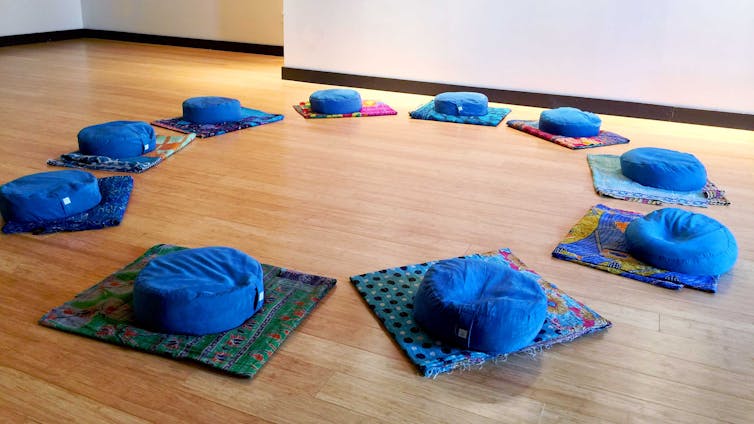
Loving-kindness, the feeling cultivated in metta meditation, is very different from romantic love. Anna Sunderland Engels

A popular New Year’s resolution is to take up meditation – specifically mindfulness meditation. This is a healthy choice.

Regular mindfulness practice has been linked to many positive health benefits, including reduced stress and anxiety, better sleep and quicker healing after injury and illness. Mindfulness can help us to be present in a distracted world and to feel more at home in our bodies, and in our lives.

There are many different types of meditation. Some mindfulness practices ask meditators simply to sit with whatever thoughts, sensations or emotions arise without immediately reacting to them. Such meditations cultivate focus, while granting more freedom in how we respond to whatever events life throws at us.

Other meditations ask practitioners to deliberately focus on one emotion – for example, gratitude or love – to deepen the experience of that emotion. The purpose behind this type of meditation is to bring more gratitude, or more love, into one’s life. The more people meditate on love, the easier it is to experience this emotion even when not meditating.

One such meditation is known as “metta,” or loving-kindness. As a scholar of communication and mindfulness, as well as a longtime meditation teacher, I have both studied and practiced metta. Here is what loving-kindness means and how to try it out for yourself:

Unbounded, universal love

Loving-kindness, or metta, is the type of love which is practiced by Buddhists around the world. Like many forms of meditation today, there are both secular and religious forms of the practice. One does not need to be a Buddhist to practice loving-kindness. It is for anyone and everyone who wants to live more lovingly.

Loving-kindness, the feeling cultivated in metta meditation, is very different from romantic love. In the ancient Pali language, the word “metta” has two root meanings: The first is “gentle,” in the sense of a gentle spring rain that falls on young plants, nourishing them without discrimination. The second is “friend.”

Metta is limitless and unbounded love; it is gentle presence and universal friendliness. Metta practice is meant to grow people’s ability to be present for themselves and others without fail.

A guided loving-kindness meditation practice.

Metta is not reciprocal or conditional. It does not discriminate between us and them, rich and poor, educated and uneducated, popular or unpopular, worthy and unworthy. To practice metta is to give what I describe in my research as “the rarest and most precious gift” – a gift of love offered without any expectation of it being returned.

How to practice loving-kindness meditation

In the fifth century, a Sri Lankan monk, Buddhaghosa, composed an influential meditation text called the “Visuddhimagga,” or “The Path of Purification.” In this text, Buddhaghosa provides instructions for how to practice loving-kindness meditation. Contemporary teachers tend to adapt and modify his instructions.

The practice of loving-kindness often involves quietly reciting to oneself several traditional phrases designed to evoke metta, and visualizing the beings who will receive that loving-kindness.

Traditionally, the practice begins by sending loving kindness to ourselves. It is typical during this meditation to say:

May I be filled by loving-kindness
May I be safe from inner and outer dangers
May I be well in body and mind
May I be at ease and happy

After speaking these phrases, and feeling the emotions they evoke, next it’s common to direct loving-kindness toward someone – or something – else: It can be a beloved person, a dear friend, a pet, an animal, a favorite tree. The phrases become:

May you be filled by loving-kindness
May you be safe from inner and outer dangers
May you be well in body and mind
May you be at ease and happy

Next, this loving-kindness is directed to a wider circle of friends and loved ones: “May they …”

The final step is to gradually expand the circle of well wishes: including the people in our community and town, people everywhere, animals and all living beings, and the whole Earth. This last round of recitation begins: “May we …”

In this way, loving-kindness meditation practice opens the heart further and further into life, beginning with the meditator themselves.

Loving-kindness and mindful democracy

Clinical research shows that loving-kindness meditation has a positive effect on mental health, including lessening anxiety and depression, increasing life satisfaction and improving self-acceptance while reducing self-criticism. There is also evidence that loving-kindness meditation increases a sense of connection with other people.

The benefits of loving-kindness meditation are not just for the individual. In my research, I show that there are also tremendous benefits for society as a whole. Indeed, the practice of democracy requires us to work together with friends, strangers and even purported “opponents.” This is difficult to do if our hearts are full of hatred and resentment.

Each time meditators open their hearts in metta meditation, they prepare themselves to live more loving lives: for their own selves, and for all living beings.The Conversation

Jeremy David Engels, Liberal Arts Endowed Professor of Communication, Penn State

This article is republished from The Conversation under a Creative Commons license. Read the original article.
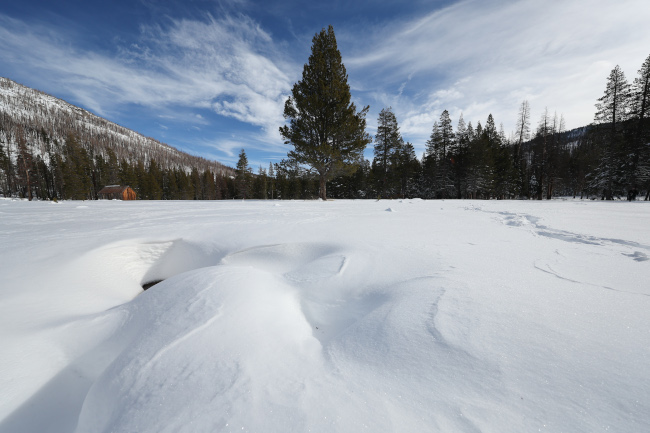
Late December atmospheric river storms deliver much-needed snowpack and water supply for California

Details
Written by: Lake County News reports
Published: 31 December 2025
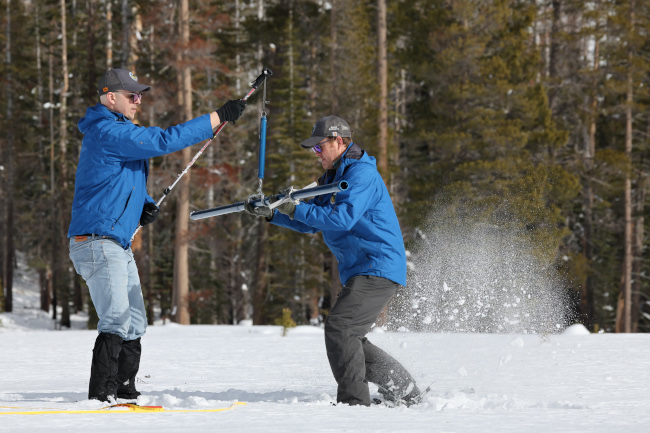
California Department of Water Resources Engineer Jacob Kollen, left, and Engineer Anthony Burdock conduct the first media snow survey of the 2026 season at Phillips Station in the Sierra Nevada. The snow survey is held approximately 90 miles east of Sacramento off Highway 50 in El Dorado County. Photo taken Tuesday, Dec. 30, 2026, by Xavier Mascareñas/California Department of Water Resources.

Atmospheric river storms across California this month have boosted water supply and snow pack, which had been lagging so far in the early water year.

The Department of Water Resources on Tuesday conducted the first snow survey of the season at Phillips Station. 

The manual survey recorded 24 inches of snow depth and a snow water equivalent of 5 inches, which is 50 percent of average for this location. 

The snow water equivalent measures the amount of water contained in the snowpack and is a key component of DWR’s water supply forecast. 

Statewide, the snowpack is 71 percent of average for this date.

Tuesday’s results are welcome news for water managers who rely on the statewide snow surveys to make water supply decisions for the year ahead. 

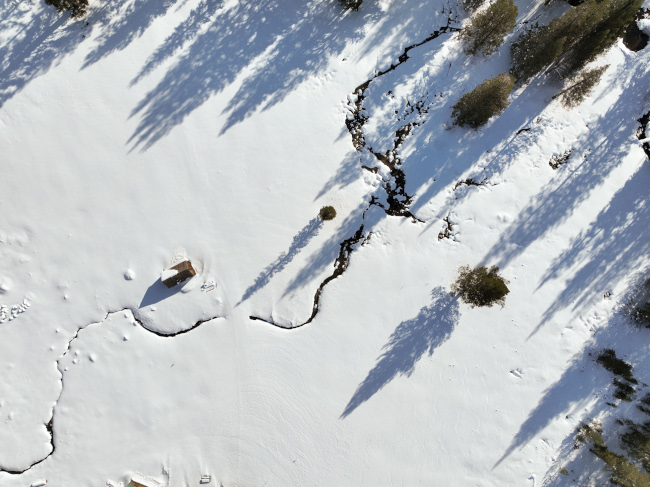
Snow blankets the Phillips Station meadow where the California Department of Water Resources conducts the first media snow survey of the 2026 season at Phillips Station in the Sierra Nevada. The snow survey is held approximately 90 miles east of Sacramento off Highway 50 in El Dorado County. Photo taken Tuesday, Dec. 30, 2026, by Xavier Mascareñas/California Department of Water Resources.


California’s statewide snowpack had been lacking in early December with above-average temperatures and very little storm activity. Recent storms have turned that around and provided a significant boost to the snowpack and the state’s water supply.

“The dry conditions and warmer temperatures in early December delayed our snow-building season, but the return of storm activity, especially in the last week, helped to build a solid base for this year’s snowpack,” said Angelique Fabbiani-Leon, state hydrometerologist for DWR. “Thankfully, the recent storms that reached the state were cold enough to provide necessary benefits for the snowpack and our water supply. While California is in a better position now, it is still early in the season and our state’s water supply for this year will ultimately depend on a continued cadence of storms throughout winter and early spring.”

DWR’s electronic readings from 130 stations placed throughout the Sierra Nevada indicate that the statewide snowpack’s snow water equivalent is 6.5 inches, or 71 percent of average for this date, compared to 115 percent on this date last year.

On average, the largest snow-producing months in the Sierra Nevada are January, February, and March. Drought and flood always marked the California climate, but extreme whiplash between wet and dry is becoming more pronounced, not just year to year but often within the same season or month.

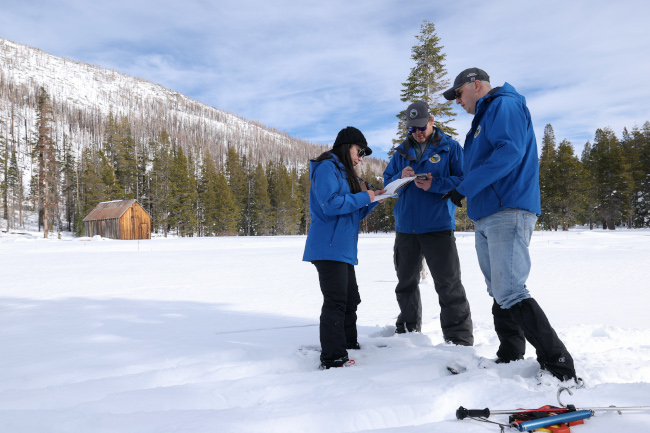
From left to right, California Department of Water Resources Hydrometeorologist Angelique Fabbiani-Leon, Engineer Anthony Burdock, and Engineer Jacob Kollen go over the data from the first media snow survey of the 2026 season at Phillips Station in the Sierra Nevada. The snow survey is held approximately 90 miles east of Sacramento off Highway 50 in El Dorado County. Photo taken Dec. 30, 2026. Photo taken Tuesday, Dec. 30, 2026, by Nick Shockey/California Department of Water Resources.


“It’s great to see so much fresh snow in the Sierra following a relatively dry December,” said DWR Director Karla Nemeth. “More than any other factor, the rain and snow that falls in these critical winter months dictates how much water can be delivered to Californians and farmland statewide. We make the most of what Mother Nature delivers with advance planning that enables Forecast Informed Reservoir Operations and groundwater recharge.”

Major reservoirs statewide are currently 123 percent of average thanks to recent precipitation on top of three consecutive years of above-average snowpack conditions.

On average, the Sierra snowpack supplies about 30 percent of California’s water needs. Its natural ability to store water is why the Sierra snowpack is often referred to as California's “frozen reservoir.” 

Data from these snow surveys and forecasts produced by DWR’s Snow Surveys and Water Supply Forecasting Unit are key factors in determining how DWR manages the state’s water resources.

DWR conducts four media-oriented snow surveys at Phillips Station each winter near the first of each month, January through April and, if necessary, May. 

The next survey is tentatively scheduled for Feb. 3.

For California’s current hydrological conditions, visit https://cww.water.ca.gov. 


A drone view of the meadow covered in snow where the California Department of Water Resources conduct the first media snow survey of the 2026 season at Phillips Station in the Sierra Nevada. The snow survey is held approximately 90 miles east of Sacramento off Highway 50 in El Dorado County. Photo taken December 30, 2026. Photo taken Tuesday, Dec. 30, 2026, by Xavier Mascareñas/California Department of Water Resources.

New in 2026: California laws taking effect in the new year

Details
Written by: Lake County News reports
Published: 31 December 2025

Several key laws will take effect in 2026 that officials said reflect California’s continued focus on public safety, affordability, transparency and accountability.

The Governor’s Office said the new laws lower prescription drug costs, increase oversight of large corporations, strengthen consumer and worker protections, and protect California’s diverse communities. 

“California is proving once again that progress isn’t something we talk about, it’s something we build. While some in Washington remain stuck debating yesterday’s problems, we’re focused on delivering real solutions for today’s families. These new laws reflect who we are: a state that protects workers, respects students, puts people before politics, and isn’t afraid to hold powerful interests accountable,” said Gov. Gavin Newsom.

EDUCATION

Expanding mental health resources for LGBTQ youth
AB 727 (Gonzalez): Requires that student ID cards issued by public middle and high schools, and public colleges/universities include a 24/7 hotline for the Trevor Project. The hotline provides crisis and suicide prevention support to LGBTQ youth. It ensures state education agencies publish and maintain resources for students who face discrimination or harassment based on sexual orientation, gender identity, or expression.

Ban on ultra-processed foods in schools
AB 1264 (Gabriel): California’s first-in-the-nation law will remove the most concerning ultra-processed foods from being served at public schools, giving students healthier, real-food meals to improve nutrition and overall health.

Supporting student literacy
AB 1454 (Rivas): Provides educators and school leaders greater access to the tools, training, and resources needed to help students become better readers.

Streamlining college admissions
SB 640 (Cabaldon): Establishes a California State University (CSU) direct admissions process by notifying eligible high school students of automatic admission to participating CSU campuses. It also requires California Community Colleges to create programs that will support a smoother transfer for community college students to a four-year university.

HEALTH

Alternative birth centers: licensing and Medi-Cal reimbursement
AB 55 (Bonta): Ensures that licensure of alternative birth centers is more accessible to midwives in California by amending or deleting onerous and unnecessary requirements.

State emergency food ban reserve program
AB 798 (Calderon): Expands the state emergency food bank program to include diapers and wipes for families with young children.

Midwifery Workforce Training Act
AB 836 (Stefani): Requires the Department of Health Care Access and Information to administer funding for a statewide midwifery education. 

Capping insulin costs
SB 40 (Wahab and Wiener): Beginning Jan. 1, 2026, large state-related health insurers must cap insulin copays at $35 for a 20-day supply, improving affordability for Californians who rely on insulin.

Access to prenatal multivitamins
SB 646 (Weber-Pierson): Expands access to prenatal multivitamins to support healthy pregnancies and infant development.

Perinatal services in rural hospitals
SB 669 (McGuire): Requires, by July 1, 2026, the establishment of a 10-year pilot project within up to 5 critical access hospitals on an application basis to establish standby perinatal services.

IMMIGRATION

Students – know your rights
AB 419 (Connolly): Requires schools to post information about students’ rights regarding immigration enforcement in administrative offices and on school websites, helping families understand that all children have the right to a free public education.

Family Preparedness Act
AB 495 (Rodriguez): Strengthens protections for parents and children by helping families in emergencies, protecting family privacy, and preventing child facilities from collecting immigration-related information, especially if a parent is detained or separated.

HOUSING

Protecting renters
AB 628 (McKinnor): Requires landlords to provide working refrigerators in rental units beginning Jan. 1, ensuring tenants have access to essential appliances.

Transit-oriented housing development
SB 79 (Wiener): Requires each county and city to adopt a comprehensive, long-term general plan for the development of the county or city, and specified land outside its boundaries, that contains certain mandatory elements, including a housing element.

ANIMAL WELFARE

Statewide ban on cat declawing
AB 867 (Lee): Bans non-therapeutic cat declawing statewide. Only medically necessary procedures performed by a licensed veterinarian remain allowed.

Addressing the puppy mill pipeline
AB 506 (Bennett): Holds pet sellers accountable, requiring them to disclose the pet’s origin and health information.
AB 519 (Berman): Prohibits third-party pet brokers, particularly online pet brokers, from selling cats, puppies, and rabbits bred by others for profit in California.
SB 312 (Umberg): requires dog importers to submit health certificates electronically to the California Department of Food & Agriculture (CDFA) within 10 days of shipment, and requires CDFA to provide those certificates upon request.

WORKPLACE RIGHTS AND PROTECTIONS

Supporting survivors of workplace sexual assault cover-ups
AB 250 (Aguiar-Curry)- Temporarily lifts the statute of limitations for adult survivors of workplace-related sexual assault cover-ups. From Jan. 1, 2026 through Dec. 21, 2027, survivors may file civil claims regardless of when the incident occurred.

Strengthening equal pay enforcement
SB 642 (Limón): Expands California's equal pay laws by broadening key definitions, extending the statute of limitations to three years (with recovery for up to six years), and clarifying categories of unlawful pay practices.

TECHNOLOGY, AI SAFETY AND DIGITAL RIGHTS

Preventing AI from posing as licensed professionals
AB 489 (Bonta): Prohibits AI chatbots from presenting themselves as doctors, nurses, or other licensed professionals to increase transparency and prevent misrepresentation by AI chatbots.

Addressing artificially generated pornography
AB 621 (Bauer-Kahan and Berman): Strengthens protections against digital sexual exploitation by targeting the creation and distribution of AI-generated sexual content.

Risk-mitigation requirements for large AI companies
SB 53 (Wiener): Requires large AI developers to maintain documented risk-mitigation strategies to improve safety and transparency in the deployment of emerging technologies.

Safeguards for minors using AI chatbots
SB 243 (Padilla): Requires AI companies to include disclaimers that chatbots are not real people when used by minors and mandates safety protocols to prevent chatbots from encouraging self-harm.

Transparency in police reports drafted with AI 
SB 524 (Arreguin): Requires law enforcement agencies to disclose when AI tools are used to draft official police reports. 

Food delivery platforms: customer service
AB 578 (Bauer-Kahan): Strengthens consumer and worker protection on food platforms by prohibiting companies from using tips to offset base pay, requiring clear and itemized pay breakdowns for delivery workers, mandating access to a real customer-service representative when automated systems cannot resolve an issue, and guaranteeing refunds when orders are undelivered, incorrectly or only partially fulfilled.

CLIMATE AND ENVIRONMENT

Updated plastic bag regulations
SB 1053 (Allen and Blakespear): Strengthens California’s plastic bag ban by closing loopholes that allowed thicker plastic film bags to be distributed as “reusable” bags. The law eliminates plastic film checkout bags altogether and requires retailers to transition to truly reusable bags that meet higher durability standards or to paper bags with recycled-content requirements, reducing plastic waste and improving statewide recycling efforts.

  1. 2025 AgVenture class wraps for the year 
  2. West Coast levee failures show growing risks from America’s aging flood defenses
  3. More atmospheric river storms to arrive midweek
  • 111
  • 112
  • 113
  • 114
  • 115
  • 116
  • 117
  • 118
  • 119
  • 120
How to resolve AdBlock issue?
Refresh this page