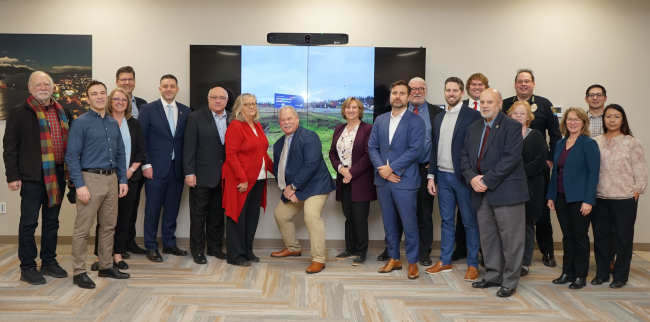
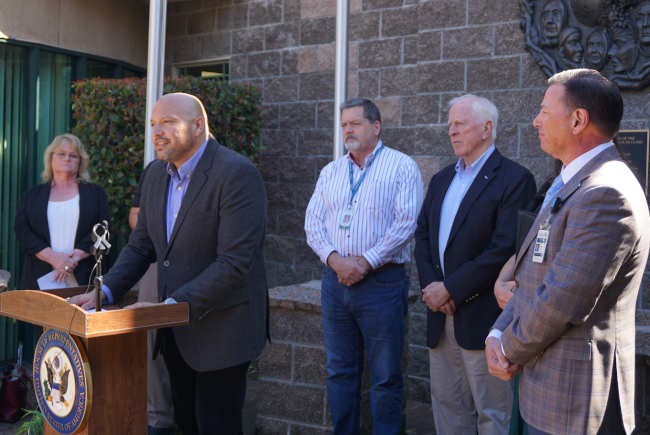
Gov. Gavin Newsom on Wednesday joined 14 other governors in launching the Governors Public Health Alliance, a new non-partisan hub coordinating public health leadership across the country.
The alliance is meant to strengthen emergency preparedness, improve communication, share data and expertise, and ensure states and territories can respond quickly and consistently to emerging health threats.
Participating governors include Bob Ferguson (WA), Josh Green (HI), Maura Healey (MA), Kathy Hochul (NY), Tina Kotek (OR), Ned Lamont (CT), Lou Leon Guerrero (GU), Dan McKee (RI), Matt Meyer (DE), Wes Moore (MD), Phil Murphy (NJ), Jared Polis (CO), JB Pritzker (IL), and Josh Stein (NC).
“California is proud to help launch this new alliance because the American people deserve a public health system that puts science before politics,” said Newsom. “As extremists try to weaponize the CDC and spread misinformation, we’re stepping up to coordinate across states, protect communities, and ensure decisions are driven by data, facts, and the health of the American people."
This announcement comes in response to what the alliance called the Trump administration’s “dangerous misguidance on vaccine safety and efficacy, and the advancement of policies like the Big Beautiful Bill that strip millions of Americans of critical health care access.”
The alliance’s statement continued, “The federal government’s failing attempts to ‘Make America Healthy Again’ have left yet another leadership gap in our nation's health and science efforts. The Governors Public Health Alliance is necessary to bring leaders and experts from across the country together, quickly, to help protect Americans from disease and injury.”
Building on existing regional leadership
The alliance announced Wednesday builds on California’s existing regional coordination efforts, like the West Coast Health Alliance.
By bringing together public health groups and regional groups, the Governors Public Health Alliance aims to enhance cross-collaboration and serve as a forum to discuss best practices and common challenges.
About GovAct The Governors Public Health Alliance is supported by GovAct, a nonprofit, nonpartisan initiative that supports governors in protecting fundamental freedoms, including public health.
GovAct serves as a centralized platform for collaboration through incubating, launching, and supporting alliances across governors’ offices. These alliances share cutting-edge policy and legal approaches to some of the most challenging and critical issues facing the nation.
As an initiative of GovAct, the alliance will also be guided by GovAct’s Bipartisan Advisory Board of former governors — Arne Carlson (R), Jim Doyle (D), Deval Patrick (D), Marc Racicot (R), Kathleen Sebelius (D), and Bill Weld (R) — and former senior federal officials Sally Yates and Larry Thompson.
As millions of student loan borrowers settle into the school year, many are stressed about how they’ll pay for their degrees. These students may find that the One Big Beautiful Bill Act, the big tax and spending bill that President Donald Trump signed into law over the summer, could limit how much they can borrow.
Until recently, graduate students could take out two types of federal loans: Direct Unsubsidized Loans, which had a lifetime limit of US$138,500, and Grad PLUS loans, which allowed students to borrow up to the full cost of attendance, minus financial aid.
But Grad PLUS loans will be eliminated next summer, with a three-year transitional period for current borrowers. That will leave only the capped loans for new borrowers, and those loans have new lifetime borrowing limits: $200,000 for students pursuing certain professional degrees, and $100,000 for nonprofessional graduate programs.
If you add both undergraduate and graduate loans, there’s a new lifetime limit of $257,500 per person.
As I reflect on these numbers and my journey to becoming a college professor, specializing in race and ethnic studies, one thing becomes clear: I would never have been able to earn my bachelor’s degree, two master’s degrees, and Ph.D. under these new rules.
Adjusting for inflation, I took out nearly $300,000 in student loans, and I paid them all off within a decade of starting my college teaching career. For me, the system worked. I wonder how today’s aspiring professionals, especially those from less prosperous backgrounds, will manage.
While some might be able to supplement their federal loans with private ones – which tend to have much worse terms for borrowers – I fear that many others will be forced to end their educations prematurely.
Black law students face unique challenges, graduating with approximately 8% more debt on average than white students and facing significant wage disparities once they enter the legal workforce. Making it harder for Black students to afford law school could reduce the number of Black attorneys, which has held steady at about 5% of active lawyers over the past 10 years.
LAKE COUNTY, Calif. — After having voted to strike earlier this month, frontline employees at eight Sutter Health facilities — including Sutter Lakeside Hospital — have reached a tentative agreement with management in contract negotiations.
SEIU-United Healthcare Workers West, or SEIU-UHW, the union representing the workers involved in negotiations, reported earlier this month that its members had approved a strike with a 96% vote in support, although a date wasn’t set.
At that point, Sutter Health maintained that it had been bargaining with SEIU–UHW since July and remained “committed to reaching a fair and sustainable agreement.”
On Saturday, however, the situation appeared to reach a resolution when the union and Sutter Health reached a tentative contract agreement.
The agreement averts a strike for unionized Sutter Health workers at eight Sutter Health facilities in Lakeport, Oakland, Santa Rosa, Roseville, Berkeley, Vallejo, Antioch, Castro Valley and San Francisco.
Sutter Health said the number of workers involved is more than 4,400 while the union gave the number as being 4,700.
The workers SEIU-UHW represents across the Sutter Health system include nursing assistants, respiratory therapists, licensed vocational nurses, environmental services, food services, x-ray technicians and respiratory therapists.
The union said the new agreement addresses “critical issues around staffing and working conditions by ensuring fair pay and benefits for frontline healthcare workers, allowing them to continue serving patients without disruption.”
“This tentative agreement shows that when we stand united, we can win improvements that protect both healthcare workers and our patients,” said Dinora Garcia, a dietary clerk from Sutter Lakeside. “Reaching this agreement wasn’t easy but we stood together to advocate for worker and patient safety, improved staffing levels, and fair wages and benefits that reflect the vital work we do every day.”
“The parties have negotiated in good faith since July for an agreement that recognizes and rewards employees while supporting our ability to deliver safe, high-quality care,” Sutter Health said in its statement on the negotiations. “We believe the tentative agreements meet those goals.”
The union said the tentative contract agreement needs to be voted on and approved by the members before it is final. The ratification vote will be scheduled for later this month.
“If approved, the agreement will provide 14 percent across-the-board raises for workers. The agreement also protects healthcare and retirement benefits for these frontline healthcare workers,” SEIU-UHW reported.
“We encourage all eligible employees to participate in the vote and support this fair contract offer,” Sutter Health said.
Email Elizabeth Larson at This email address is being protected from spambots. You need JavaScript enabled to view it.. Follow her on Twitter, @ERLarson, and on Bluesky, @erlarson.bsky.social. Find Lake County News on the following platforms: Facebook, @LakeCoNews; X, @LakeCoNews; Threads, @lakeconews, and on Bluesky, @lakeconews.bsky.social.
LAKE COUNTY, Calif. — The Lake County Sheriff’s Office said a teenager wanted in connection for a stabbing last week has been taken into custody.
On Friday, deputies located and arrested 14-year-old Nova Fabisch, according to sheriff’s office spokesperson Lauren Berlinn.
Berlinn said deputies found Fabisch in Lakeport and arrested her on charges of assault with a deadly weapon, battery causing serious bodily injury and attempted murder.
Last Wednesday, sheriff’s deputies responded to Sutter Lakeside Hospital after receiving reports of a female juvenile who had sustained multiple stab wounds, as Lake County News previously reported.
During an interview at the hospital with the victim and her parents, the deputies were told that the suspect — identified as Fabisch — had stabbed her multiple times with a pocket knife.
The victim was expected to make a full recovery, according to the sheriff’s office.
Due to the seriousness of the charges and Fabisch’s identification as the suspect, the sheriff’s office chose to release her name.
After her arrest on Friday, Fabisch was transported to and transferred into the custody of the Lake County Probation Office, Berlinn said.
So far, there does not appear to be any plans to charge Fabisch as an adult.
Chief Deputy District Attorney Rich Watson told Lake County News that Fabisch is being handled as a juvenile case.
Email Elizabeth Larson at This email address is being protected from spambots. You need JavaScript enabled to view it.. Follow her on Twitter, @ERLarson, and on Bluesky, @erlarson.bsky.social. Find Lake County News on the following platforms: Facebook, @LakeCoNews; X, @LakeCoNews; Threads, @lakeconews, and on Bluesky, @lakeconews.bsky.social.
LAKE COUNTY, Calif. — The Lake County Air Quality Management District reported that it has completed the process to approve minor changes to the burn program.
Starting with the 2025-26 burn season, the annual Lake County Burn Ban will be lifted on Nov. 1 of each year.
Additional changes to the burn program include specific holidays to be designated as no burn days in Lake County thus ensuring the community is able to enjoy clean air during the holidays.
Burn permits will be available on Nov. 1 by going to www.lcaqmd.net and following the link to the online burn permits.
Residential and agricultural burn permits are available online from any device that has internet access. This includes libraries with public computer access. Feel free to call the air quality office if assistance is needed.
Burn permits are required for all outdoor burning in the Lake County Air Basin.
A smoke management plan burn permit is required for any of the following: multi-day or overnight burning, smoke impact potential, tule burning, piles > 10 feet diameter, more than 1 acre of standing vegetation, whole vines, or whole trees, and burning more than 20 acres in one day.
A smoke management plan can be obtained at the Lake County Air Quality Management District office by appointment. Call 707-263-7000 to schedule an appointment and be sure to bring a map showing the burn location (https://gispublic.co.lake.ca.us/portal/home/), burn site coordinates (GPS locations), parcel number or address, acres to be burned, and details of vegetation to be burned.
A fee is required for all burn permits, payable at the time the permit is issued. Burn permit fees have increased this year. The fee for a residential burn permit is $63 and the fee for an agricultural burn permit is $94.
The fee for a smoke management plan burn permit varies by size, type and amount of parcels, and range from $125 for pile burning; $188 for standing brush; and $625 for complex burns such as levees, dams, right of ways and reservoir burns. Other fees are posted on the district website for special permits, exemptions, lot clearing and tule burns.
Residential and agricultural burn permits issued online are paid by credit card at time of issuance. If an alternative payment method is needed please call the district office to make arrangements. Credit card payment is not available for smoke management plans at this time, payment must be made at the time of issuance by cash, check or money order to the district.
Only clean dry vegetation that was grown on the property may be burned. Residential burn permits require a one acre or larger parcel, a burn location that is at least 100 feet from all neighbors, and at least 30 feet from any structure in order to qualify.
Read your burn permit carefully and follow all the conditions. Please be considerate of your neighbors. A permit does not allow you to create health problems for others. You can be liable for health care costs, fines, and other costs resulting from your burning.
Consider composting or using the vegetative waste pickup provided with your waste collection service as an alternative to burning leaves. Greenwaste bins and dumpsters are available through your local waste collection provider.
LAKE COUNTY, Calif. — The city of Clearlake’s Measure V Oversight Board is set to hold a special meeting to consider an annual report and review upcoming projects.
The oversight board will meet at 3 p.m. Wednesday, Oct. 15, in the council chambers at Clearlake City Hall, 14050 Olympic Drive.
Community members also can participate via Zoom. The pass code is 918903.
Public comments should be submitted by noon on the day of the meeting to Administrative Services Director/City Clerk Melissa Swanson at This email address is being protected from spambots. You need JavaScript enabled to view it..
In November 2016, Clearlake’s voters approved Measure V, a one cent sales and use tax to be used for improving the city’s roads.
Items on the agenda include the receipt and filing of the 2024 meeting minutes and review of Resolution No. 2021-18, affirming the duties of the Measure V Citizen Oversight Committee members.
The oversight board also will review the fiscal year 2024-25 Measure V revenue and expenditure report and adopt a resolution declaring its compliance with city ordinance.
Also on the agenda is a review of Measure V projects through 2031.
Email Elizabeth Larson at This email address is being protected from spambots. You need JavaScript enabled to view it.. Follow her on Twitter, @ERLarson, and on Bluesky, @erlarson.bsky.social. Find Lake County News on the following platforms: Facebook, @LakeCoNews; X, @LakeCoNews; Threads, @lakeconews, and on Bluesky, @lakeconews.bsky.social.
The former Pearce Field airport in Clearlake, California, was slated to have been the site of a new medical clinic project that is now stalled after Adventist Health Clear Lake backed out of the project due to the fallout of federal legislation. Photo by Lingzi Chen/Lake County News.
CLEARLAKE, Calif. — A flagship clinic project in Clearlake has come to a halt after Adventist Health Clear Lake withdrew, citing the potential fallout from new federal legislation that will slash Medicaid funding.
In its Oct. 2 newsletter, the city of Clearlake announced Adventist Health’s decision to withdraw due to the passage of the “One Big Beautiful Bill Act,” or OBBBA — a law signed by President Donald Trump on July 4 that proposes sweeping health care cuts across the country.
“While the full impact is still uncertain, Adventist Health expects the legislation to significantly affect health systems serving large Medi-Cal populations in rural areas,” the city’s newsletter stated.
Adventist’s decision effectively stalls the long-planned medical complex along Highway 53, a $50 million, 38,000-square-foot facility originally expected to open in 2026 and draw up to 165,000 patient visits a year, while also anchoring a major new commercial development site.
“As responsible stewards of our resources, we must carefully adjust our plans in light of these financial realities,” said Adventist Health Clear Lake Operations Executive Chuck Kassis in the newsletter. “This was not an easy decision. Adventist Health Clear Lake’s priority remains ensuring long-term stability and resilience while advancing opportunities to strengthen community health.”
While Lake County has long struggled with limited health care access, it is also among the California counties most dependent on federal funding, with over 35,000 out of its total 68,000 residents — more than half the population — relying on Medi-Cal.
The act’s staggered timeline, which experts say is politically calculated to take full effect after the 2026 midterm elections, has not stopped its ripple effects from reaching Lake County — where a major health care provider has already dropped a key capital project, turning speculation into reality.
Over the next decade, the act would reduce federal Medicaid spending by an estimated $911 billion. An additional 10 million people could become uninsured, according to an analysis by health policy research nonprofit KFF using data from the Congressional Budget Office, or CBO.
For California, the KFF projects an increase in the uninsured population by 1.2 to 1.9 million in 2034. But research from the California Budget and Policy Center suggests the impact could be even greater, with as many as 3.4 million people losing Medi-Cal coverage and the state losing $30 billion in federal funding each year.
The city’s No. 1 priority
The clinic project originated in 2023, when the Clearlake City Council voted unanimously to sell three acres of property at the former Pearce Field airport to Adventist Health at the price of $1.
The city also was reserving an additional 10 acres in case Adventist would want to expand the development, as Lake County News reported at the time.
“It’s definitely disappointing,” Clearlake City Manager Alan Flora said of Adventist’s withdrawal in a phone call with Lake County News. “It is our No. 1 priority project for the city.”
Adventist Health has invested in early-stage planning, including assessments and preliminary design, while the city of Clearlake has already spent $700,000 in environmental and entitlement processes for the entire site, including the medical building, according to Flora.
“We put a lot of work into having a wellness component as part of this site,” Flora said. “There’s a lot of paths the project could take. We really liked this one because there's a lot of healthcare needs in the community.”
Despite Adventist Health leaving the table, the city is exploring alternatives to move the project forward, Flora was quoted as saying in the newsletter.
Clearlake City Council members and executive leaders of Adventist Health Clear Lake celebrate the newly installed sign (seen in image behind group) signifying the first step towards building the new rural health clinic on Thursday, Dec. 7, 2023. Photo courtesy of Adventist Health Clear Lake.
Behind Adventist Health’s withdrawal
Adventist’s decision to withdraw was finalized in late September.
The passage of the OBBBA served as “the most significant factor” in the decision-making, according to Kim Lewis, Adventist’s marketing and communication manager, in an email to Lake County News on Monday.
After evaluating the long-term financial implications of the act, Adventist Health determined that moving forward with the project at this time “would not be fiscally responsible given the uncertainty surrounding future Medicaid funding,” Lewis said.
In his conversations with Adventist Health, Flora said the negative long-term outlook on federal funding led them to downsize capital investment.
“They're feeling like the money that they had planned to put into capital is going to be needed to backfill operations because of the reduction in Medicaid funding,” Flora said. “So that's my understanding of what's really happening here.”
“I was told this is not the only project that has been terminated,” Flora added.
Lewis did not specify which other projects have been affected but said the organization is “reassessing timelines and scopes for several projects.”
“Adventist Health is taking a careful, systemwide approach to reviewing all major capital projects in light of OBBBA and its potential to significantly alter Medicaid reimbursement across California,” she said. “The goal is to prioritize financial resilience and the continued delivery of quality care — particularly in rural communities that will be most affected by these funding reductions.”
Both Clearlake’s newsletter and Lewis’ email cited an estimated “$168 billion” reduction in California’s Medicaid funding over the next decade under the federal act, on which Adventists' decision was said to be based.
However, Lake County News was unable to verify this figure using publicly available sources, and has reached out to Flora and Lewis for clarification.
Flora said the number was provided by Adventist, and Lewis said the figure was an initial projection by the California Hospital Association, or the CHA.
“But our corporate team has since notified us that CHA has updated its analysis, with the high-end estimate now showing a potential reduction of $128 billion over the next 10 years,” Lewis said in an email on Saturday.
According to the CHA, California’s potential health care funding loss now ranges from $66 billion to $128 billion. The KFF, meanwhile, estimates a range of $112 billion to $187 billion in Medicaid funding losses for the state.
Clearlake City Manager Alan Flora at Pearce Field during a tour with county leaders and Congressman Mike Thompson on May 28, 2024. Photo by Elizabeth Larson/Lake County News.
Not just about health care
For the city of Clearlake, the project is not just about health care but also about revitalizing the local economy.
“Adventist currently leases a lot of space in the city that could be used for retail,” Flora explained.
The city hopes that by consolidating those services in a new central location, it could free up existing space for retail use and stimulate commercial activity.
“It was expected to generate close to 100,000 patient visits a year,” Flora said of the original project. “So we wanted that traffic at the site, which would help support the retail.”
While the purchase agreement was approved in 2023, “the property was never actually transferred to them,” Flora said of Adventist.
The original agreement between the city and Adventist Health called for the property transfer to take place after the environmental review and entitlements were completed. Flora said the city is finalizing the environmental document and still owns the property.
The agreement also allows Adventist to “withdraw for any reason,” Flora said in an email. “There is not a financial penalty associated with the withdrawal.”
Since Adventist’s withdrawal, Flora said the city has been exploring ways to keep the health care project alive, including bringing in another developer to build the facility and lease it to Adventist, or finding a new health care provider to take it over.
Lake County Tribal Health Consortium Chief Executive Officer Ernesto Padilla speaks about the potential for service cuts on Friday, Feb. 28, 2025, as Congressman Mike Thompson, second from right, looks on. Photo by Elizabeth Larson/Lake County News.
Anticipated impact on Lake County
The concerns over potential impact of federal cuts on local health care are not new to Lake County.
In February, Congressman Mike Thompson, Board of Supervisors Chair Eddie Crandell and five local health care leaders warned that the then-passed Republican budget resolution may jeopardize access to care and create more food insecurity in Lake County at a press conference.
“So this is not a Tribal Health or Sutter or Adventist issue — this is a Lake County issue,” said Tribal Health CEO Ernesto Padilla at the press conference. “This could be crippling.”
At that time, Padilla told Lake County News that Tribal Health receives 60 to 70% of its funding from Medi-Cal.
On the night of Saturday, Oct. 4, Lake County Health Public Health Director Anthony Arton, who was not at the February meeting alongside the other health care leaders, responded to Lake County News’ inquiry on the anticipated impact of the OBBBA on the department and the county.
While saying the impact on the department has been “minimal” so far, Arton mentioned scaling back services and reconsidering hiring priorities.
“We are scaling back the CalFresh Nutrition Education Program as funding runs out and focusing on cross training staff,” he said. “We're also prioritizing mission critical roles in our hiring process and staying in close communication with our healthcare partners both locally and at the state level.”
He added: “As Medicaid changes take effect, we are preparing to enhance community education efforts to ensure residents are informed about available resources and how to obtain care.”
When talking about the potential impact on Lake County, Flora mentioned the $50 billion set aside for rural health care in the OBBBA.
The Senate Committee of Finance statement said, “The $50 billion rural hospital fund is intended to provide immediate relief to rural hospitals while allowing facilities to establish the tools necessary to be successful in the long term.”
However, Flora was not so optimistic of how much it will benefit California.
While he believes California is likely to get some of that amount, “with the sort of game that's being played between Trump and Newsom, we may not get the share that we really should,” Flora said. “That's something everyone's trying to keep an eye on, but we just don't have any answers right now.”
Email staff reporter Lingzi Chen at This email address is being protected from spambots. You need JavaScript enabled to view it..

 How to resolve AdBlock issue?