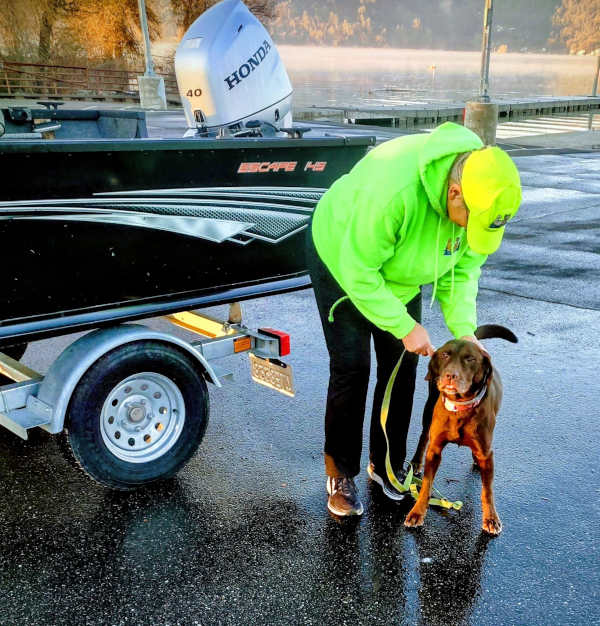
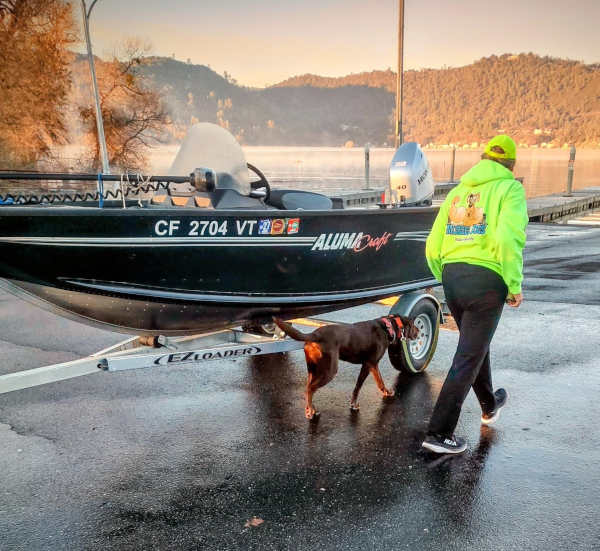
Alison Herrold from Nice, California, and Edna “E-DNA” from Mussel Dogs. Photo by Craig Nelson.
LAKE COUNTY — As the American Bass Association kicked off its season opener on Saturday morning, 23 boats braved a chilly 36-degree start.
But the most important participant didn't have a fishing rod; she had a highly trained nose.
Meet Edna (nicknamed "E-DNA"), a 6-year-old chocolate lab and scent detection dog.
Alongside her handler, Alison Herrold, Edna is the front line of defense against invasive species that threaten the health of Lake County’s waterways.
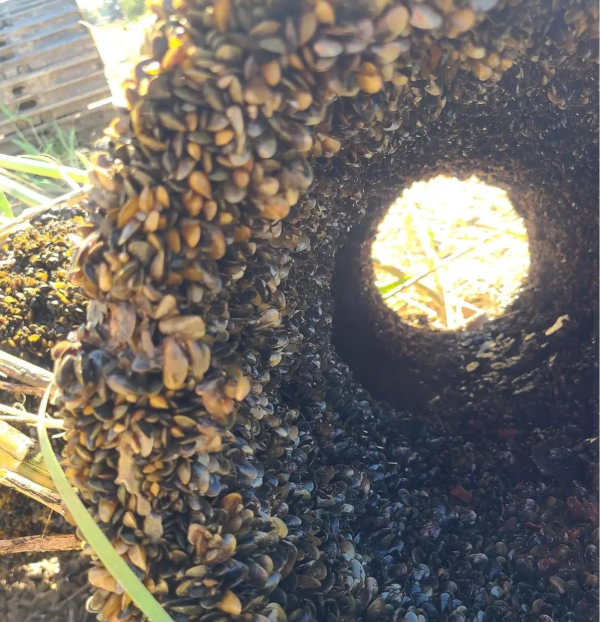
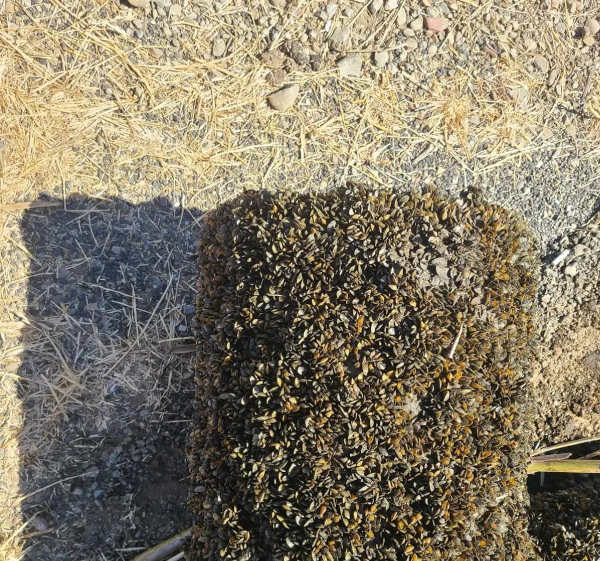
Examples of quagga mussel infestations as shown in park signage. Photo by Craig Nelson.
Edna is part of a specialized team from Mussel Dogs and Lake County Water Resources, operated by Dogs with Jobs LLC.
Their mission is to prevent the spread of quagga, zebra and golden mussels — invasive filter feeders that strain essential food particles like phytoplankton, zooplankton and algae from the water, disrupting the entire local ecosystem.
The stakes for Lake County are incredibly high.
Examples of quagga mussel infestations as shown in park signage. Photo by Craig Nelson.
Eighty percent of Lake County residents rely on the lake for their water. An infestation would "wreak havoc" on the county’s water pipes and infrastructure, according to water experts.
By partnering with federal, state and municipal agencies, Mussel Dogs uses the most effective methods to keep these species out of the water and keep the lake open for recreation.
While traditional inspections can be time-consuming, Edna makes the process seamless for visitors and local anglers.
“It’s amazing; it takes 30 seconds to a minute for Edna to inspect a boat,” said Herrold.
The program is designed to be boater-friendly. Inspections are completely free to the boater. If mussels are found, the county provides decontamination services at no charge.
Alison Herrold from Nice, California, and Edna “E-DNA” from Mussel Dogs. Photo by Craig Nelson.
While private launch ramps remain a challenge, the team works diligently at public ramps to ensure the lake remains both safe and enjoyable.
When she isn't working the major bass tournaments hosted at Clear Lake, Edna stays at the Mussel Dogs facility in Ukiah.
Herrold, who also teaches K-9 nose work — “the sport of scent detection” — ensures Edna remains at the top of her game.
Thanks to this partnership between local government, Lake County Water Resources and specialized scent-detection teams, Lake County’s waters remain protected — one 30-second sniff at a time.
Craig Nelson is a former professional golfer who fell in love with tournament bass fishing 20 years ago. He found Lake County after fishing an FLW Stren Series event and never left. He’s the back-to-back winner of the Konocti Classic and runner up in the inaugural WON Bass Clear Lake Open.
Alison Herrold from Nice, California, and Edna “E-DNA” from Mussel Dogs. Photo by Craig Nelson.
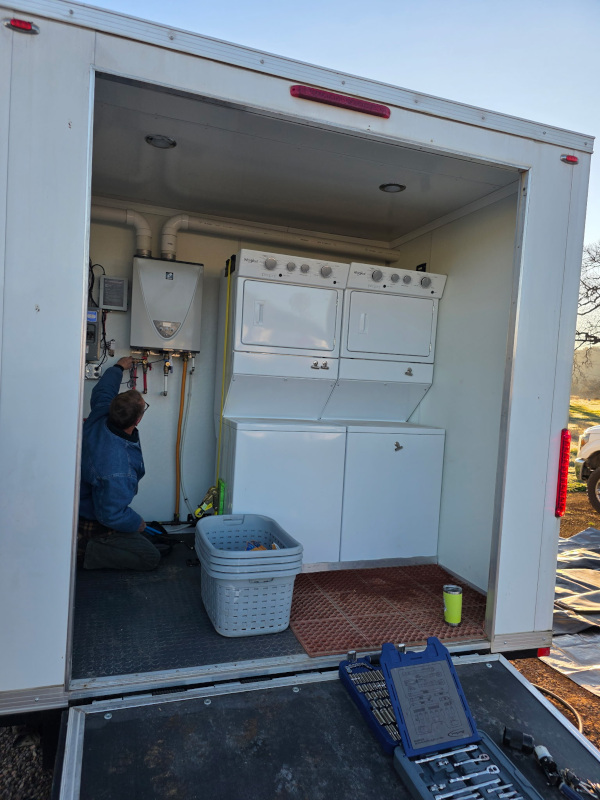
The laundry and shower trailer being used in the Robin Lane Sewer Spill incident area. Photo courtesy of the county of Lake.
LAKE COUNTY, Calif. — The county of Lake on Sunday evening issued its latest update in the ongoing response to a massive sewage spill that began a week ago.
The 2026 Robin Lane Sewer Spill incident, which began on the morning of Sunday, Jan. 11, resulted when a 16-inch force main ruptured and continued until Monday night. That equipment is operated by Lake County Special Districts.
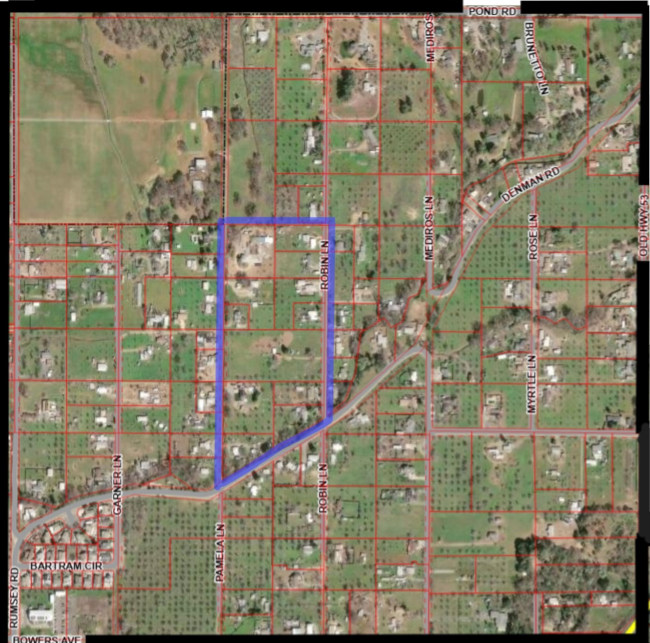
County officials reported that 2.9 million gallons of sewage were spilled during the 37.5-hour incident, which has impacted wells and property over an area that is east of Smith Lane, west of Old Highway 53, south of Pond Road and north of Bowers Avenue.
The area impacted by the spill originally was estimated at 40 acres, but late last week was expanded to about 357 acres, as Lake County News has reported.
A town hall meeting to update the community on the incident is planned for 6 p.m. Wednesday, Jan. 21. The location has so far not been announced.
Public Health Officer Dr. Robert Bernstein continues to advise residents in the impacted area who rely on private drinking wells to temporarily relocate until their wells are deemed safe.
For residents who choose to remain in their homes, Bernstein urges them to contact Special Districts for a safe water supply; to thoroughly clean and disinfect any surfaces, materials, or household items that may have come into contact with private well water at 7 a.m. Sunday, Jan. 11; and seek medical attention if they develop symptoms including diarrhea, vomiting, stomach cramps, fever or flu-like symptoms, skin rashes or infections, and eye, ear or wound infections.
On Sunday, the county said its Environmental Health Department’s assessments show that groundwater levels in the affected area “are higher than originally expected, with water in some locations just a few feet below the ground surface.”
Late last week, residents in the area who had received test results shared them with Lake County News. The test results showed extremely high levels of both coliform and E.coli.
The county reported that, “While higher groundwater levels can help dilute contaminants, they also mean that surface materials can reach groundwater more quickly.”
As of Sunday, 51 private wells have either been sanitized or are scheduled for sanitization, and outreach to additional well owners is ongoing, the county reported.
Officials said water quality testing will resume on Tuesday to ensure accurate results.
“Any chlorine used during the sanitization process will be fully removed through standard well purging before testing occurs. Conditions in newly identified areas are still being evaluated, and updates will be shared as more information becomes available,” the county said in its Sunday report.
Meanwhile, Lake County Special Districts reported that it is focusing its ongoing response on delivering water for households and animal use, although the district said the expansion of the impacted area limits its ability to deliver water directly to individual households.
The agency is making showers, laundry services and potable water available at the entrance of the wastewater treatment plant located at 2485 Pond Road.
The county reported that cleanup and dewatering efforts are continuing throughout the area impacted by the spill.
“In locations where standing water remains, additional treatment methods are limited, and crews are addressing those areas as conditions allow. The area has undergone multiple rounds of decontamination, and response teams will continue monitoring and mitigation efforts to protect public health and safety,” the county’s update said.
The spill area map, with the outlined area representing the original impact area. Courtesy photo.
Available resources
County officials direct spill area residents to the following resources.
ADA showers: Available 8 a.m. to 5 p.m. Tuesday and Friday at the Clearlake Senior Center, 3245 Bowers Ave.
Drinking water: Highlands Water Co. offers a free public water filling station from 8 a.m. to 4 p.m. Monday through Friday at 14580 Lakeshore Drive. Please bring your own jugs or bottles.
Drinking water guidance and information on testing of private wells: Contact Environmental Health at 707-263-1164.
Relocation: Affected residents are directed to first contact their homeowner’s insurance provider to inquire about coverage for temporary lodging under their policy. Residents may also contact Lake County Special Districts at 707-263-0119 for additional assistance and guidance.
Showers, laundry services and potable water: A mobile laundry and hygiene service trailer is available to the public at the entrance to the wastewater treatment plant located at 2485 Pond Road. It includes two laundry sets, with the ability to bring in a larger trailer if additional capacity is needed. Residents can drop off their laundry with on-site staff, who will tag each load with a number, then wash, dry, and fold items before returning them in a clean bag. The unit also includes a double-shower setup (family) and three sinks large enough to wash dishes. A separate family shower area is available and includes one sink, two showers, and a bench, providing space for families and individuals to clean up comfortably and safely. For potable water, members of the public are asked to bring their own water containers. Special Districts staff are on site to assist the public, and a 24-hour call-answering service is available to respond to inquiries related to Special Districts services.
Support to mitigate water and sewer-related needs: Call Special Districts at 707-263-0119.
Email Elizabeth Larson at This email address is being protected from spambots. You need JavaScript enabled to view it.. Follow her on Twitter, @ERLarson, and on Bluesky, @erlarson.bsky.social. Find Lake County News on the following platforms: Facebook, @LakeCoNews; X, @LakeCoNews; Threads, @lakeconews, and on Bluesky, @lakeconews.bsky.social.
KELSEYVILLE, Calif. — Authorities took a Kelseyville man into custody on Friday morning after they said he assaulted a woman.
The Lake County Sheriff’s Office reported on the incident in the 5900 block of Single Spring Drive in Kelseyville.
On Friday at 8 a.m., Sheriff’s Office Dispatch received a call from Travis Bonson, 45, who was self-reporting he physically assaulted an adult female.
Deputies responded to the residence and located an adult female victim. She was transported to an out of county hospital for medical treatment.
Authorities said she was in critical condition after the assault. Her identity has so far not been released.
Sheriff’s Major Crimes Unit detectives responded to the scene and arrested Bonson on felony charges related to attempted murder and assault with a deadly weapon.
On Monday, Bonson remained in custody at the Lake County Jail. He’s being held for felony attempted murder and mayhem, and misdemeanor assault with a deadly weapon that’s not a firearm. Bail is set at $$725,000.
This is an active investigation. Anyone who believes they may have information related to this incident is asked to contact the Lake County Sheriff’s Office Major Crimes Unit at 707-262-4088 or Sgt. Jeff Mora at 707-262-4224.
As an emergency room pediatrician in central Massachusetts, I’m seeing a tremendous amount of flu over the past few weeks. I’m hearing from colleagues in emergency rooms across the country that they are experiencing a similar explosion of flu cases.
The spike in flu cases – widely referred to in media reports as a “superflu” – is largely driven by a newly identified subtype of the virus called subclade K.
What’s different about the current flu season?
Flu seasons vary every year. In 2024-2025, influenza cases rose fast beginning in October 2024. In contrast, the 2025-2026 season started out slow, but then it’s as if a switch was flipped in early to mid-December.
Public health experts expect flu rates to remain high for several more weeks.
Traditionally, the flu is most dangerous for people over 65 or those with underlying health conditions, with young children experiencing more mild symptoms. But this year’s strain is hitting kids harder. They are arriving in the emergency room after having had a high fever of more than 104 degrees for 5-7 days, or with flu complications including febrile seizures, croup or severe dehydration.
Subclade K has proved itself to be a particularly infectious variant, based on how quickly the volume of flu cases has surged. Its dominance may be driven by mutations that make it different from previous strains. Some scientists speculate that H3 influenza viruses have circulated at relatively low levels the past few years, which may have led to lower levels of immunity in the general population.
In my emergency department, we’re also seeing particularly high spiking fevers of 104 or 105 degrees, compared with more usual lower grade fevers. That in itself is not dangerous, but for young children it does result in more instances of febrile seizures and dehydration.
For people still considering getting the flu shot for this season, I strongly recommend doing so sooner rather than later. Waiting longer would limit the window in which the vaccine is most effective. That’s because it takes a couple of weeks for the flu shot to impart its maximal benefits. Vaccination in mid-January would mean peak protection in late January and early February.
In my opinion, in most cases home testing for flu is not especially useful.
Many people seek out flu tests to determine whether they should get antiviral therapies like Tamiflu. But while those therapies might decrease your symptoms slightly, they aren’t particularly effective, and they come with their own risks, such as upset stomach, vomiting and diarrhea. Most of my colleagues in the emergency department, myself included, rarely recommend them.
Whether you have the flu or a flu-like illness such as RSV, COVID-19 or rhinovirus, the recommendations for treating and managing the illness at home as well as the point at which I’d suggest someone seek care are no different.
Because of that, being able to put a label on the disease isn’t all that important. With the high levels of flu circulating now, if you’re feeling unwell and have signs of fever and upper respiratory symptoms, you can almost assume it’s the flu.
One exception is for people with underlying health conditions such as heart disease or severe asthma. For them, as for people who are hospitalized for flu, antiviral therapy may be recommended and thus testing for the flu can be helpful.
Basic precautions can protect you and your community
The same precautions apply for all flu-like illnesses, but it’s worth being particularly mindful of just how contagious subclade K seems to be.
It’s important to protect yourself and your community. Washing your hands frequently can minimize exposure to flu-containing droplets. Even more importantly, people who feel unwell – particularly if they have a fever – should stay home from work, school or activities, if possible, until they are fever-free for 24 hours.
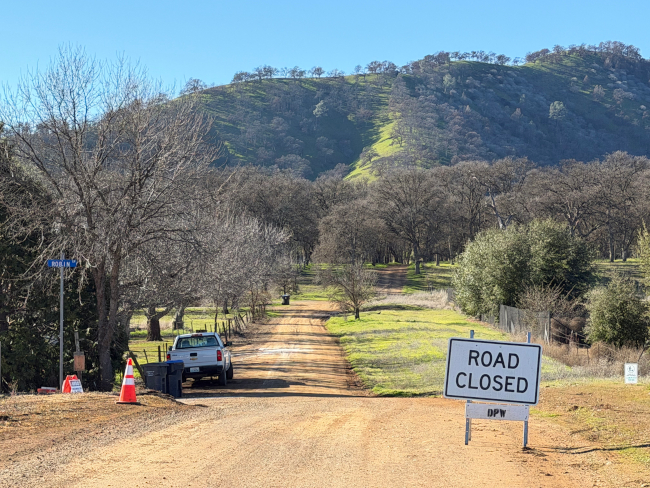
Roads in the spill area were temporarily closed even after the spill was contained as county personnel worked on mitigation. The spill continued for 37.5 hours. Photo by Lingzi Chen/Lake County News.
CLEARLAKE, Calif. – A week after several million gallons of wastewater were spilled onto dozens of properties in Clearlake, residents there are facing uncertainty about the safety of their well water and struggling to find solutions in the midst of disrupted lives.
An estimated 2.9 million gallons of sewage were released during the Robin Lane sewer spill in Clearlake, county staff said in an email response to Lake County News’ request on Saturday.
The disclosure came a week after the rupture of a county-operated 16-inch force main on Sunday, Jan. 11 that resulted in a massive sewage spill. The spill lasted from last Sunday morning through Monday night.
The initial report filed with the state emergency services on Jan. 11 by Lake County Special Districts – the agency that operates the wastewater system – listed the volume of sewage released as 2,000 gallons.
The newly disclosed estimate is roughly 1,450 times higher.
The report to the state was updated on Thursday with the 2.9 million gallon figure, but was not released to the public until Lake County News again requested the total spill size on Saturday. Lake County News had previously requested that figure on Jan. 12.
“Staff was able to contain and recover much of the spill,” the county’s email response provided through Chief Deputy County Administrative Officer Matthew Rothstein said. It did not specify how much sewage was recovered.
“Draft reports have been filed with the State Water Board, and the final reporting will show how much of the sewage was contained and recovered, when final numbers are received from the engaged pumper trucks,” the email added.
“Remarkably,” the email said, “only approximately 3,900 gallons were released into the drainage ditch that ran to Burns Creek and into Clear Lake.”
The volume of the sewage spill, however, is not merely a seven-digit figure on paper; it has been felt by impacted residents and workers on the ground.
For workers responding to the incident, it meant pumping sewage away around the clock. “They had to just continuously pump 24/7,” said Lori Baca, customer service supervisor for Lake County Special Districts, during a Wednesday night town hall at Clearlake City Hall.
She explained that crews ran into parts shortages and multiple valve installation failures before the spill was finally stopped at 9:55 p.m. Monday.
“They worked their butts off to try to shut it off,” said Supervisor Bruno Sabatier at the town hall. “Unfortunately, it's very frustrating when everything seems to fail. It was just horrible the way it went down.”
For impacted residents, it means life “upended,” in Sabatier’s words.
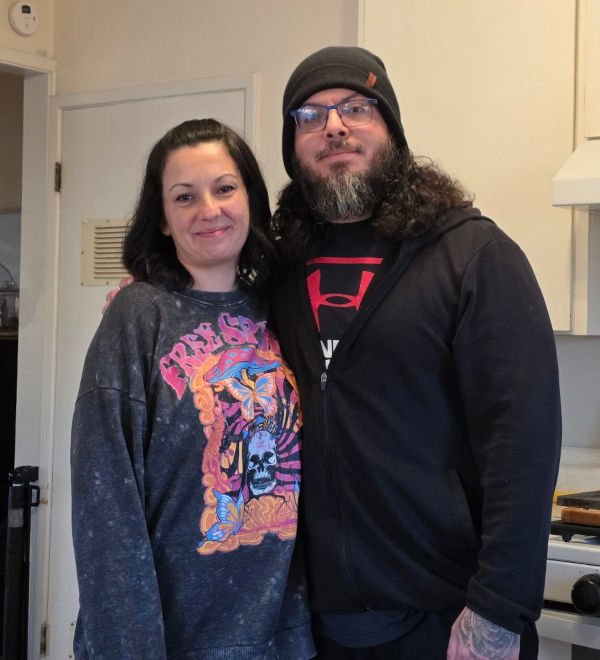
Stephanie and Juan Piseno run an in-home child care business on Robin Lane in Clearlake, California, which has been temporarily closed because of a massive sewage spill. The situation has left the family without its main source of income. Photo by Lingzi Chen/Lake County News.
Child care home forced to close over drinking water safety
Stephanie and Juan Piseno run an in-home child care business on Robin Lane and have been caring for 11 children until Jan. 11, when the sewer system ruptured near their home, sending a massive sewage spill across the road and into what Juan described as “a river of poop and pee.”
“So we have to close it, and we don’t know when we can reopen,” Stephanie said Wednesday afternoon, standing in her kitchen, four days after the spill started.
“That’s the family’s only income,” she said, trying to steady her voice but choking. “Our income is gone. We have to pay a mortgage for a house that we can't live in.”
The habitat has to be safe and have clean running water to be licensed as a child care home, Juan said.
“We care about the safety of all the kids,” Stephanie added. And in a soft tone with a reluctant smile, “We don’t even want our kids here,” she said.
The couple have four children of their own, with the youngest just 2 years old, who, as the conversation went on, was crawling on the floor with a bright, innocent smile. Her mom scooped her up from the floor.
The broken force main, located near the northern end of Robin Lane just over 500 yards up from the Pisenos’ home, extends along the road.
The sewage flow that flooded the area was initially marked by the county as enclosed by Pond Road, Rumsey Road, Pamela Lane and Robin Lane.
On Friday, the county revised the impact area map and expanded it by eight times – from an estimated 40 acres to 357 acres, based on a Lake County News assessment of the impacted area – to include east of Smith Lane, west of Old Highway 53, south of Pond Road and north of Bowers Avenue.
This revision of the impact zone was due to water testing results obtained by Lake County Environmental Health, and is subject to change, according to the county's announcement.
The Pisenos’ home is among the first announced 58 properties that have been impacted, many of which rely on a private well for everyday use of water, including drinking.
Public notification of the incident and warnings against the use of well water, however, did not come timely.
“I went outside around 12:30 in the afternoon because I noticed the water flowing,” Stephanie said of Sunday in a text message. “I got a [Nixle] alert at 4 p.m. not to drink the water.”
So had the family of six been drinking water from the well until 4 p.m.?
“Pretty much yes,” Stephanie replied. “We thought it was a small situation at first [and] didn't think our personal well would be impacted.”
The first Nixle Stephanie received about the matter came at 11:20 a.m. and asked her to avoid the area “due to a sewage leak.”
The first Nixle alert advising against consuming well water arrived at 3:58 p.m.
In fact, Lake County Special Districts was notified of sewage running down the street at 7:30 a.m. on Jan. 11, according to Baca’s statements at the town hall.
The agency filed its initial report with California Governor's Office of Emergency Services, or Cal OES, at 9:39 a.m. Jan. 11, reporting just 2,000 gallons of sewage had been released and that no waterways – a reference to the nearby creek or lake – had been impacted.
That initial report also stated that the spill was “stopped and contained” just two hours after it began. However, in total, the spill lasted 37.5 hours, Clearlake City Manager Alan Flora told the City Council during its Thursday night meeting.
The county’s first press release reached Lake County News’ inbox and Facebook page around 3:30 p.m. Jan. 11, followed by the Nixle alert to residents about water use around 4 p.m. – both more than eight hours after the incident began and over six hours after the Special Districts’ first official filing with Cal OES.
Still, not all residents in the area have access to Nixle or social media like Facebook where government agencies communicate sewage leak, potential water contamination and public health advice.
Shean Heape, who lives on Old Highway 53 with his wife, said they immediately stopped using well water after seeing the alerts in the afternoon.
“Everything got shut off first for me,” said Heape, who then started making phone calls to alert neighbors.
Only on Monday, Heape found out that there were neighbors around without any access to Nixle alerts or the internet.
“Some neighbors are on flip phones,” he said. “Not everybody has everything.”
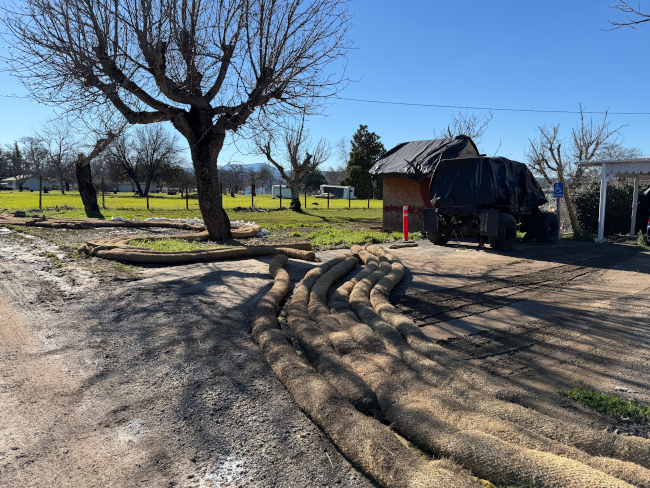
Straw wattles were placed in the spill area in an effort to keep the wastewater from residences. Photo by Lingzi Chen/Lake County News.
Seeking test results and explanations
Although Robin Lane is within the city limit of Clearlake, it remains a private road. Residents on the street and City Manager Flora said the city does not pave it.
It is an unpaved, dirt road – with numerous potholes especially toward the south end near Rumsey – which turned muddy and carried an “atrocious” smell as the sewage flowed through, as described by Christina Huron, who lives next door to the Pisenos.
Standing in her driveway, Huron pointed to an area carved out by straw wattles leading into her property. Sewage was directed there and pooled in her front yard, she said, when two trucks were positioned in front of her house, sucking sewage as it flowed “all across our property” and onto a neighbor’s property farther down the road before returning to Pamela Lane.
“We have gotten nothing but two and a half gallons of water,” she said of the only help she received on Sunday and Monday, when the spill was still active.
A few hours after the Thursday morning interview outside her property – where straw wattles lining the road separated her from the Lake County News reporter – Huron said in an email she had just received the well testing results, which suggested her well may be among the most contaminated in the area.
“Coliform 2419.6” and “E.coli 2419.6,” she sent the numbers over.
“I was told these are off the charts numbers and they can’t calculate any higher than these numbers,” Huron said of what she had learned from the call with staff from Environmental Health.
The U.S. The Centers for Disease Control and Prevention says coliform is a water quality indicator, and that “a positive test for fecal coliforms or E. coli likely means that poop (feces), and the harmful germs in poop, have gotten into your well water.”
Lake County News reached out to the county, requesting explanations on what these readings mean and what kind of risks and level of seriousness these numbers signify, along with questions on overall well testing results and progress, on Thursday and Friday.
No information on these questions has been provided so far either through public updates or direct correspondence with Lake County News.
It appears later that for some, it’s even difficult to acquire their own results.
Stephanie Piseno said she called Environment Hall three times on Friday asking for well testing readings for her home.
“They just told me ‘positive’ but no numbers,” she said in a text message.
So far, the overall extent of contamination remains unknown to the public.
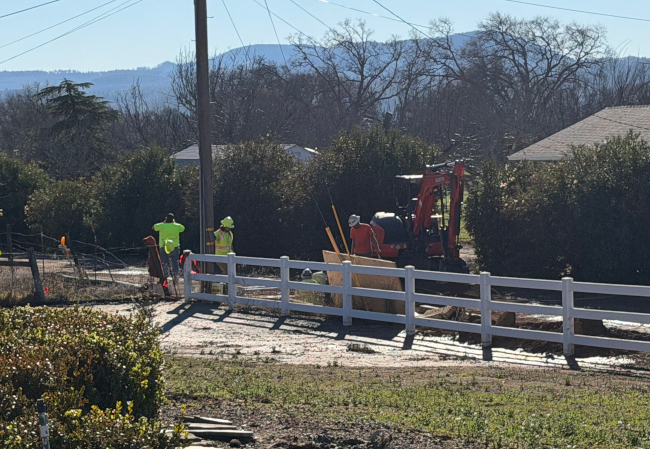
A crew works on repairs in the spill area on Wednesday, Jan. 14, 2026, in Clearlake, California. Photo by Lingzi Chen/Lake County News.
The relocation conundrum
Even before the public health officer advised residents relying on private wells to relocate, Cassandra Hulbert, who also lives on Robin Lane, knew she had to find a safe place for her family to stay.
Hulbert has two disabled children and an autoimmune disorder herself. She said her priority was keeping her children and herself safe and alive.
“We’ve been placed in a hotel – and only one other family has – and that’s because we pushed and pushed and pushed,” Hulbert said Wednesday afternoon during an interview on Robin Lane.
She explained that she returns every day to feed her four chickens, three rabbits, four cats and two giant mastiffs that she cannot bring with her to the hotel.
At that moment, she said the family was told to move out of the hotel room on Thursday, and that she was ready to fight.
“If I need to physically be there and state my case and fight – fight the good fight – that's what I'm prepared to do,” she said.
Over the past week, Hulbert has been among a group of outspoken neighbors in the impacted area who organized resources, called public agencies for information and advocated for affected residents while caring for their own families.
“We have elderly, we have disabled, we have pets and horses that are two feet deep in poop water,” she said of the vulnerable residents and animals impacted that need help and support, which in her opinion, don’t come easily.
“I’m really exhausted,” she said on Friday.
After the Wednesday town hall, Hulbert said she had the hotel room for the family extended until next Tuesday.
“Not ideal but more days than yesterday,” she said in a text message.
Hulbert isn’t waiting until Tuesday, but has been actively talking to officials every day including Supervisor Sabatier.
“I just wanted to make sure we were gonna get word before Tuesday morning if it was extended or not,” she said on Saturday in a text message.
With an expanded impact area, Clearlake City Manager Flora said the number of properties impacted would be bigger than the previously stated 58.
Since Public Health Officer Dr. Robert Bernstein advised relocation on Wednesday, how many households have relocated remains unknown. Also unknown is the anticipated duration of stay for those who have got a hotel room.
The Piseno family of six also managed to secure a hotel room coming out of the Wednesday town hall, also with a Tuesday expiration date for that assistance.
Stephanie Piseno said on Friday that she has no idea what’s going to happen next for the relocation, or when they can return home safely.
Huron on Thursday said she missed the life before this “catastrophe.”
“Everything was green because we just had rain. Everything was beautiful,” she said, looking around the yard. “And it's just sewage.”
Saturday afternoon, Huron said some people are getting water tanks and portable toilets. “My husband is on the phone now talking with special districts because we were supposed to receive those too,” she said in a text message.
“Straw wattles have been removed and our driveway and walkway were sprayed with a disinfectant,” she added in her update.
At least the stray cats scouting nearby no longer have to leap over the wattles while wandering around potentially contaminated soil as seen on Wednesday.
Email staff reporter Lingzi Chen at This email address is being protected from spambots. You need JavaScript enabled to view it..
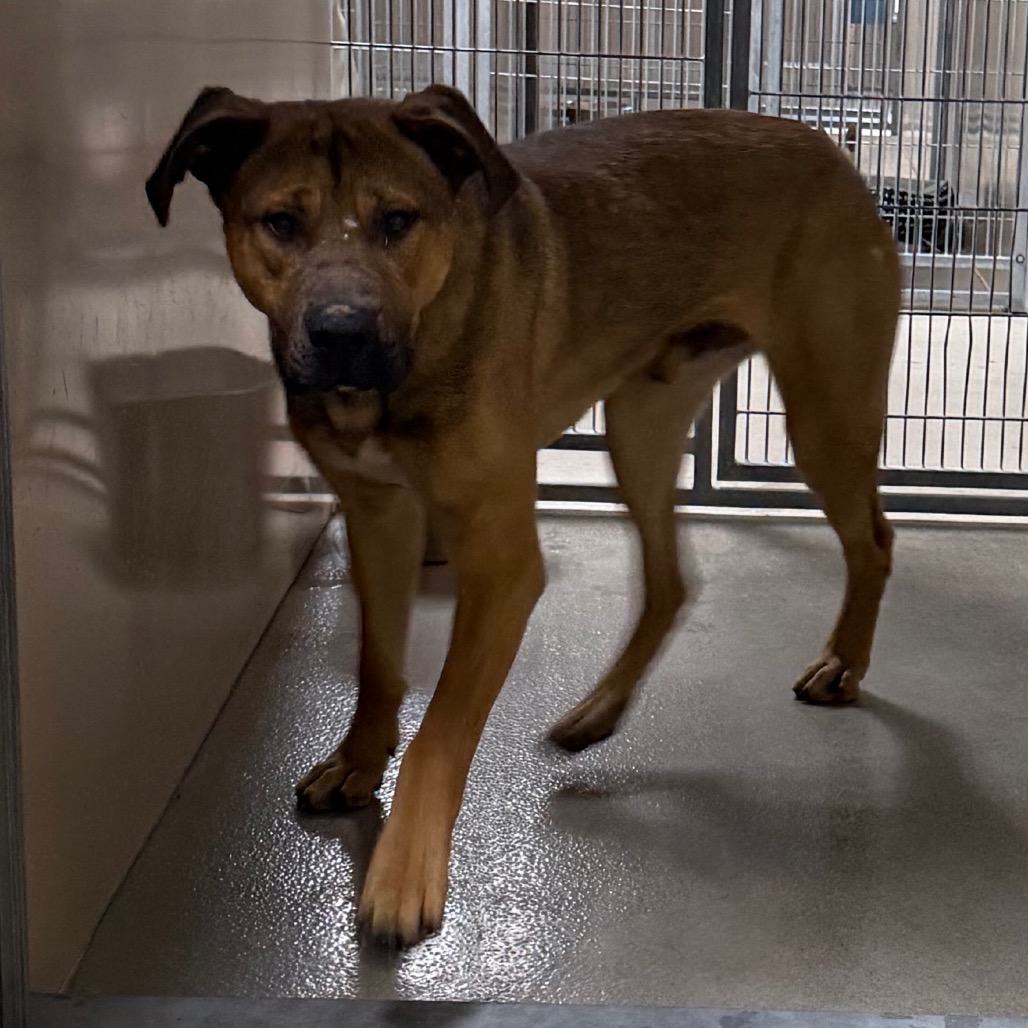
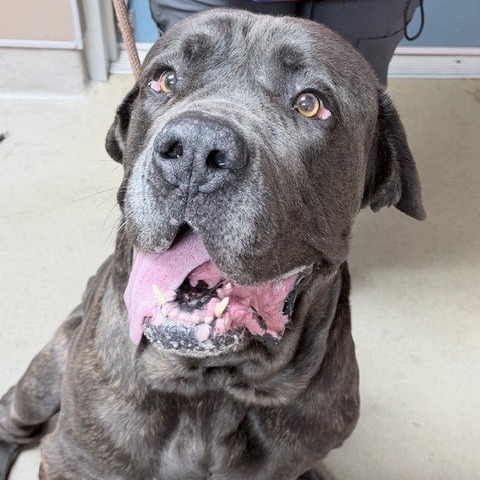
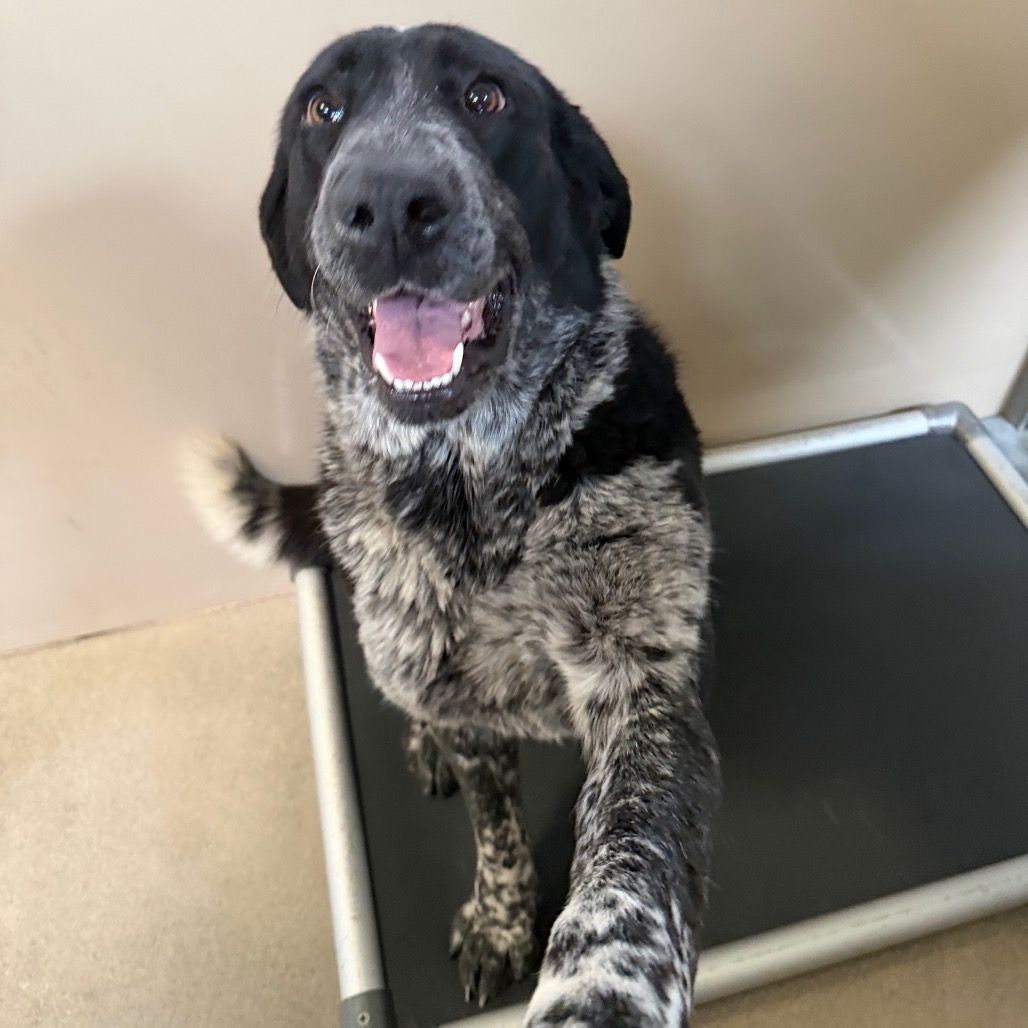
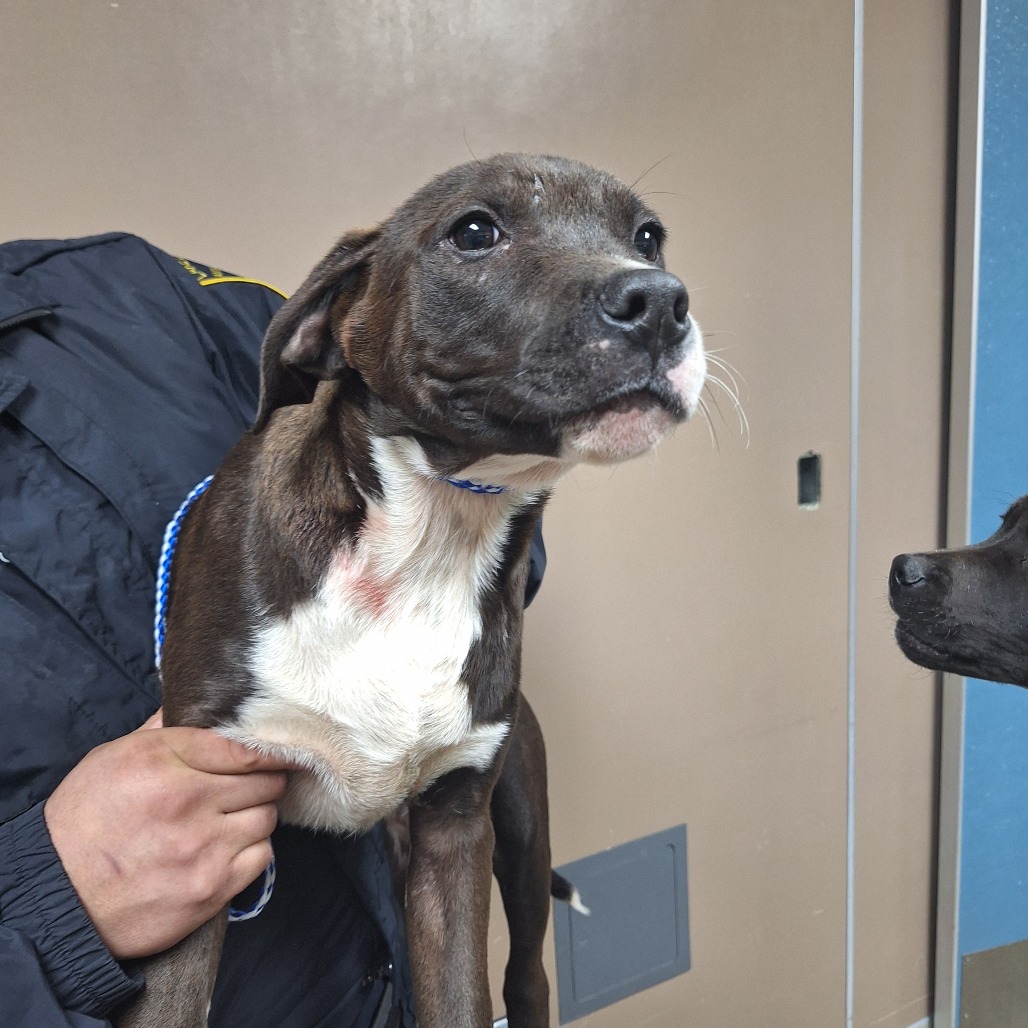
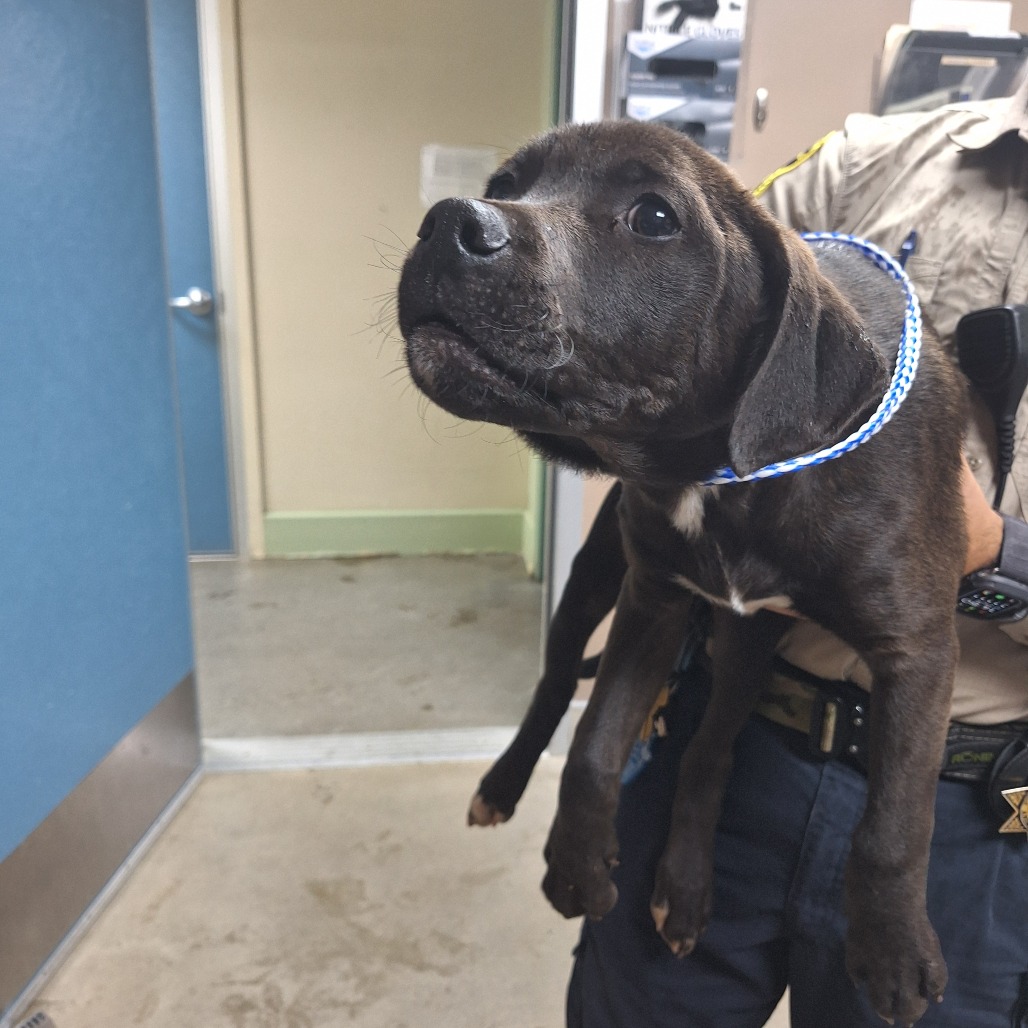
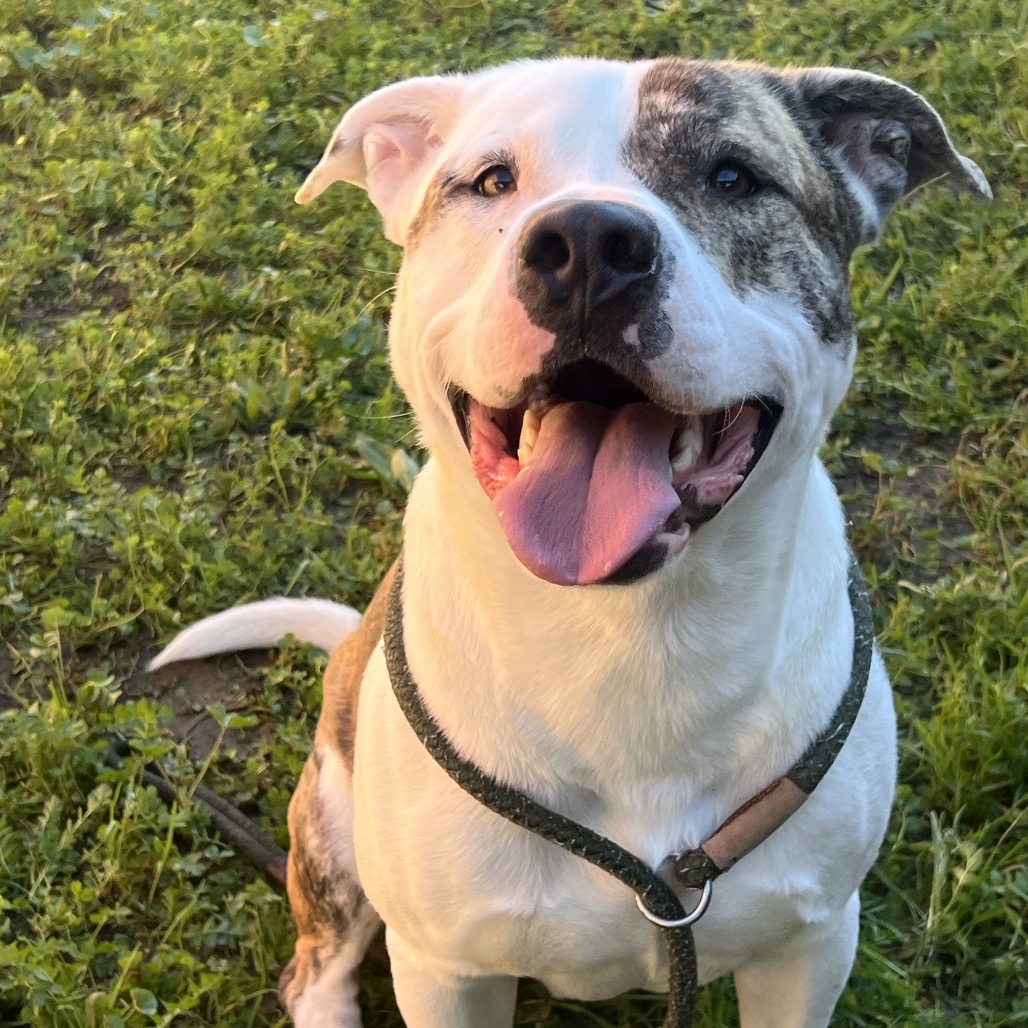
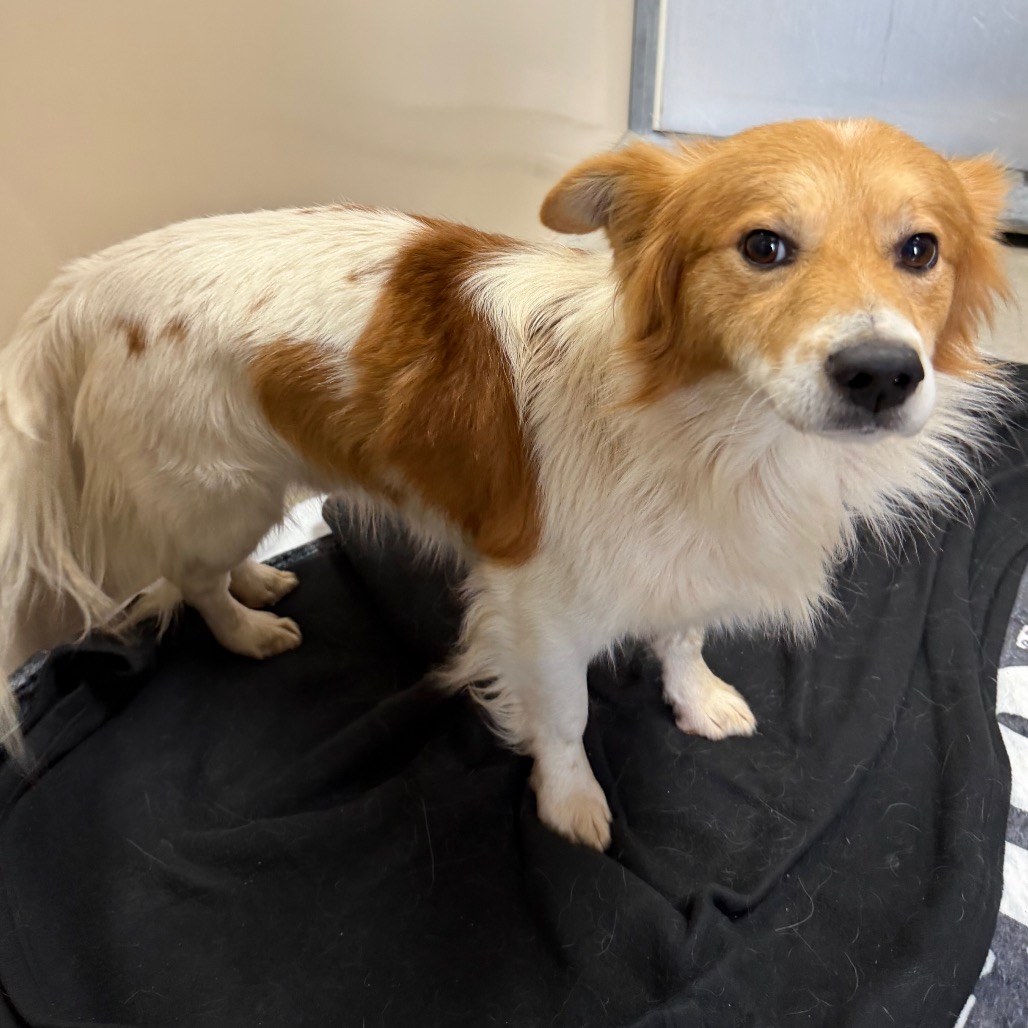
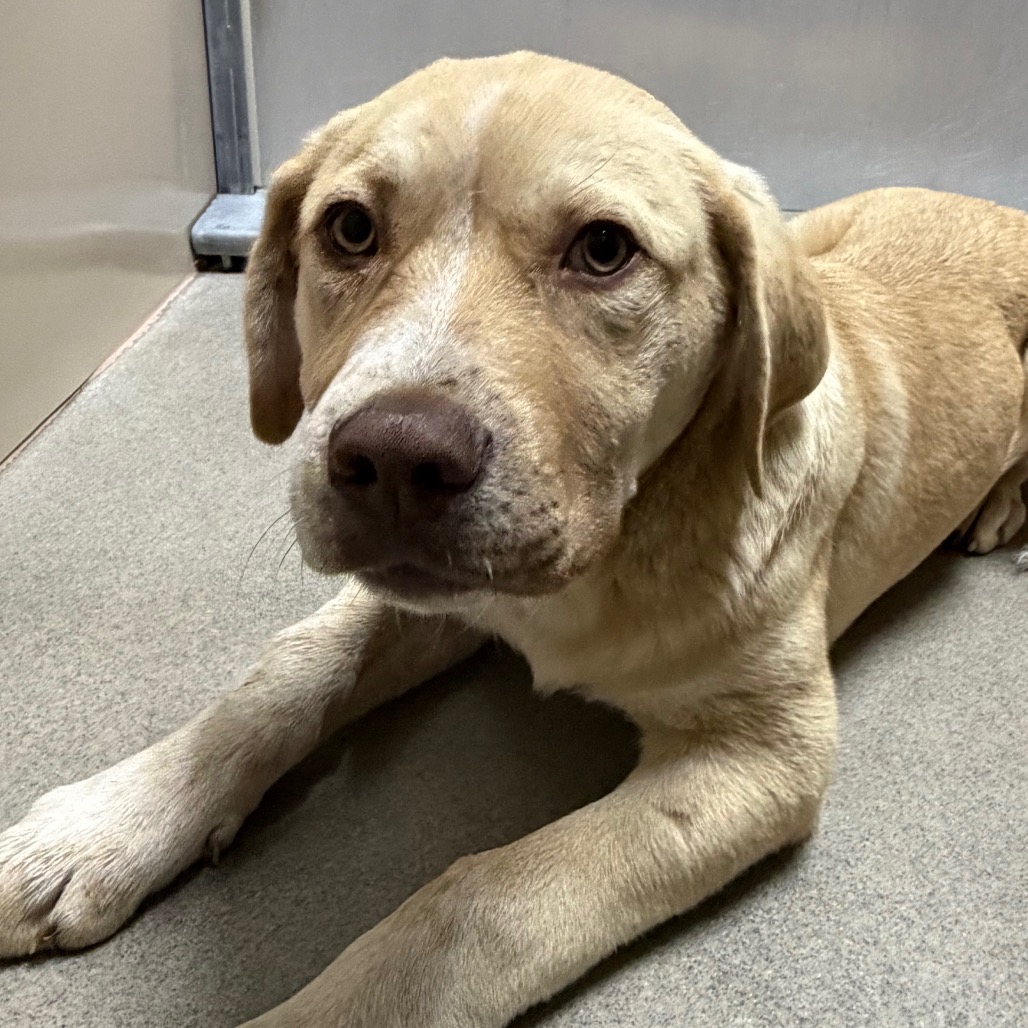
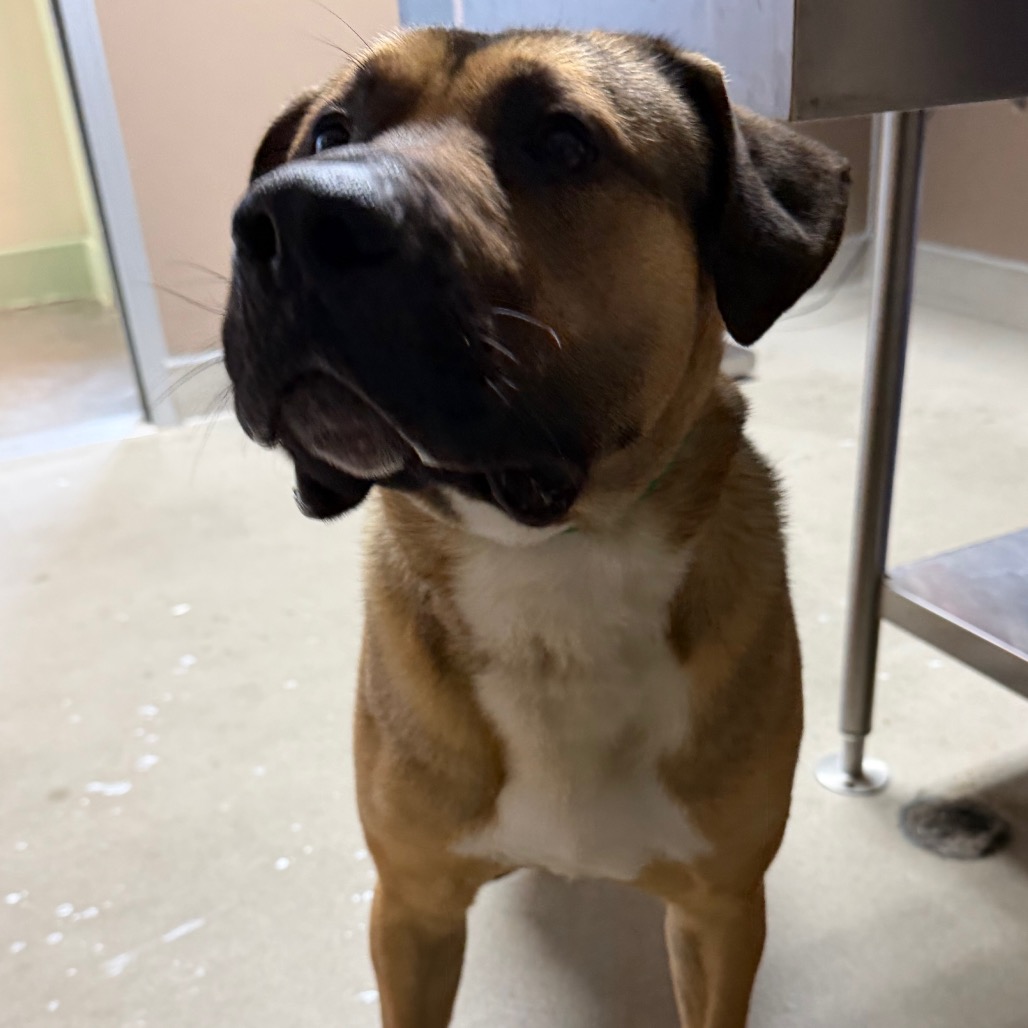
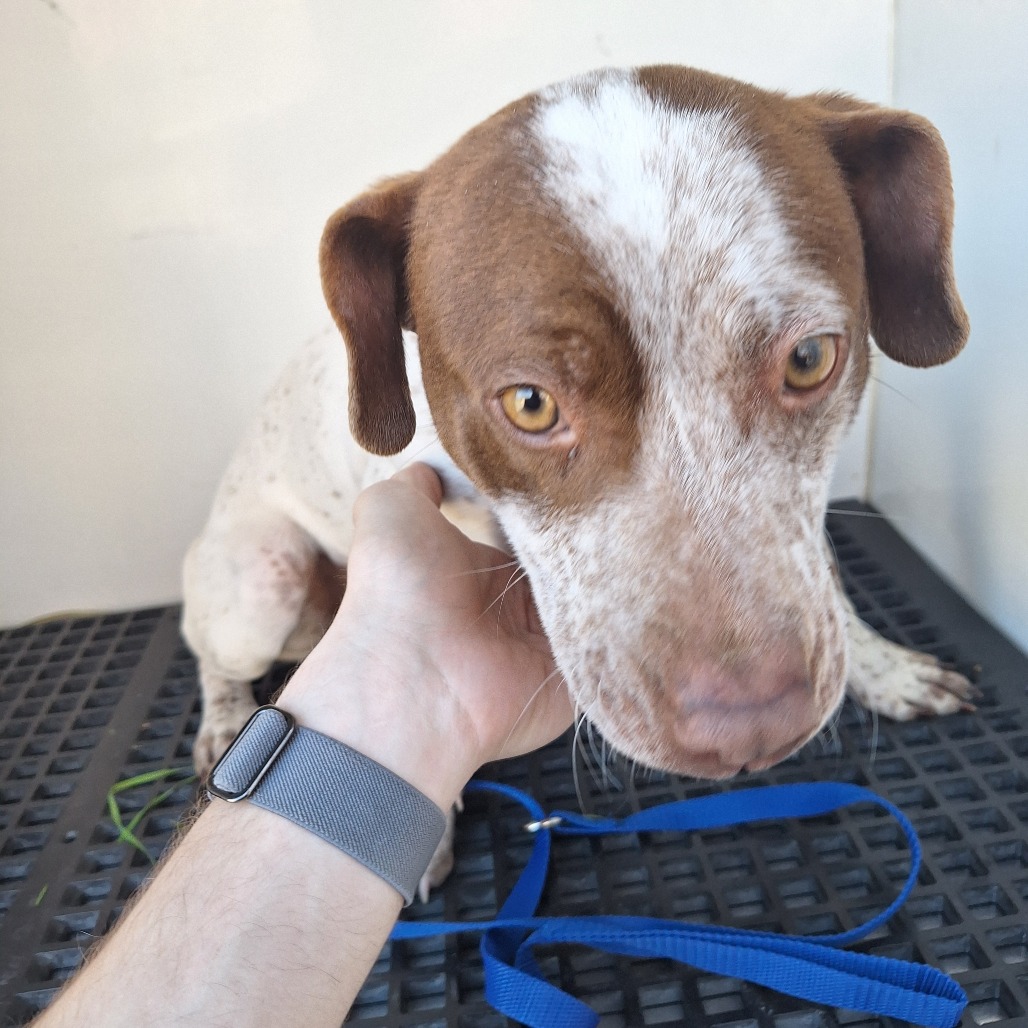
LAKE COUNTY, Calif. – Lake County Animal Care and Control has new puppies and dogs waiting to meet their new families.
The dogs available for adoption this week include mixes of Belgian Malinois, Chihuahua, corgi, Doberman Pinscher, German shepherd, husky, Labrador retriever, mastiff, pit bull terrier, Rottweiler and shepherd.
Dogs that are adopted from Lake County Animal Care and Control are either neutered or spayed, microchipped and, if old enough, given a rabies shot and county license before being released to their new owner. License fees do not apply to residents of the cities of Lakeport or Clearlake.
Those animals shown on this page at the Lake County Animal Care and Control shelter have been cleared for adoption.
Call Lake County Animal Care and Control at 707-263-0278 or visit the shelter online for information on visiting or adopting.
The shelter is located at 4949 Helbush in Lakeport.
Email Elizabeth Larson at This email address is being protected from spambots. You need JavaScript enabled to view it.. Follow her on Twitter, @ERLarson, and on Bluesky, @erlarson.bsky.social. Find Lake County News on the following platforms: Facebook, @LakeCoNews; X, @LakeCoNews; Threads, @lakeconews, and on Bluesky, @lakeconews.bsky.social.
President Donald Trump appears to have upended an 85-year relationship between American farmers and the United States’ global exercise of power. But that link has been fraying since the end of the Cold War, and Trump’s moves are just another big step.
During World War II, the U.S. government tied agriculture to foreign policy by using taxpayer dollars to buy food from American farmers and send it to hungry allies abroad. This agricultural diplomacy continued into the Cold War through programs such as the Marshall Plan to rebuild European agriculture, Food for Peace to send surplus U.S. food to hungry allies, and the U.S. Agency for International Development, which aimed to make food aid and agricultural development permanent components of U.S. foreign policy.
When U.S. farmers faced labor shortfalls, the federal government created guest-worker programs that provided critical hands in the fields, most often from Mexico and the Caribbean.
At the end of World War II, the U.S. government recognized that farmers could not just rely on domestic agricultural subsidies, including production limits, price supports and crop insurance, for prosperity. American farmers’ well-being instead depended on the rest of the world.
Even before the nation’s founding, farmers in what would become the United States staked their livelihood on international networks of labor, plants and animals, and trade.
Cotton was the most prominent early example of these relationships, and by the 19th century wheat farmers depended on expanding transportation networks to move their goods within the countryandoverseas.
Workers load cattle on a train for shipment to market in the late 19th century.Bettmann via Getty Images
But fears that international trade could create economic uncertainty limited American farmers’ interest in overseas markets. The Great Depression in the 1930s reinforced skepticism of international markets, which many farmers and policymakers saw as the principal cause of the economic downturn.
World War II forced them to change their view. The Lend-Lease Act, passed in March 1941, aimed to keep the United States out of the war by providing supplies, weapons and equipment to Britain and its allies. Importantly for farmers, the act created a surge in demand for food.
And after Congress declared war in December 1941, the need to feed U.S. and allied troops abroad pushed demand for farm products ever higher. Food took on a significance beyond satisfying a wartime need: The Soviet Union, for example, made special requests for butter. U.S. soldiers wrote about the special bond created by seeing milk and eggs from a hometown dairy, and Europeans who received food under the Lend-Lease Act embraced large cans of condensed milk with sky-blue labels as if they were talismans.
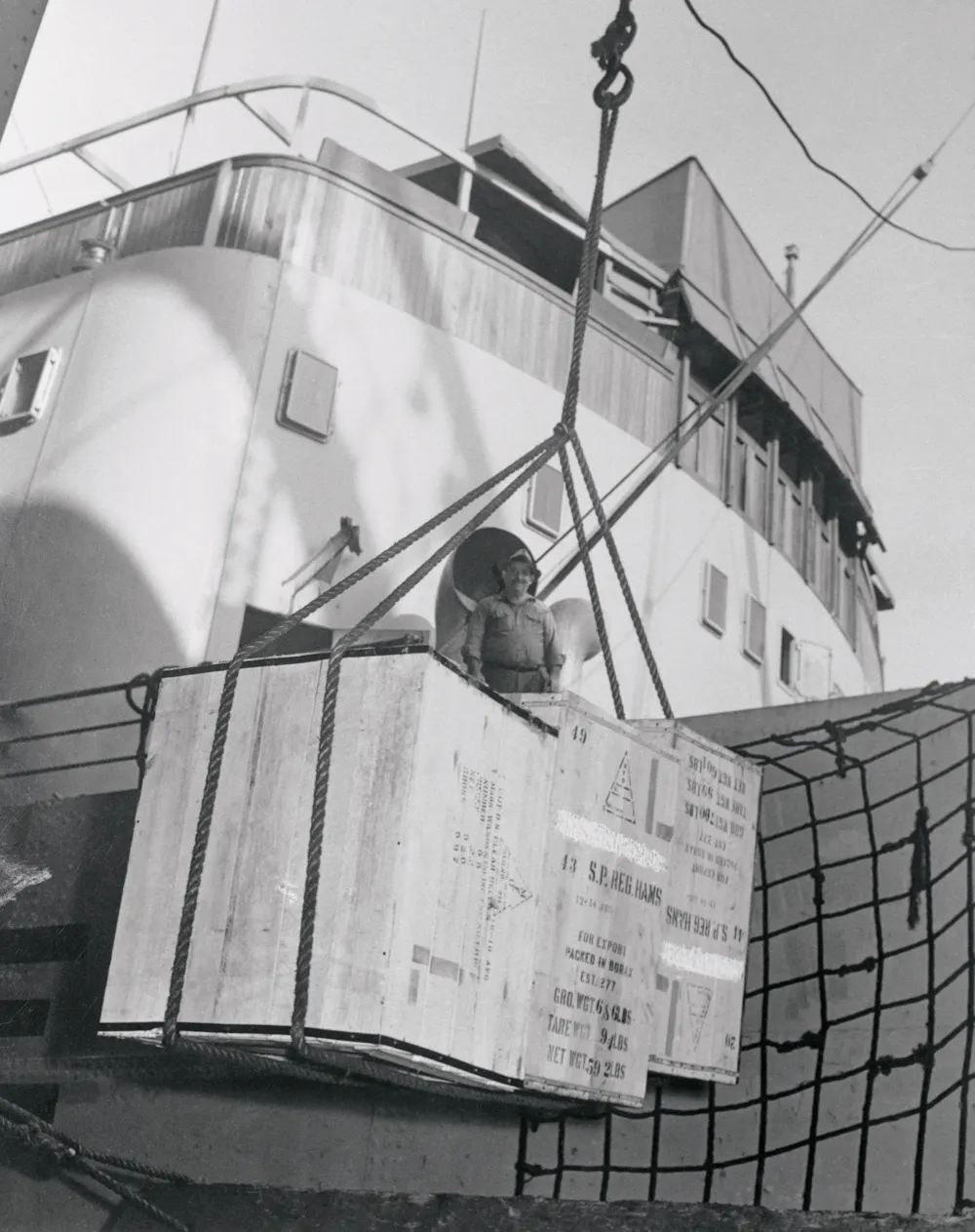
Crates of American hams, supplied through the Lend-Lease Act, are loaded on a ship bound for Britain in 1941.Bettmann via Getty Images
Another war ends
But despite their critical contribution to the war, American farmers worried that the familiar pattern of postwar recession would repeat once Germany and Japan had surrendered.
Congress fulfilled farmers’ fears of an economic collapse by sharply reducing its food purchases as soon as the war ended in the summer of 1945. In 1946, Congress responded weakly to mounting overseas food needs.
More action waited until 1948, when Congress recognized communism’s growing appeal in Europe amid an underfunded postwar reconstruction effort. The Marshall Plan’s more robust promise of food and other resources was intended to counter Soviet influence.
Sending American food overseas through postwar rehabilitation and development programs caused farm revenue to surge. It proved that foreign markets could create prosperity for American farmers, while food and agriculture’s importance to postwar reconstruction in Europe and Asia cemented their importance in U.S. foreign policy.
Farmers in the modern world
Farmers’ contribution to the Cold War shored up their cultural and political importance in a rapidly industrializing and urbanizing United States. The Midwestern farm became an aspirational symbol used by the State Department to encourage European refugees to emigrate to the U.S. after World War II.
American farmers volunteered to be amateur diplomats, sharing methods and technologies with their agricultural counterparts around the world.
By the 1950s, delegations of Soviet officials were traveling to the Midwest, including Soviet premier Nikita Khrushchev’s excursion to Iowa in 1959. U.S. farmers reciprocated with tours of the Soviet Union. Young Americans who had grown up on farms moved abroad to live with host families, working their properties and informally sharing U.S. agricultural methods. Certain that their land and techniques were superior to those of their overseas peers, U.S. farmers felt obligated to share their wisdom with the rest of the world.
U.S. farmers shifted crops from wheat to corn and soybeans to feed growing numbers of livestock around the world. They used newly available genetically engineered seeds that promised unprecedented yields.
But U.S. farmers have faced higher costs for seeds and fertilizer, as well as new international competitors such as Brazil. With a diminished competitive advantage and the loss of the Cold War’s cooperative infrastructure, U.S. farmers now face a more volatile global market that will likely require greater government support through subsidies rather than offering prosperity through commerce.
That includes the Trump administration’s December 2025 announcement of a US$12 billion farmer bailout. As Trump’s trade wars continue, they show that the U.S. government is no longer fostering a global agricultural market in which U.S. farmers enjoy a trade advantage or government protection – even if they retain some cultural and political significance in the 21st century.

 How to resolve AdBlock issue?