During a solar eclipse, astronomers who study heliophysics are able to study the Sun’s corona – its outer atmosphere – in ways they are unable to do at any other time.
The brightest part of the Sun is so bright that it blocks the faint light from the corona, so it is invisible to most of the instruments astronomers use. The exception is when the Moon blocks the Sun, casting a shadow on the Earth during an eclipse. But as an astronomer, I know eclipses are rare, they last only a few minutes, and they are visible only on narrow paths across the Earth. So, researchers have to work hard to get their equipment to the right place to capture these short, infrequent events.
In their quest to learn more about the Sun, scientists at the European Space Agency have built and launched a new probe designed specifically to create artificial eclipses.
Meet Proba-3
This probe, called Proba-3, works just like a real solar eclipse. One spacecraft, which is roughly circular when viewed from the front, orbits closer to the Sun, and its job is to block the bright parts of the Sun, acting as the Moon would in a real eclipse. It casts a shadow on a second probe that has a camera capable of photographing the resulting artificial eclipse.
The two spacecraft of Proba-3 fly in precise formation about 492 feet (150 meters) apart.ESA-P. Carril, CC BY-NC-ND
Having two separate spacecraft flying independently but in such a way that one casts a shadow on the other is a challenging task. But future missions depend on scientists figuring out how to make this precision choreography technology work, and so Proba-3 is a test.
This technology is helping to pave the way for future missions that could include satellites that dock with and deorbit dead satellites or powerful telescopes with instruments located far from their main mirrors.
The side benefit is that researchers get to practice by taking important scientific photos of the Sun’s corona, allowing them to learn more about the Sun at the same time.
An immense challenge
The two satellites launched in 2024 and entered orbits that approach Earth as close as 372 miles (600 kilometers) – that’s about 50% farther from Earth than the International Space Station – and reach more than 37,282 miles (60,000 km) at their most distant point, about one-sixth of the way to the Moon.
During this orbit, the satellites move at speeds between 5,400 miles per hour (8,690 kilometers per hour) and 79,200 mph (127,460 kph). At their slowest, they’re still moving fast enough to go from New York City to Philadelphia in one minute.
While flying at that speed, they can control themselves automatically, without a human guiding them, and fly 492 feet (150 meters) apart – a separation that is longer than the length of a typical football stadium – while still keeping their locations aligned to about one millimeter.
They needed to maintain that precise flying pattern for hours in order to take a picture of the Sun’s corona, and they did it in June 2025.
The Proba-3 mission is also studying space weather by observing high-energy particles that the Sun ejects out into space, sometimes in the direction of the Earth. Space weather causes the aurora, also known as the northern lights, on Earth.
LAKE COUNTY, Calif. — Firefighters are on the scene of a fast-moving wildland fire in Clearlake.
The North fire was first reported at about 2:10 p.m. Friday on Sulphur Bank Drive about a mile south of North Drive, according to reports from the scene.
Within minutes, Cal Fire’s St. Helena Dispatch Center sent a full wildland dispatch of ground and air resources to join Lake County Fire Protection District units.
The fire, as of 2:15 p.m., was estimated to be between 10 and 15 acres and moving north toward the ridgeline to Clearlake Oaks. No structures were believed to be threatened at that time.
A portion of Country Club Drive at Bush Street in Clearlake is being temporarily closed and air resources are inbound, officials said over the radio.
At 2:20 p.m., the Clearlake Police Department issued a Nixle alert asking people to avoid the fire area.
By 2:30 p.m., air attack estimated the fire to be 20 acres in grass, with the head of fire hitting a ridgetop road. Air attack estimated the fire has the potential to reach 50 acres.
Tankers are reported to be dropping retardant on the two flanks of the fire, and the fire is being held on the ridge.
At about 2:40 p.m. there was a report of another fire on Huron Avenue at Crawford Avenue, which burned a spot estimated at 50 feet by 100 feet.
It was contained by locals in about five minutes and unit, according to radio traffic.
At 2:56 p.m., incident command said the main fire was still between 15 to 20 acres, with forward progress stopped and containment estimated at 20%.
The firefighting effort remains active, with fire activity still active on the lines and a helicopter continuing to make water drops, based on radio reports.
Email Elizabeth Larson at This email address is being protected from spambots. You need JavaScript enabled to view it.. Follow her on Twitter, @ERLarson, and on Bluesky, @erlarson.bsky.social. Find Lake County News on the following platforms: Facebook, @LakeCoNews; X, @LakeCoNews; Threads, @lakeconews, and on Bluesky, @lakeconews.bsky.social.
LAKE COUNTY, Calif. — Two environmental groups that have been the staunchest opponents of a proposed south county luxury resort said Thursday they have reached an agreement with the developers to protect habitat and reduce greenhouse gas emissions.
The Center for Biological Diversity and the California Native Plant Society reached the agreement with the developers of the Guenoc Valley Mixed Use Planned Development Project.
The agreement calls for the conservation of more than 3,700 acres of the 16,000 acres that’s part of the overall Guenoc property, as well as implementation of measures to reduce greenhouse gas emissions, with an $2 million secured for additional off-site conservation.
The announcement of the agreement comes as the Lake County Planning Commission is set to continue its hearing on Friday morning regarding the new environmental impact report for the Guenoc Valley project.
“A large swath of open space will be permanently protected with this agreement, allowing wildlife to roam and benefiting the entire community,” said Peter Broderick, a senior attorney at the Center for Biological Diversity. “As temperatures rise and wildfires become more destructive, developers need to focus on projects that minimize climate risks and keep communities safe. The common-sense measures in this agreement are a big improvement from what was proposed five years ago.”
The agreement will permanently preserve 3,717 acres of the project site, which includes oak woodlands habitat for golden eagles, foothill yellow-legged frogs and western pond turtles and serves as an important wildlife corridor for the region.
Other terms of the agreement include funding for local projects to reduce greenhouse gas emissions, groundwater monitoring, increased development setback for perennial streams and wetlands, and additional protections for sensitive plants.
“In addition to permanently protecting a large area of sensitive serpentine habitat, today’s settlement also ensures better monitoring of rare plant mitigation efforts and adds more buffer zones to protect riparian and aquatic habitats from development,” said Nick Jensen, California Native Plant Society conservation director. “These changes mark major improvements to the project, made possible by years of advocacy and negotiation.”
These terms in the agreement are in addition to others previously reached between the developer and California’s attorney general. Those include measures to reduce wildfire ignition risks and reduce the number of dead-end roads originally planned for the project. The separate agreement also calls for solar panels and electric vehicle charging equipment in all residential and commercial buildings.
The Board of Supervisors approved the project’s first EIR in July 2020, and the Center for Biological Diversity and the California Native Plant Society sued the county in September of that year for approving the development in violation of the California Environmental Quality Act. The California attorney general later filed his own legal challenge.
A 2021 trial in Lake County Superior Court led to a January 2022 ruling in which Judge J. David Markham found that the county’s EIR on the project was insufficient due to its conclusions that community fire evacuation routes were “less than significant.” Markham’s ruling led to a new EIR.
Late last year, the California First District Appellate Court ruled in the matter, also ordering a new EIR and determining that the county failed to assess how the project would worsen existing wildfire risks.
The revised project now being considered by the county expects a multiple-phase development of up to 400 hotel rooms, 450 resort residential units, 1,400 residential estates, 500 workforce co-housing units, a community clubhouse and associated infrastructure, a proposed water supply well on an off-site parcel and pipeline located adjacent to and within Butts Canyon Road, and intersection and electrical transmission line improvements.
As part of the newly announced agreement, the Center for Biological Diversity and the California Native Plant Society agreed to not challenge this revised version of the development currently pending before the Lake County Planning Commission.
The Center for Biological Diversity is a national, nonprofit conservation organization with more than 1.8 million members and online activists dedicated to the protection of endangered species and wild places.
The California Native Plant Society is a statewide nonprofit organization that protects California’s native plants and their natural habitats through science, education, stewardship, gardening and advocacy.
Email Elizabeth Larson at This email address is being protected from spambots. You need JavaScript enabled to view it.. Follow her on Twitter, @ERLarson, and on Bluesky, @erlarson.bsky.social. Find Lake County News on the following platforms: Facebook, @LakeCoNews; X, @LakeCoNews; Threads, @lakeconews, and on Bluesky, @lakeconews.bsky.social.
LAKE COUNTY, Calif. — The Lake County Sheriff’s Office said it will provide its annual report on military equipment later this month.
On Aug. 6, the sheriff’s office completed a military equipment annual report and posted the report to the agency’s website.
On Monday, Aug. 18, at noon, the sheriff’s office will hold a public meeting to present the report to the community and answer questions or address concerns as it pertains to the report, use, and possession of equipment deemed “military equipment” by California Government Code 7070.
The meeting will take place in the Board of Supervisors Chambers, 255 N. Forbes St., Lakeport.
The webinar ID is 891 3022 0726; the passcode is 793324.
To join by one-tap by phone: +16694449171,,89130220726#,,,,*793324# US or +16699006833,,89130220726#,,,,*793324# US.
In accordance with Section 7072 of the California Government Code, the Lake County Sheriff’s Office is required to submit an annual military equipment report to the Board of Supervisors and make it available to the public.
Pursuant to 7071 California Government Code, the Lake County Board of Supervisors shall annually review any ordinance adopted pursuant to this section and vote to either approve or disapprove the renewal of ordinance No. 3123.
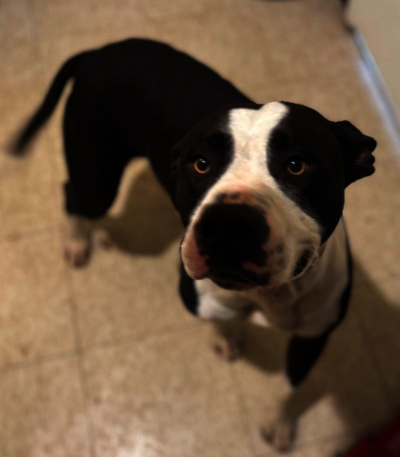
“Happy.” Photo courtesy of Clearlake Animal Control.
CLEARLAKE, Calif. — Clearlake Animal Control has dozens of dogs needing new homes.
The shelter has 48 adoptable dogs listed on its website.
This week’s dogs include “Happy,” a male pit bull terrier mix with a short black and white coat.
The shelter is located at 6820 Old Highway 53. It’s open from 9 a.m. to 6 p.m. Tuesday through Saturday.
For more information, call the shelter at 707-762-6227, email This email address is being protected from spambots. You need JavaScript enabled to view it., visit Clearlake Animal Control on Facebook or on the city’s website.
This week’s adoptable dogs are featured below.
Email Elizabeth Larson at This email address is being protected from spambots. You need JavaScript enabled to view it.. Follow her on Twitter, @ERLarson, and on Bluesky, @erlarson.bsky.social. Find Lake County News on the following platforms: Facebook, @LakeCoNews; X, @LakeCoNews; Threads, @lakeconews, and on Bluesky, @lakeconews.bsky.social.
Researchers are in the earliest phase of piecing together how the shingles vaccine could play a role in lowering the risk of dementia. PM Images/DigitalVision via Getty Images
Over the past two centuries, vaccines have been critical for preventing infectious diseases. The World Health Organization estimates that vaccination prevents between 3 million and 5 million deaths annually from diseases like diphtheria, tetanus, influenza, measles and, more recently, COVID-19.
While there has long been broad scientific consensus that vaccines prevent or mitigate the spread of infections, there is new research suggesting that the therapeutic impact might go beyond the benefit of preventing infectious diseases.
An April 2025 study published in the prominent journal Nature found tantalizing evidence that the herpes zoster – or shingles – vaccine could lower the risk of dementia in the general population by as much as 20%.
We are a team of physician scientists with expertise in the clinical and basic science of neurodegenerative disorders and dementia.
We believe that this study potentially opens the door to other breakthroughs in understanding and treating dementia and other degenerative disorders of the brain.
A role for vaccines in reducing dementia risk?
One of the major challenges researchers face when trying to study the effects of vaccines is finding an unvaccinated “control group” for comparison – a group that is similar to the vaccine group in all respects, save for the fact that they haven’t received the active vaccine. That’s because it’s unethical to assign some patients to the control group and deprive them of vaccine protection against a disease such as shingles.
The Nature study took advantage of a policy change in Wales that went into effect in 2013, stating that people born on or after September 2, 1933, were eligible for the herpes zoster vaccination for at least a year, while those born before that cutoff date were not. The vaccine was administered to prevent shingles, a painful condition caused by the same virus that causes chickenpox, which can lie dormant in the body and be reactivated later in life.
The researchers used the policy change as a natural laboratory of sorts to study the effect of shingles vaccination on long-term health outcomes. In a statistically sophisticated analysis of health records, the team found that the vaccine reduced the probability of getting dementia by one-fifth over a seven-year period. This means that people who received the shingles vaccine were less likely to develop clinical dementia over the seven-year follow-up period, and women benefited more than men.
The study design allowed researchers to compare two groups without actively depriving any one group of access to vaccination. The two groups were also of comparable age and had similar medical comorbidities – meaning similar rates of other medical conditions such as diabetes or high blood pressure.
Results from this and other related studies raise the possibility that vaccines may have a broader role in experimental therapeutics outside the realm of infectious diseases.
These studies also raise provocative questions about how vaccines work and how our immune system can potentially prevent dementia.
How vaccines might be protective
One scientific explanation for the reduction of dementia by the herpes zoster vaccine could be the direct protection against the shingles virus, which may play a role in exacerbating dementia.
However, there is also the possibility that the vaccine may have conferred protection by activating the immune system and providing “trained immunity,” in which the immune system is strengthened by repeated exposure to vaccines or viruses.
The study did not differentiate between different types of dementia, such as dementia due to Alzheimer’s disease or dementia due to stroke. Additionally, researchers cannot draw any definitive conclusions about possible mechanisms for how the vaccines could be protective from an analysis of health records alone.
The next step would be a prospective, randomized, double-blind, placebo-controlled study – the “gold standard” for clinical trials in medicine – to directly examine how the herpes zoster vaccine compares with a placebo in their ability to reduce the risk of dementia over time. Such studies are necessary before any vaccines, as well as other potential therapies, can be recommended for routine clinical use in the prevention of dementia.
Randomized, placebo-controlled trials are needed in order to determine how the shingles vaccine compares with a placebo over time in protecting against dementia.Peter Dazeley/Getty Images News
A January 2025 study provided updated figures on lifetime dementia risk across different subsets of the U.S. population. The researchers estimate that the lifetime risk of dementia after age 55 is 42% – more than double earlier estimates. The dementia risk was 4% by age 75, and 20% by age 85, with the majority of risk occurring after 85. The researchers projected that the number of new cases of dementia in the U.S. would double over the next four decades from approximately 514,000 cases in 2020 to 1 million in 2060.
Once considered a disease largely confined to the developed world, the deleterious effects of dementia are now apparent throughout the globe, as life expectancy increases in many formerly developing countries. While there are different forms of dementia with varying clinical manifestations and underlying neurobiology, Alzheimer’s disease is the most common.
Prospective studies that specifically test how giving a vaccine changes the risk for future dementia may benefit from studying patient populations with specific types of dementia because each version of dementia might require distinct treatments.
Unfortunately, for the past two to three decades, the amyloid hypothesis of Alzheimer’s disease – which posits that accumulation of a protein called amyloid in the brain contributes to the disorder – dominated the scientific conversation. As a result, most of the efforts in the experimental therapeutics of Alzheimer’s disease have focused on drugs that lower the levels of amyloid in the brain.
There is sometimes a tendency among scientists to cling to older, familiar models of disease and a reluctance to move in more unconventional directions.
Yet the process of doing science has a way of teaching researchers like us humility, opening our minds to new information, learning from our mistakes and going where that data takes us in our quest for effective, lifesaving therapies.
Vaccines may be one of those paths less traveled. It is an exciting possibility that may open the door to other breakthroughs in understanding and treating degenerative disorders of the brain.

 How to resolve AdBlock issue?