 How to resolve AdBlock issue?
News
- Details
- Written by: Elizabeth Larson
Donnie Gene Cruise III, 37, was the victim of the homicide, said Lt. Corey Paulich of the Lake County Sheriff’s Office.
On the afternoon of March 10 Cruise was found unconscious with visible head injuries and a stab wound to his stomach near Clark’s Island and E. State Highway 20 in Clearlake Oaks, as Lake County News has reported.
He died hours later after being transported to Adventist Health Clear Lake Hospital for treatment.
Paulich said Cruise’s death was the result of the stab wound he suffered.
He said there is no additional information the sheriff’s office is releasing about the crime at this time.
“Detectives are still canvassing and interviewing potential witnesses,” Paulich said.
Authorities are asking anyone with information in the case to contact Det. Richard Kreutzer at 707-262-4233.
Email Elizabeth Larson at
- Details
- Written by: Lake County News reports
Between 1940 and 1945, the percent of women in the workforce jumped from 27 percent to nearly 37 percent, and by the end of the war, nearly one out of every four married women worked outside the home.
These “Rosies” took positions across various industries, but the aviation industry saw the biggest increase of female workers – with more than 310,000 working in the aircraft industry in 1943, representing 65 percent of its workforce.
Phyllis Gould, 99, of Fairfax, California, was one of the first six women to work as Navy-certified journeyman welders at the Kaiser-Richmond shipyards from 1942 to 1945, providing the weapons and ammunition to help end the war.
“During the Second World War, countless women answered the call of service by taking on new roles to support the wartime efforts at home,” said Rep. Huffman. “These ‘Rosies’ made tremendous sacrifices and contributions, redefining women’s role in the workforce, and setting a powerful example for women across the country. Decades later, they continue to inspire the generations who have followed in their footsteps. Their “We Can Do It” spirit in times of hardship is particularly inspiring as we persevere through the impacts of the COVID-19 pandemic. I have the privilege of representing some of these Rosies here in Congress and know the importance of continuing to honor them and the rest of these heroines for their bravery and service.”
“Rose Will Monroe, the original Rosie the Riveter, worked long hours at the Willow Run Aircraft Factory in Ypsilanti, Michigan building the bombers that helped us win World War II,” said Congresswoman Dingell. “A National Rosie the Riveter Day won’t just honor and celebrate her contributions to this nation, but all of the Rosies who walked into factories demanding to serve and protect their nation. I can’t wait to get this resolution signed and get these fearless women the recognition they deserve.”
“Rosies represent an important part of our nation’s history, both in the impact they had on the home front effort in World War II and for the future of women in the workforce. At the Kaiser Shipyards in Richmond, these dedicated women confronted gender and race discrimination while breaking barriers by taking jobs as riveters, welders, and electricians that were pivotal in supporting our country’s war effort. I am so proud that the Rosie the Riveter Historic Site celebrates their legacies right here in Richmond, and I am pleased to join my colleagues in paying further tribute to them with a national day of recognition during Women’s History Month,” said Congressman Mark DeSaulnier.
"There is no greater call in life than serving your community and country, and innumerable, brave women answered that call during World War II. These 'Rosie the Riveters' made many personal sacrifices, but their ‘We Can Do It’ spirit inspired a nation navigating the unique hardships of war to rise up and energize the war effort across the country," said Rep. Fitzpatrick. "As we mark the valuable contributions and triumphs of women this Women’s History Month, I am incredibly proud to join the effort to honor and celebrate these heroes with a National Rosie the Riveter Day. I’m especially proud to represent Levittown’s Mae Krier. I admire Mae for her continued, tireless efforts advocating on behalf of her fellow ‘Rosies’ for this long-time, well-deserved recognition."
“The home front years were one of the most challenging periods in American history, but our Rosie the Riveters rose to the occasion,” said Rep. Speier. “They built the weapons, vehicles and ammunition that helped win the war; filled vacancies across male-dominated industries; kept their communities afloat; and pushed for government reforms to support women and families. By defying stereotypes and discrimination, Rosies fundamentally changed the American workforce and society. A ‘National Rosie the Riveter Day’ would acknowledge the tremendous debt of gratitude we owe these American heroes.”
The bill is cosponsored by Reps. Raul Grijalva (D-AZ), Julia Brownley (D-CA), Seth Moulton (D-MA), Brendan Boyle (D-PA), Adam Smith (D-WA), Alcee Hastings (D-FL), Derek Kilmer (D-WA), Gwen Moore (D-WI), Alan Lowenthal (D-CA), Eleanor Holmes Norton (D-DC), Dina Titus (D-NV), Brenda Lawrence (D-MI), Scott Peters (D-CA), Barbara Lee (D-CA), Steve Cohen (D-TN), Brett Guthrie (R-KY), Ashley Hinson (R-IA), Juan Vargas (D-CA), Debbie Wasserman Schultz (D-FL), and Grace Meng (D-NY).
- Details
- Written by: JOHN VOORHEIS
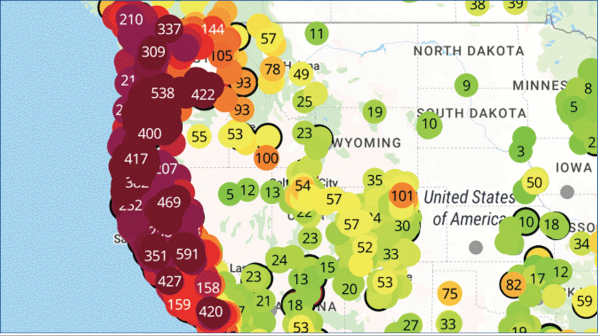
When severe forest fires last year blanketed Oregon and California with a thick layer of smoke, the high concentrations of fine particulate matter spewed into the air created one of the worst air pollution events in recent history.
A large body of research has documented that breathing in these fine particulates has severe negative health impacts, leading to cardiovascular disease and respiratory illness, and, in some cases, death.
Exposure to fine particulates has also been linked to lower educational attainment and reduced earnings.
Now new research by the U.S. Census Bureau suggests that exposure to fine particulates not only harms those directly exposed but may also indirectly impact the economic health of their children and grandchildren.
In a recent U.S. Census Bureau working paper co-authored with Jonathan Colmer, an assistant professor at the University of Virginia, we explore the long-term and even the multigenerational effects of pollution.
Our findings: Pollution affects not only individuals exposed directly and those exposed while in the womb (“first generation”) but also the “second generation” or children of those directly exposed.
In other words, if a woman is exposed to pollution while pregnant, it may affect both the child she’s carrying and her grandchildren.
For example, according to the findings, children whose parents were exposed to less air pollution were more likely to attend college as adults and, consequently, have higher expected earnings.
To examine this, we first identified hundreds of millions of links between parents and children in the 2000 and 2010 decennial censuses. We then used the American Community Survey to measure whether the children later attended college and administrative records to identify where the parents were born.
By combining these stats with measures of outdoor air quality from the Environmental Protection Agency, we were able to measure exposure to particulate matter when parents (the first generation) were in the womb.
Effect of pollution
To examine what drives the effects of pollution exposure across generations, we first compared adopted second-generation individuals to biological children in the second generation.
We found no substantial differences, suggesting that the intergenerational effects of pollution exposure do not work through a biological channel.
But we did find that how much parents earn and invest in their children has an impact. When the first generation was exposed to less pollution, they tended to have higher earnings and spend more time on child-enrichment activities, suggesting that the effect on the next generation is driven by these parental investments.
Pollution and demographics
This research is especially important in light of several other recent papers that have shown there are substantial disparities in pollution exposure across different demographic groups.
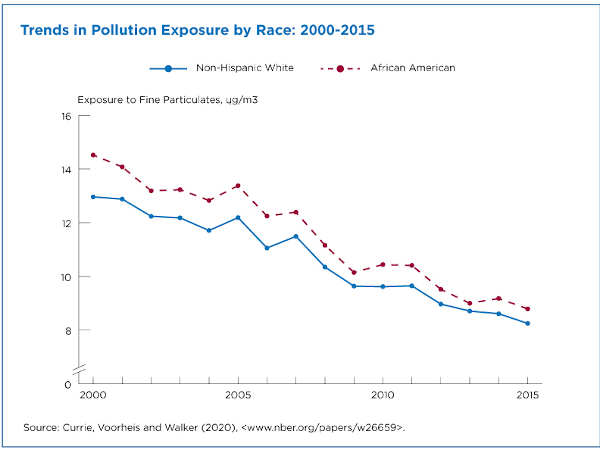
A Census working paper from 2020 shows that African Americans were exposed to higher levels of particulate matter than Whites, although this gap has narrowed in the last two decades.
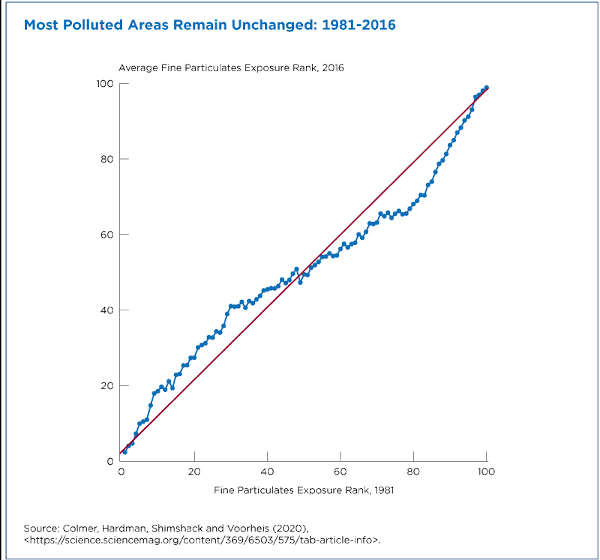
Another paper, recently published in Science, shows that while air quality has improved dramatically since the 1980s, the most polluted neighborhoods in 1981 were still the most polluted 30-40 years later.
Together, these results suggest that disparities in exposure to environmental hazards may be an important driver of differences in economic opportunity. Poor people are exposed to more pollution but pollution also harms the economic well-being of poor people and their children.
Connecting the dots with Census data
Census Bureau data is invaluable in the study of the connections between the environment, population and the economy.
To facilitate the use of this data, researchers in the Center for Economic Studies formed the Environment, Natural disasters and Energy Research Group, or ENERG. The group works to foster new innovative research and disseminate environmental insights produced from Census data with a goal of developing new public-use data products.
The research and statistics show how the environment — air and water pollution, a changing climate, and increasingly damaging natural disasters — affects America’s people and businesses.
An important part of this research is to understand how these effects interact with issues of environmental justice and the disproportionate environmental burden on disadvantaged communities. Answering these questions offers an exciting new opportunity for the Census Bureau.
John Voorheis is an economist in the U.S. Census Bureau’s Center for Economic Studies.
- Details
- Written by: NATIONAL AERONAUTICS AND SPACE ADMINISTRATION

The gas-giant orbiter is illuminating the provenance of Jovian polar light shows.
New results from the Ultraviolet Spectrograph instrument on NASA’s Juno mission reveal for the first time the birth of auroral dawn storms – the early morning brightening unique to Jupiter’s spectacular aurorae.
These immense, transient displays of light occur at both Jovian poles and had previously been observed only by ground-based and Earth-orbiting observatories, notably NASA’s Hubble Space Telescope.
Results of this study were published March 16 in the journal AGU Advances.
First discovered by Hubble’s Faint Object Camera in 1994, dawn storms consist of short-lived but intense brightening and broadening of Jupiter’s main auroral oval – an oblong curtain of light that surrounds both poles – near where the atmosphere emerges from darkness in the early morning region.
Before Juno, observations of Jovian ultraviolet aurora had offered only side views, hiding everything happening on the nightside of the planet.
“Observing Jupiter’s aurora from Earth does not allow you to see beyond the limb, into the nightside of Jupiter’s poles. Explorations by other spacecraft – Voyager, Galileo, Cassini – happened from relatively large distances and did not fly over the poles, so they could not see the complete picture,” said Bertrand Bonfond, a researcher from the University of Liège in Belgium and lead author of the study. “That’s why the Juno data is a real game changer, allowing us a better understanding what is happening on the nightside, where the dawn storms are born.”
Researchers found dawn storms are born on the nightside of the gas giant. As the planet rotates, the soon-to-be dawn storm rotates with it into the dayside, where these complex and intensely bright auroral features grow even more luminous, emitting anywhere from hundreds to thousands of gigawatts of ultraviolet light into space. The jump in brightness implies that dawn storms are dumping at least 10 times more energy into Jupiter's upper atmosphere than typical aurora.
“When we looked at the whole dawn storm sequence, we couldn’t help but notice that they are very similar to a type of terrestrial auroras called substorms,” said Zhonghua Yao, co-author of the study at the University of Liège.”
Substorms result from brief disturbances in the Earth’s magnetosphere – the region of space controlled by the planet’s magnetic field – that release energy high into the planet’s ionosphere. The similarity between terrestrial and Jovian substorms is surprising because the magnetospheres of Jupiter and Earth are radically different.
On Earth, the magnetosphere is essentially controlled by the interaction of the solar wind – the stream of charged particles flowing from the Sun – with Earth’s magnetic field.
Jupiter’s magnetosphere is mostly populated by particles escaping from the volcanic moon Io, which then get ionized and trapped around the gas giant via its magnetic field.
These new findings will allow scientists to further study the differences and similarities driving the formation of aurora, providing a better understanding how these most beautiful of planetary phenomena occur on worlds both within our solar system and beyond.
“The power that Jupiter possesses is amazing. The energy in these dawn aurorae is yet another example of how powerful this giant planet really is,” said Scott Bolton, principal investigator of Juno from the Southwest Research Institute in San Antonio. “The dawn storm revelations are another surprise from the Juno mission, which is constantly rewriting the book on how giant planet’s work. With NASA’s recent mission extension, we’re looking forward to many more new insights and discoveries.”
More information about Juno is available at https://www.nasa.gov/juno and https://www.missionjuno.swri.edu.
Follow the mission on Facebook and Twitter at https://www.facebook.com/NASASolarSystem and https://www.twitter.com/NASASolarSystem.