 How to resolve AdBlock issue?
News
- Details
- Written by: Elizabeth Larson
Snow began to fall in parts of the county, including Cobb, Lakeport and Upper Lake, on Tuesday night, and was followed early Wednesday afternoon by nearly an hour’s worth of steady snowfall along the Northshore. In the case of Wednesday’s snow, it quickly melted off.
The National Weather Service’s observation stations reported the following 24-hour precipitation totals in inches through 12 a.m. Thursday:
– Bartlett Springs: 0.46.
– Cache Creek near Lower Lake: 0.17.
– County line (at Colusa side): 0.11.
– Hidden Valley Lake: 0.48.
– Kelseyville: 0.17.
– Knoxville Creek: 0.28.
– Lyons Valley (northwest of Lakeport): 0.49.
– Soda Creek: 0.82.
– Upper Lake: 0.47.
– Whispering Pines: 0.52.
Frosty conditions are expected Thursday morning and possibly Friday morning as well, based on the forecast.
The National Weather Service said high pressure will bring quiet and dry weather with a fair amount of sunshine and light winds Thursday through Saturday.
Forecasters said the next cold front is projected to swing through the region around Sunday or Sunday night, with snow levels forecast to be at around the 4,000 foot elevation mark on Sunday.
About half and inch to an inch of rain expected for most of northwest California, with lighter amounts likely in Lake County, the forecast said.
Across much of Lake County, the forecast calls for chances of rain on Saturday and Sunday, with the potential for snow to return on Monday morning, dropping to as low as the 1,500-foot elevation mark, the forecast said.
Once that front passes, the forecast calls for clearer weather through midweek.
Through the weekend, daytime temperatures are expected to climb into the high 50s and low 60s around Lake County, dropping into the high 30s at night.
Cooler temperatures are expected early next week, with some parts of the county likely to see daytime temperatures in the high 40s and nighttime conditions in the mid to high 30s.
Email Elizabeth Larson at
- Details
- Written by: Bryan Keogh, The Conversation
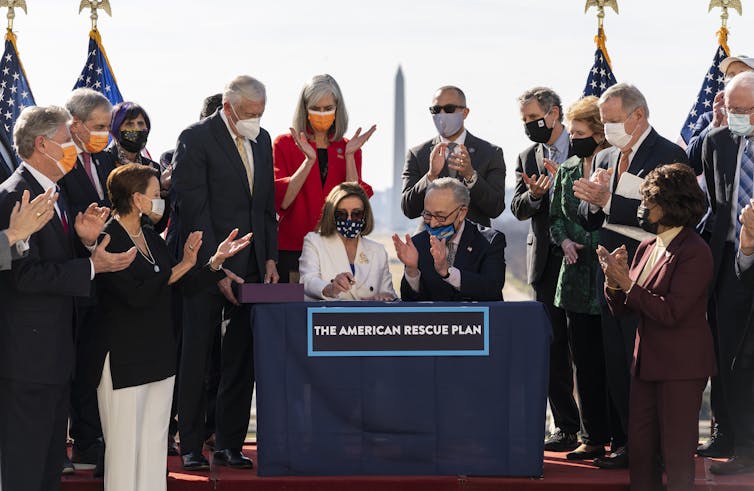
The U.S. economy and millions of people struggling because of the pandemic are about to get a US$1.9 trillion jolt of stimulating relief.
On March 10, the House of Representatives approved a version of President Joe Biden’s coronavirus package that barely squeezed through the Senate. Both votes were almost entirely along party lines. Biden is expected to sign the measure on March 12.
The legislation includes $1,400 relief checks for most Americans, an extension of the $300 supplement for the unemployed, a more generous child tax credit and much more. We turned to our archive to provide some context on this historic legislation.
1. About those $1,400 checks
Among the signature – and most popular – features of the package are the $1,400 payments most Americans will soon receive.
There was some wrangling in the Senate about what the level of income at which to phase out the payments, and ultimately the threshold was lowered from what it was for earlier rounds of relief checks so they’re more targeted at lower incomes – $80,000 for singles and $160,000 for couples. But even so, the checks make little economic sense, argue Monmouth economists Robert H. Scott III and Kenneth Mitchell.
“Research conducted on the first round of checks found that the vast majority of Americans saved most of the money or used it to pay down debt,” they write. “We believe President Biden’s COVID-19 relief bill gets a lot right. … Sending one-off $1,400 checks to people experiencing no economic hardship during the pandemic is not among them.”
2. Relief or stimulus?
One of the other heated debates over the legislation has been whether it will overheat the economy by providing too much stimulus. The White House, on the other hand, explicitly refers to it as a “rescue.”
Whether you call this big pot of money a relief or a stimulus package is more than just a question of semantics, because it reflects what is actually ailing the U.S. economy and what course of medicine the nation needs, writes William Hauk, an economist at the University of South Carolina.
“To the extent that a program gets people spending more, it is a stimulus,” he wrote. “To the extent that the same program leads to job creation for the unemployed, it is a relief package.”
Hauk examines what kind of crisis we’re in now and whether the $1.9 trillion is the right remedy.
3. Why it’s still needed
But there’s little doubt millions of Americans still need assistance, according to Harvard public opinion scholars Mary G. Findling, John M. Benson and Robert J. Blendon.
They conducted a survey in 2020 after Congress passed the first major coronavirus package and spent a record $2.2 trillion trying to support an economy in free fall at the time. They found that the vast majority of people affected by the pandemic were still suffering despite the $1,200 checks that were sent out and the supplemental unemployment insurance.
[Deep knowledge, daily. Sign up for The Conversation’s newsletter.]
“Our findings suggest there is a definite need for further government aid on a large scale for tens of millions of families,” they write. “The pandemic has been an economic disaster for some – particularly low-income and Black and Latino households – more than others. They still need a lifeboat to get them through the storm.”
4. Reconcilable differences
Despite the apparent need and the measure’s high popularity in surveys, it passed the Senate by the barest of majorities – 50 to 49 – and Biden’s victory was possible only because of a little thing called “budget reconciliation.”
Congress invented reconciliation in 1974 to reduce budget deficits, but more recently lawmakers have used the process to get around the usual 60-vote requirement for major legislation. For example, Republicans used the process in 2001, 2003 and 2017 to pass tax cuts, all of which actually increased the deficit, explains Raymond Scheppach, a public policy professor at University of Virginia.
“Perhaps the most significant negative effect is that it has reduced the rights of the minority party to shape legislation, which often leads to more extreme policies,” he said. “Passing legislation through reconciliation, I believe, exacerbates voter frustration and weakens democracy.”
Editor’s note: This story is a roundup of articles from The Conversation’s archives.
Bryan Keogh, Senior Editor, Economy + Business, The Conversation
This article is republished from The Conversation under a Creative Commons license. Read the original article.
- Details
- Written by: Lake County News reports
Lt. Rich Ward said the sheriff’s office responded to the area of Clarks Island and E. State Highway 20 at 2:10 p.m. Wednesday to check the welfare of a male subject that appeared to be the victim of an assault.
Upon their arrival, Ward said the deputies met with medical personnel and located a middle-aged Caucasian male adult.
The victim was unconscious and had visible injuries to his head. Ward said the man also appeared to be suffering from an unknown type of puncture wound to his abdomen. No other witnesses or bystanders were located in the immediate area.
Advanced life-saving measures were administered on scene and the victim was soon transported via ambulance to Adventist Health Clear Lake, Ward said.
This investigation is ongoing and the Lake County Sheriff’s Office encourages anyone with information pertaining to this investigation and/or surveillance footage in the area to contact Det. Richard Kreutzer at Central Dispatch’s nonemergency line at 707-263-2690 or email
- Details
- Written by: Elizabeth Larson
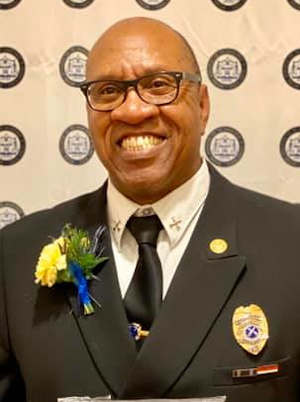
LAKE COUNTY, Calif. – The Lakeport Fire Protection District is preparing to welcome its new chief.
The district’s board of directors announced it has appointed Salt Lake City Battalion Chief Jeffrey James Thomas to serve as the new Lakeport Fire chief, effective March 29.
Thomas will succeed Rick Bergem, who is retiring after more than 40 years with the agency.
In Thomas’ hiring, the 127-year-old department is welcoming its first Black fire chief.
Thomas also is believed to be the first Black fire executive officer to serve in a Lake County agency.
He’s used to breaking barriers. When he became battalion chief at Salt Lake City Fire in 2005, he was the first Black firefighter to hold the role and the first Black fire officer in the state of Utah.
Thomas was born and grew up in California. He was raised in Richmond and had what he described in a 2020 interview as a middle-class upbringing, with a mom who was a nurse, a dad who was a truck driver, four brothers and a sister.
He left California to play football on a scholarship for the University of Utah.
Thomas began his work in the fire service after becoming interested in it thanks to an older brother who was a firefighter for the city of San Jose, and who later retired as one of that fire department’s highest-ranking officers.
He has served with the Salt Lake City Fire Department for 36 years and is reported to be an avid outdoorsman.
“Chief Thomas is looking forward to returning home and serving the community of Lakeport,” Lakeport Fire said in its Tuesday night statement on his hiring.
Email Elizabeth Larson at