 How to resolve AdBlock issue?
News
- Details
- Written by: Elizabeth Larson
The wreck occurred at about 9:45 p.m. Saturday along Highway 20 at Garden Court.
Firefighters were first dispatched to a report of a vehicle into a house with one person reported trapped.
However, when arriving on the scene, Northshore Fire personnel reported over the air that they found the vehicle behind a house, not into it, with one person who had been ejected from the vehicle trapped underneath it.
Incident command requested an air ambulance to land at Cal Fire’s Station 40 in Clearlake Oaks.
Extrication efforts continued until after 11 p.m. The crash victim was transported to the landing zone at about 11:20 p.m. to be flown to a regional trauma center, according to radio reports.
Scanner traffic indicated the incident was terminated at 11:50 p.m.
Additional information will be published as it becomes available.
Email Elizabeth Larson at
- Details
- Written by: Richard B. Primack, Boston University
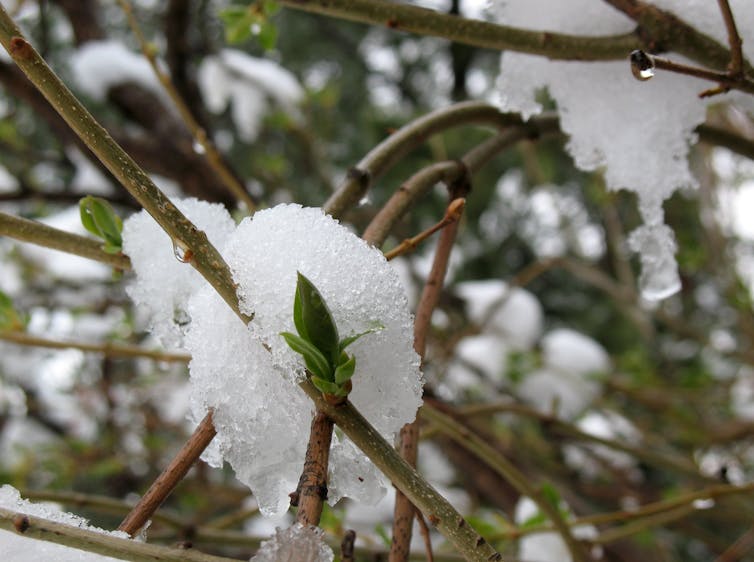
Weather patterns across the U.S. have felt like a roller coaster ride for the past several months. December and January were significantly warmer than average in many locations, followed by February’s intense cold wave and a dramatic warmup.
If you’ve ever seen lilac bushes crushed by snowdrifts, then budding on a warm day just a few weeks later, you may wonder how plants tolerate such extremes. I study how climate change affects the timing of seasonal events in the life cycles of plants, birds and insects in Massachusetts, so I know that species have evolved here to handle New England’s famously changeable weather. But a warming climate is disrupting weather patterns and testing the abilities of many species to adapt.
Tolerating cold
On brutal winter days when temperatures are far below freezing, animals hibernate underground or huddle in protected spots. But trees and shrubs have to sit there and take it. The tissues in their trunks, branches and roots are alive. How do they survive the freezing cold?
In autumn, woody plants in many parts of North America start preparing for winter. When their leaves change color and fall, their twigs, branches and trunks start to lose water. As a result, their cells contain higher concentrations of sugars, salts and organic compounds.
This lowers the freezing point of the cells and tissues, and allows them to survive temperatures far below the normal freezing point of water. The trick has its limits, though, so extreme cold events can still kill certain plants.

Tree and shrub roots remain largely unchanged and inactive during winter, relying on insulation from snow and soil for protection. For the most part, the temperature of the soil around roots stays at or above freezing. Soil, fallen leaves and persistent snow layers insulate the ground above the roots and prevent it from losing heat.
The surprising danger of spring frosts
After plants stoically withstand cold winters, early spring brings new dangers. Plants need to leaf out as early as they can in spring to take full advantage of the growing season. But this involves pumping water into their developing leaves, which reduces the concentration of sugars, salts and organic compounds in their tissues and removes their winter protection from cold.
Each species has a characteristic leaf-out time. Early-leafing species such as blueberries and willows are the gamblers of the plant kingdom. Later species, like oak and pine, are the cautious and conservative types. For any species, leafing out too early is a risk because late frosts can damage or kill young leaves.
Flowers are also vulnerable to unpredictable spring frosts because they contain lots of water. If the flowers of fruit trees, such as apples, are killed by frost, the trees won’t produce fruit later in the summer. Late frosts also can cause disappointingly short flowering seasons for early-flowering ornamental plants such as forsythias and magnolias.
Plant wake-up calls
To guard against frost and still take advantage of the full growing season, trees and shrubs have developed three ways to know when it is time to start growing in spring.
First, plants have winter chilling requirements: They hold on to winter dormancy until they have been exposed to a certain number of cold winter days. This trait helps them avoid leafing or flowering during abnormally warm periods in midwinter.
Second, plants also have spring warming requirements that promote growth after they experience a certain number of warm days each spring. This feature helps them start to grow as soon as it is warm enough.

Third, some plants also have a photoperiod response, which means they react to the length of time they are exposed to light in a 24-hour period. This prepares them to leaf out as days get longer and warmer in the spring. Beech trees have both a warming requirement and a photoperiod response, but the temperature requirement is much stronger, so they get going after just a few warm days in late spring.
Interestingly, North American trees such as red maple and black birch are more cautious and conservative than European and East Asian trees. The weather in eastern North America is more variable, and the threat of late spring frosts is higher here than in those regions. As a result, North American trees have evolved to leaf out a few weeks later than comparable trees from Europe and East Asia.
Climate change scrambles the signals
Plants are highly attuned to temperature signals, so warming driven by climate change is making it harder for many species to withstand winter cold and spring frosts. As spring temperatures get warmer than in the past, trees such as apples and pears may respond by leafing out and flowering several weeks earlier than normal. This can increase their vulnerability to late frosts.
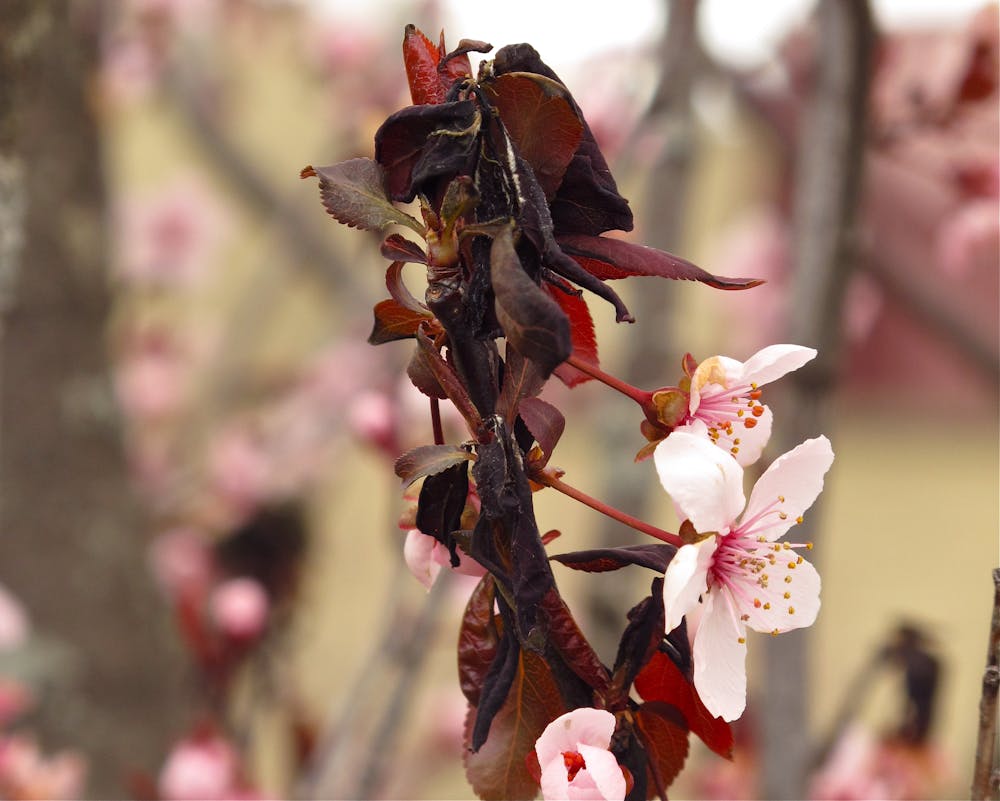
Such late frosts are becoming more common because climate change is destabilizing the jet stream, leading it to dip much farther south, bringing bursts of unusually cold weather.
In 2007, an exceptionally warm period in March triggered trees to leaf out across the eastern and central United States. A hard frost in April then killed the young leaves and flowers of oaks, hickories and other tree species. The trees were able to produce a second crop of leaves, but could not fully replace the leaves they’d lost, which quite likely stunted their growth for that year.
Insect pests also pose an increasing threat to plants. Harsh winter weather holds in check many insects found in northern climates, such as hemlock woolly adelgids and emerald ash borers. As winters become milder, these insects are more likely to survive, move further northward, cause major outbreaks and damage trees.
Warmer winters also lead to more days when the ground is bare. Cold snaps that occur when there is no insulating layer of snow can freeze the soil and kill roots. Tree and shrub branches then die back because the damaged roots cannot supply enough water and nutrients. In extreme cases, the plants may die.
In coming decades, many cold-loving tree species such as spruces and firs will become less abundant when they are not able to handle new challenges associated with a warmer climate. In the Northeast U.S., native species such as sugar maple and beech will be gradually replaced by native species from farther south, such as oaks and hickories. And nonnative species, such as Norway maples, are taking advantage of these disruptions to disperse into forests from roadsides and neighborhoods.
Similar shifts are happening in many places as climate change alters the signals plants rely on to mark the changing seasons.
[You’re smart and curious about the world. So are The Conversation’s authors and editors. You can read us daily by subscribing to our newsletter.]
Richard B. Primack, Professor of Biology, Boston University
This article is republished from The Conversation under a Creative Commons license. Read the original article.
- Details
- Written by: Elizabeth Larson
Dogs available for adoption this week include mixes of boxer, Chihuahua, German Shepherd, Labrador Retriever and pit bull.
Dogs that are adopted from Lake County Animal Care and Control are either neutered or spayed, microchipped and, if old enough, given a rabies shot and county license before being released to their new owner. License fees do not apply to residents of the cities of Lakeport or Clearlake.
The following dogs at the Lake County Animal Care and Control shelter have been cleared for adoption (additional dogs on the animal control Web site not listed are still “on hold”).
Call Lake County Animal Care and Control at 707-263-0278 or visit the shelter online at http://www.co.lake.ca.us/Government/Directory/Animal_Care_And_Control.htm for information on visiting or adopting.

Boxer-pit bull terrier mix
This female boxer-pit bull mix has a short red coat.
She is in kennel No. 18, ID No. 14356.

Male pit bull terrier
This senior male pit bull terrier has a short tan and white coat.
He is in kennel No. 22, ID No. 14392.

German Shepherd-Labrador Retriever mix
This male German Shepherd-Labrador Retriever mix has a short black and tan coat.
He is in kennel No. 31, ID No. 14383.

German Shepherd-Labrador Retriever mix
This male German Shepherd-Labrador Retriever mix has a short black and tan coat.
He is in kennel No. 32, ID No. 14382.

Female Chihuahua
This female Chihuahua has a short brown and gray coat.
She has been spayed.
She’s in kennel No. 33, ID No. 14368.
Email Elizabeth Larson at
- Details
- Written by: Lake County News reports

After traveling several billion miles toward the Sun, a wayward young comet-like object orbiting among the giant planets has found a temporary parking place along the way.
The object has settled near a family of captured ancient asteroids, called Trojans, that are orbiting the Sun alongside Jupiter.
This is the first time a comet-like object has been spotted near the Trojan population.
The unexpected visitor belongs to a class of icy bodies found in space between Jupiter and Neptune. Called "Centaurs," they become active for the first time when heated as they approach the Sun, and dynamically transition into becoming more comet-like.
Visible-light snapshots by NASA's Hubble Space Telescope reveal that the vagabond object shows signs of comet activity, such as a tail, outgassing in the form of jets, and an enshrouding coma of dust and gas. Earlier observations by NASA's Spitzer Space Telescope gave clues to the composition of the comet-like object and the gasses driving its activity.
"Only Hubble could detect active comet-like features this far away at such high detail, and the images clearly show these features, such as a roughly 400,000-mile-long broad tail and high-resolution features near the nucleus due to a coma and jets," said lead Hubble researcher Bryce Bolin of Caltech in Pasadena, California.
Describing the Centaur's capture as a rare event, Bolin added, "The visitor had to have come into the orbit of Jupiter at just the right trajectory to have this kind of configuration that gives it the appearance of sharing its orbit with the planet. We’re investigating how it was captured by Jupiter and landed among the Trojans. But we think it could be related to the fact that it had a somewhat close encounter with Jupiter."
The team's paper appears in the Feb. 11, 2021, issue of The Astronomical Journal.
The research team's computer simulations show that the icy object, called P/2019 LD2 (LD2), probably swung close to Jupiter about two years ago. The planet then gravitationally punted the wayward visitor to the Trojan asteroid group's co-orbital location, leading Jupiter by about 437 million miles.
Bucket brigade
The nomadic object was discovered in early June 2019 by the University of Hawaii's Asteroid Terrestrial-impact Last Alert System, or ATLAS, telescopes located on the extinct volcanoes, one on Mauna Kea and one on Haleakala. Japanese amateur astronomer Seiichi Yoshida tipped off the Hubble team to possible comet activity.
The astronomers then scanned archival data from the Zwicky Transient Facility, a wide-field survey conducted at Palomar Observatory in California, and realized that the object was clearly active in images from April 2019.
They followed up with observations from the Apache Point Observatory in New Mexico, which also hinted at the activity.
The team observed the comet using Spitzer just days before the observatory's retirement in January 2020, and identified gas and dust around the comet nucleus. These observations convinced the team to use Hubble to take a closer look.
Aided by Hubble's sharp vision, the researchers identified the tail, coma structure and the size of the dust particles and their ejection velocity. These images helped them confirm that the features are due to relatively new comet-like activity.
Although LD2's location is surprising, Bolin wonders whether this pit stop could be a common pull-off for some sunward-bound comets. "This could be part of the pathway from our solar system through the Jupiter Trojans to the inner solar system," he said.
The unexpected guest probably will not stay among the asteroids for very long. Computer simulations show that it will have another close encounter with Jupiter in about another two years. The hefty planet will boot the comet from the system, and it will continue its journey to the inner solar system.
"The cool thing is that you're actually catching Jupiter flinging this object around and changing its orbital behavior and bringing it into the inner system," said team member Carey Lisse of the Johns Hopkins University Applied Physics Laboratory, or APL, in Laurel, Maryland. "Jupiter controls what's going on with comets once they get into the inner system by altering their orbits."
The icy interloper is most likely one of the latest members of the so-called "bucket brigade" of comets to get kicked out of its frigid home in the Kuiper belt and into the giant planet region through interactions with another Kuiper belt object.
Located beyond Neptune's orbit, the Kuiper belt is a haven of icy, leftover debris from our planets' construction 4.6 billion years ago, containing millions of objects, and occasionally these objects have near misses or collisions that drastically alter their orbits from the Kuiper belt inward into the giant planet region.
The bucket brigade of icy relics endure a bumpy ride during their journey sunward. They bounce gravitationally from one outer planet to the next in a game of celestial pinball before reaching the inner solar system, warming up as they come closer to the Sun.
The researchers say the objects spend as much or even more time around the giant planets, gravitationally pulling on them – about 5 million years – than they do crossing into the inner system where we live.
"Inner system, 'short-period' comets break up about once a century," Lisse explained. "So, in order to maintain the number of local comets we see today, we think the bucket brigade has to deliver a new short-period comet about once every 100 years."
An early bloomer
Seeing outgassing activity on a comet 465 million miles away from the Sun (where the intensity of sunlight is 1/25th as strong as on Earth) surprised the researchers.
"We were intrigued to see that the comet had just started to become active for the first time so far away from the Sun at distances where water ice is barely starting to sublimate," said Bolin.
Water remains frozen on a comet until it reaches about 200 million miles from the Sun, where heat from sunlight converts water ice to gas that escapes from the nucleus in the form of jets. So the activity signals that the tail might not be made of water.
In fact, observations by Spitzer indicated the presence of carbon monoxide and carbon dioxide gas, which could be driving the creation of the tail and jets seen on the Jupiter-orbiting comet. These volatiles do not need much sunlight to heat their frozen form and convert them to gas.
Once the comet gets kicked out of Jupiter's orbit and continues its journey, it may meet up with the giant planet again.
"Short-period comets like LD2 meet their fate by being thrown into the Sun and totally disintegrating, hitting a planet, or venturing too close to Jupiter once again and getting thrown out of the solar system, which is the usual fate," Lisse said. "Simulations show that in about 500,000 years, there's a 90 percent probability that this object will be ejected from the solar system and become an interstellar comet."