 How to resolve AdBlock issue?
News
- Details
- Written by: Elizabeth Larson
The following dogs are ready for adoption or foster.

‘Ben’
“Ben” is a male American Pit Bull terrier mix.
He has a short brindle coat.
He is dog No. 4454.

‘Breeze’
“Breeze” is a female American Pit Bull Terrier mix.
She has been spayed.
She is dog No. 4445.

‘Bruce’
“Bruce” is a male American Staffordshire Terrier mix puppy.
He has a short smooth yellow coat.
He is dog No. 4383.

‘Bumble’
“Bumble” is a male Siberian Husky with a gray and black coat.
He is dog No. 4452.

‘Inky’
“Inky” is a male German Shepherd mix.
He has a long smooth black coat.
He is dog No. 4324.

‘Jerry’
“Jerry” is a male American Pit Bull terrier with a short brindle coat.
He is dog No. 4455.

‘Rudolph’
“Rudolph” is a male shepherd mix.
He has a short tan and black coat.
He is dog No. 4436.

‘Tinsle’
“Tinsle” is a female American Pit Bull Terrier mix puppy.
She has a short brindle and brown coat.
She is dog No. 4433.

‘Toby’
“Toby” is a male boxer mix.
He has a short tan and white coat.
He is dog No. 4389.

‘Yule’
“Yule” is a husky of undetermined gender with a black and white coat.
Yule is dog No. 4432.
Call the Clearlake Animal Control shelter at 707-273-9440, or email
Visit Clearlake Animal Control on Facebook or on the city’s website.
Email Elizabeth Larson at
- Details
- Written by: Lake County News reports
The recommendations clarify the state’s vaccine prioritization process and that after appropriate efforts to reach highest priority groups, health departments and providers may offer doses to lower priority groups when high-priority demand subsides, or when doses are about to expire.
As of Jan. 7, a total of 586,379 vaccine doses have been administered statewide and a total of 2,052,025 vaccine doses, which includes the first and second dose, have been shipped to local health departments and health care systems that have facilities in multiple counties, the state reported.
“California’s health care providers have done incredible work thus far in vaccinating hundreds of thousands of Californians,” said Gov. Gavin Newsom. “On behalf of our state, I thank our hospitals, doctors, nurses, and others for joining us in this all-hands-on-deck commitment to safely and quickly Vaccinate All 58. When Californians join together, our spirit of resiliency and innovation always wins. By continuing to take the precautions we need to get through this surge, and by ramping up safe and equitable vaccinations, we can and we will get through this darkest part of the tunnel to the light.”
To maximize vaccine administration and reduce the potential for waste, local health departments and providers should immediately administer COVID-19 vaccines to individuals in all tiers of Phase 1a.
In addition to frontline health care workers, this includes a wide range of people in health care settings such as community health care workers, public health field staff, primary care clinics, specialty clinics, laboratory workers, dental clinics and pharmacy staff.
Local health departments and providers should make special efforts to administer vaccine to vaccinators and consider partnering with others to provide vaccinations for individuals in prioritized tiers.
They may also allocate doses on the assumption that immunization will be accepted by some but not all who are offered the vaccine, and then continue to offer vaccinations in progressive priority tiers.
For example, if a county has maximized use of the vaccine to administer individuals in Phase 1a, they should move to Tier 1 of Phase 1b while continuing to offer vaccines to those in higher priority groups.
- Details
- Written by: Michael Addonizio, Wayne State University
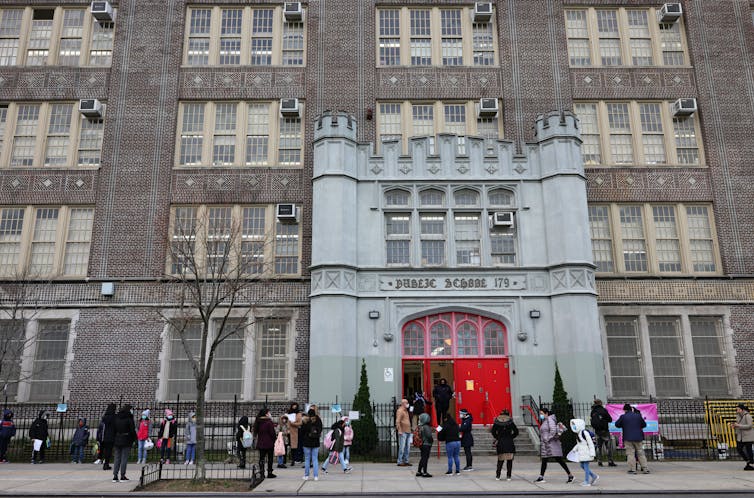
The year 2020 may prove to be pivotal in the history of U.S. public education. Many children have gone missing from school completely since March, and millions more are struggling with wholly inadequate online learning experiences. Lower-income and minority children are particularly hard-hit.
The pandemic has exposed and exacerbated deep inequities across our public schools. Merely restoring school budgets to their prepandemic levels will not be enough to address them after this long period of limited learning.
So far, most states have avoided deep education budget cuts this school year. However, they project revenue shortfalls for the 2021-22 school year.
Because education is labor-intensive, budget cuts would mean layoffs and pay freezes. This would harm in-class instruction and student progress and well-being at a time when it’s most needed.
As a former state education administrator and current university professor and researcher, I have seen how state investment in public schools can boost economies long-term and strengthen civic life.
Where the money comes from
U.S. public schools are decentralized – there are 50 state systems and the District of Columbia. This limits the role of the federal government. Still, Washington can help.
Superintendents of the nation’s three largest school districts – New York, Los Angeles and Chicago – have called on Congress to appropriate funds for school cleaning and protective equipment, testing and contact tracing, mental health supports and in-person summer school programs. Cost is estimated at US$125 billion nationally.
President-elect Biden has called for nearly $200 billion in new funding for schools and pledged to direct the Federal Emergency Management Agency to guarantee schools full access to disaster relief funds.
Given the federal government’s virtually unlimited borrowing capacity at very low interest and Washington’s current appetite for deficit spending, a K-12 investment at the level called for by the superintendents or the president-elect could be folded into a larger relief package aimed at state and local government by the new 2021 Congress.
Any lasting rescue of our K-12 schools, however, must come from the states, which provide, on average, 47% of school revenue. Local districts raise 45%, with the remaining 8% coming from the federal government. And unlike Congress, states must balance their budgets.
State revenues held up better than expected this past spring. Revenues for fiscal year 2020, which ended June 30 in most states, came in higher than expected. That’s largely because the recession primarily hit lower-income workers, who pay less in taxes than their higher-earning counterparts.
Federal aid from the CARES Act, including expanded unemployment benefits, also boosted incomes and spending back in the spring and summer. The act provided about $13.5 billion directly to schools to cover costs of COVID-19 safety measures and related costs.
The higher-than-expected tax revenues, along with the CARES Act funds, helped states cushion the blow to school districts’ current year budgets. For example, in my state of Michigan, K-12 funding for fiscal years 2020 and 2021 was spared from cuts. In fact, districts were given a small, one-time cushion of $160 million to cover COVID-19-related expenses.
Georgia, on the other hand, cut K-12 funding for fiscal year 2021 by nearly $1 billion.
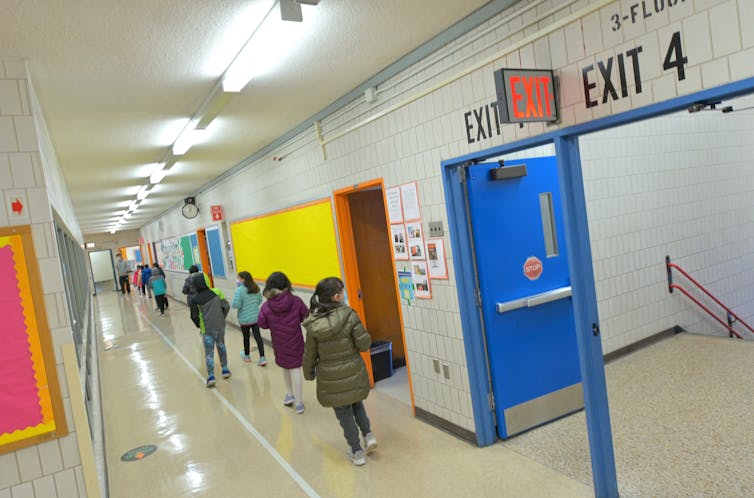
Trouble ahead
Concerns about education budget cuts for the coming school year are not misplaced. Much of the CARES Act federal aid expired at the end of 2020.
In late December, Congress agreed on a new $900 billion relief package that includes $54 billion for K-12 schools. Most of this aid will be delivered through Title I funding, which goes to schools with concentrations of low-income children. This one-time relief will help schools this year, but some states may reduce their own support for schools in response.
When the new federal aid runs out, will states fill the breach? The current economic outlook is extremely uncertain. As COVID-19 cases continue to surge, our weak but slowly recovering economy could slip back into recession, threatening states’ ability or willingness to adequately fund their schools.
Local districts rely on property taxes, and these revenues have been more stable during the pandemic than the sales and income taxes that fill state coffers. But, with few exceptions, local districts cannot rescue themselves.
States play an essential role in equalizing educational opportunities across rich and poor districts, with most aid distributed by formulas that favor poor districts. As a result, thousands of property-poor and low-income districts rely heavily on state aid.
Right now, researchers say the need for support among poorer districts is enormous and growing. As the pandemic surges into the winter months and schools continue to rely heavily on remote instruction, evidence of student learning loss is mounting.
Researchers from Stanford University analyzed reading and math scores in 18 states and the District of Columbia. They found that, by the end of the 2019-20 school year, the average elementary and secondary school student had lost between a third of a year and a full year in reading progress since March. In math, the loss was from about three-quarters of a year to more than a year. The losses were much more severe for students from economically disadvantaged families.
Another study by management consulting firm McKinsey & Company found similar evidence of learning loss, with greater losses in math than reading and particularly acute losses in schools predominately serving students of color.
Educators may question the precision of these findings, and the Stanford researchers note their estimates of learning loss are based on projected and not actual 2020 achievement scores. More study, including in-class assessments by skilled classroom teachers, will be needed to accurately gauge students’ learning losses.
But two basic conclusions are inescapable. First, remote learning has proven far inferior to in-class learning for the vast majority of students. And second, the consequences have been much more dire for low-income and minority children, who are more likely to be learning remotely while lacking the technology, school support and family resources needed to succeed in that environment.
Left unaddressed, these educational deprivations can have effects that last a lifetime, robbing students of their economic prospects and their potential for rewarding civic participation.
Local districts cannot address these growing inequities and learning gaps on their own. They will need to rely on states and the federal government to not only help restore local school budgets to prepandemic levels, but provide schools with additional resources – including more teachers, counselors, social workers, psychologists, technology and training – to remedy the educational and emotional deficits that have mounted since the pandemic struck in the spring.
[You need to understand the coronavirus pandemic, and we can help. Read The Conversation’s newsletter.]
Michael Addonizio, Professor of Educational Leadership and Policy Studies, Wayne State University
This article is republished from The Conversation under a Creative Commons license. Read the original article.
- Details
- Written by: Elizabeth Larson
Congressman Mike Thompson (CA-05) and his staff – along with Congressman John Garamendi (CA-03), Lake County’s other member of Congress, and his staffers – were safe and sheltering in place for much of Wednesday afternoon and evening as authorities worked to clear the U.S. Capitol building.
Hours earlier, a mob of Trump supporters forced their way into the building, breaking windows, getting into the offices of members of Congress and invading the chambers.
In a Wednesday afternoon phone interview with Lake County News, Thompson said he was in his office, located in the nearby Cannon Office Building, when, very early in the afternoon, he and his staff were evacuated from the building after a pipe bomb was found and the area’s security had been breached.
Authorities later reported that they had found a total of two pipe bombs in the area.
A short time later, Thompson and his staff were allowed back into their offices and were there for about 20 minutes when they were again told to evacuate.
It was at around 2 p.m. that the mob went through barriers and rushed into the building.
Thompson said that when the mob’s attack began both houses of Congress were in the process of debating whether to accept the Electoral College votes from Arizona after an objection was raised. It was the first of several states in which a number of Republican legislators objected.
He and his staff moved to a secured, undisclosed location and remained there into Wednesday evening as the process of clearing the Capitol building continued. Thompson said they needed to sweep the building to look for bombs and he was hoping evidence was being collected to prosecute the rioters.
Early Wednesday evening, Thompson was waiting to be able to get back to work on the Electoral College vote certification.
“We’re planning to go back into session and to certify the vote,” Thompson said.
Thompson criticized Trump, who had called for a protest to take place in the nation’s capital during the Electoral College certification and even spoke to supporters on Wednesday morning, urging them to go to the Capitol building. That appearance has been blamed for inciting the riot that followed. Thompson compared Trump to a school ground bully.
“This is really tragic. This has never happened in the history of our country,” Thompson said. “It just sends a terrible picture to the rest of the world.”
He added, “We’ve been a beacon for hope and democracy around the globe, and now this.”
Thompson said it was an insurrection provoked by Trump and said the outgoing president should be held accountable for it.
He said he hopes Vice President Mike Pence and the cabinet have the courage to invoke the 25th Amendment and remove Trump from office, but added, “I don’t know if they do,” noting that Trump has replaced most of the cabinet with lackeys.
In this case, Thompson said the 25th Amendment should be invoked, Trump should be impeached again and removed from office.
“If I had my way, I'd bring it up tonight,” he said.
However, Thompson said the first order of business was to get the election results confirmed, clearing the way for Joe Biden to become the 46th president on Jan. 20.
In addition to the hours of debate expected to continue through the night, Thompson said, “Because of COVID, it takes us over an hour to cast a vote,” with members of Congress required to make their way through the chamber in small groups.
A short time after he spoke with Lake County News, Thompson tweeted, “After today’s events, I’m calling on the Vice President to initiate proceedings under the 25th Amendment to gather the Cabinet and remove the President from office.”
Congress remained in session until shortly before 12:45 a.m. Pacific Time – 3:45 a.m. Eastern Standard Time – completing the certification of the Electoral College vote with Vice President Mike Pence declaring Biden the winner of the presidency and Kamala Harris as vice president-elect.
In a statement released shortly afterward, Thompson said, “Congress has done its Constitutional duty and certified the results of the Electoral College from the 2020 Presidential Election. On January 20, Joe Biden will be the President and Kamala Harris will be the Vice President. We must ensure the peaceful transfer of power.”
Just before Pence declared the joint session of Congress dissolved, U.S. Senate Chaplain Barry C. Black, offered a closing prayer.
He prayed for healing and unity, offered thanks for what lawmakers were able to accomplish in spite of the threats to liberty and said we have been warned that eternal vigilance continues to be freedom’s price, and that we need to see in each other a common humanity that reflects the image of God.
Chaplain Black addressed the tragedies that he said have reminded us that words matter and that – quoting the book of Proverbs said – “The power of life and death is in the tongue.”
Email Elizabeth Larson at