 How to resolve AdBlock issue?
News
- Details
- Written by: Yasmin Anwar
Even average residents of wealthy countries belonging to the Organization for Economic Cooperation and Development, or OECD, such as Japan, were on par with or outliving affluent Americans in 2018, said UC Berkeley demographer Magali Barbieri, associate director of the Human Mortality Database and author of the report funded by the Society of Actuaries and published Nov. 17.
“Life expectancy for the most affluent American men was one year less than for the average Japanese man,” Barbieri said. “Meanwhile, the gap between average Japanese women and the most affluent American women reached nearly 3.5 years.”
Using U.S. Census and other national vital statistics data, Barbieri tracked mortality rates for residents in dozens of U.S. counties based on education, income, employment, occupation, housing costs and quality, and other socioeconomic characteristics. She calculated the average lifespans of men and women, separately, in all these counties for every year from 1999 to 2018.
Notably, Barbieri discovered that, in 2018, men in the most affluent U.S. category could expect to live at least seven years longer than those in the most disadvantaged U.S. group (80.5 vs. 73.2 years). For women, that gap was six years (84.9 vs. 79.9 years). The socioeconomic gap was particularly high for children and for adults between the ages of 40 and 60.
By comparison, the socioeconomic gap in life expectancy in 1999 amounted to 5.5 years for men and 3.4 years for women.
Although she did not factor in data for 2019 and 2020, which is still being collected, mortality rates in the U.S. and worldwide are projected to rise sharply due to the COVID-19 pandemic.
Over the last century, life expectancy in the United States and other OECD nations has risen at a rate of three to four months per year.
But Barbieri found that, after 2010, life expectancy in the U.S. leveled off and then decreased from 2014 to 2017, going up slightly in 2018. The higher death toll, she said, is partly due to the opioid epidemic and unsuccessful efforts to control cardiovascular disease, the leading cause of death in the U.S.
While the most disadvantaged U.S. counties saw a rise in mortality between 2010 and 2014, the life expectancy of affluent Americans increased only slightly over that same period.
As for how the lifespan of Americans compares to that of other industrialized countries, Barbieri finds the U.S. is losing ground.
“Overall, Americans are lagging further and further behind in life expectancy, compared to similarly wealthy democratic countries where mortality has continued to decline at a relatively fast pace over the first two decades of the 21st century,” Barbieri said.
“Only the 10 percent of Americans in the most affluent U.S. counties can now expect to live as long as their peers in similarly wealthy nations,” she added. “And, when compared with Japan where the length of life is particularly long, and where progress has continued unabated, all socioeconomic categories of Americans are falling further and further behind.”
Yasmin Anwar writes for the UC Berkeley News Center.
- Details
- Written by: Elizabeth Larson
Dogs available for adoption this week include mixes of husky, Labrador Retriever, pit bull, heeler and Shar Pei.
Dogs that are adopted from Lake County Animal Care and Control are either neutered or spayed, microchipped and, if old enough, given a rabies shot and county license before being released to their new owner. License fees do not apply to residents of the cities of Lakeport or Clearlake.
The following dogs at the Lake County Animal Care and Control shelter have been cleared for adoption (additional dogs on the animal control Web site not listed are still “on hold”).
Call Lake County Animal Care and Control at 707-263-0278 or visit the shelter online at http://www.co.lake.ca.us/Government/Directory/Animal_Care_And_Control.htm for information on visiting or adopting.

Male husky
This male husky has a medium-length black and white coat and blue eyes.
He’s in kennel No. 22, ID No. 14194.

Female pit bull terrier
This young female pit bull terrier has a short brown coat.
She is in kennel No. 25, ID No. 14181.

Male pit bull terrier
This male pit bull terrier has a short gray and brindle coat.
He is in kennel No. 26, ID No. 14138.

Male pit bull terrier
This young male pit bull terrier has a short blue and white coat.
He is in kennel No. 28, ID No. 14198.

Male heeler-Labrador Retriever
This male heeler-Labrador Retriever mix has a short black and white coat.
He is in kennel No. 29, ID No. 14178.

Male pit bull-Shar Pei
This male pit bull-Shar Pei has a short brown coat.
He is in kennel No. 30, ID No. 14177.

‘Hugo’
“Hugo” is a male pit bull terrier with a medium-length black and white coat.
He has been neutered.
He’s in kennel No. 34, ID No. 14174.
Email Elizabeth Larson at
- Details
- Written by: NATIONAL AERONAUTICS AND SPACE ADMINISTRATION

The hungriest of black holes are thought to gobble up so much surrounding material they put an end to the life of their host galaxy.
This feasting process is so intense that it creates a highly energetic object called a quasar – one of the brightest objects in the universe – as the spinning matter is sucked into the black hole’s belly.
Now, researchers have found a galaxy that is surviving the black hole’s ravenous forces by continuing to birth new stars – about 100 Sun-sized stars a year.
The discovery from NASA’s telescope on an airplane, the Stratospheric Observatory for Infrared Astronomy, can help explain how massive galaxies came to be, even though the universe today is dominated by galaxies that no longer form stars. The results are published in the Astrophysical Journal.
“This shows us that the growth of active black holes doesn’t stop star birth instantaneously, which goes against all the current scientific predictions,” said Allison Kirkpatrick, assistant professor at the University of Kansas in Lawrence Kansas and co-author on the study. “It’s causing us to re-think our theories on how galaxies evolve.”
SOFIA, a joint project of NASA and the German Aerospace Center, DLR, studied an extremely distant galaxy, located more than 5.25 billion light years away called CQ4479. At its core is a special type of quasar that was recently discovered by Kirkpatrick called a “cold quasar.”
In this kind of quasar, the active black hole is still feasting on material from its host galaxy, but the quasar’s intense energy has not ravaged all of the cold gas, so stars can keep forming and the galaxy lives on.
This is the first time researchers have a detailed look at a cold quasar, directly measuring the black hole’s growth, star birth rate, and how much cold gas remains to fuel the galaxy.
“We were surprised to see another oddball galaxy that defies current theories,” said Kevin Cooke, postdoctoral researcher at the University of Kansas in Lawrence, Kansas, and lead author of this study. “If this tandem growth continues both the black hole and the stars surrounding it would triple in mass before the galaxy reaches the end of its life.”
As one of the brightest and most distant objects in the universe, quasars, or “quasi-stellar radio sources,” are notoriously difficult to observe because they often outshine everything around them. They form when an especially active black hole consumes huge amounts of material from its surrounding galaxy, creating strong gravitational forces.
As more and more material spins faster and faster toward the center of the black hole, the material heats up and glows brightly. A quasar produces so much energy that it often outshines everything around it, blinding attempts to observe its host galaxy.
Current theories predict that this energy heats up or expels the cold gas needed to create stars, stopping star birth and driving a lethal blow to a galaxy’s growth. But SOFIA reveals there is a relatively short period when the galaxy’s star birth can continue while the black hole’s feast goes on powering the quasar’s powerful forces.
Rather than directly observing the newborn stars, SOFIA used its 9-foot telescope to detect the infrared light radiating from the dust heated by the process of star formation.
Using data collected by SOFIA's High-resolution Airborne Wideband Camera-Plus, or HAWC+ instrument, scientists were able to estimate the amount of star formation over the past 100 million years.
“SOFIA lets us see into this brief window of time where the two processes can co-exist,” said Cooke. “It’s the only telescope capable of studying star birth in this galaxy without being overwhelmed by the intensely luminous quasar.”
The short window of joint black hole and star growth represents an early phase in the death of a galaxy, wherein the galaxy has not yet succumbed to the devastating effects of the quasar.
Continued research with SOFIA is needed to learn if many other galaxies go through a similar stage with joint black hole and star growth before ultimately reaching the end of life.
Future observations with the James Webb Space Telescope, which is scheduled to launch in 2021, could uncover how quasars affect the overall shape of their host galaxies.
SOFIA is a joint project of NASA and the German Aerospace Center. NASA’s Ames Research Center in California’s Silicon Valley manages the SOFIA program, science, and mission operations in cooperation with the Universities Space Research Association, headquartered in Columbia, Maryland, and the German SOFIA Institute at the University of Stuttgart.
The aircraft is maintained and operated by NASA’s Armstrong Flight Research Center Building 703, in Palmdale, California. The HAWC+ instrument was developed and delivered to NASA by a multi-institution team led by NASA’s Jet Propulsion Laboratory.
- Details
- Written by: Janine Smith Citron
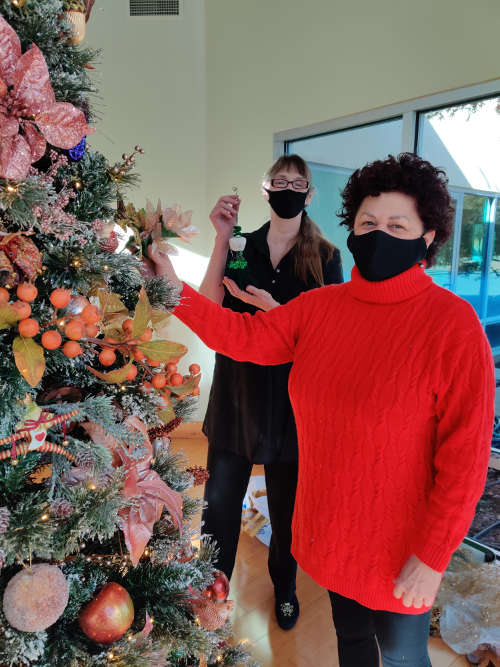
LAKEPORT, Calif. – COVID-19 may be disrupting our lives and forcing us to socially distance but it won’t dim our holiday spirit.
Hospice Services of Lake County has transformed the original “Festival of Trees” gala event into a public display of spectacularly designed Christmas trees and a virtual auction.
The fundraising event supporting the Wings of Hope Bereavement program for children and special needs of Hospice patients runs through Dec. 1.
Community members are invited to view the 27 beautifully designed trees at local businesses and visit the virtual auction site to bid on the uniquely designed trees and other auction items available.
The auction site may be viewed at https://hslcfestivaloftrees2020.ggo.bid.
Online bidding closes on Dec. 1 at 4 p.m.
“Photos of trees taken by local professionals are located on the bid site with a description of each tree and some include wonderful heartfelt stories of loved ones,” said event organizer and staff community relations manager, Beth Havrilla. “However an ‘in-person’ viewing of trees really captures the amazing detail that each designer has put into the decorations.”
Havrilla said business owners are adhering to COVID-19 precautions where trees are located for your safety.
All trees were donated and designed by local Lake County individuals and businesses.
“My family is dedicated to participating in this meaningful event each year,” said Hospice Services Board member Patty Brunetti. “I personally experienced the compassionate services Hospice of Lake County provides when the team cared for my mother at the end of her life. This is my way of supporting Hospice so they can continue providing the same wonderful care to other community members.”
Brunetti’s donated tree is on display at Red’s at The Skyroom in Lakeport.
On Saturday, Nov. 28, community members are encouraged to attend an “open air” open house in downtown Kelseyville highlighting the Festival of Trees from 3 to 6 p.m.
Many trees can be viewed with the full effects of holiday lighting throughout the downtown community.
During the event, meet new Hospice Executive Director Cindy Sobel at A+H General Store from 4 to 6 p.m.
There are 20 festive tabletop centerpieces available to purchase made by Hospice Services volunteers Peggy Landini and Nikka Deacon. Proceeds will support the “Joy in a Vase” project that distributes floral arrangements to Hospice patients and families. The auction site also includes an opportunity to donate directly to the Wings of Hope program.
Hospice Services a nonprofit health care organization is celebrating its 41st anniversary, providing compassionate comfort care for patients and families experiencing life-threatening conditions.
The Wings of Hope Bereavement camp and school-based counseling program is an opportunity for children in the community to receive professional support when someone special in their life has died. These services are available due to the generous support from community members and fundraising.
For more information about the Festival of Trees contact
Janine Smith Citron is director of development for Hospice Services of Lake County.