 How to resolve AdBlock issue?
News
- Details
- Written by: Dennis Fordham

What is the legal remedy when one person tortiously (wrongfully) interferes with another person’s estate planning so that an intended beneficiary receives either no or a lesser inheritance?
Since 2012 California has recognized the tort [i.e., a civil wrongdoing] of “Intentional Interference with Expected Inheritance” (Beckwith v. Dahl (2012) 205 Cal.App.4th 1039, 1050-1056.).
This tort applies when someone, “ ‘… by fraud, duress or other tortious means intentionally prevents another from receiving from a third person an inheritance or gift that he [or she] would otherwise have received is subject to liability to the other for loss of the inheritance or gift.’ ” (Beckwith v. Dahl, supra, 205 Cal.App.4th at p. 1050.)
On Sept. 22, 2020, the California’s Third Appellate Department (Shasta) issued its appellate opinion in Louise A. Gomez v. Tammy J. Smith involving the Estate of Frank Gomez (deceased).
The decedent Frank Gomez’s daughter Tammy Smith had prevented him from seeing his own attorney to review and sign a new trust in his deathbed. Smith did not want her father to leave his new wife Louise Gomez a life estate in the father’s residence; it would have delayed Smith’s own inheritance until Louise Gomez died. After Frank Gomez died, his wife Louise sued his daughter.
To win, Louise Gomez had to prove each of these six elements: (1) That she had an expectancy of an inheritance; (2) that the bequest or devise would have been in effect at the time of the death of the testator if there had been no such interference; (3) that the defendant had knowledge of the plaintiff’s expectancy of inheritance and took deliberate action to interfere with it; (4) that the interference involved underlying conduct that was itself wrong other than the fact of the interference; (5) that the interference resulted in damages (i.e., no or a lesser inheritance); (6) that the interference was directed at someone (Frank Gomez) other than the plaintiff (Louise Gomez).
Deciding the case involved a detailed facts and circumstances analysis. Three of the six elements are easy to understand, but the second, third, and fourth elements deserve discussion.
That is, Louise Gomez proved the second element because the bequest would have been in effect because had Tammy Smith not prevented Frank Gomez’s attorney from seeing him at his deathbed then Frank Gomez would have signed a new trust giving Louise Gomez lifetime benefits. Smith would then have had to prove that Frank Gomez lacked capacity or was subject to undue influence to overcome the presumption of the trust’s validity.
Next, Louise Gomez proved the third element because Smith knew her father’s intention to take care of his wife and Smith deliberately interfered by preventing Frank Gomez’s attorney from entering into the residence to have him sign the documents.
Lastly, let’s discuss the fourth element that the underlying conduct was wrong in itself. The court’s opinion said that, “[t]he usual case is that in which the third person has been induced to make or not to make a bequest or a gift by fraud, duress, defamation or tortious abuse of fiduciary duty, or has forged, altered or suppressed a will or a document making a gift. Thus one who by legitimate means merely persuades a person to disinherit a child and to leave the estate to the persuader instead is not liable to the child.” (Rest.2d Torts, § 774B, com. c, pp. 58-59.)
Here the court found that, “Tammy indisputably ‘knew of [Frank’s] physical weakness and distress and took actions whereby [she] physically separated [his] attorney from [him] intentionally preventing [Frank] from confirming an estate plan that he had been trying to put in place for months.’ Frank’s will was overborne by Tammy because he was bedridden and unable to intervene when Tammy precluded [Frank’s attorney] Aanestad from entering the home.”
Deathbed estate planning is fraught with risk. It becomes even riskier with deep family divisions that sometimes exist in second marriages between stepchildren and stepparents. It is even more important not to wait to get one’s affairs in order.
Dennis A. Fordham, attorney, is a State Bar-Certified Specialist in estate planning, probate and trust law. His office is at 870 S. Main St., Lakeport, California. He can be reached at
- Details
- Written by: NATIONAL AERONAUTICS AND SPACE ADMINISTRATION
Americans exercise their right to vote from all over the world, and for November’s election, few ballots will have traveled as far as those cast by NASA astronauts living and working aboard the International Space Station.
During earlier days of human spaceflight, astronauts would only visit space for days, or maybe weeks, at a time.
Today, astronauts typically stay in space for six-month missions on the space station, increasing the odds of a spacefarer off the planet during an election. So how does one vote from space?
How it works
Like other forms of absentee voting, voting from space starts with a Federal Postcard Application, or FPCA. It’s the same form military members and their families fill out while serving outside of the U.S.
By completing it ahead of their launch, space station crew members signal their intent to participate in an election from space.
Because astronauts move to Houston for their training, most opt to vote as Texas residents. Of course, NASA’s astronauts come from all over, so those wishing to vote as residents of their home states can work with their counties to make special arrangements to vote from space.
Once their FPCA is approved, the astronaut is almost ready to vote. Like many great things in space, voting starts with an experiment. The county clerk who manages elections in the astronaut’s home county sends a test ballot to a team at NASA’s Johnson Space Center in Houston.
Then they use a space station training computer to test whether they’re able to fill it out and send it back to the county clerk.
After a successful test, a secure electronic ballot generated by the Clerk’s office of Harris County and surrounding counties in Texas is uplinked by Johnson’s Mission Control Center to the voting crew member. An email with crew member-specific credentials is sent from the County Clerk to the astronaut. These credentials allow the crew member to access the secure ballot.
The astronaut will then cast their vote, and the secure, completed ballot is downlinked and delivered back to the County Clerk’s Office by email to be officially recorded. The clerk has their own password to ensure they are the only one who can open the ballot.
It’s a quick process, and the astronaut must be sure to submit it by 7 p.m. local time on Election Day if voting as a Texas resident.
Will astronauts vote in this election?
Expedition 63/64 crew member Kate Rubins is assigned to a six-month mission launching Oct. 14, and will vote from space. It won’t be her first time – Rubins also cast her vote from the International Space Station during the 2016 election.
With a SpaceX Crew Dragon scheduled to carry three additional U.S. crew members to the space station on Oct. 31 as part of the Crew-1 mission, Mike Hopkins, Victor Glover and Shannon Walker will make it to the space station just in time to cast their ballots there, as well. All three have filled out the paperwork and are ready to do so.
Voting in space has been possible since 1997 when a bill passed to legally allow voting from space in Texas.
Since then, several NASA astronauts have exercised this civic duty from orbit. As NASA works toward sending astronauts to the Moon in 2024 and eventually on to Mars, the agency plans to continue to ensure astronauts who want to vote in space are able to, no matter where in the solar system they may be.
- Details
- Written by: Elizabeth Larson
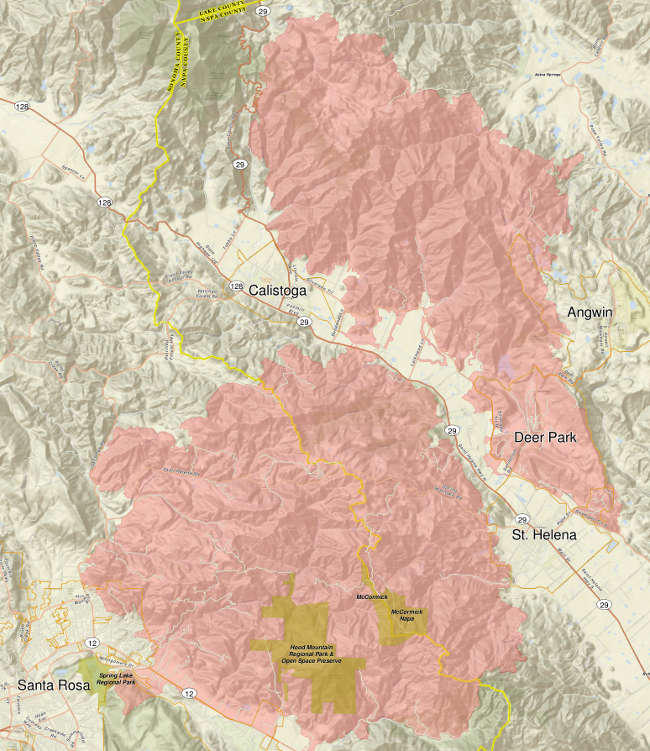
LAKE COUNTY, Calif. – As firefighters continue to push the Glass fire in Napa and Sonoma counties closer to full containment, on Friday evacuation warnings for areas south of Middletown in Lake County were lifted and a stretch of Highway 29 in the fire area was reopened.
Cal Fire said the Glass fire remained at 67,484 acres on Friday, having shown no growth overnight, with containment up by 4 percent to 74 percent.
At 3 p.m. Friday, the Lake County Sheriff’s Office issued an update reporting that, in conjunction with the Glass Fire Incident Management Team, it had rescinded the evacuation warnings for two areas south of Middletown at the Lake-Napa County line.
Those specifically are:
– South of Rancheria Road, east of the Lake-Sonoma County line, north of the Lake-Napa County line and west of Highway 29; and
– South of Mirabel Road, east of Highway 29, north of the Lake-Napa County line, and west of McGuire and Three Peaks ridgeline.
The evacuation warnings for those areas had been issued on Oct. 4 due to the Glass fire approaching Lake County.
The most recent mapping of the fire shows it is less than a mile from the south county border.
Also on Friday, officials said Highway 29 from Bradford Road near Middletown to Tubbs Lane in Napa County has been reopened. It also had been closed due to the fire’s close proximity.
Officials reminded the public to stay vigilant on current fire conditions.
They asked people to drive slowly and yield to emergency personnel in the area.
There also will be smoke in the area as firefighters continue firefighting operations, the sheriff’s office reported.
Email Elizabeth Larson at
- Details
- Written by: Lake County News reports
Thanks to the diligent efforts of the ag community, the workers and Lake County Public Health, there were no major outbreaks of COVID-19 that resulted from pear harvest.
Preventing the spread of COVID-19 in the workplace has been the No. 1 objective in the fields and packing sheds this summer.
Local ag employers were meeting with Lake County’s Public Health Officer Dr. Gary Pace as early as June to prepare for pear harvest.
“Dr. Pace provided great leadership and support,” said Pat Scully of Scully Packing, Lake County’s remaining pear packer. “He held multiple weekly Zoom meetings with ag employers before and during the season with detailed suggestions for precautionary measures.”
Scully added of Pace, “He was committed to avoiding an outbreak and his suggestions were instrumental in avoiding one.”
The outdoor nature of harvesting pears naturally allows for social distancing. Pear farmers put additional precautions in place surrounding break times and congregate living situations for out-of-county crews.
The packing sheds, however, were a larger source of concern, as the effort requires many employees working indoors in close quarters.
Scully Packing made substantial changes this year to mitigate the risk of COVID-19 spread among its employees.
Facility modifications included ventilation systems all through the sheds, vinyl dividers at sorting stations, extra handwashing and sanitizer stations, and a complete redesign of the front office. Face masks were required and provided and family members/carpool groups were assigned to the same work areas.
Trees were removed in the orchard adjacent to the shed to erect two large tents for training and breaks with 150 new picnic tables for required social distancing.
Scully Packing also implemented procedural changes and employee training which helped to prevent an outbreak.
Four infrared facial recognition digital thermometers were purchased to test each employee as they entered the workplace.
On the third day of packing, one family unknowingly came to work with COVID-19 and were stopped after being screened by office staff.
“We immediately sent all three family members who were working, and one who was scheduled to report the next day, home to quarantine until testing could be done,” Scully said.
He said the family members tested positive and were quarantined for the required 14 days.
Thankfully, it was an isolated incident, according to Scully. “While several other people got tested during the season, no other positive cases were reported. We did have several workers who had been identified as close contacts that were kept away from work until their quarantine periods had expired.”
All supervisors and employees received intensive training on COVID-19 prevention, symptoms and procedures. This included payment for lost wages for those with positive tests.
Scully also gives credit to the employees for the success of these measures.
“We had about 450 employees between the two sheds,” Scully said. “Everyone followed the guidelines to protect themselves and their fellow workers. They stayed home and reported when they felt sick, wore their masks constantly, practiced diligent hand washing, respected social distancing rules during breaks, and were conscientious about avoiding social gatherings outside the workplace. Nobody wanted to get sick and we all followed the rules to keep each other well. It worked!”
In his Sept. 22 update to the Board of Supervisors, Dr. Pace praised Lake County’s pear industry.
“We did have some real success over the past few months in the agricultural industry. The pears have been harvested and packed and there were no serious outbreaks there. Many workers came from out of the area, lived in congregate living situations, and worked in the packing sheds or other close quarters. The owners, managers and workers all put a lot of effort into taking steps to control the spread of the virus in these risky settings,” Pace said.
The conclusion of pear harvest coincides with the beginning of winegrape harvest. Winegrape employers have been involved in the meetings with Dr. Pace as early as June and have already employed mitigating measures in the field.
In early September, Scully and Dr. Pace met with winery operators via Zoom to share Scully
Packing’s successful procedures for indoor operations.
The Lake County Ag Department still has masks and sanitation supplies available for ag employers and their employees.
Contact the Lake County Ag Department at 707-263-0217 for more information.