The U.S. population age 65 and older rose by 3.1% to 61.2 million while the population under age 18 decreased by 0.2% to 73.1 million from 2023 to 2024, according to the new Vintage 2024 Population Estimates released by the U.S. Census Bureau.
The data show the population continued to age, with the share of the population age 65 and older steadily increasing from 12.4% in 2004 to 18.0% in 2024, and the share of children declining from 25.0% to 21.5%.
Ongoing growth among the older population, coupled with persistent annual declines in the population under age 18 has reduced the size difference between these two age groups from just over 20 million in 2020 to just below 12 million in 2024.
From 2020 to 2024, the older population grew by 13.0%, significantly outpacing the 1.4% growth of working-age adults (ages 18 to 64), while the number of children declined by 1.7%.
"Children still outnumber older adults in the United States, despite a decline in births this decade,” said Lauren Bowers, chief of the Census Bureau’s Population Estimates Branch. "However, the gap is narrowing as baby boomers continue to age into their retirement years. In fact, the number of states and counties where older adults outnumber children is on the rise, especially in sparsely populated areas.”
As recently as 2020, there were just three states where older adults outnumbered children: Maine, Vermont, and Florida. By 2024, this number had increased to 11, with Delaware, Hawaii, Montana, New Hampshire, Oregon, Pennsylvania, Rhode Island, and West Virginia joining their ranks.
Similarly, from 2020 to 2024, the number of U.S. metro areas with more older adults than children increased from 58 to 112. This represents nearly 30% of the nation’s 387 metro areas. Additionally, in 2024, three metro areas with at least 1 million people (Cleveland, OH; Providence-Warwick, RI-MA; and Hartford-West Hartford-East Hartford, CT) had more older people than younger people for the first time.
In 2020, 31.3% (or 983) of the nation’s 3,144 counties had more older adults than children. This figure increased to almost 45% (1,411 counties) in 2024. In both years, most of these counties had small populations and were located outside of metro and micro areas.
Other highlights
Age and sex:
• In 2024, the U.S. median age reached a new record high of 39.1, up 0.1 years from 2023, and up 0.6 years from 38.5 in 2020. • Regionally, the West (38.4) and South (38.8) had the lowest median ages in 2024; the Northeast had the highest (40.6), followed by the Midwest (39.3). Maine’s population in 2024 was the oldest, with a median age of 44.8; Utah’s was the youngest (32.4). • The median age across all counties in 2024 ranged between 20.9 and 68.1; 74% (2,340 of 3,144) had a median age at or above the median age for the nation. • Women outnumbered men by 3.4 million, making up 50.5% of the U.S. population in 2024.
Race and Hispanic origin:
• Between 2023 and 2024, the Asian population grew the fastest (4.2%), followed by the Hispanic or Latino population (2.9%). • From 2023 to 2024, the Hispanic or Latino population increased by 1.9 million; this gain was larger than the change for all other race and ethnicity groups combined. • The White population was the only population that dropped, declining 0.1% between 2023 and 2024. • While the Hispanic or Latino share of the U.S. total population reached 20% for the first time in 2024, only nine states and 457 counties were at least 20% Hispanic. • The Asian population experienced its largest gains in California, followed by Texas; however, Texas’ annual growth rate (6.9%) was substantially faster than California’s (2.7%).
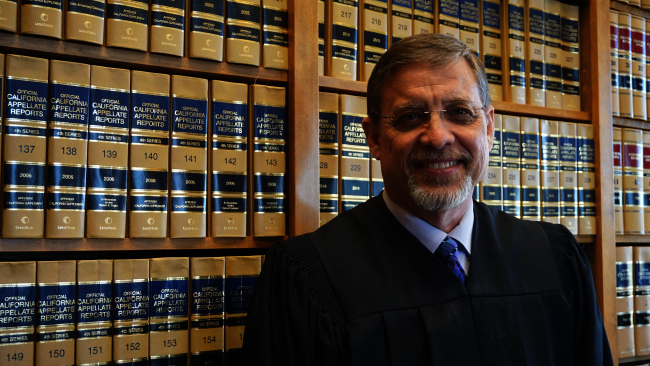
Judge Andrew Blum. Photo by Elizabeth Larson/Lake County News.
LAKEPORT, Calif. — After four decades in the legal profession, including 15 years on the bench, Lake County’s senior Superior Court judge is stepping down.
Judge Andrew Blum announced his plans to retire in early May and last week completed his tenure.
In an interview with Lake County News in his chambers this spring, after he made the decision to retire, Blum explained that he’d been in the legal profession for more than 40 years, mostly as a prosecutor and then, for the last 15 years, as a judge.
“So I think it’s time,” said Blum, who is 65.
In retirement, Blum said he wants to travel, and so far his schedule hasn’t allowed for much of that.
Going with him into retirement is his wife, Yolanda, who has worked for the courts for 29 years, most recently as court coordinator, judicial assistant and senior employee.
“I can’t travel without her,” he said of his wife. “She’s made that clear.”
Blum has no plans to move out of Lake County, where he’s lived for decades, but he does want to be able to visit his three adult children, who are living across the United States, and his grandchildren. This spring his fifth grandchild was born and a sixth is on the way.
He’s also looking forward to doing more work with the Lakeport Rotary and other community organizations of which he is a part.
His last day on the bench as a full-time judge was Thursday, July 3.
“The Fourth of July will be my Independence Day,” he quipped.
However, as many of his predecessors have done, Blum expects to take some judicial assignments as a retired judge at some point in the future, “if they need me.”
That they’ll need him is a given. With his retirement, the Lake County Superior Court has had to make changes to assignments, with the three remaining judges — Shanda Harry, Michael Lunas and J. David Markham — having to shift to take on additional duties.
“We’re going to miss Judge Blum,” said Lunas. “Fifteen years of excellence on the court. It’s going to be missed.”
Lunas, now the longest-serving judge of the Lake County Superior Court bench, has taken over Blum’s duties as presiding judge, a position that rotates through the judicial ranks and involves making decisions about day to day operations in addition to case work. As such, Lunas has worked to shift schedules and assignments to cover for the loss of Blum on a permanent basis.
He said they are planning to bring in visiting judges to assist with handling cases, as there are no longer any retired judges from Lake County hearing cases since David Herrick and Arthur Mann left the program.
Blum’s retirement has triggered a process that began with him notifying the Governor’s Office, which will be responsible for appointing a successor until the next election.
Interested members of the legal community can apply — there is already reported to be at least half a dozen potential candidates in the offing — and the process will be an extensive one.
Blum, who went through it himself, explained that the Commission on Judicial Nominees Evaluation, or JNE, will take several months to thoroughly vet applications. Nine months to a year is the common time frame.
“It’s an important decision. They shouldn’t do it without due thought,” Blum said.
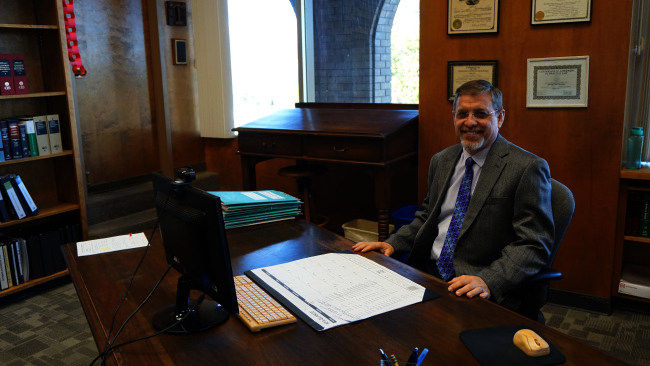
Judge Andrew Blum in his office on the fourth floor of the Lake County Courthouse in Lakeport, California. Photo by Elizabeth Larson/Lake County News.
He received his Bachelor of Arts degree from California Lutheran University in Thousand Oaks, and his juris doctorate degree from the University of California, San Francisco's Hastings College of the Law, where he and Susan Krones — today Lake County’s district attorney — attended law school together.
Blum, who first appeared in federal court in 1982 as a law student, was admitted to the California State Bar in December 1984. That year he began working as a research attorney for the Santa Clara County Superior Court.
In 1985, he accepted a position as a deputy district attorney in the Los Angeles County District Attorney’s Office, where he remained until 1989, the year he accepted a position with the Lake County District Attorney's Office.
From 1989 to 1991, he was a deputy district attorney in Lake County and was promoted to chief deputy district attorney in 1992, serving for five years in that job under then-District Attorney Stephen Hedstrom, who later became a Lake County Superior Court judge.
Blum later moved to Kosrae State, Micronesia, where he worked from 1997 to 2000. There, he first served as assistant attorney general under his friend and former deputy district attorney Richard Martin, who later also became a superior court judge in Lake County. After Martin left Micronesia, Blum took over as attorney general.
Blum left his post in Micronesia in 2000, going on to teach high school English from 2001 to 2002 before joining the Commission on Judicial Performance in 2003. For the next seven years, Blum prosecuted judges accused of misconduct.
In his time on the bench, he’s seen increasing challenges, such as correctional realignment, which resulted in many more people being incarcerated in county jails rather than prisons, as well as legislative changes that impacted sentencing and prison time.
He’s seen the pendulum swing back and forth between incarceration and rehabilitation. Those philosophical differences have resulted in laws continually changing.
“Every time we turn around, the rules have changed. It’s been challenging to keep up with it,” he said. “Once you get used to one set of rules, they change them again.”
He added, “There is less judicial discretion than there once was.”
In considering his tenure, Blum points to developments that he considers important, such as opening veterans and mental health courts to address the unique needs of those populations. Both of those special courts involve treatment and structures with support from multiple agencies. He said the goal is to deal with participants’ problems at core level rather than locking everyone up.
“Mental health court is fairly new still, so the jury’s out on that,” said Blum.
However, he’s received a great response on veterans court, aimed at helping those who served our country and who have a unique set of experiences — and needs.
“It made sense to split those out from the general population,” Blum said. “I’ve had great feedback on how successful that is.”
A community program in which he has participated for several years is Every 15 Minutes, which teaches high school students about the dangers of driving under the influence.
The program reenacts fatal car crashes fueled by drug and alcohol abuse, shows mock arrests and even has the students who are acting out parts in the program make an appearance in Lake County Superior Court. There, they’ve encountered Blum, acting as judge, recounting the crimes that led them there and putting them through the same process that real defendants experience.
“I like that program,” he said, recalling seeing the impact on participants. “It’s just trying to get across to young people, who don’t think about it, the consequence of their actions.”
He’s also participated in the Lake County Mock Trial, and helped get that program off the ground more than a decade ago.
There also have been people who let him know his work mattered to them in a special way.
“People I've sent to prison have sent me letters thanking me,” he said, explaining that he believes they felt they were treated fairly.
He also recalled once coming out of the courthouse one evening when he met an elderly woman on the sidewalk. She looked up at him, asked him if he was a judge and after he said yes, she said he had sent her son to prison.
Just as he was thinking the encounter was about to go bad, the woman thanked him and said it was the best thing that had ever happened.
“That could have gone very differently,” he said, noting that, to this day, that’s the only mother to thank him in that way.
“It’s an adversarial system so it’s not designed for a lot of warm and fuzzy,” he said.
Hedstrom, who retired in 2019 from the bench, offered praise to Blum for his work in the legal community.
“During my time as the Lake County District Attorney, I had the pleasure of working with many outstanding individuals, including several who later became District Attorneys and Judges themselves,” Hedstrom said in an email to Lake County News. “When I made the decision to appoint Andy to the position of Chief Deputy District Attorney, I had complete confidence in his integrity, judgment, and leadership. Andy was my Chief Deputy District Attorney from 1992 to 1997. Throughout his career, Andy has consistently demonstrated judicial temperament. I’ve genuinely enjoyed working with him in the DA’s Office and in the Court. I am honored to have had that opportunity. I sincerely congratulate Andy on his retirement – it’s well-deserved, and I wish him and his family all the best in the years to come.”
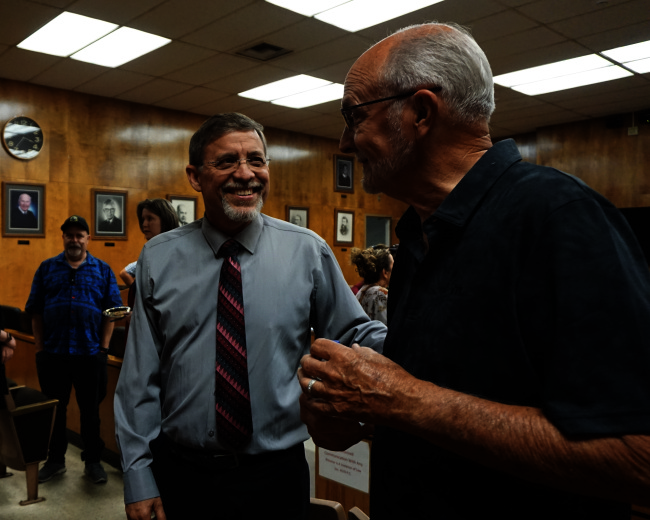
Retiring Judge Andrew Blum, left, speaks with Terry Norton, a retiree from the Lake County Sheriff’s Office Corrections Division, during a retirement reception for Blum on Thursday, July 3, 2025, his last day on the bench as a full-time judge. Photo by Elizabeth Larson/Lake County News.
A heavy caseload
In his 15 years on the bench, Blum and his fellow judges have handled a caseload that can include hundreds of cases per week.
A typical Monday calendar can have as many as 30 preliminary hearings and a dozen sentencings. On the day Lake County News interviewed Blum at the courthouse, he had just conducted nine sentencings that same afternoon and had a dozen file folders stacked on his desk for upcoming trials.
Tuesdays can see the judges working through more than 100 other cases, along with in-custody arraignments. Then, jury trials start on Wednesdays and can continue through the rest of the week, along with more preliminary hearings and arraignments.
“We have a much higher caseload than most courts, big or small,” Blum said, explaining that Lake County has more cases per judge than most counties.
The Judicial Council of California does a survey on caseloads per judge, weighted to type. “We are near the top of the list to get a fifth judge,” said Blum.
However, the State Legislature has to approve the creation of new judgeships. “They don’t do it when there is a budget shortfall, like there is right now,” he explained.
Just up the road, after more than a decade of delays — and the persistent championing of the project by Blum and his fellow judges — the new Lakeport courthouse is rising on Lakeport Boulevard.
At 45,300 square feet, it will triple the room now available to the Superior Court — which is mostly cramped into the 15,000 square feet on the fourth floor of the courthouse on S. Forbes Street. However, there isn’t room for a fifth courtroom to house that much-needed new judge.
That’s despite asking for it, Blum said. “They did not do that for us.”
Lake County’s second courthouse, located in Clearlake, is No. 6 on the list of worst courthouses in the state, with the county the only one to have two courthouses in need of replacement in the top 10.
Blum fought long and hard for the new Lake County courthouse. After 17 years of effort by all of the judges, the new courthouse is expected to be finished until late 2026. He and other judges toured the new building in the spring and noted it’s coming along well.
“When I told the judges I was retiring, they suggested on opening day [of the new courthouse] I should sit on the bench,” he said.
Retiring Judge Andrew Blum, right, and Lake County Superior Court Commissioner John Langan at a retirement reception for Blum on Thursday, July 3, 2025, his last day on the bench as a full-time judge. Photo by Elizabeth Larson/Lake County News.
Challenges and a pandemic
During Blum’s tenure, the Superior Court has had more than the usual challenges and its fill of emergencies.
In 2018, due to the sprawling Mendocino Complex that caused the entire city of Lakeport to be evacuated, Blum — then serving as presiding judge — had to shut down the courthouse. That required the permission of the state Supreme Court’s chief justice.
“That was unprecedented,” said Blum, recounting that in-custody proceedings had to be conducted in Mendocino County.
Two years later, the court’s operations — like the activities of much of the rest of society — were upended by the COVID-19 pandemic.
“COVID was more challenging because the whole world was shut down,” he said.
It led to dramatic changes in court operations for a few years, with more virtual appearances, some of which continue.
With challenges also have come opportunities.
Blum said that in a larger county, a judge may rarely hold the presiding or supervising judge job, nor be involved with making decisions on the executive committee.
With just four judges, “We are the executive committee,” said Blum.
He said of the court, “It’s a good size for being a judge because you have input on everything of significance.”
During his time on the bench, he also taught judicial ethics across the state and served on the Trial Court Budget Committee, which advises the Judicial Council of California.
Asked about memorable cases, Blum said the seven or eight murder trials he’s presided over have all fit that definition.
One of the most notable was the trial in 2020 of Mavrick Fisher, a young deaf man accused of killing another deaf man, Grant David Whitaker, in Humboldt County the previous year. Fisher was alleged to have brought Whitaker’s body to Lake County, where it was found in 2019.
When the case came to trial, the court held the proceedings in the larger space of Phil Lewis Hall at the Lake County Fairgrounds, where jurors, prosecutors, defense and court staff could be spaced apart.
Lewis Hall at that point was adorned with big pictures of roller skates. Blum said that he had fallen and broken his foot and so was getting around Lewis Hall with a scooter.
“I could get going at a pretty good speed so that was pretty memorable,” he said.
Fisher was convicted in November 2020 of involuntary manslaughter and taking a vehicle without permission, while the jury found him not guilty of murder and hung on charges of voluntary manslaughter and assault with a deadly weapon with a special allegation of great bodily injury or death.
Blum sentenced him to four years in state prison the month after the conviction.
A case Blum had to handle with even larger implications was that of Luther Ed Jones Jr.
In early 2016, it came to light that Jones had been falsely accused and then convicted of child molestation after the alleged victim came forward to say her mother, once Jones’ significant other, had pressured her to lie.
Then-District Attorney Don Anderson filed a writ of habeas corpus, and he and attorney Angela Carter, then the head of the county’s indigent defense contract, took the matter to Blum, expecting a hearing process to begin that could have lasted weeks, if not months.
However, after a review of the materials and thorough questioning of Anderson about whether or not he believed Jones was innocent — he did — Blum surprised everyone by immediately ordering Jones to be released.
Carter praised Blum for courage in acting quickly, noting, “He cut through bureaucratic tape in about an hour.”
Blum said he’d never seen a case like Jones’, with a DA telling him a person was innocent.
He recalled telling all involved, “I don’t see the need for a hearing. I’m going to order his immediate release. I don’t want him another day in jail.”
Blum added, “I think they were a little surprised I did it that way.”
That was justified by the circumstances. “I was horrified. I hadn’t seen that in all my years as a prosecutor and judge,” Blum said, adding, “That was a memorable situation for sure.”
It’s a reminder that the system is not perfect, “but overall it’s quite good,” he said.
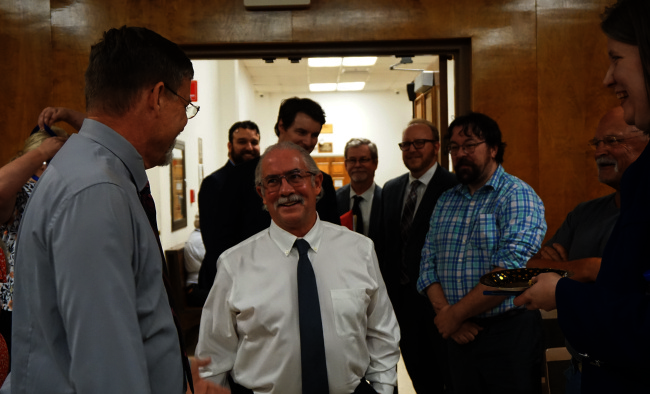
Retiring Judge Andrew Blum, left, speaks with Judge Michael Lunas, center, as current and former members of the District Attorney’s Office look on at a retirement reception for Blum on Thursday, July 3, 2025, his last day on the bench as a full-time judge. Photo by Elizabeth Larson/Lake County News.
A sendoff with praise and friendship
On Thursday, his last day on the bench, Superior Court staff held a farewell reception for Blum in his Department 3 courtroom.
Dropping in to share snacks, stories, a handshake and a hug were staffers from the District Attorney’s Office, Behavioral Health, Victim-Witness, the Lake County Sheriff’s Office, court and security staff, police officers and bailiffs.
Judge Lunas, Superior Court Commissioner John Langan, and supervisors Brad Rasmussen and Bruno Sabatier were there, and retirees including former Chief Deputy District Attorney Rich HInchcliff, former Deputy County Counsel Bob Bridges, also came by.
“The good news is, I’m leaving. The bad news is, I’m taking Yolanda with me,” Blum told Terry Norton, who retired from the Lake County Sheriff’s Office Corrections Division.
There was a great deal of praise for Blum, both as a judge and as a person, with all of those Lake County News spoke to wishing him a happy retirement but being sad at seeing him go.
Senior Deputy District Attorney Ed Borg said he has enormous respect for Blum, who he called both an excellent judge and a stellar human being. Blum’s retirement is “a huge loss for the criminal justice system in Lake County because he’s an excellent judge.”
Borg said Blum is fair, treats people well, follows the law and works hard. When he rules against someone, he tells them why which, from a practical standpoint, is helpful.
Marion Titus, a deputy district attorney, wished Blum nothing but the best, crediting him and his fellow judges for being among the reasons she chose to move to Lake County due to their fairness. She said she hopes Blum’s successor has the same mindset.
“It has been an honor to work in his courtroom,” said Krones, who added that she appreciated Blum’s sense of humor and work ethic. “I just think the world of him.”
She is sad to see him retire, but hopes he will enjoy his retirement and the travel he wants to do.
Across the room, Blum and Bridges reminisced about their early days in Lake County Superior Court, when there was just one judge — John Golden, whose portrait was among the seven on the wall staring down on the assembly. Blum’s own portrait will join that collection in the near future.
Bridges recalled Golden’s nickname — “Jammin’ John” — because of his speed and efficiency in running the court.
Bridges believes Golden influenced the quality of the current bench of superior court judges.
“That’s a fair statement,” said Blum.
During the interview in his office with Lake County News weeks before his final days on the bench, Blum was asked what people should know about his profession.
He replied that, despite what they may hear in the public or media, “The system’s really geared towards being fair and letting everyone have a chance to be heard.”
That extends from the jurors — who over the years have impressed Blum with the time and attention they dedicate to their service — to the rest of the people who work in the system.
He was also asked about the encouragement Judge Mann had offered him before he took the bench 15 years ago, telling him that he was going to love the job of judge.
Was Mann right?
“For the most part, it’s true,” Blum said. “Overall, I have enjoyed being a judge. I've tried to be the best judge I could be, to be fair to all sides. There are moments when I would say I did not love it.”
However, he added, “I wouldn’t have done it this long if I hadn’t loved it.”
Email Elizabeth Larson at This email address is being protected from spambots. You need JavaScript enabled to view it.. Follow her on Twitter, @ERLarson, and on Bluesky, @erlarson.bsky.social. Find Lake County News on the following platforms: Facebook, @LakeCoNews; X, @LakeCoNews; Threads, @lakeconews, and on Bluesky, @lakeconews.bsky.social.
LAKE COUNTY, Calif. — Fires around Lake County kept firefighters particularly busy on Saturday.
Shortly after 10:30 a.m. Saturday a fire was reported in the 1500 block of East Highway 20 near the Pomo Pumps gas station in Nice.
Northshore Fire, Lakeport Fire and Cal Fire were dispatched to the incident, called the Pomo fire, with Cal Fire sending aircraft that helped contain the fire.
While structures were reported to be threatened initially, not were damaged based on scanner reports, with the blaze running into an area that had burned earlier this year.
Cal Fire said the incident was contained at 16 acres just an hour after dispatch. The cause remains under investigation.
Then, at around 2:45 p.m., a fire was reported at Highland Springs reservoir.
Witnesses reported the fire was started by juveniles with fireworks, and supplied authorities with pictures of them.
Two groups of juveniles were seen leaving, one group running for cover in trees, another group trying to walk out of the area, according to radio traffic.
The 200-foot by 100-foot fire was quickly contained, based on radio reports.
Later, shortly after 11 p.m., firefighters were dispatched to the 13000 block of Manakee Avenue in Clearlake on the report of a residential structure fire.
Firefighters arriving on scene minutes later reported that another two structures had caught fire, with power lines down and some wildland also involved.
Just after 11:20 p.m., firefighters reported over the scanner that they had contained the fires in the first two structures and had knocked down the wildland fire.
The fire in the third structure was contained just after 12:30 a.m., with reports from the scene indicating there would be several hours of mop up.
Email Elizabeth Larson at This email address is being protected from spambots. You need JavaScript enabled to view it.. Follow her on Twitter, @ERLarson, and on Bluesky, @erlarson.bsky.social. Find Lake County News on the following platforms: Facebook, @LakeCoNews; X, @LakeCoNews; Threads, @lakeconews, and on Bluesky, @lakeconews.bsky.social.
LAKE COUNTY, Calif. — Lake County Animal Care and Control has many dogs of all sizes and many breeds ready for adoption this week.
The dogs available for adoption this week include mixes of Chihuahua, German shepherd, husky, Labrador Retriever, pit bull terrier, Pomeranian, terrier and shepherd.
Dogs that are adopted from Lake County Animal Care and Control are either neutered or spayed, microchipped and, if old enough, given a rabies shot and county license before being released to their new owner. License fees do not apply to residents of the cities of Lakeport or Clearlake.
Those animals shown on this page at the Lake County Animal Care and Control shelter have been cleared for adoption.
Call Lake County Animal Care and Control at 707-263-0278 or visit the shelter online for information on visiting or adopting.
The shelter is located at 4949 Helbush in Lakeport.
Email Elizabeth Larson at This email address is being protected from spambots. You need JavaScript enabled to view it.. Follow her on Twitter, @ERLarson, and on Bluesky, @erlarson.bsky.social. Find Lake County News on the following platforms: Facebook, @LakeCoNews; X, @LakeCoNews; Threads, @lakeconews, and on Bluesky, @lakeconews.bsky.social.
Sky chart showing Mercury and Mars in the western sky following sunset in early July. NASA/JPL-Caltech.
What’s up for July? Mars shines in the evening sky, 60 years after its first close-up, Venus brightens your mornings, and the eagle soars overhead.
First up, Mercury is visible for a brief time following sunset for the first week of July. Look for it very low in the west 30 to 45 minutes after sundown. It sets within the hour after that, so be on the ball if you want to catch it!
Mars is visible for the first hour or two after it gets dark. You'll find it sinking lower in the sky each day and looking a bit dimmer over the course of the month, as our two planets' orbits carry them farther apart. The crescent Moon appears right next to Mars on the 28th.
July is the 60th anniversary of the first successful flyby of Mars, by NASA’s Mariner 4 spacecraft in 1965. Mariner 4 sent back the first photos of another planet from deep space, along with the discovery that the Red Planet has only a very thin, cold atmosphere.
Sky chart showing Venus in the morning sky in July. NASA/JPL-Caltech.
Next, Saturn is rising late in the evening, and by dawn it's high overhead to the south.
Looking to the morning sky, Venus shines brightly all month. You'll find it in the east during the couple of hours before sunrise, with the Pleiades and bright stars Aldebaran and Capella. And as the month goes on, Jupiter makes its morning sky debut, rising in the hour before sunrise and appearing a little higher each day.
By the end of the month, early risers will have the two brightest planets there greeting them each morning. They're headed for a super-close meetup in mid-August, and the pair will be a fixture of the a.m. sky through late this year. Look for them together with the crescent moon on the 21st and 22nd.
Sky chart showing the shape and orientation of the constellation Aquila in the July evening sky. Aquila's brightest star, Altair, is part of the Summer Triangle star pattern. NASA/JPL-Caltech.
Aquila, the eagle
From July and into August, is a great time to observe the constellation Aquila, the eagle.
This time of year, it soars high into the sky in the first half of the night. Aquila represents the mythical eagle that was a powerful servant and messenger of the Greek god Zeus. The eagle carried his lightning bolts and was a symbol of his power as king of the gods.
To find Aquila in the sky, start by locating its brightest star, Altair. It’s one the three bright stars in the Summer Triangle, which is super easy to pick out during summer months in the Northern Hemisphere. Altair is the second brightest of the three, and sits at the southernmost corner of the triangle.
The other stars in Aquila aren’t as bright as Altair, which can make observing the constellation challenging if you live in an area with a lot of light pollution. It’s easier, though, if you know how the eagle is oriented in the sky. Imagine it’s flying toward the north with its wings spread wide, its right wing pointed toward Vega. If you can find Altair, and Aquila's next brightest star, you can usually trace out the rest of the spread-eagle shape from there. The second half of July is the best time of the month to observe Aquila, as the Moon doesn't rise until later then, making it easier to pick out the constellation's fainter stars.
Observing the constellation Aquila makes for a worthy challenge in the July night sky. And once you're familiar with its shape, it's hard not to see the mythical eagle soaring overhead among the summertime stars.
Preston Dyches works for NASA's Jet Propulsion Laboratory.
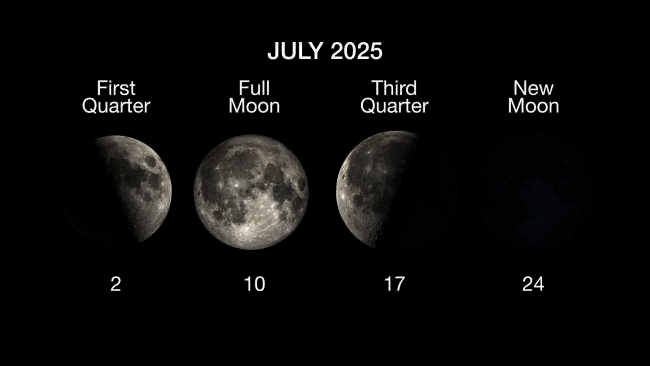
The phases of the Moon for July 2025. NASA/JPL-Caltech.
Enjoying the fireworks show in Lakeport, California, on the evening of Friday, July 4, 2025. Photo by Lingzi Chen/Lake County News.
LAKEPORT, Calif. — Thousands of people packed into the city of Lakeport for its annual July 4 celebration on Friday.
The day was marked by a variety of activities and vendors.
The event culminated in the nighttime fireworks display over Clear Lake.
If you missed the celebration in Lakeport, don’t worry, there’s more to come on Saturday.
Clearlake’s daylong celebration will begin with the parade on Saturday morning, continuing through the day and ending with the fireworks display.
On Saturday evening there will be fireworks in Lakeport at Konocti Vista Casino and at the Lakeport Speedway following racing action.
More details on the Saturday evenings are below.
A sailboat passes Library Park in Lakeport, California, on the evening of Friday, July 4, 2025. Photo by Lingzi Chen/Lake County News.
SATURDAY, JULY 5
CLEARLAKE
Redbud Parade and Festival
The Lakeshore Lion’s Club of Clearlake is sponsoring its 67th annual Redbud Parade and Festival.
The parade will start at Redbud Park at 11 a.m. on Saturday, July 5, and will proceed down Lakeshore Drive to Austin Park.
The theme of this year’s parade is “Cruising the 50s.”
The event will feature local marchers, marching bands, decorated floats, vintage cars, parade and show horses, fire and police vehicles, and much more.
The city of Clearlake will host a free concert showcasing Dylan Schneider at 7 p.m.
The Lakeshore Lion’s Club will sponsor the firework display at dark.
LAKEPORT
Konocti Vista community fireworks show and party
Konocti Vista Casino will hold its free community fireworks show.
The evening will begin with a party at 6 p.m. featuring vendors, food, a DJ and bar, with the Fun Zone Arcade open indoors.
Fireworks start at dusk, approximately 9:30 p.m. They can be viewed from the marina and parking lot.
Konocti Vista is located at 2755 Mission Rancheria Road.
Lakeport Speedway fireworks display
Lakeport Speedway will host its annual fireworks display following an evening of racing on Saturday, July 5.
Grandstands open at 5 p.m. with racing at 7 p.m. and fireworks to follow.
The committee assigned to draft the Declaration of Independence, from left: Thomas Jefferson, Roger Sherman, Benjamin Franklin, Robert R. Livingston and John Adams. Currier & Ives image, photo by MPI/Getty Images
Right around the Fourth of July, Americans pay renewed attention to the country’s crucial founding document, the Declaration of Independence. Whether Republican or Democrat or independent, some will say – with reverence – that adherence to the values expressed in the declaration is what makes them American.
President Barack Obama, in his second inaugural address, gave voice to this very conviction.
“What binds this nation together,” he stated, “is not the colors of our skin or the tenets of our faith or the origins of our names.” What truly makes Americans American, he resolved, “is our allegiance to an idea, articulated in a declaration made more than two centuries ago.”
The declaration still stands today as a manifesto. There are its lofty, “self-evident” principles, of course: that “all men are created equal” and that they are “endowed by their Creator with certain unalienable Rights” such as “Life, Liberty and the pursuit of Happiness.”
But I’m a historian of the early republic, and I wish to remind you that the declaration doesn’t just go all pie in the sky. And it’s more than an academic paper waxing on and on about the fashionable philosophical doctrines of the 18th century – freedom and equality – or the coolest philosopher ever, John Locke.
The declaration provides a realistic depiction of a wounded society, one shivering with fears and teetering on the brink of disaster.
The declaration has been central to American identity; here, a 1942 poster, printed during World War II, reminds Americans of its history.Smith Collection/Gado/Getty Images
Repeated injuries and usurpations
On June 11, 1776, the Continental Congress asked five of its members to prepare a text that would notify the British king and his Parliament of America’s firm intention to get a divorce.
The drafting committee comprised Benjamin Franklin of Pennsylvania, John Adams of Massachusetts, Roger Sherman of Connecticut, Robert R. Livingston of New York, and a man who had a stellar reputation as a gifted writer, Thomas Jefferson of Virginia.
The committee was smitten by the clarity and effectiveness of the document. Other than suggesting a few corrections, Jefferson’s colleagues were elated by the text.
The Continental Congress promptly received the document, discussed it, made a handful of alterations, and in the late morning of July 4, 1776, adopted it.
Late that night, Philadelphia printer John Dunlap was given the historic task of issuing the first copies of the final Declaration of Independence.
In retrospect, all of this may sound like a tale of fearless heroes eager to break the chains of oppression and single-handedly affirm their boundless love of freedom.
However, when Thomas Jefferson took the pen in his hand, he didn’t think of himself as a hero. Rather, looking ahead at the immediate future and the drama that would inexorably unfold, he felt overwhelmed. A war, pitting brethren against brethren, the Colonists against their mother country, had already started.
We Colonists thought we were free, the logic of the declaration goes, but now we are waking up to the dismal realization that the king and the Parliament treat us like their personal slaves.
Jefferson’s words appear to longingly express how wonderful it would be for “one people” not to be put in the condition to “dissolve the political bands which have connected them with another.” How desirable it would have been if a way to renew “the ties of our common kindred” could be found.
Unfortunately, what Jefferson calls “repeated injuries and usurpations” have created enemies out of a common ancestry, thus stifling the “voice of justice and of consanguinity.”
How not to grieve at these “injuries”? The king is guilty for “abolishing our most valuable Laws”; he has “excited domestic insurrections amongst us”; he has sent “Officers to harass our people”; he has obstructed “the Laws for Naturalization of Foreigners”; and he has “made Judges dependent on his Will alone.”
Americans didn’t seek a revolution, the declaration concludes, but Colonists must accept “the necessity” of a separation: “Such has been the patient sufferance of these Colonies; and such is now the necessity which constrains them to alter their former Systems of Government.”
Painter N.C.Wyeth’s depiction of Thomas Jefferson writing the text of the Declaration of Independence.Bettman/Getty Images
‘Forget our former love for them’
Americans today may believe that the Declaration of Independence belongs to them – which it does. The declaration is an American document.
But to an even larger extent, it belongs to Thomas Jefferson. It’s a Jeffersonian document.
For him, human beings should not live as isolated atoms in constant competition against each other. Jefferson was a communitarian, which means that he believed that the very happiness voiced in the declaration could occur only when individuals regard themselves as functional parts of a larger whole made of other human beings.
The declaration was built upon the tenet that, as Jefferson would explain many years later, “Nature hath implanted in our breasts a love of others, a sense of duty to them, a moral instinct in short, which prompts us irresistibly to feel and to succour their distresses.”
In Jefferson’s account, this king has carried out the supreme betrayal – like tyrannical powers often do. He has stabbed the Americans as well as the British. He has split them into antagonistic parties. And we Americans, as Jefferson wrote in a telling passage of the declaration that didn’t survive revisions, “must endeavor to forget our former love for them.”
The American nation was born of the traumatic experience of an amputation. It’s a residual half of a former whole that one way or another managed to learn to become a whole again.
But after 250 years, America appears once more a people who seem to have lost what binds them together. Those “political bands which have connected them with another” are being tested; “the ties of … common kindred” are frayed.
Such words describe a time, centuries ago, of great uncertainty, fear and sadness. It seems America has arrived yet again at such a time.

 How to resolve AdBlock issue?