How to resolve AdBlock issue?
News
- Details
- Written by: Lake County News reports
Just after 10 a.m. Sunday, authorities said a Cal Fire law enforcement prevention officer on Highway 162 approximately half a mile from the intersection of Highway 101 contacted an adult male who reported being the victim of an armed robbery which had occurred approximately 20 minutes prior.
The adult male told the officer that three to four subjects armed with assault weapon-style rifles and dressed in body armor had fled, possibly southbound, on Highway 101 in a black Chevrolet Tahoe and gray Toyota Tacoma, officials said.
This information was broadcast by radio to on-duty personnel with the Mendocino County Sheriff's Office, California Highway Patrol and Ukiah Police Department.
A Mendocino County Sheriff's Office sergeant was on routine patrol on Highway 20 east of Potter Valley when he saw two vehicles matching the suspect vehicle descriptions, the sheriff’s office said.
He attempted a traffic stop on the black Chevrolet Tahoe, which failed to stop and instead accelerated to speeds over 100 miles per hour. Authorities said a vehicle pursuit was initiated with the assistance of the California Highway Patrol.
The Chevrolet Tahoe continued several miles eastbound on Highway 20 before making a U-turn and heading westbound on Highway 20 for a short time before turning onto a rural parcel of property near Mile Post Marker 41, which was on the east side of the highway, officials said.
The Chevrolet Tahoe continued along a dirt road in poor condition which led up into the wooded hillside. Fearing an ambush, the patrol sergeant discontinued the pursuit and began to establish a search perimeter, the sheriff’s office said.
During the Chevrolet Tahoe pursuit, officials said a deputy responding to assist the sergeant was able to conduct a traffic stop on the Toyota Tacoma.
Authorities said the deputy identified the driver as Jesus Estevan Vargas Jr., 41, of Moreno Valley, and a subsequent investigation resulted in his arrest in connection with the reported armed robbery.
During the establishment of the search perimeter, authorities said the sergeant learned of a possible exit point to the east along Highway 101. The sergeant took a position at this eastern location to intercept the Chevrolet Tahoe.
A short time later a few gunshots were heard and then a person was heard screaming. Sometime thereafter, law enforcement personnel on the search perimeter were contacted by two adult males. The sheriff’s office said the deputies learned the adult males had been kidnapped during the armed robbery and had been bound by zip-ties and their heads covered by some type of material.
They reported the Chevrolet Tahoe had become disabled on the dirt road and one of the adult male victims was shot in the back while trying to escape. The sheriff’s office said the adult victims reported the two subjects fled on foot, were armed with assault-style rifles and clothed in body armor.
The adult male victim with the gunshot wound to the back of his shoulder was transported by air ambulance to an ouT-of-county hospital for medical treatment, the sheriff’s office said.
Based upon the circumstances of the situation, officials said a request was made for the Mendocino County Multi-Agency SWAT team who later arrived on the scene.
The SWAT team utilized the armored citizen rescue vehicle and drove to the area of the disabled Chevrolet Tahoe. At the same time, H-14, a CHP Helicopter, began providing aerial assistance to the SWAT team.
As H-14 conducted overflight operations its crew was able to locate one of the armed subjects in the wooden terrain uphill from the disabled Chevrolet Tahoe. The sheriff’s office said this subject disarmed himself and surrendered to the SWAT team by walking downhill to their position.
The sheriff’s office said H-14 continued overflight operations and located the second subject nearby to where the first subject initially was observed. H-14 was able to see that the second subject was armed with a handgun and rifle.
Sometime thereafter, several gunshots were heard which were attributed to the second subject and H-14 continued to observe his location, officials said.
During this time H-14 radioed to the SWAT team that the suspect had possibly suffered a self-inflicted gunshot wound but was still making body movements which showed he was alive and still a potential danger as he was still armed, the sheriff’s office said.
As H-14 began to exhaust its fuel, a mutual aid request was sent to the Sonoma County Sheriff's Office for its helicopter Henry-1, which subsequently arrived on the scene. The sheriff’s office said that when H-14 left for refueling, Henry-1 assumed overflight operations and assisted SWAT team members in safely approaching the second subject.
At this time, H-14 was able to return to the scene to provide further assistance as Henry-1 was exhausting its fuel, officials said.
The sheriff’s office said the SWAT team was able to take the second subject into custody and noticed he needed immediate medical treatment due to a self-inflicted gunshot wound to his head.
A SWAT team medic began life-saving treatment and the second subject was immediately transported by sheriff's office vehicle to the staging area near Highway 101 where an ambulance and H-14 were waiting. Authorities said the second subject was prepped for flight and H-14 transported him to an out-of-county hospital for medical treatment.
Sheriff's detectives are conducting ongoing investigations at this time into the reported robbery and kidnapping, the sheriff’s office said.
At the time of the sheriff’s office’s Sunday report, it appeared that the robbery and kidnapping were connected to a marijuana sale/purchase transaction between the involved individuals.
One law enforcement member experienced a heat-related emergency at the conclusion of the several-hour-long event and had to be transported to Adventist Health-Ukiah Valley by ambulance where he was treated/released, the sheriff’s office said.
Authorities said there were no other law enforcement injuries and no shots were fired by law enforcement personnel during the incident/operation.
The Mendocino County Sheriff's Office thanked Cal Fire, CHP, the Sonoma County Sheriff’s Office, Ukiah Police Department, MedStar Ambulance and Potter Valley Fire Department for their assistance during this incident/operation.
- Details
- Written by: BETSY LADYZHETS
This past week, the United States passed 200,000 deaths due to COVID-19. When Dr. Deborah Birx predicted this death toll back in March, the high number was called alarmist; now, it is a sad reality for thousands of families who have lost their loved ones in this pandemic.
The novel coronavirus continues to rage across the country. K-12 schools in many states are open for in-person learning and college students have returned to campus – but schools like the University of North Carolina at Chapel Hill have already sent students back home due to rampant outbreaks.
Cases are rising in the Midwest, specifically in South Dakota and Wisconsin, according to the COVID Tracking Project at The Atlantic.
Though testing is trending up in some regions, the increasing use of antigen tests makes it difficult to determine accurate counts.
As has been true throughout America’s COVID-19 history, every state – and even every county – has its own COVID-19 story, driven by local policies and behaviors.
To help you see how your region compares, Stacker has developed two national data visualizations which present the state of COVID-19 infection rates in America right now.
The state-level visualization uses data from the COVID Tracking Project at The Atlantic, a volunteer project, which compiles COVID-19 case, testing, and outcomes figures from state public health agencies.
The county-level visualization uses data from The New York Times’ COVID-19 data repository, which includes case and death values compiled from state and local health agencies.
Both visualizations rank geographic regions according to their current infection rates, calculated by summing the region’s case count for the past week (Sept. 15 to 21), then dividing by the region’s population (using population data from the U.S. Census’ 2018 American Community Survey).
The visualizations also include data on current death rates, positivity rates, and hospitalizations at the state level.
County-level test positivity data are taken from the Center for Medicare & Medicaid Services’ county testing dataset, and are as of Sept. 9, the most recent date available.
- Details
- Written by: Elizabeth Larson
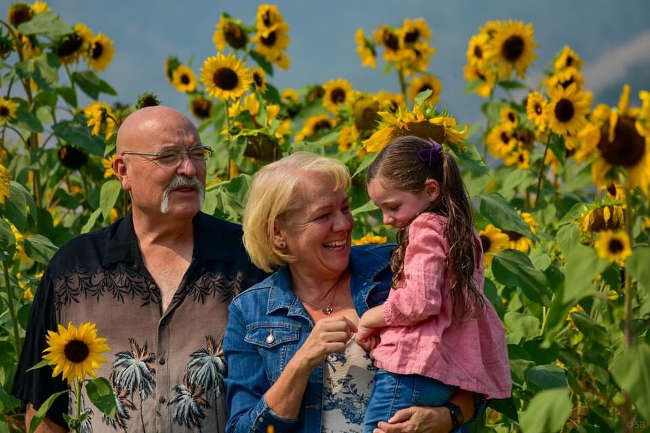
LAKE COUNTY, Calif. – A longtime Lake County resident who has for decades been a devoted mom to an ever-increasing number of children through foster care and adoption is being honored for her work.
Congressman Mike Thompson announced that his nominee, Denice Solgat of Cobb, has been chosen as the 2020 “Angel in Adoption” for California’s Fifth Congressional District.
The Angels in Adoption Program is run by the Congressional Coalition on Adoption Institute and honors people and organizations that promote strong adoption, permanency and child welfare programs across the county.
Each year they recognize individuals who are dedicated to these issues and make a deep national impact.
“Denice represents the very best in foster parents, having fostered more than 300 children over the past 25 years and adopting 11. She is particularly adept at helping medically fragile and special needs children who can get otherwise passed over by foster parents,” said Thompson. “She’s made a measurable difference in the lives of so many and I am proud that she has been selected as this year’s Angel in Adoption for our district.”
Solgat said the award is “an amazing honor.”
She calls her work with foster children “a grand adventure.”
Solgat said she’s always been a “kid person,” beginning to babysit when she was just 10 years old. “I’ve always been somebody kids migrate to.”
She spent part of her childhood in Marin County before her family moved to Lake County in 1978. She attended Kelseyville schools and Mendocino College.
When Solgat was a child, she said her aunt was a foster mom. Doing such work provided her aunt with a way to stay home yet bring in a second income.
So like her aunt, when Solgat first started into foster care 28 years ago, it also was a way for her to earn some extra income while she and husband, Dave, raised their three biological children.
“It just evolved into a passion, a very great passion, and something our family is very good at,” she said.
As a result of years of experience and a team of care providers who support her family, they are now able to accept with open arms and open hearts whatever child needs them.
Over the past 25 years, she’s seldom had an empty bed in her home, where she takes a maximum of six foster children at any given time. She’s quick to point out that doesn’t mean there are only six children around at once, as she still has grandchildren and extended relations coming over to hang out on a regular basis.
Between placements, she said she takes a break to refuel and recharge her family, as she acknowledges that it takes a lot of energy from everyone to incorporate a new member.
Most of the children she fosters are reunited with their families, Solgat said. “That’s the nature of the business.”
Typically, the county tries to reunify families within 18 months, preferably 12 months. “Sometimes it works, sometimes it doesn’t,” Solgat said.
“Going to foster care is a timeout for your whole family,” she said, explaining that her family is a safety net and a time out for other families to reset priorities and to heal.
Solgat said the majority of times it works thanks to lots of good social workers and families working hard to make positive things happen.
The Solgat family specializes in serving children that are medically fragile with sometimes health complexities.
They’ve been known to travel across the country to find medical solutions for children with serious health issues.
The intricate care network Solgat has developed to support the medically vulnerable and special needs children she fosters includes relationships with agencies from the California Children’s Services, to UCSF, to the Children’s Hospital Oakland.
Solgat also credits a team of local health care providers – including Marlene Quilala, a pediatrician at Lake County Tribal Health, and Ruby Carlson at Riviera Dental – for providing a key part of her family’s foster parenting structure.
When you have long-term relationships with medical providers you’re able to communicate at a different level, Solgat said.
The Solgats have also had to face the challenges that come with wildland fires, including days-long evacuations such as the one they faced when leaving their Cobb home during the 2015 Valley fire.
“We have quite the contingency evacuation plan,” she said.
“We tend to just go calmly and with grace, and put it all in the God box and play lots of Uno,” she added.
Solgat said they treat evacuations like camping adventures. “Retreating means that we’re just going camping and we don’t know when we’re coming back and it’s a grand adventure,” she said. “It certainly adds another dimension of challenge.”
When word gets out that her family has an opening, she said she’ll get calls not just from Lake County but from Mendocino and Sonoma counties.
“The counties are really trying to do the right fit placement, and that’s a luxury,” she said, explaining that a home like hers that specializes with an established team for medically fragile kids is unique.
“Finding the right fit is so important for everybody involved,” she said, adding that it prevents foster parent and social worker burnout.
She said her husband Dave is “full-time Mr. Mom.”
About 23 years ago, she started work at Mendocino College’s Lake Center. “He came home to stay home with the kids. We traded places for health insurance.”
She serves as the center assistant at the college’s Lake Center in Lakeport. “It’s just another mom role,” in which she said she nurtures students and helps them navigate the complexities of the system.
The Solgats’ oldest daughter, Jacqueline Solgat, is now a foster provider in Lake County; her special niche is working with newborn babies.
“I can’t do babies anymore, I need my sleep at night,” Denice Solgat said.
In addition to the children they’ve adopted, Solgat said they regularly hear from about 20 others who have been reunified with their families but still like to keep in touch because they appreciated her family’s efforts on their behalf.
One thing she hears a lot from them is, “I wish I would have listened to you.”
“I have to believe that the kids are going to take from you what they can,” and apply it in their own time, she said.
For people who have an interest in helping children and the capacity to do it, Solgat encourages them to consider being foster parents.
“There’s a desperate need for foster homes, continually,” not just locally but statewide, she said.
Solgat said the county of Lake is now certifying its own foster homes.
Interested individuals can contact Lake County Social Services, 707-262-0235, for more information.
Email Elizabeth Larson at

- Details
- Written by: Kathleen Scavone

LAKE COUNTY, Calif. – Finally! As I write this, our favorite star, the sun is shining brightly in our beautiful, blue Lake County skies once again.
After living in a sepia-colored, smoky world for so long I began paying attention to the diversity of yellow flora and fauna in the surrounding landscape now.
Those who study color psychology tell us that the color yellow solicits our attention more than almost any other color.
Yellow is said to be the shade of cheerfulness and contentment; of hopefulness, creativity along with inspiration. The happy-face color is also the color of vibrant lemons and cheerful daffodils.
Yellow tarweed makes itself known before it is even seen, through its piquant scent that clings to clothes if you happen to brush against it as you wander by. If you touch it you'll have sticky fingers for some time to come.
According to Calscape, the California Native Plant Society guide there are 51 kinds of tarweed native to California, and most are yellow or white in color.

These summer-to-fall blooming flowers have earned their name due to the secretions that coat their leaves and stems.
The special coating plays several important roles. One is that it aids the plants in retaining moisture during the heat of the day, thereby rendering them drought-tolerant, and another is that tarweed's coating keeps them from being eaten by insects or animals.
There are studies that show that some tarweed species attract insects by causing them to adhere to the plants' sticky coating then in turn, allow yet another kind of insect to dine on the tarweed victims who are stuck. This clever ability causes a decline in insects that are undesirable to the tarweed.
Some varieties of the plant were used by native peoples when they harvested the seeds to make pinole.
The book, “California Indians and their Environment” by Kent G. Lightfoot and Otis Parrish, explains that seeds from some tarweed varieties were stored raw, for use during the year when they could be cooked and pounded prior to consumption.
Is there any flower more cheering than the pollinator-friendly sunflower? These butter yellow beauties attract a large variety of both native bees and honey bees along with other pollinators such as moths and butterflies, all while producing delicious and nutritious seeds for human and avian consumption.
The Great Sunflower Project is a great way to investigate this humble plant as well as to contribute to citizen science. The organization has more than 100,000 members and has a handy set of bee identification cards for those who are interested and curious.
Native sunflowers, which grow in spring, and are smaller in stature, are also terrific pollinator-friendly plants and were used as a food source for native peoples.
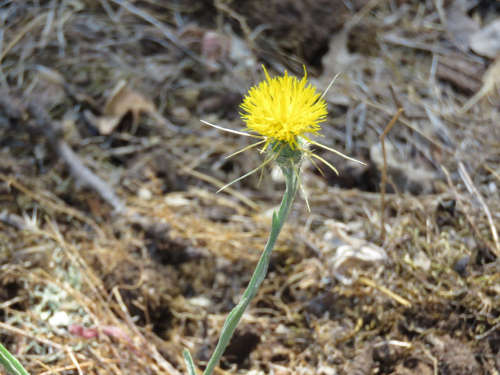
A familiar but invasive yellow plant is the starthistle, a noxious weed that probably arrived in California during the Gold Rush era by fastening itself to alfalfa seed. This spiky plant originated in Turkey or Greece.
The release of a particular type of weevil – along with control burns and herbicides in some areas – has somewhat reduced the onslaught of starthistle plants. Its mellow yellow color, along with the fact that it attracts honey bees, is not reason enough to like this plant, since it takes over and crowds out native plant populations and is poisonous to horses.
I've never met a bird I didn't like, and the lesser goldfinches that congregate at my feeder always put a smile on my face. They are found in open woodlands in the oaks, cottonwoods and willow trees where they consume a variety of seed types.
These diminutive yellow and black songbirds use their sturdy bills to pry open seeds but sometimes complement their diet with plant lice.
The primary color of yellow may influence your mood and your thinking – it may even determine your snack choice by persuading you to dine on some delectable golden, locally grown pears and apples.
Kathleen Scavone, M.A., is a retired educator, potter, freelance writer and author of “Anderson Marsh State Historic Park: A Walking History, Prehistory, Flora, and Fauna Tour of a California State Park” and “Native Americans of Lake County.”