 How to resolve AdBlock issue?
News
- Details
- Written by: Elizabeth Larson
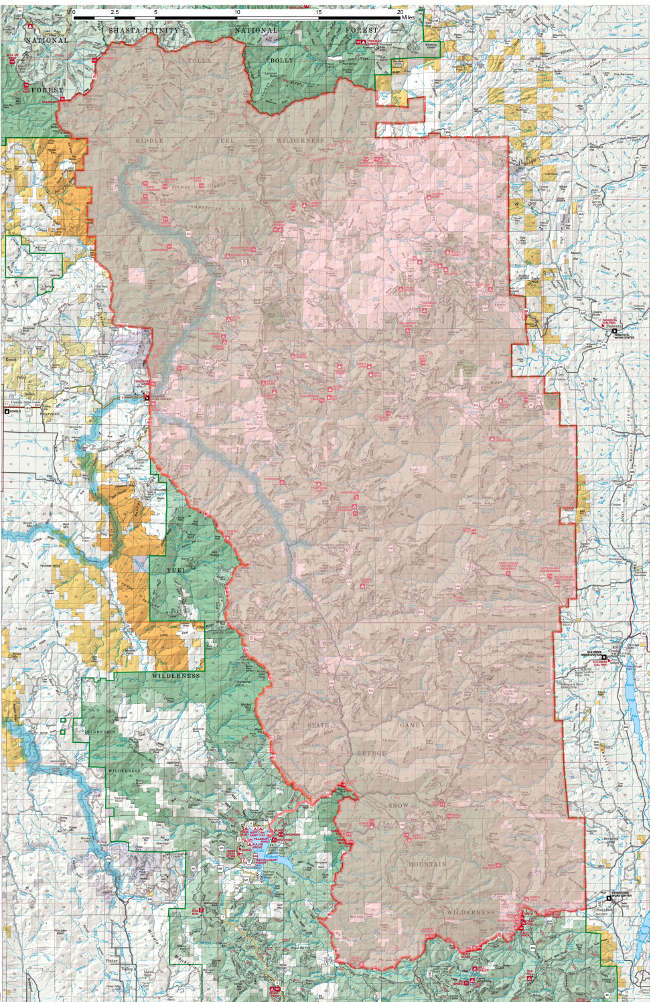
The August Complex had grown to 143,663 acres and 6-percent containment as of Friday night, according to the US Forest Service.
The complex is made up of 32 fires that have burned into 20 larger fires, officials said.
The Forest Service said 353 firefighters and 69 overhead personnel, 29 engines, two helicopters, five bulldozers, seven water tenders and six fire crews are assigned.
Officials said the Tathum and Cold Springs fires – located four miles west of Paskenta – have merged. The Forest Service is working in tandem with Cal Fire, which is constructing dozer lines along County Road 306 to protect the private homes and properties.
Mendocino National Forest officials said they have implemented a temporary area closure for the August Complex effective Friday.
The closure is to provide for firefighter and public safety due to extreme fire behavior and hazards associated with the complex, officials said.
“We understand it is hunting season and people want to go hunting and camping,” Forest Supervisor Ann Carlson said in a Friday statement. “However, this closure is necessary to ensure no one is injured within or near the fires or that visitors enter areas and find their egress compromised by dangerous fire activity. It will also help keep fire personnel safe while working on and near roads in order to contain the fires.”
Although this is a sizable closure and all National Forest System lands, inclusive of roads, trails, and campgrounds within the closure area will be closed until the hazards can be reduced to an acceptable level, officials said much of the forest remains open.
Officials ask visitors to please remember good camping etiquette and pack out everything that you pack in.
Email Elizabeth Larson at
- Details
- Written by: Lake County News reports
Air Pollution Control Officer Doug Gearhart said the smoke and haze visible around Lake County has so far remained outside of the populated areas of the Lake County air basin.
However, winds are expected to start shifting which could result in smoke from the Walbridge fire in Sonoma County, the LNU Lightning Complex in Lake, Napa, Yolo and Solano counties, and the August Complex in the Mendocino National Forest settling into the Lake County air basin.
All areas of Lake County may experience periods of “moderate” to “unhealthy” conditions primarily starting Saturday, depending on the wind, Gearhart said.
Gearhart said regional wind patterns are forecast to start moderate changes beginning overnight into Saturday. This forecast is based on the latest weather, monitoring, fire activity information and will be updated as necessary.
The district is actively monitoring the smoke impacts throughout the county. Go to www.lcaqmd.net and follow the link to “Current Air Quality Index at: purpleair.com” for current particulate levels around the county.
Current particulate levels in Lake County are in the range from “good” to “moderate.” Should particulate levels reach “unhealthy” levels, everyone needs to take steps to protect themselves from exposure, said Gearhart.
Concentrations of smoke may vary depending upon location, weather, and distance from the fire. Smoke from wildfires and structure fires contain harmful chemicals that can affect your health. Smoke can cause eye and throat irritation, coughing, and difficulty breathing.
People who are at greatest risk of experiencing symptoms due to smoke include: those with respiratory disease (such as asthma), those with heart disease, young children, and older adults.
These sensitive populations should stay indoors and avoid prolonged activity. All others should limit prolonged or heavy activity and time spent outdoors. Even healthy adults can be affected by smoke. Seek medical help if you have symptoms that worsen or become severe.
Follow these general precautions to protect your health during a smoke event:
• Minimize or stop outdoor activities, especially exercise.
• Stay indoors with windows and doors closed as much as possible.
• Do not run fans that bring smoky outdoor air inside – examples include swamp coolers, whole-house fans, and fresh air ventilation systems.
• Run your air-conditioner only if it does not bring smoke in from the outdoors. Change the standard air conditioner filter to a medium or high-efficiency filter. If available, use the “recirculate” or “recycle” setting on the unit.
• Do not smoke, fry food, or do other things that will create indoor air pollution.
If you have lung disease (including asthma) or heart disease, closely monitor your health and contact your doctor if you have symptoms that worsen.
Consider leaving the area until smoke conditions improve if you have repeated coughing, shortness of breath, difficulty breathing, wheezing, chest tightness or pain, palpitations, nausea, unusual fatigue, lightheadedness.
“While we know that this is an added burden for everyone who has been dealing with the risks from COVID for all of these months, we definitely encourage folks to pay attention to the air quality and to take steps to protect themselves and their families,” said Lake County Public Health Officer Dr. Gary Pace.
Updated guidance from the CDC is available on reducing wildfire smoke exposure given COVID-19 considerations.
- Details
- Written by: DENNIS FORDHAM
Expressly disinheriting, or simply omitting, a child as a beneficiary in one’s will or trust can occur for a wide variety of reasons; such as, a quarrel, an estrangement, not wanting to give more to a child who has plenty, or not wanting to give to a child who will abuse or squander their inheritance.
What happens when a decedent’s will or trust does not provide for a decedent’s child?
First, was the child born or adopted after the decedent’s testamentary documents were already executed?
In California, section 21620 of the Probate Code generally presumes that, “… a[n omitted] child of decedent born or adopted after the execution of all of the decedent’s testamentary instruments, … shall receive a share in the decedent’s estate … .” A testamentary instrument is a will or trust.
The statutory presumption has three important exceptions (section 21621): Did the decedent’s testamentary instrument itself show the decedent’s intention to omit the child; did the decedent give substantially all of the estate to the omitted child’s other parent; and did the decedent otherwise provide for the omitted child and express that intention in the testamentary instrument, by the amount of the other gift, or otherwise.
With after born/adopted children, therefore, California’s law generally favors an omitted child receiving a share except when the decedent’s contrary intention is apparent from the will or trust, other gifting, or otherwise. Other gifting includes death benefits from insurance and retirement plans and lifetime gifts.
If the presumption applies, the after born or adopted child receives an “intestate share” in the decedent’s estate. That is, what he or she would have received as an heir had the decedent died with no will or trust.
Second, was the omitted child already born or adopted at the time when all of the decedent’s testamentary instruments were executed. In California, section 21622 of the Probate Code provides if, “… the decedent failed to provide for a living child solely because the decedent believed the child to be dead or was unaware of the child, the child shall receive a share in the estate … .”
On August 3, 2020, in Kimberly Rallo et al., v. Virginia O’Brian (Case # B29052), California’s Second District Court of Appeals in Los Angeles addressed whether the general disinheritance provision – one that does not name the disinherited person(s) – in deceased actor Hugh O’Brien’s trust could defeat a claim brought under section 21622 by his children who were living when Hugh O’Brien executed his trust.
The children alleged that Hugh O’Brien did not know they were born and would have provided for them had he known. They argued that it was enough simply to show that he was simply unaware of their births and against the general disinheritance provision that said, “I am intentionally not providing for … any other person who claims to be a descendant or heir of mine under any circumstances and without regard to the nature of any evidence which may indicate status as a descendant or heir.”
The Appellate Court disagreed: “[A]n omitted child’s recovery under section 21622 is conditional: (1) the decedent must have been unaware of the child’s birth (or mistaken about the child’s death), and (2) the decedent must have failed to provide for the unknown child solely because of that lack of awareness (or mistaken belief).” The children failed the second requirement.
The court found that a general disinheritance provision showed that the decedent’s failure to provide was not “solely” due to his being unaware of a child’s existence or mistaken belief as to the child’s death. Rather, it was because he did not intend to give his omitted heirs a share.
Thus, at least in California’s Second District Court of Appeal (Los Angeles County), a general disinheritance provision defeats claims by omitted children whether they are born before or after the will or trust.
Anyone confronting the issues discussed above should consult an attorney for guidance.
Dennis A. Fordham, attorney, is a State Bar-Certified Specialist in estate planning, probate and trust law. His office is at 870 S. Main St., Lakeport, California. He can be reached at
- Details
- Written by: Lonnie Shekhtman
Several years ago, planetary scientist Lynnae Quick began to wonder whether any of the more than 4,000 known exoplanets, or planets beyond our solar system, might resemble some of the watery moons around Jupiter and Saturn.
Though some of these moons don’t have atmospheres and are covered in ice, they are still among the top targets in NASA’s search for life beyond Earth. Saturn’s moon Enceladus and Jupiter’s moon Europa, which scientists classify as “ocean worlds,” are good examples.
“Plumes of water erupt from Europa and Enceladus, so we can tell that these bodies have subsurface oceans beneath their ice shells, and they have energy that drives the plumes, which are two requirements for life as we know it,” said Quick, a NASA planetary scientist who specializes in volcanism and ocean worlds. “So if we’re thinking about these places as being possibly habitable, maybe bigger versions of them in other planetary systems are habitable too.”
Quick, of NASA’s Goddard Space Flight Center in Greenbelt, Maryland, decided to explore whether — hypothetically — there are planets similar to Europa and Enceladus in the Milky Way galaxy. And, could they, too, be geologically active enough to shoot plumes through their surfaces that could one day be detected by telescopes.
Through a mathematical analysis of several dozen exoplanets, including planets in the nearby TRAPPIST-1 system, Quick and her colleagues learned something significant: More than a quarter of the exoplanets they studied could be ocean worlds, with a majority possibly harboring oceans beneath layers of surface ice, similar to Europa and Enceladus. Additionally, many of these planets could be releasing more energy than Europa and Enceladus.
Scientists may one day be able to test Quick’s predictions by measuring the heat emitted from an exoplanet or by detecting volcanic or cryovolcanic (liquid or vapor instead of molten rock) eruptions in the wavelengths of light emitted by molecules in a planet’s atmosphere. For now, scientists cannot see many exoplanets in any detail. Alas, they are too far away and too drowned out by the light of their stars. But by considering the only information available — exoplanet sizes, masses and distances from their stars — scientists like Quick and her colleagues can tap mathematical models and our understanding of the solar system to try to imagine the conditions that could be shaping exoplanets into livable worlds or not.
While the assumptions that go into these mathematical models are educated guesses, they can help scientists narrow the list of promising exoplanets to search for conditions favorable to life so that NASA’s upcoming James Webb Space Telescope or other space missions can follow up.
“Future missions to look for signs of life beyond the solar system are focused on planets like ours that have a global biosphere that’s so abundant it’s changing the chemistry of the whole atmosphere,” said Aki Roberge, a NASA Goddard astrophysicist who collaborated with Quick on this analysis. “But in the solar system, icy moons with oceans, which are far from the heat of the Sun, still have shown that they have the features we think are required for life.”
To look for possible ocean worlds, Quick’s team selected 53 exoplanets with sizes most similar to Earth, though they could have up to eight times more mass. Scientists assume planets of this size are more solid than gaseous and, thus, more likely to support liquid water on or below their surfaces. At least 30 more planets that fit these parameters have been discovered since Quick and her colleagues began their study in 2017, but they were not included in the analysis, which was published on June 18 in the journal Publications of the Astronomical Society of the Pacific.
With their Earth-size planets identified, Quick and her team sought to determine how much energy each one could be generating and releasing as heat. The team considered two primary sources of heat.
The first, radiogenic heat, is generated over billions of years by the slow decay of radioactive materials in a planet’s mantle and crust. That rate of decay depends on a planet’s age and the mass of its mantle.
Other scientists already had determined these relationships for Earth-size planets. So, Quick and her team applied the decay rate to their list of 53 planets, assuming each one is the same age as its star and that its mantle takes up the same proportion of the planet’s volume as Earth’s mantle does.
Next, the researchers calculated heat produced by something else: tidal force, which is energy generated from the gravitational tugging when one object orbits another. Planets in stretched out, or elliptical, orbits shift the distance between themselves and their stars as they circle them. This leads to changes in the gravitational force between the two objects and causes the planet to stretch, thereby generating heat. Eventually, the heat is lost to space through the surface.
One exit route for the heat is through volcanoes or cryovolcanoes. Another route is through tectonics, which is a geological process responsible for the movement of the outermost rocky or icy layer of a planet or moon. Whichever way the heat is discharged, knowing how much of it a planet pushes out is important because it could make or break habitability.
For instance, too much volcanic activity can turn a livable world into a molten nightmare. But too little activity can shut down the release of gases that make up an atmosphere, leaving a cold, barren surface. Just the right amount supports a livable, wet planet like Earth, or a possibly livable moon like Europa.
In the next decade, NASA’s Europa Clipper will explore the surface and subsurface of Europa and provide insights about the environment beneath the surface. The more scientists can learn about Europa and other potentially habitable moons of our solar system, the better they’ll be able to understand similar worlds around other stars — which may be plentiful, according to today’s findings.
"Forthcoming missions will give us a chance to see whether ocean moons in our solar system could support life,” said Quick, who is a science team member on both the Clipper mission and the Dragonfly mission to Saturn’s moon Titan. “If we find chemical signatures of life, we can try to look for similar signs at interstellar distances.”
When Webb launches, scientists will try to detect chemical signatures in the atmospheres of some of the planets in the TRAPPIST-1 system, which is 39 light years away in the constellation Aquarius. In 2017, astronomers announced that this system has seven Earth-size planets. Some have suggested that some of these planets could be watery, and Quick’s estimates support this idea. According to her team’s calculations, TRAPPIST-1 e, f, g and h could be ocean worlds, which would put them among the 14 ocean worlds the scientists identified in this study.
The researchers predicted that these exoplanets have oceans by considering the surface temperatures of each one. This information is revealed by the amount of stellar radiation each planet reflects into space. Quick’s team also took into account each planet’s density and the estimated amount of internal heating it generates compared to Earth.
“If we see that a planet’s density is lower than Earth’s, that’s an indication that there might be more water there and not as much rock and iron,” Quick said. And if the planet’s temperature allows for liquid water, you’ve got an ocean world.
“But if a planet’s surface temperature is less than 32 degrees Fahrenheit (0 degrees Celsius), where water is frozen,” Quick said, “then we have an icy ocean world, and the densities for those planets are even lower.”
Other scientists who participated in this analysis with Quick and Roberge are Amy Barr Mlinar from the Planetary Science Institute in Tucson, Arizona, and Matthew M. Hedman from the University of Idaho in Moscow.
Lonnie Shekhtman works for NASA’s Goddard Space Flight Center in Greenbelt, Maryland.