 How to resolve AdBlock issue?
News
- Details
- Written by: Elizabeth Larson
The meeting will take place via webinar beginning at 6 p.m. Tuesday, July 21.
The agenda can be found here.
To speak on an agenda item, access the meeting remotely here or join by phone by calling toll-free 877-309-2074 or 213-929-4221. The access code is 887-783-896; the audio pin will be shown after joining the webinar. Those phoning in without using the web link will be in “listen mode” only and will not be able to participate or comment.
Comments can be submitted by email to
Please indicate in the email subject line "for public comment" and list the item number of the agenda item that is the topic of the comment. Comments that read to the council will be subject to the three minute time limitation (approximately 350 words). Written comments that are only to be provided to the council and not read at the meeting will be distributed to the council prior to the meeting.
On Tuesday, Police Chief Brad Rasmussen will ask the council to review and adopt a resolution accepting grant funding and joining into partnership with the State of California Department of Alcoholic Beverage Control as part of the city being awarded a state grant.
Rasmussen said the Lakeport Police Department, in partnership with the Clearlake Police Department, applied for grant funding to conduct enforcement and training relative to the presence of alcoholic beverages.
The application secured $24,975 of grant funding for the implementation of “minor decoy” and “shoulder tap” programs and for the conducting of Informed Merchants Preventing AlcoholRelated Crime Tendencies, or IMPACT, inspections, targeting both ABC-licensed premises and individuals who furnish alcoholic beverages to underage subjects.
“This project is targeted to reduce underage drinking and the resultant DUI driving injuries and fatalities, and/or property damage, reduce youth access to alcoholic beverages through education of licensee, enforcement intervention and the impressions of omnipresence of law enforcement in and around the cities of Lakeport and Clearlake,” Rasmussen wrote in his report.
Public Works Director Doug Grider also will seek the council’s approval of the purchase of four standby generators funded by the $300,000 Public Safety Power Shutoff Resiliency Allocation Grant the city has received from the state.
“The generators will replace the existing units at city hall, police department and corporation yard. These all have a history of mechanical issues and are generally undersized. A new unit will be installed at the Silveira Community Center,” Grider said.
Grider said the city received five bids, only one of which met the EPA Tier 4 certification for California Air Resources Board compliance suggested by the Lake County Air Quality Management District.
Grider said that bid came from Leete Generators in the amount of $263,536.
In other business, Assistant City Manager Kevin Ingram will ask the council to approve a professional service agreement with 4LEAF Inc. for the provision of supplemental building services in the amount not to exceed $25,000 and the council will be asked to nominate its voting delegates for the League of California Cities Annual Conference to be held Oct. 7 to 9.
On the consent agenda – items considered noncontroversial and usually accepted as a slate on one vote – are ordinances; minutes of the regular council meeting on July 8; confirmation of the continuing existence of a local emergency for the Mendocino Complex fire; confirmation of the continuing existence of a local emergency for the February 2019 storms; confirmation of the continuing existence of a local emergency for the October 2019 public safety power shutoff; confirmation of the continuing existence of a local emergency for the COVID-19 public health emergency; and endorsement of the California Economic Summit’s efforts urging the governor to develop a statewide broadband action policy.
Email Elizabeth Larson at
- Details
- Written by: Elizabeth Larson
The following cats at the shelter have been cleared for adoption.
Call Lake County Animal Care and Control at 707-263-0278 or visit the shelter online at http://www.co.lake.ca.us/Government/Directory/Animal_Care_And_Control.htm for information on visiting or adopting.

Domestic short hair cat
This male domestic short hair cat has a brown tabby coat.
He has been neutered.
He is in kennel No. 138, ID No. 13701.
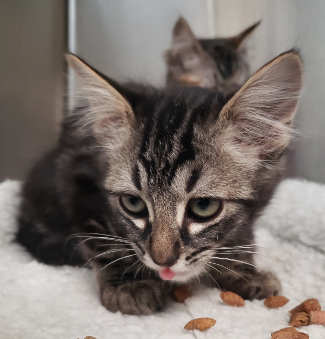
Brown tabby kitten
This male brown tabby kitten has a medium-length coat and gold eyes.
He has been neutered.
He is in kennel No. 147A, ID No. 13779.

Tortie kitten
This female kitten has a medium-length tortie coat and gold eyes.
She has been spayed. She is in kennel No. 147B, ID No. 13780.
Email Elizabeth Larson at
- Details
- Written by: Lake County News reports
The Lake County Vector Control District said the mosquitoes, Culex tarsalis (western encephalitis mosquito), were collected near Middletown on July 14.
“Detecting West Nile virus is typical for July in Lake County,” said Jamesina Scott, Ph.D., district manager and research director of the Lake County Vector Control District.
“Many of us are spending more time at home and in our yards this summer, and during the COVID-19 pandemic it’s easy to forget that West Nile virus is still here,” Scott said. “Thankfully, mosquitoes cannot transmit COVID-19.”
Lake County Vector Control District continues to provide mosquito control services to the community.
If residents need help with a mosquito problem, please call the district from 7:30 a.m. to 4 p.m., Monday through Friday, or request service online anytime at http://lcvcd.org/request-service/ .
The district also provides free mosquito-eating fish for swimming pools or spas that are not being maintained, and for backyard ponds, water features and animal watering troughs.
“Mosquitoes develop in water, so you can protect yourself and your family from mosquito bites by dumping out standing water,” Scott said. “Take a walk around your yard today and look for places that might hold water like buckets, toys, and boats and dump out any water you find. If you have a pond, livestock watering trough, or water feature that can’t be drained, then contact the district and we can provide free mosquito-eating fish to prevent mosquitoes from growing there.”
The district encourages residents to reduce their risk of contracting West Nile virus and other mosquito-borne diseases by:
– Dumping or draining standing water to prevent mosquitoes. Mosquitoes need water to complete their life cycle.
– Defending yourself. Use repellents containing DEET, Picaridin, IR3535, or oil of lemon eucalyptus. Follow the label directions.
– Avoiding the outdoors when mosquitoes are present, typically dawn and dusk.
So far this year, West Nile virus activity has been detected in one mosquito sample in Lake County.
Statewide, 20 California counties have detected WNV this year, mainly in mosquitoes.
As of July 17, two human cases of West Nile virus illness have been reported in California residents this year.
Residents with questions or who would like help with a mosquito problem, including reporting a neglected pool or spa, or have an in-ground yellowjacket nest on their property that they want treated should contact the Lake County Vector Control District at 707-263-4770 or visit the district website at www.lcvcd.org .
For more information about West Nile virus, visit http://www.westnile.ca.gov/ . Information about mosquito repellents can be found on the US Centers for Disease Control and Prevention website at http://www.cdc.gov/westnile/faq/repellent.html .
- Details
- Written by: Lawrence Burnley, University of Dayton
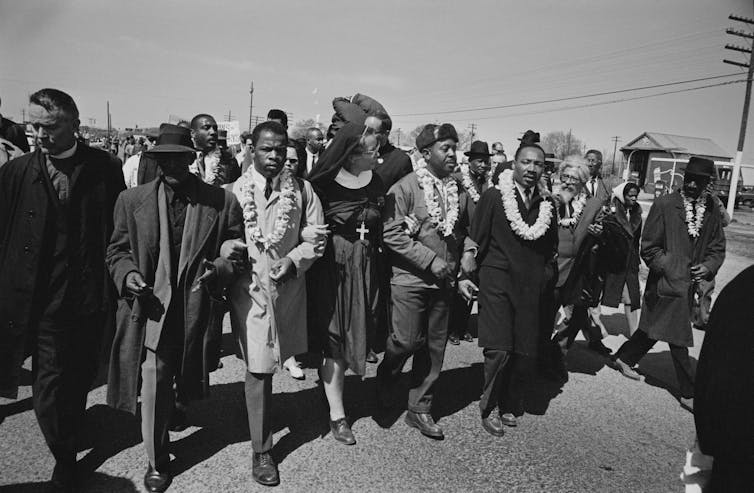
With the deaths of Rep. John Lewis and the Rev. Cordy Tindell “C.T.” Vivian, the U.S. has lost two civil rights greats who drew upon their faith as they pushed for equality for Black Americans.
Vivian, an early adviser to the Rev. Martin Luther King Jr., died July 17 at the age of 95. News of his passing was followed just hours later by that of Lewis, 80, an ordained Baptist minister and towering figure in the civil rights struggle.
That both men were people of the cloth is no coincidence.
From the earliest times in U.S. history, religious leaders have led the struggle for liberation and racial justice for Black Americans. As an ordained minister and a historian, I see a common thread running from Black resistance in the earliest periods of slavery in the antebellum South, through the civil rights movement of the 1950s and 1960s – in which Lewis and Vivian played important roles – and up to today’s Black Lives Matter movement.
As Patrisse Cullors, a founder of the Black Lives Matter movement, says: “The fight to save your life is a spiritual fight.”
Spiritual calling
Vivian studied theology alongside Lewis at the American Baptist College in Nashville, Tennessee.
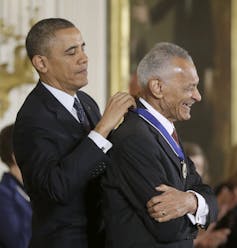
For both men, activism was an extension of their faith. Speaking to PBS in 2004, Lewis explained: “In my estimation, the civil rights movement was a religious phenomenon. When we’d go out to sit in or go out to march, I felt, and I really believe, there was a force in front of us and a force behind us, ’cause sometimes you didn’t know what to do. You didn’t know what to say, you didn’t know how you were going to make it through the day or through the night. But somehow and some way, you believed – you had faith – that it all was going to be all right.”
Fellow civil rights activists knew Vivian as the “resident theologian” in King’s inner circle due to “how profound he is in both his political and biblical exegesis,” fellow campaigner Rev. Jesse Jackson recalled.
Rejecting ‘other world’ theology
Faith traditions inform the civil rights and social justice work of many Black religious leaders. They interpret religious teachings through the prism of the injustice in the here and now.
Speaking of King’s influence, Lewis explained: “He was not concerned about the streets of heaven and the pearly gates and the streets paved with milk and honey. He was more concerned about the streets of Montgomery and the way that Black people and poor people were being treated in Montgomery.”
This focus on real-world struggles as part of the role of spiritual leaders was present in the earliest Black civil rights and anti-slavery leaders. Nat Turner, a leader in the revolt against slavery, for example, saw rebellion as the work of God, and drew upon biblical texts to inspire his actions. Likewise fellow anti-slavery campaigners Sojourner Truth and Jarena Lee rejected the “otherworld” theology taught to enslaved Africans by their white captors, which sought to deflect attention away from their condition in “this world” with promises of a better afterlife.
Incorporating religion into the Black anti-slavery movement sowed the seeds for faith being central to the struggle for racial justice. As the church historian James Washington observed in 1986, the “very disorientation of their slavery and the persistent impact of systemic racism and other forms of oppression provided the opportunity – indeed the necessity – of a new religious synthesis.”
‘Ubuntuism’
The synthesis continued into the 20th century. Religious civil rights leaders like Lewis and Vivian clearly felt compelled to make the struggle for justice a central part of a spiritual leader’s role.
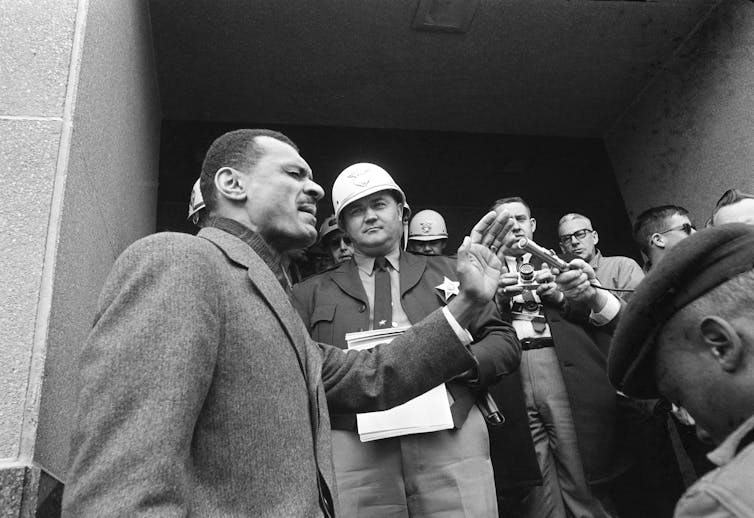
In 1965, Vivian was punched in the mouth by Dallas County Sheriff Jim Clark in an incident caught on camera and carried on national news. Vivian later said: “Everything I am as a minister, as an African American, as a civil rights activist and a struggler for justice for everyone came together in that moment.”
Though their activism was grounded in Christianity, Lewis and Vivian both forged strategic and powerful coalitions with those outside of their faith. In some ways, they transcended theologically informed ideologies with a world view more akin to Archbishop Desmond Tutu’s interpretation of “Ubuntu” – that one’s own humanity is inextricably bound up with that of others.
Lewis and Vivian personified this value in their leadership styles.
George Floyd
Racial justice remains integral to Black Christian leadership in the 21st century.
After the killing of George Floyd in police custody in Minneapolis, it was the Rev. Al Sharpton whose words were carried across the globe, calling on white America to “get your knee off our necks” at Floyd’s memorial service.
In recent years, the Rev. William J. Barber II has been such a vocal and powerful presence in protests that some Americans consider him to be a the successor to past civil rights greats.
In an interview in early 2020, Barber said: “There is not some separation between Jesus and justice; to be Christian is to be concerned with what’s going on in the world.”
John Lewis and Rev. C.T. Vivian lived those words.
Some of this information appeared in a previous article published on June 17
Lawrence Burnley, Vice President for Diversity and Inclusion, University of Dayton
This article is republished from The Conversation under a Creative Commons license. Read the original article.