 How to resolve AdBlock issue?
News
- Details
- Written by: Elizabeth Larson
Dogs available for adoption this week include mixes of cattle dog Catahoula Leopard Dog, Chihuahua, German Shepherd, pit bull and poodle.
Dogs that are adopted from Lake County Animal Care and Control are either neutered or spayed, microchipped and, if old enough, given a rabies shot and county license before being released to their new owner. License fees do not apply to residents of the cities of Lakeport or Clearlake.
The following dogs at the Lake County Animal Care and Control shelter have been cleared for adoption (additional dogs on the animal control Web site not listed are still “on hold”).
Because the shelter in place order remains in effect, call Lake County Animal Care and Control at 707-263-0278 or visit the shelter online at http://www.co.lake.ca.us/Government/Directory/Animal_Care_And_Control.htm for information on visiting or adopting.

Male Chihuahua
This male Chihuahua has a short brown and white coat.
He is in kennel No. 19, ID No. 13754.

‘Archie’
“Archie” is a male poodle with a white coat.
He has been neutered.
He is in kennel No. 20, ID No. 13384.

‘Lady’
“Lady” is a female pit bull mix with a short tan coat.
She has been spayed.
She is in kennel No. 22, ID No. 13703.

Catahoula Leopard Dog
This young female Catahoula Leopard Dog has a short white coat with black spots.
She is in kennel No. 27, ID No. 13752.

Catahoula Leopard Dog
This young male Catahoula Leopard Dog has a short black and white coat.
He is in kennel No. 28, ID No. 13753.

Male German Shepherd
This young male German Shepherd has a fully brown and black coat.
He is in kennel No. 31, ID No. 13706.
Email Elizabeth Larson at
- Details
- Written by: Lonnie Shekhtman

Several years ago, planetary scientist Lynnae Quick began to wonder whether any of the more than 4,000 known exoplanets, or planets beyond our solar system, might resemble some of the watery moons around Jupiter and Saturn.
Though some of these moons don’t have atmospheres and are covered in ice, they are still among the top targets in NASA’s search for life beyond Earth. Saturn’s moon Enceladus and Jupiter’s moon Europa, which scientists classify as “ocean worlds,” are good examples.
“Plumes of water erupt from Europa and Enceladus, so we can tell that these bodies have subsurface oceans beneath their ice shells, and they have energy that drives the plumes, which are two requirements for life as we know it,” says Quick, a NASA planetary scientist who specializes in volcanism and ocean worlds. “So if we’re thinking about these places as being possibly habitable, maybe bigger versions of them in other planetary systems are habitable too.”
Quick, of NASA’s Goddard Space Flight Center in Greenbelt, Maryland, decided to explore whether — hypothetically — there are planets similar to Europa and Enceladus in the Milky Way galaxy. And, could they, too, be geologically active enough to shoot plumes through their surfaces that could one day be detected by telescopes.
Through a mathematical analysis of several dozen exoplanets, including planets in the nearby TRAPPIST-1 system, Quick and her colleagues learned something significant: More than a quarter of the exoplanets they studied could be ocean worlds, with a majority possibly harboring oceans beneath layers of surface ice, similar to Europa and Enceladus. Additionally, many of these planets could be releasing more energy than Europa and Enceladus.
Scientists may one day be able to test Quick’s predictions by measuring the heat emitted from an exoplanet or by detecting volcanic or cryovolcanic (liquid or vapor instead of molten rock) eruptions in the wavelengths of light emitted by molecules in a planet’s atmosphere.
For now, scientists cannot see many exoplanets in any detail. Alas, they are too far away and too drowned out by the light of their stars.
But by considering the only information available — exoplanet sizes, masses and distances from their stars — scientists like Quick and her colleagues can tap mathematical models and our understanding of the solar system to try to imagine the conditions that could be shaping exoplanets into livable worlds or not.
While the assumptions that go into these mathematical models are educated guesses, they can help scientists narrow the list of promising exoplanets to search for conditions favorable to life so that NASA’s upcoming James Webb Space Telescope or other space missions can follow up.
“Future missions to look for signs of life beyond the solar system are focused on planets like ours that have a global biosphere that’s so abundant it’s changing the chemistry of the whole atmosphere,” says Aki Roberge, a NASA Goddard astrophysicist who collaborated with Quick on this analysis. “But in the solar system, icy moons with oceans, which are far from the heat of the Sun, still have shown that they have the features we think are required for life.”
To look for possible ocean worlds, Quick’s team selected 53 exoplanets with sizes most similar to Earth, though they could have up to eight times more mass. Scientists assume planets of this size are more solid than gaseous and, thus, more likely to support liquid water on or below their surfaces.
At least 30 more planets that fit these parameters have been discovered since Quick and her colleagues began their study in 2017, but they were not included in the analysis, which was published on June 18 in the journal Publications of the Astronomical Society of the Pacific.
With their Earth-size planets identified, Quick and her team sought to determine how much energy each one could be generating and releasing as heat. The team considered two primary sources of heat.
The first, radiogenic heat, is generated over billions of years by the slow decay of radioactive materials in a planet’s mantle and crust. That rate of decay depends on a planet’s age and the mass of its mantle. Other scientists already had determined these relationships for Earth-size planets.
So, Quick and her team applied the decay rate to their list of 53 planets, assuming each one is the same age as its star and that its mantle takes up the same proportion of the planet’s volume as Earth’s mantle does.
Next, the researchers calculated heat produced by something else: tidal force, which is energy generated from the gravitational tugging when one object orbits another. Planets in stretched out, or elliptical, orbits shift the distance between themselves and their stars as they circle them. This leads to changes in the gravitational force between the two objects and causes the planet to stretch, thereby generating heat. Eventually, the heat is lost to space through the surface.
One exit route for the heat is through volcanoes or cryovolcanoes. Another route is through tectonics, which is a geological process responsible for the movement of the outermost rocky or icy layer of a planet or moon. Whichever way the heat is discharged, knowing how much of it a planet pushes out is important because it could make or break habitability.
For instance, too much volcanic activity can turn a livable world into a molten nightmare. But too little activity can shut down the release of gases that make up an atmosphere, leaving a cold, barren surface. Just the right amount supports a livable, wet planet like Earth, or a possibly livable moon like Europa.
In the next decade, NASA’s Europa Clipper will explore the surface and subsurface of Europa and provide insights about the environment beneath the surface. The more scientists can learn about Europa and other potentially habitable moons of our solar system, the better they’ll be able to understand similar worlds around other stars — which may be plentiful, according to today’s findings.
"Forthcoming missions will give us a chance to see whether ocean moons in our solar system could support life,” says Quick, who is a science team member on both the Clipper mission and the Dragonfly mission to Saturn’s moon Titan. “If we find chemical signatures of life, we can try to look for similar signs at interstellar distances.”
When Webb launches, scientists will try to detect chemical signatures in the atmospheres of some of the planets in the TRAPPIST-1 system, which is 39 light years away in the constellation Aquarius. In 2017, astronomers announced that this system has seven Earth-size planets. Some have suggested that some of these planets could be watery, and Quick’s estimates support this idea. According to her team’s calculations, TRAPPIST-1 e, f, g and h could be ocean worlds, which would put them among the 14 ocean worlds the scientists identified in this study.
The researchers predicted that these exoplanets have oceans by considering the surface temperatures of each one. This information is revealed by the amount of stellar radiation each planet reflects into space. Quick’s team also took into account each planet’s density and the estimated amount of internal heating it generates compared to Earth.
“If we see that a planet’s density is lower than Earth’s, that’s an indication that there might be more water there and not as much rock and iron,” Quick says. And if the planet’s temperature allows for liquid water, you’ve got an ocean world.
“But if a planet’s surface temperature is less than 32 degrees Fahrenheit (0 degrees Celsius), where water is frozen,” Quick says, “then we have an icy ocean world, and the densities for those planets are even lower.”
Other scientists who participated in this analysis with Quick and Roberge are Amy Barr Mlinar from the Planetary Science Institute in Tucson, Arizona, and Matthew M. Hedman from the University of Idaho in Moscow.
Lonnie Shekhtman works for NASA’s Goddard Space Flight Center in Greenbelt, Maryland.
- Details
- Written by: Elizabeth Larson
The Mule fire was initially dispatched at around 2:10 p.m. on Highway 20, nearly four miles west of Walker Ridge Road, east of Clearlake Oaks.
“There was a suspect apprehended,” Will Powers, a Cal Fire public information officer, confirmed to Lake County News.
Air resources arriving at the scene said the fire initially was about an acre and making a run uphill. Within a few minutes, it was reported to be about five acres and making a hard push uphill toward structures.
However, firefighters were able to hold the fire’s advance, with one small spot fire reported outside of the lines just after 3 p.m.
At about 3:15 p.m., one person was reported to be in custody with prevention officers from Cal Fire later asked to respond to the Lake County Jail.
Sheriff Brian Martin told Lake County News that deputies took a Hispanic male adult into custody at the scene.
Martin said there was a seven-minute standoff before the arrest as the man tried to hold off deputies with a knife in the middle of Highway 20.
He added that there was a language barrier between deputies and the man, who was transported to the Lake County Jail.
Martin said early Saturday evening that he did not yet have any additional details about the arrest.
Powers said the Mule fire had burned six acres. Late on Sunday afternoon it was reported to be 50 percent contained.
“They’ll be out there for a while,” Powers said of firefighters, who are constructing line and mopping up.
He said Cal Fire is the lead agency on the fire, with local fire agencies also involved. Radio traffic indicated that including Northshore, Lake County and Kelseyville all were dispatched.
Powers said the California Highway Patrol was on scene to assist with one-way traffic control in the area.
Shortly before 7:20 p.m., Powers reported that the fire was fully contained at 7.35 acres.
Another small fire, dispatched just before 3 p.m. in the 1200 block of Highway 20 near Van Sleeper Road in Upper Lake, involved a trailer load of hay that firefighters quickly contained.
Email Elizabeth Larson at
- Details
- Written by: LAKE COUNTY NEWS REPORTS
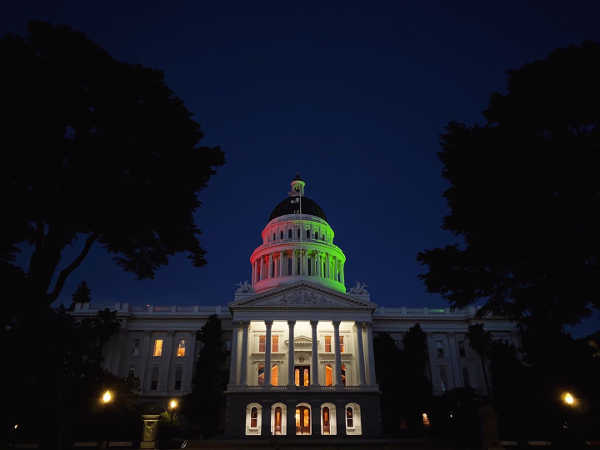
Gov. Gavin Newsom issued a proclamation Friday commemorating June 20 as Juneteenth in California.
He stood in support of the California Legislative Black Caucus’ call to light up the Capitol Dome in red, black and green, which took place on Friday night. These pan-African colors represent the African diaspora to enslavement in the New World.
“As we celebrate Juneteenth, we must redouble our efforts to achieve justice and take on systemic racism and its devastating consequences for Black Americans,” said Gov. Newsom. “Recent demonstrations, fueling important reforms throughout the United States, are the latest contributions to building a more perfect union – where liberty and justice are indeed ‘for all.’ We remember those who have lived and died in this pursuit, and their memory inspires us to make that promise real.”
In the proclamation, Gov. Newsom detailed the history of Juneteenth and its present-day celebration.
On June 19, 1865, Union General Gordon Granger led troops into Galveston, Texas, to announce the end of the Civil War and the insidious institution of slavery.
Thousands of enslaved people in Texas – among the last to learn of their liberation – tasted hard-won freedom for the first time.
The joyous commemorations that began in Texas spread around the nation, with cities and communities in California joining in celebration of this milestone in the American journey to freedom for all.
Since 2003, the state of California has celebrated Juneteenth as a day to honor and reflect on the significant contributions of Black Americans to our nation.
“Juneteenth is Freedom Day and a cause for celebration,” said Assemblymember Shirley N. Weber, Ph.D., chair of the California Legislative Black Caucus. “What is encouraging is the renewed interest in Juneteenth by young people. I think it is this moment where they recognize their power to make change. The message of Juneteenth is especially salient in the context of the current protests over ongoing and persistent brutality and inequity in the lives of Black Americans. American ideals promise equality, but have yet to fulfill that promise. By lighting the State Capitol in red, black and green, the California Legislative Black Caucus demonstrates its commitment to making that promise a reality in California.”
California State Senate President pro Tempore Toni G. Atkins called Juneteenth “one of the most significant moments in the history of the United States— the day enslaved people learned of their freedom.”
Atkins added, “Juneteenth to me marks a day of hope and the dawn of America.”
“Juneteenth was made possible by abolitionists who stood up against racism and oppression,” said California State Assembly Speaker Anthony Rendon. “Over 100 years later, Juneteenth 2020 takes place at a time when activists are still fighting for equality. The current uprisings around the country give me hope that we will celebrate Juneteenth 2021 having used our actions to further racial equality and this holiday's promise of freedom for all. Black Lives Matter.”