How to resolve AdBlock issue?
News
- Details
- Written by: Lake County News reports
According to the latest data from the state Employment Development Department, or EDD, more than 5.6 million unemployment claims were processed since the pandemic began, and a total of $3.4 billion in benefits were paid last week alone.
In just the last three months, the EDD has paid just shy of the total unemployment benefits issued during the entire year at the peak of the Great Recession in 2010, which totaled $22.9 billion.
The EDD said that, to date, 5,174,833 Unemployment Insurance claims have been submitted by workers online for the period of March 14 to May 30.
The claims processed is a higher number, accounting for more than just those online but also those that came in by phone. That number for the same time period is 5,658,219 claims, EDD said.
Individuals claiming benefits so far total 4,015,504, according to the EDD’s latest report.
EDD introduces new help tools to assist workers
In recent weeks, EDD introduced a chat bot on Facebook (“Send Message”) as well as on the website (“EDD Help”) to answer claimants’ questions in English and Spanish, the EDD has also launched a new text message service.
The EDD has also launched a new revised page of frequently asked questions featuring the most common questions we are hearing about each week from our customers.
Here is a sampling of some of the most recent developments in serving California workers impacted by the pandemic.
What can I do if I have a question or want to know the status of my claim and I can’t get through on the call center lines?
In addition to a chat bot feature the EDD implemented on Facebook (“Send Message”) as well as website (“EDD Help”) to answer claimants’ questions in English and Spanish, the EDD has also launched a new text message service.
These texts notify individuals about updates on their UI claim including when the claim is processed in our systems and when the first benefit payment is issued on the claim.
The EDD is also now expanding this service to notify individuals when a federal extension is filed on their behalf, when we need further documents from individuals to verify their identity, and when we have received those documents verifying the identity. This will help keep individuals posted on developments with their claim and reduce the need to call for assistance, freeing up access to agents for those who have more complex issues and need to talk to a representative.
Text alerts are sent from 51074 to the phone number the claimant indicates on their UI application. There is no cost to use this service, but standard carrier fees for text messaging may apply and the service can only send a message, not reply to messages from a claimant.
Is EDD getting more staff to help keep up with the demand for benefits?
Yes, when unemployment was at a record low in February, the EDD had low federal funding and low staff. But as the workload has spiked, the EDD has received more federal funding to support a mass expedited hiring effort.
So far, the EDD has hired at least half of an initial 1,800 staff we are seeking to help process an unprecedented volume of unemployment claims, assist customers in our call centers, and review documents from claimants and employers to determine benefits.
The EDD is now also hiring an additional 1,200 for a total of 3,000 new staff over the next few weeks to bolster the delivery of critical unemployment services to Californians in need.
For more information about the positions being filled, visit the EDD Careers webpage.
If I’ve run out of my regular Unemployment Insurance benefits, how quickly can I get 13 weeks of extension benefits?
As of May 27, the EDD is regularly sweeping our system to identify claims that started on or after June 2, 2019 and all associated benefits are exhausted. If you do not have enough subsequent wages to make you eligible for a new regular UI claim, the EDD will automatically file a Pandemic Emergency Unemployment Compensation extension on your last UI claim. You will receive a notice through the mail about 5-7 days later with more information.
But for a faster process, check the Inbox of your UI Online account for an email about potential extension eligibility, and then a follow-up email within a few days about weeks available to certify for payment.
If my benefit year started before June 2, 2019, can I get extension benefits?
PEUC extension benefits are available on claims that started as early as July 2018 if you are fully or partially unemployed. Starting next month, the EDD will start mailing notices to those who used all their UI benefits sometime after July 2018 and before June 2, 2019, who were not included in Phase 1.
If you are in this group, you should not delay in applying for a new UI claim if you haven’t already done so since your benefit year has expired. If you are not eligible for a new regular UI claim, the EDD will automatically file a PEUC extension on your last UI
Claim.
Do I have to wait for an EDD Customer Account Number before I can certify my eligibility for payment?
The EDD will automatically complete your registration in UI Online for those who file their claim through UI Online and don’t have any issues requiring identity or wage verification. That means you can move more quickly to certifying your eligibility for payment rather than waiting on a notice through the mail with your EDD Customer Account Number, or EDDCAN. Look for an email that says “New Online Account Created.”
For all other claimants, look for the notice with the EDDCAN mailed to your address which you can use to finish your registration in UI Online and move to certifying for benefit payments. If you have received an Award Notice but have not received your EDDCAN email or notice, call 1-833-978-2511 from 8 a.m. to 8 p.m. seven days a week.
What can I do if my claim status shows 'pending'?
A “pending” status means a potential eligibility issue is identified on either your initial application for benefits or your certification for your benefit payment and staff will have to follow up if it can’t be automatically processed through our system.
This can occur for a number of reasons including EDD needing to first verify your identity or your wages which don’t match with our records.
In some cases a payment can be made after such a review. In other cases, the EDD is required to schedule a determination interview. You will receive a notice in the mail with the date and time of your appointment to speak with an EDD staff who will ask you questions about the eligibility issue. The staff person may also have to follow up with your employer.
Reasons that necessitate further fact-finding include your ability and availability to work, reasons for separation from your employer, and other eligibility requirements defined by law. The EDD will send you a notice in the mail if you are found ineligible for benefits, or the pending weeks will be processed and you will receive an update in the Inbox of your UI Online account.
The EDD recommends you continue to certify for any weeks that become available while your claim shows pending, in order to quicken the issuing of benefits if and when you are determined
Eligible.
I’m a full-time student who usually works part-time, but I am unemployed or have reduced hours due to COVID-19. Am I eligible for PUA benefits?
Yes, PUA benefits are available to people who work part-time, and who are unemployed, partially unemployed, or unable or unavailable to work because of one of the COVID-19 related reasons provided under the PUA program.
In addition, based on your work history, you may qualify for unemployment insurance benefits. The EDD will first determine whether you have sufficient work history to qualify for UI, and if you do not, you may qualify for PUA.
If you qualify for either UI or PUA benefits, you will receive an additional $600 in federal stimulus funds on top of your weekly benefit amount between March 29 and July 25, 2020.
I’m a full-time student who usually works during the summer months when school is not in session but I was not able to get a summer job this year due to COVID-19. Am I eligible for PUA benefits?
If you were scheduled to start or return to a summer job but the job offer fell through due to COVID-19, you may be eligible for PUA.
However, PUA does not provide benefits to people who have been unable to search for or obtain a job due to COVID-19 unless they are unemployed due to another COVID-19 related
reason provided under the PUA program.
- Details
- Written by: Lake County News reports
The seventh annual California Invasive Species Action Week, or CISAW, runs from Saturday, June 6, through Sunday, June 14.
Historically, agencies, nonprofits and volunteer organizations across the state have teamed up to host events for CISAW.
This year, due to COVID-19 concerns, activities will be hosted online, including webinars, videos and Facebook live events. Visit www.wildlife.ca.gov/CISAW to view the schedule.
All Californians can help stop the spread of invasive species by taking small, everyday actions, such as landscaping with native plants, not releasing unwanted pets into the wild, reporting invasive species findings, and cleaning, draining and drying gear when recreating in bodies of water.
Additionally, the winners of CDFW’s annual California Invasive Species Youth Art Contest will be announced on social media during CISAW. The theme of this year’s contest was “Be a Habitat Hero.”
The mission of CDFW’s Invasive Species Program is to reduce the impacts of invasive species on the wildlands and waterways of California.
The program is involved in efforts to prevent the introduction of these species into the state, detect and respond to introductions when they occur and prevent the spread of those species that have been established.
For questions or more information about CISAW, please contact
- Details
- Written by: Lake County News reports
Gov. Newsom will work toward a statewide standard for policing peaceful protests and ending the carotid hold.
This announcement follows the work California did last year to enact the nation’s strongest standard for police use of deadly force.
“We have a unique and special responsibility here in California to meet this historic moment head-on,” said Gov. Newsom. “We will not sit back passively as a state. I am proud that California has advanced a new conversation about broader criminal justice reform, but we have an extraordinary amount of work left to do to manifest a cultural change and a deeper understanding of what it is that we're working to advance. We will continue to lead in a direction that does justice to the message heard all across this state and nation.”
Gov. Newsom called for the creation of new standards for crowd control and use of force in protests.
He committed to working with the Legislature, including the California Legislative Black Caucus, the California Latino Legislative Caucus and other legislative leaders, in consultation with national experts, community leaders, law enforcement and journalists to develop those standards – much like the collaboration that produced AB 392 last year, California’s nation-leading use-of-force bill.
Additionally, he called for the end of the carotid hold and other like techniques in California, directing that the carotid hold be removed from the state police training program and state training materials.
He committed to working with the Legislature on a statewide ban that would apply to all police forces across the state.
Criminal justice reform has been a key priority of Governor Newsom’s first year in office. He placed a moratorium on the death penalty, citing racial and economic disparities in how it was applied. He proposed to close the Division of Juvenile Justice and proposed closing two state prisons. In his May Revision budget, he proposed expanding opportunities for rehabilitation and shortening prison time for offenders participating in treatment programs, in education programs and otherwise engaging in good behavior; as well as increasing access to higher education for young people who are incarcerated.
Gov. Newsom acknowledged on Friday that more action is needed, and stated that additional reforms around police practices, educational equity, economic justice, health equity and more must be addressed with urgency.
- Details
- Written by: NATIONAL AERONAUTICS AND SPACE ADMINISTRATION
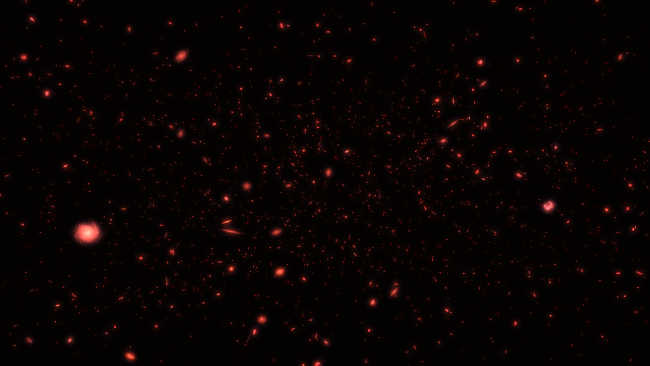
New results from the NASA/ESA Hubble Space Telescope suggest the formation of the first stars and galaxies in the early universe took place sooner than previously thought.
A European team of astronomers have found no evidence of the first generation of stars, known as Population III stars, as far back as when the universe was just 500 million years old.
The exploration of the very first galaxies remains a significant challenge in modern astronomy.
We do not know when or how the first stars and galaxies in the universe formed. These questions can be addressed with the Hubble Space Telescope through deep imaging observations. Hubble allows astronomers to view the universe back to within 500 million years of the big bang.
A team of European researchers, led by Rachana Bhatawdekar of the European Space Agency, or ESA, set out to study the first generation of stars in the early universe.
Known as Population III stars, these stars were forged from the primordial material that emerged from the big bang.
Population III stars must have been made solely out of hydrogen, helium and lithium, the only elements that existed before processes in the cores of these stars could create heavier elements, such as oxygen, nitrogen, carbon and iron.
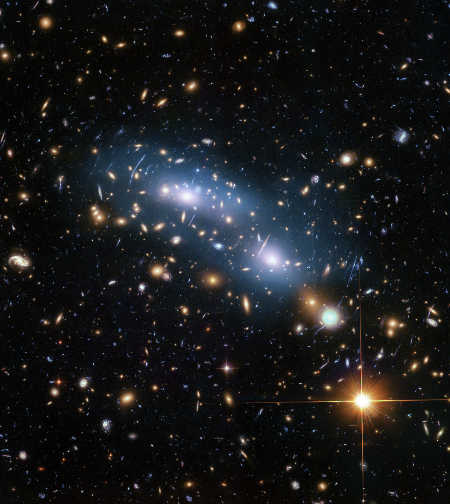
Bhatawdekar and her team probed the early universe from about 500 million to 1 billion years after the big bang by studying the cluster MACS J0416 and its parallel field with the Hubble Space Telescope (with supporting data from NASA's Spitzer Space Telescope and the ground-based Very Large Telescope of the European Southern Observatory).
"We found no evidence of these first-generation Population III stars in this cosmic time interval," said Bhatawdekar of the new results.
The result was achieved using the Hubble Space Telescope's Wide Field Camera 3 and Advanced Camera for Surveys, as part of the Hubble Frontier Fields program.
This program (which observed six distant galaxy clusters from 2012 to 2017) produced the deepest observations ever made of galaxy clusters and the galaxies located behind them which were magnified by the gravitational lensing effect, thereby revealing galaxies 10 to 100 times fainter than any previously observed.
The masses of foreground galaxy clusters are large enough to bend and magnify the light from the more distant objects behind them. This allows Hubble to use these cosmic magnifying glasses to study objects that are beyond its nominal operational capabilities.
Bhatawdekar and her team developed a new technique that removes the light from the bright foreground galaxies that constitute these gravitational lenses.
This allowed them to discover galaxies with lower masses than ever previously observed with Hubble, at a distance corresponding to when the universe was less than a billion years old.
At this point in cosmic time, the lack of evidence for exotic stellar populations and the identification of many low-mass galaxies supports the suggestion that these galaxies are the most likely candidates for the reionization of the universe.
This period of reionization in the early universe is when the neutral intergalactic medium was ionized by the first stars and galaxies.
"These results have profound astrophysical consequences as they show that galaxies must have formed much earlier than we thought," said Bhatawdekar. "This also strongly supports the idea that low-mass/faint galaxies in the early universe are responsible for reionization."
These results also suggest that the earliest formation of stars and galaxies occurred much earlier than can be probed with the Hubble Space Telescope. This leaves an exciting area of further research for the upcoming NASA/ESA/CSA James Webb Space Telescope – to study the universe's earliest galaxies.
These results are based on a previous 2019 paper by Bhatawdekar et al., and a paper that will appear in an upcoming issue of the Monthly Notices of the Royal Astronomical Society. These results are also being presented at a press conference during the 236th meeting of American Astronomical Society.
The European team of astronomers in this study consists of R. Bhatawdekar and C.J. Conselice.
The Hubble Space Telescope is a project of international cooperation between NASA and ESA. NASA’s Goddard Space Flight Center in Greenbelt, Maryland, manages the telescope. The Space Telescope Science Institute in Baltimore conducts Hubble science operations. STScI is operated for NASA by the Association of Universities for Research in Astronomy in Washington, D.C.