How to resolve AdBlock issue?
Refresh this page
How to resolve AdBlock issue?
Refresh this page
Lake County News,California
  • Home
    • Registration Form
  • News
    • Community
      • Obituaries
      • Letters
      • Commentary
    • Education
    • Veterans
    • Police Logs
    • Business
    • Recreation
    • Health
    • Religion
    • Legals
    • Arts & Life
    • Regional
  • Calendar
  • Contact us
    • FAQs
    • Phones, E-Mail
    • Subscribe
  • Advertise Here
  • Login

Estate Planning: Using the right estate planning approach

Dennis Fordham. Courtesy photo.
Estate planning can involve a wide variety of asset types, such as, money, stocks and bonds, real estate, life insurance, personal property, and sometimes business interests. 

How these different assets are managed during the owner’s life and later distributed at death depends on the asset type, the person’s situation and estate planning approaches used. It may also depend on any existing court orders, such as from family court proceedings.

Does the asset or a court order restrict the owner’s options? Retirement accounts (e.g., 401(k) and Individual Retirement Accounts), for example, cannot be transferred to the participant’s trust.

They can be managed by the participant’s agent under a power of attorney and ultimately passed to the participant’s surviving designated death beneficiaries.

Also, a family court order may require certain estate planning to be in place for a minor. 

However, if there is no living death beneficiary who is named to inherit some or all of the retirement account then some or all of the account may pass under the deceased participant’s will or, failing a will, under the laws of intestate succession to the participant’s heirs. 

This is yet another reason why a will is always needed even when one has a trust and designated death beneficiary accounts because unforeseen events may upset the intended estate planning approach.

Do the circumstances of one or more death beneficiaries limit the estate planning options? For example, are one or more beneficiaries underaged minors, incapacitated persons, receiving needs based welfare benefits, or unable to manage inheritances for one reason or another? If so, then such person’s inheritances are usually held in further trust that can be designated as a beneficiary to receive any and all inheritance assets. Such trusts are drafted to meet the situation.

If real property is involved then a trust, or perhaps a Transfer on Death (“TOD”) beneficiary deed, is usually appropriate in order to avoid either a full probate court proceeding or at least a court petition to determine ownership of a decedent’s primary residence. 

Alternatively a joint tenancy or a life estate deed may be sufficient, depending on the situation.

If bank and brokerage accounts and personal property are involved, then a will, a power of attorney and pay on death beneficiary bank and transfer on death brokerage accounts may be sufficient estate planning. That depends on the situation of the beneficiaries and the person’s intentions for how they want their assets to be managed and distributed.

If an interest in a going business is involved, then it is typically advisable for the going business to be held in a legal entity such as an LLC, or a corporation or a partnership. Businesses that are operated as sole proprietorships do not continue at the death of the proprietor. The business assets, however, can still be transferred as assets. 

All said, however, if a person owns real property then a living trust is usually still the preferred estate planning vehicle as it allows for lifetime management and distribution of most asset types notably excluding retirement accounts. 

Trusts allow for contingency (‘what if’) planning by providing alternative solutions and special trustee authority to handle unforeseen eventualities, such as alternative beneficiaries and solutions to situations when the beneficiary cannot receive an outright distribution of their inheritance. 

The foregoing brief discussion is not legal advice. 

Dennis A. Fordham, attorney, is a State Bar-Certified Specialist in estate planning, probate and trust law. His office is at 870 S. Main St., Lakeport, California. He can be reached at This email address is being protected from spambots. You need JavaScript enabled to view it. and 707-263-3235.
Details
Written by: DENNIS FORDHAM
Published: 07 February 2026

Space News: NASA’s Artemis II plans to send a crew around the Moon to test equipment and lay the groundwork for a future landing

A banner signed by NASA employees and contractors outside Launch Complex 39B, where NASA’s Artemis II rocket is visible in the background. NASA/Joel Kowsky, CC BY-NC-ND

Almost as tall as a football field, NASA’s Space Launch System rocket and capsule stack traveled slowly – just under 1 mile per hour – out to the Artemis II launchpad, its temporary home at the Kennedy Space Center in Florida, on Jan. 17, 2026. That slow crawl is in stark contrast to the peak velocity it will reach on launch day, over 22,000 miles per hour, when it will send a crew of four on a journey around the Moon.

A rocket launch is always at the mercy of a variety of factors outside of the launch team’s control – from the literal position of the planets down to flocks of birds or rogue boats near the launchpad. While Artemis II is currently planned for March 2026, it may not launch until later in April. In fact, March already represents a small delay from the initially estimated February launch opportunity.

Artemis II’s goal is to send people to pass by the Moon and be sure all engineering systems are tested in space before Artemis III, which will land astronauts near the lunar south pole.

If Artemis II is successful, it will be the first time any person has been back to the Moon since 1972, when Apollo 17 left to return to Earth. The Artemis II astronauts will fly by the far side of the Moon before returning home. While they won’t land on the surface, they will provide the first human eyes on the lunar far side since the 20th century.

To put this in perspective, no one under the age of about 54 has yet lived in a world where humans were that far away from Earth. The four astronauts will orbit the Moon on a 10-day voyage and return through a splashdown in the Pacific Ocean. As a planetary geologist, I’m excited for the prospect of people eventually returning to the Moon to do fieldwork on the first stepping stone away from Earth’s orbit.

A walkthrough of the Artemis II mission, which plans to take a crew around the Moon.

Why won’t Artemis II land on the Moon?

If you wanted to summit Mount Everest, you would first test out your equipment and check to make sure everything works before heading up the mountain. A lunar landing is similar. Testing all the components of the launch system and crew vehicle is a critical part of returning people safely to the surface of the Moon and then flying them back to Earth.

And compared to the lunar surface, Everest is a tropical paradise.

NASA has accomplished lunar landings before, but the 54-year hiatus means that most of the engineers who worked on Apollo have retired. Only four of the 12 astronauts who have walked on the Moon are still alive.

Technology now is also vastly different. The Apollo lunar landing module’s computer only had about 4 kilobytes of RAM. A single typical iPhone photo is a few megabytes in size, over 1,000 times larger than the Apollo lunar landing module’s memory.

The two components of the Artemis II project are the rocket (the Space Launch System) and the crew capsule. Both have had a long road to the launchpad.

The Orion capsule was developed as part of the Constellation program, announced in 2005 and concluded in 2010. This program was a President George W. Bush-era attempt to move people beyond the space shuttle and International Space Station.

The Space Launch System started development in the early 2010s as a replacement vehicle for the Ares rocket, which was meant to be used with the Orion capsule in the Constellation program. The SLS rocket was used in 2022 for the Artemis I launch, which flew around the Moon without a crew. Boeing is the main contractor tasked with building the SLS, though over 1,000 separate vendors have been involved in the rocket’s fabrication.

The Apollo program, too, first sent a crewed capsule around the Moon without landing. Apollo 8, the first crewed spacecraft to leave Earth orbit, launched and returned home in December 1968. William Anders, one of the astronauts on board tasked with testing the components of the Apollo lunar spacecraft, captured the iconic “Earthrise” image during the mission.

The white and blue cloudy Earth is visible above a gray edge of the Moon's surface
The Apollo 8 ‘Earthrise’ image, showing the Earth over the horizon from the Moon. This image, acquired by William Anders, became famous for its portrayal of the Earth in its planetary context. NASA

“Earthrise” was the first time people were able to look back at the Earth as part of a spacefaring species. The Earthrise image has been reproduced in a variety of contexts, including on a U.S. postage stamp. It fundamentally reshaped how people thought of their environment. Earth is still far and beyond the most habitable location in the solar system for life as we know it.

Unique Artemis II science

The Artemis II astronauts will be the first to see the lunar far side since the final Apollo astronauts left over 50 years ago. From the window of the Orion capsule, the Moon will appear at its largest to be about the size of a beach ball held at arm’s length.

Over the past decades, scientists have used orbiting satellites to image much of the lunar surface. Much imaging of the lunar surface has been accomplished, especially at high spatial resolution, by the lunar reconnaissance orbiter camera, LROC.

LROC is made up of a few different cameras. The LROC’s wide angle and narrow angle cameras have both captured images of more than 90% of the lunar surface. The LROC Wide Angle Camera has a resolution on the lunar surface of about 100 meters per pixel – with each pixel in the image being about the length of an American football field.

The LROC narrow angle camera provides about 0.5 to 2 meters per pixel resolution. This means the average person would fit within about the length of one pixel from the narrow angle camera’s orbital images. It can clearly see large rocks and the Apollo lunar landing sites.

If the robotic LROC has covered most of the lunar surface, why should the human crew of Artemis II look at it, at lower resolution?

Most images from space are not what would be considered “true” color, as seen by the human eye. Just like how the photos you take of an aurora in the night sky with a cellphone camera appear more dramatic than with the naked eye, the image depends on the wavelengths the detection systems are sensitive to.

Human astronauts will see the lunar surface in different colors than LROC. And something that human astronauts have that an orbital camera system cannot have is geology training. The Artemis II astronauts will make observations of the lunar far side and almost instantly interpret and adjust their observations.

The proceeding mission, Artemis III, which will include astronauts landing on the lunar surface, is currently scheduled to launch by 2028.

What’s next for Artemis II

The Artemis II crew capsule and SLS rocket are now waiting on the launchpad. Before launch, NASA still needs to complete several final checks, including testing systems while the rocket is fueled. These systems include the emergency exit for the astronauts in case something goes wrong, as well as safely moving fuel, which is made of hydrazine – a molecule made up of nitrogen and hydrogen that is incredibly energy-dense.

Completing these checks follows the old aerospace adage of “test like you fly.” They will ensure that the Artemis II astronauts have everything working on the ground before departing for the Moon.

Editor’s note: This article was updated on Feb. 3, 2026, to represent the next possible launch window shifting into March.The Conversation

Margaret Landis, Assistant Professor of Earth and Space Exploration, Arizona State University

This article is republished from The Conversation under a Creative Commons license. Read the original article.

Details
Written by: Margaret Landis, Arizona State University
Published: 07 February 2026

Officials discuss groundwater contamination, new equipment for residents in sewer spill impact area

Undersheriff Corey Paulich speaks during the sewer spill town hall on Wednesday, Feb. 4, 2026, at City Hall in Clearlake, California. Photo by Lingzi Chen/Lake County News.

CLEARLAKE, Calif. – Residents impacted by the Robin Lane sewage spill will receive home filtration and sanitization systems, officials said Wednesday, as groundwater restoration is expected to take a long time. 

After consulting with experts, including a hydrologist, the incident command team determined that groundwater contamination may persist despite temporary negative well test results for fecal bacteria, officials said at Wednesday’s town hall at Clearlake City Hall. 

“The path to the aquifer being clear – to the extent that our team and Public Health are comfortable saying your water is safe to drink again, for most properties at least – is going to be an extended period of time,” said Clearlake City Manager Alan Flora at the Wednesday town hall meeting. “Probably months.”

Given the length of time to clear the aquifer, Flora said each impacted residence will be offered a “whole-house filtration and sanitation system that includes sediment and carbon filters and a UV filter.” 

These systems are designed to disinfect water that may be "microbiologically unsafe, which is obviously the main issue here,” he said.

“The county will be covering the cost of the systems and the install,” Flora added.

The plan marks a shift from guidance given a week earlier, when officials said a well would be deemed safe for use after two negative test results taken 24 hours apart following sanitation. 

“Even if you got a zero-zero test, there could be the possibility of a reoccurrence,” said Undersheriff Corey Paulich, who also is the deputy director for the Office of Emergency Services. “So we don't want to take that chance – so that's why we kind of abandoned that plan.”

Incident team to offer additional equipment

The recovery efforts led by the city of Clearlake and the Lake County Office of Emergency Services, or Lake County OES, follow a massive sewage spill that began nearly a month ago, on Sunday, Jan. 11.

A 16-inch force main operated by the Lake County Sanitation District – overseen by the Lake County Special Districts – ruptured on Robin Lane, releasing 2.9 million gallons of sewage over a roughly 38-hour period.

The impacted area has expanded from the immediate vicinity of the rupture to about 550 acres – illustrated in a large color map hung on both sides of the Clearlake City Hall meeting room – impacting estimated 164 houses relying on private wells. 

Residents within the impacted zone remain under a public health advisory to avoid using water from their wells, amid ongoing well tests, sanitization and retests. 

According to the city’s latest update on Wednesday, a total of 33 water tanks had been installed to provide impacted residents with sufficient clean water, including eight through Lake County Social Services. The remaining 25 water tanks were installed by the incident management team using funds from the $750,000 approved by the Board of Supervisors on Jan. 21.

A total of 489 water samples had been collected from a total of 151 sites. And a total of 67 wells had been sanitized, up from 65 on Tuesday. 

Flora said Wednesday that the plan is to provide filtration and sanitization systems to all residences within the area that need them.

“We are working to identify contractors that will install those units,” Flora said at the town hall. “We intend to work with a large number of general contractors to complete those installs as soon as possible.”

On Thursday, Flora confirmed that 100 units of these systems had been ordered.

“That is what they have available,” Flora said in a text message to Lake County News. “Needed additional units will be ordered once they are available.”

Impacted residents must submit requests for the filtration and sanitization system through the online portal, Flora said. Residents experiencing difficulty accessing the portal may reach out to the city for assistance. 

Through the same portal, residents may also request water tanks, well testing and bottled water delivery.

“I know there's a lot of frustration out there from folks. It's taken too long to get where we are now,” Flora said during the Clearlake City Council’s meeting Thursday evening, adding that he’s incredibly proud of city staff who have been supporting the recovery effort.

The sewage spill event “is not something that is really the city's responsibility to deal with but we felt that it was imperative to step in and help the folks that do live within our community,” Flora said.

Flora also explained at the Thursday night council meeting that the hydrologist hired to assist in the recovery, who spoke at the Wednesday night town hall, concluded that “it’s unknown at this time how long it will take the sewer plume to dissipate from the aquifer."

The hydrologist: Impact on aquifer, caution to rainstorm

The incident occurred within the Burns Valley groundwater basin, specifically affecting a shallow alluvial aquifer composed of stream gravel and clay, according to Hydrologist Dr. Annjanette Dodd of Northpoint Consulting, hired by the incident command team to study the spill’s impact on the aquifer. 

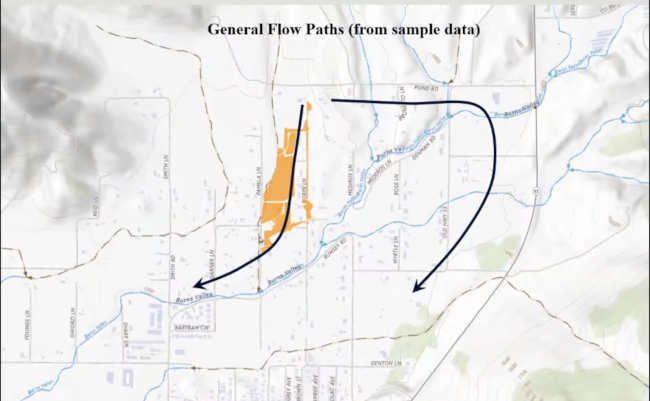
By analyzing aerial imagery and water quality samples over a 21-day period, Dodd identified two primary plume directions: one moving southeast and another moving southwest through the water-bearing gravel layers.

Dodd said the major challenge in her investigation is the lack of pre-spill data, which makes it difficult for her to “really ascertain baseline conditions.” So the assumption of her analysis: “If I see elevated levels of bacteria – there's something going on in that direction.”

A diagram showing the path of water flow in the aquifer in the Robin Lane sewer spill area. Courtesy image.


"Shallow groundwater wells are particularly vulnerable to contamination because they intersect the part of the aquifer system that is closest to the land surface, meaning it's less protected by natural barriers," she said.

Later, Lake County Environmental Health Director Craig Wetherbee said that the average well depth is about 74 feet and they ranged "anywhere between 34 feet to 140 feet.”

“Basically anything less than 100 feet is considered a very shallow well and lightly susceptible to surface water intrusions,” Wetherbee added. 

Dodd advised residents to adopt a proactive defense strategy with their wells: test well water at least once a year – ideally following significant rainfall – and implement point-of-entry treatment systems. Maintaining the physical integrity of wellheads and seals is critical, she said, as any changes in water taste, odor or clarity serve as immediate warning signs that the well’s natural or mechanical barriers have failed.

In response to a resident’s question on her observation of the movement of the plume, “I'm generally seeing things decrease and the plume slowing down,” she said. “I'm waiting for some more samples.”

As the spill plume moves further away from the ruptured force main, “I'm seeing numbers go down, and I'm seeing the spread lesson,” Dodd said. 

“What if we get significant rain?” a resident asked. 

“My intuition: if we get rain, we'll see dilution,” Dodd responded, adding that rainstorms will also cause “mobilization of what’s already there in the aquifer.”

“So after a rainstorm, we're going to want to continue sampling to see what things look like,” she added.

The costs of recovery

Cassandra Hulbert, a ground zero impacted resident living on Robin Lane, asked about expenditures related to recovery efforts at the town hall.

“I don’t have that number sitting right here today,” said Undersheriff Paulich, adding that the funds had been used for various expenses, including purchasing tanks and water deliveries. “A lot of that is very expensive.”

Each of the 25 tanks installed by the incident management team costs approximately $8,000, according to Lauren Berlinn, public information officer for Lake County OES, in an email response to Lake County News.

Regarding how frequently the tanks are being refilled for residents and the estimated weekly cost of refilling, Berlinn said delivery is as needed and invoices are still coming in so the cost can’t be calculated yet.

Filtration and sanitization systems cost about $1,800 per home to purchase, while installation costs will not be available until invoices are submitted, Berlinn said.

Flora said the systems carry an “NSF/ANSI-55 Class A” rating and are equipped with monitoring and alarm features that alert homeowners if the disinfection system experiences a problem.

An existing order of 100 units totals $180,000. Combined with the 25 tanks, total invoiced costs for the two items to date are at least about $380,000, according to a Lake County News calculation. 

“I’ve requested a financial update,” District 2 Supervisor Bruno Sabatier whose district includes the spill impact area said in a phone call with Lake County News on Thursday. 

Sabatier said he expected to hear the update early next week and bring up further requests for funds, if needed, to the Board of Supervisors. 

Sabatier also explained that the local emergency declarations have brought assistance from the state departments including Public Health, Water Board and OES. 

So far, the governor hasn’t declared a state emergency, which is a prerequisite for federal emergency declaration, according to Lauren Ott, communications director for Congressman Mike Thompson, in a Jan. 21 email response to Lake County News’ inquiries. 

“The sewage spill in Lake County is terrible and has disrupted families’ lives and risked making people ill,” Thompson said in a comment. “I contacted Lake County officials immediately upon news of the spill to offer my help if any federal needs arose.”

He added that he had remained in contact with local officials during this cleanup effort, and “prepared to help deliver all available federal resources as needed.”

Email staff reporter at Lingzi Chen at This email address is being protected from spambots. You need JavaScript enabled to view it.. 

Details
Written by: Lingzi Chen
Published: 06 February 2026

Chasing ‘Boat No. 1’: The legacy of the Clear Lake Chamber Bass Tournament

LAKE COUNTY, Calif. – For nearly 40 years, one event has defined the spirit of skill and endurance on the waters of Clear Lake. 

Since its inception in 1987, the Chamber of Commerce Bass Tournament – affectionately dubbed “The Chamber” by locals – has served as both a cornerstone of community economic development and a magnet for anglers seeking greatness.

Originally known as "The Lake County Record Bee" and later "The Holder Ford," this competition holds the distinction of being the oldest tournament of its kind on our waters. 

More than just a contest, it is a prestigious March tradition that draws talent from across the region.

On Clear Lake, the battle for the leaderboard begins long before the first cast is ever made. Because the lake is famous for its "community fishing holes," being the first boat out provides a massive strategic advantage in claiming the best spots.

The quest for the coveted “Boat No. 1” is legendary. The late Jerry “The Godfather” Tilton once coached me to spend the night in the lookout point parking lot just to secure that top starting spot. My own first attempt at securing the lead spot taught me a shivering lesson; I arrived in shorts and flip-flops, only to spend the night with chattering teeth.

Local angler George Cockriell has mastered this dedication, holding the honor of Boat Number One for the last decade, missing the event only once when it was canceled due to COVID. While he once lost the top title to Skeet and Jimmy Reese by less than a pound, his commitment to the tournament remains unmatched.

Historically, over 200 boats would participate, with anglers lining up at the Record Bee with cots and sleeping bags as early as 3 p.m. the day before. If you plan to fish "The Chamber," come prepared for a fight against more than just the fish. Tournament history suggests at least one day of "nasty" weather is almost guaranteed. I still recall racing to a weigh-in at 60 mph while a gnarly hailstorm pelted my face.

As veteran angler Ross England famously told me, "You're not going to win it on Day One, but you can definitely take yourself out of it if you don't catch 'em" – and the elements are often the biggest obstacle to that catch.

The 38th annual event is just around the corner. Whether you are aiming for the "Big Fish" award or the overall championship, here is what you need to know. 

The consecutive two-day team tournament begins March 14. It’s a $250 entry fee and anglers registration for the event is at www.abatournaments.com.

Awards will be presented for Big Fish and Big Bag, culminating in the crowning of this year's champion after two days of intense competition.

The first three boats for Day One are as follows; on Day Two, the order is reversed: 

• Boat No. 1: George and Kevin Cockriel.
• Boat No. 2: Wayne Breazeale and Craig Nelson.
• Boat No. 3: Sandy and Brian McGeoch.

Craig Nelson is a former professional golfer who fell in love with tournament bass fishing 20 years ago. He found Lake County after fishing an FLW Stren Series event and never left. He’s the back-to-back winner of the Konocti Classic and runner up in the inaugural WON Bass Clear Lake Open.

Craig Nelson from Upper Lake, California, during the 2004 Record Bee Bass Tournament. Courtesy photo.


Details
Written by: Craig Nelson
Published: 06 February 2026
  • 1
  • 2
  • 3
  • 4
  • 5
  • 6
  • 7
  • 8
  • 9
  • 10

Public Safety

  • Lakeport Police Department celebrates long-awaited new headquarters

  • Lakeport Police Department investigates flag vandalism cases

  • Lakeport Police Department thanks Kathy Fowler Chevrolet for donation

Community

  • Hidden Valley Lake Garden Club installs new officers

  • 'America's Top Teens' searching for talent

  • 'The Goodness of Sea Vegetables' featured topic of March 5 co-op talk

Community & Business

  • Annual 'Adelante Jovenes' event introduces students, parents to college opportunities

  • Gas prices are dropping just in time for the holiday travel season

  • Lake County Association of Realtors installs new board and presents awards

  • Local businesses support travel show

  • Preschool families harvest pumpkins

  • Preschool students earn their wings

How to resolve AdBlock issue?
Refresh this page