 How to resolve AdBlock issue?
Changes to Mill Fire closure area put in place
MENDOCINO NATIONAL FOREST, Calif. – The closure order for the Mill Fire area was adjusted on Saturday, restoring access to Letts Lake, while maintaining the closure within most of the fire perimeter on the Mendocino National Forest.
The new closure order opened up the M10 Road access to the north of the fire, including access to the recreation sites on the southern portion of the Snow Mountain Wilderness. On the south, it reestablishes access to Goat Mountain Road.
The closure includes roads and popular off-highway vehicle trails that were damaged in the wildfire.
Residents and landowners or lessees of land within the closure area are exempt from the order to the extent necessary to access their property.
The forest is currently involved in Burned Area Emergency Rehabilitation (BAER) evaluation and activities to address the damage from the Mill Fire.
This includes looking at vegetation, soils and the watershed, as well as roads, trails and facilities in the area.
“We are happy to be able to allow the public to access Letts Lake and the Snow Mountain Wilderness from the M10 Road again,” said Forest Supervisor Sherry Tune. “We are asking the public to respect the closure order for the majority of the Mill Fire area, including roads and trails within the burned acreage. This will help us maintain public and firefighter safety, as well as safely continue our work to stabilize and rehabilitate these areas to protect the natural resources and provide for future visitor use.”
The Mill Fire started Saturday, July 7, and consumed more than 29,500 acres between the Letts Lake area and the community of Stonyford on the Grindstone Ranger District of the Mendocino National Forest.
Violation of the closure order is punishable by a fine of no more than $5,000 for an individual, $10,000 for an organization, or up to six months imprisonment or both.
For more information, please visit www.fs.usda.gov//mendocino or contact the Forest at 530-934-3316.
Space News: Satellites see unprecedented Greenland ice sheet surface melt
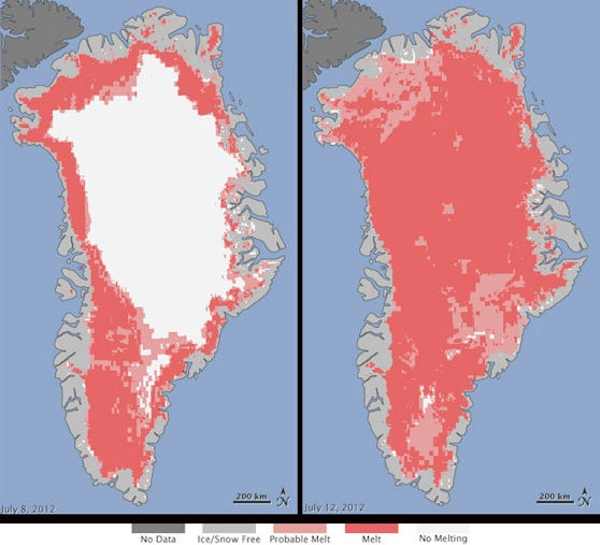
For several days this month, Greenland’s surface ice cover melted over a larger area than at any time in more than 30 years of satellite observations.
Nearly the entire ice cover of Greenland, from its thin, low-lying coastal edges to its two-mile-thick center, experienced some degree of melting at its surface, according to measurements from three independent satellites analyzed by NASA and university scientists.
On average in the summer, about half of the surface of Greenland’s ice sheet naturally melts. At high elevations, most of that melt water quickly refreezes in place. Near the coast, some of the melt water is retained by the ice sheet and the rest is lost to the ocean.
But this year the extent of ice melting at or near the surface jumped dramatically. According to satellite data, an estimated 97 percent of the ice sheet surface thawed at some point in mid-July.
Researchers have not yet determined whether this extensive melt event will affect the overall volume of ice loss this summer and contribute to sea level rise.
“The Greenland ice sheet is a vast area with a varied history of change. This event, combined with other natural but uncommon phenomena, such as the large calving event last week on Petermann Glacier, are part of a complex story,” said Tom Wagner, NASA’s cryosphere program manager in Washington. “Satellite observations are helping us understand how events like these may relate to one another as well as to the broader climate system.”
Son Nghiem of NASA’s Jet Propulsion Laboratory in Pasadena, Calif., was analyzing radar data from the Indian Space Research Organisation’s (ISRO) Oceansat-2 satellite last week when he noticed that most of Greenland appeared to have undergone surface melting on July 12.
Nghiem said, “This was so extraordinary that at first I questioned the result: was this real or was it due to a data error?”
Nghiem consulted with Dorothy Hall at NASA’s Goddard Space Flight Center in Greenbelt, Md. Hall studies the surface temperature of Greenland using the Moderate-resolution Imaging Spectroradiometer (MODIS) on NASA’s Terra and Aqua satellites.
She confirmed that MODIS showed unusually high temperatures and that melt was extensive over the ice sheet surface.
Thomas Mote, a climatologist at the University of Georgia, Athens, Ga; and Marco Tedesco of City University of New York also confirmed the melt seen by Oceansat-2 and MODIS with passive-microwave satellite data from the Special Sensor Microwave Imager/Sounder on a U.S. Air Force meteorological satellite.
The melting spread quickly. Melt maps derived from the three satellites showed that on July 8, about 40 percent of the ice sheet’s surface had melted. By July 12, 97 percent had melted.
This extreme melt event coincided with an unusually strong ridge of warm air, or a heat dome, over Greenland. The ridge was one of a series that has dominated Greenland’s weather since the end of May.
“Each successive ridge has been stronger than the previous one,” said Mote.
This latest heat dome started to move over Greenland on July 8, and then parked itself over the ice sheet about three days later. By July 16, it had begun to dissipate.
Even the area around Summit Station in central Greenland, which at 2 miles above sea level is near the highest point of the ice sheet, showed signs of melting.
Such pronounced melting at Summit and across the ice sheet has not occurred since 1889, according to ice cores analyzed by Kaitlin Keegan at Dartmouth College in Hanover, N.H. A National Oceanic and Atmospheric Administration weather station at Summit confirmed air temperatures hovered above or within a degree of freezing for several hours July 11-12.
“Ice cores from Summit show that melting events of this type occur about once every 150 years on average. With the last one happening in 1889, this event is right on time,” said Lora Koenig, a Goddard glaciologist and a member of the research team analyzing the satellite data. “But if we continue to observe melting events like this in upcoming years, it will be worrisome.”
Dr. Tony Phillips works for the National Aeronautics and Space Administration.
REGIONAL: Skeletal human remains found near boat launch area at Sacramento River
NORTHERN CALIFORNIA – The Glenn County Sheriff’s Office is investigating the discovery of human remains at the Ord Bend Park.
Glenn County Sheriff Larry Jones said the remains were found at around 3:30 p.m. Friday by a Glenn County Public Works Department employee and a county inmate worker.
During clean up of a burn pile operation, a human skull was uncovered. Jones was notified of the situation by the supervisor of the worker on scene.
The sheriff and deputies responded and confirmed the find, also discovering additional bones. The area was declared a crime scene and the park was closed.
Detectives from the Major Crimes Unit were called to the scene. Due to the area still burning, the Ord Bend Fire Department was summoned to mist the area with water, Jones reported.
The scene was guarded through the night by members of the Sheriff’s Posse and the painstaking and laborious effort of processing the scene was started at 7 a.m. Saturday, according to Jones.
With the assistance of the Glenn County Sheriff’s Search & Rescue, dirt excavated from the scene was sifted through and additional bones were found, Jones said.
Jones said a specialist in forensic anthropology preliminarily identified the remains of that of a Caucasian female, between the ages of 35 to 45 years; however, additional forensic work must be completed.
The Glenn County Sheriff’s Office is conducting the investigation as a homicide. The process of attempting to identify the victim will now begin. Jones said the victim is classified as a Jane Doe at this time.
He said it is far to early to determine whether or not the victim died at the location the remains were found or was dumped there. It is also yet to be determined how long the remains have been there but preliminary estimates put it at several months. The cause of death also is unknown.
Jones said work was completed late Saturday afternoon at the crime scene and the park was reopened.
Additional information will be released as it becomes available, Jones said.
Fire scorches acreage near Rodman Slough; second fire sparked in Robin Hill area
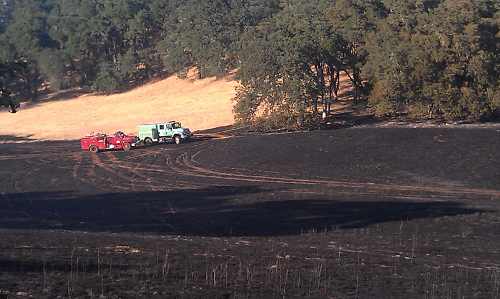
LAKE COUNTY, Calif. – Dozens of firefighters responded on Saturday afternoon to a fire that started along a roadside and resulted in a large spot fire that burned in a nearby vineyard.
The fire began along Westlake Road near the Nice-Lucerne Cutoff and the Rodman Slough.
By Saturday night, Cal Fire Battalion Chief Linda Green, the incident commander, estimated the fire burned a total of 35 acres, including a seven-acre hot spot that had burned near a vineyard in the Robin Hill area.
Green said full containment was expected on Sunday morning.
“We’ll be out here all night,” said Green.
She said the fire area will be mapped on Sunday morning, and the final acreage could change.
The California Highway Patrol shut down a portion of Westlake Road as well as the Nice-Lucerne Cutoff, where flames consumed blackberry bushes and vegetation on a hillside lining the roadway.
The Nice-Lucerne Cutoff was reopened at about 10 p.m. Saturday, according to radio reports.
Green said firefighters were first dispatched shortly before 4 p.m.
When she arrived, the fire was running downhill and away from an area on the side of Westlake Road where there was a pile of dumped trash, including a broken toilet.
The fire scorched a large field of grass and oak trees across the road from the Westlake Seventh-day Adventist School, moving in the direction of the Nice-Lucerne Cutoff.
Green said no structures were damaged. Early on the fire pushed toward buildings on the Lake County Land Trust Rodman Preserve property at the corner of Westlake Road and the Nice-Lucerne Cutoff.
“But then the wind pushed the fire the other way,” she said.
Northshore Fire Battalion Chief Steve Hart said firefighters worked the main part of the fire from the ground.
Nearly an hour after the fire was reported, embers from the fire were reported to have drifted and started a fire on Mackie Road at Robin Hill Drive in North Lakeport.
Lakeport Fire Chief Ken Wells confirmed that the main fire’s embers started the second fire. He estimated it burned about seven acres in and around a vineyard, where he said additional hot spots were popping up.
Air tankers and a Cal Fire helicopter that Green said was from Vina in Tehama County worked the second fire as a crowd of people watched nearby.
Wells said firefighters did some firing operations to help stop the smaller fire, and a dozer line was put around it.
He said there had been concerns that the fire has caused downed power lines in the area. A Pacific Gas & Electric technician visited the scene and it later was reported that there were no fallen lines.
Green said the fire also had gotten close to structures in the Robin Hill area. Some residents there reported the fire coming close to their homes.
The fire’s cause remained under investigation, said Green. An investigator was set to arrive at the scene Sunday morning.
Early Saturday evening, the air tankers on the fire were being made available to go to new fires that had broken out in other areas of Northern California, including the Plumas National Forest, Green said.
Some of the Cal Fire personnel released from the scene Saturday evening had to return to the North Fire, burning near Cow Mountain in Mendocino County, which also began earlier in the day. That fire had burned 150 acres by nightfall.
Local resources had been stretched with a small wildland fire in Clearlake reported not long after the Westlake incident was dispatched.
Northshore Fire Deputy Chief Pat Brown said Williams Fire sent an engine and water tender to cover the district’s Clearlake Oaks station.
Agencies that responded to the Westlake Road fire scene along with Cal Fire included the U.S. Forest Service, Northshore Fire, Lakeport Fire, Kelseyville Fire, Lake County Fire, South Lake County Fire and CHP. PG&E also sent a truck to investigate the initial report of lines down.
Green said no firefighters were injured.
Email Elizabeth Larson at




