How to resolve AdBlock issue?
WATER: Groups, California members of Congress react to ‘peripheral tunnel’ plan
NORTHERN CALIFORNIA – The unveiling of the Bay Delta Conservation Plan resulted in several groups and California members of Congress expressing their opposition to the plan.
On Wednesday, Gov. Jerry Brown and Secretary of the Interior Ken Salazar announced that they intend to move forward with construction of a massive tunnel system underneath the Sacramento-San Joaquin Delta, ultimately shipping water south and economically and environmentally devastating the region.
The members of Congress rejected the proposal by criticizing the void of scientific support as well as the utter lack of regard for current and future water rights for Northern California, and the likelihood that the plan will likely cause economic and environmental harm to the Bay-Delta and Northern California.
“A plan this reckless will not succeed,” said Rep. Jackie Speier (D-San Mateo).
The coalition of representatives have called on the U.S. Department of the Interior to include the input of the Bay-Delta communities, demanding a seat at the table as the BDCP has moved forward.
Congressman Mike Thompson (D-St. Helena), who represents Lake County in the House of Representatives, said the proposed Bay Delta Conservation Plan missed a golden opportunity to develop sound water policy, instead choosing politics over science.
“It will cost jobs, harm our environment and is a bad deal for Northern California,” he said. “All that we’ve insisted on is that any BDCP be based on sound science. Given the announced preferred alternative, this was apparently too much to ask. Before making irreversible decisions, we need a transparent, comprehensive and impartial discussion, with all stakeholders at the table, on how this would impact the farmers, fishers and businesses that depend on the Delta for their livelihoods. Today’s announcement ignores the needs of Northern California and will devastate our economy.”
“I am troubled by the tone of today’s announcement,” said Rep. George Miller (D-Martinez). “If ‘getting it done’ means cutting corners, leaving out details, and getting ahead of the science, we’re not actually getting anything done – we’re just getting into a trap.”
Miller said there are parts of this proposal that are encouraging and are a step forward from previous efforts, but there’s a lot of work left to be done before any final decisions can be made. “Keep in mind what is at stake here – a badly designed plan can harm drinking water supplies, further endanger California’s salmon runs, and ruin the economic livelihood of tens of thousands in the fishing and related industries up and down our coast.”
“To solve California’s water issues, northern California must be part of the decision making process. Unfortunately we were not,” said Rep. Doris Matsui (D-Sacramento). “Imagine if San Francisco decided to build the Golden Gate Bridge without consulting Marin County? The 9,000 cfs facility being proposed is simply not acceptable. It will cause massive impacts in the Sacramento area and suck our river dry. There are still a lot of unaddressed issues, and it is my sincere hope they will be addressed before any BDCP moves forward. This proposal will also put at risk Senior Water rights that Sacramento County and the Delta region hold.”
Rep. John Garamendi (D-Fairfield) said the proposed conveyance facility “could wreak havoc on the Delta and the jobs it sustains and put existing water rights in the Delta and Northern California at risk.”
He said it’s possible for California to solve its water problems, “but the Delta and Northern California counties must be at the table, and it will take a comprehensive, multifaceted approach, not just a piece of plumbing in the Delta. We must address the needs of all Californians by prioritizing storage, conservation, recycling, levee improvements, and habitat restoration. A BDCP without these elements is incomplete at best.”
At the same time, Restore the Delta, Sierra Club, Food & Water Watch, the Planning and Conservation League, the Environmental Water Caucus, Friend of the River, the Pacific Coast Federation of Fishermen’s Associations and a dozen other groups on Wednesday launched their campaign against the “Peripheral Tunnels” with a rally at the State Capitol.
Opponents pointed out “fatal flaws” of the tunnels they said would damage water, the environment, fish, and farming and impose billions of dollars of increases on water ratepayers.
“We oppose the rush to build a project that would exterminate salmon runs, destroy sustainable family farms and saddle taxpayers with tens of billions in debt, mainly to benefit a small number of huge corporate agribusinesses on the west side of the San Joaquin Valley,” said Barbara Barrigan-Parrilla, executive director of Restore the Delta. “This proposal is fatally-flawed.”
The opponents assailed the failure to conduct a cost-benefit analysis of the proposal, and said the costs would fall on water ratepayers.
Kristin Lynch, Pacific Region Director for Food & Water Watch, said, “This project would cost billions upon billions of dollars to give ever-increasing amounts of taxpayer and ratepayer subsidized water to corporate agriculture and real estate developers to make millions upon millions in profits. It is the ultimate fleecing of ratepayers and taxpayers.”
Lynch said it’s a fallacy that the plan is the only way to secure reliable water for southern California. “There are no guarantees that southern California residents will receive more water. As an indication to the contrary, LA Dept. of Water and Power is already projecting increased rates for decreased water consumption. How much will rates need to increase if this project moves forward?”
Zeke Grader, Pacific Coast Federation of Fishermen’s Associations and the Golden Gate Salmon Association, said, “History clearly shows those who covet salmon water in California will take as much of it as they can get away with. They’ve done it time and again. They’ve been reined in a bit since pumping restrictions designed to keep salmon and other fish from going extinct went into effect starting in late 2008.”
Bill Jennings, executive director of the California Sportfishing Protection Alliance, said the tunnels represent a massive transfer of wealth from north to south, with two-thirds of Delta water exports going to support 0.3 to 0.4 percent of the California population and economy on the westside of the San Joaquin Valley, while less than a third goes to areas representing two-thirds of the state’s population and economy.
“Why would anyone choose to sacrifice family farms on prime farmland in the Delta in order to send subsidized water to grow subsidized crops on the impaired soils of Westside plantations, whose owners live in Pacific Heights and Beverly Hills?” he asked. “Why would we use two and a half times the water to grow an almond in the Westside of the Valley than is required to grow an almond in Butte County?”
Caleen Sisk, Chief and Spiritual Leader of the Winnemem Wintu Tribe, said, “The common people will pay for the tunnels and a few people will make millions. It will turn a once pristine Delta waterway into a sewer pipe. It will be bad for the fish, the ocean and the people of California.”
Lake County Quilt Trail stretches along Main Street in Kelseyville
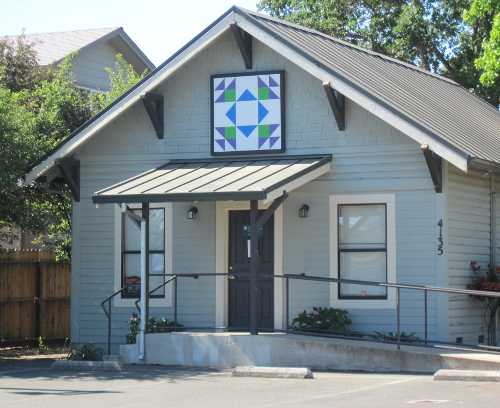
KELSEYVILLE, Calif. – Two new additions to the Lake County Quilt Trail were added to Main Street in Kelseyville. Summer Winds at 4135 Main St. and Birds Nest at 3925 Main St. were recently installed.
Each quilt block is 4-feet by 4-feet in size and fits snugly over the storefronts’ entrances.
Summer Winds can be seen on the 90-year-old structure at 4135 Main, home for decades to many Kelseyville families.
In 1985, Dr. Kirk and Quincy Andrus purchased the property and have continuously used the 1,700 square foot facility as medical offices. GPS location: N38° 58’ 38” W122°50’58”
“This community has been our home for 33 years,” Quincy Andrus said. “We raised our family here and established ourselves professionally. The LCQT is another way for our family to participate and support a fun community-project.”
Andrus chose the green and blue colors to represent the renewal of spring and the blue skies of Lake County.
Birds Nest is displayed at 3925 Main St. Built in 1937, the building has been used as a variety/dime store, an annex to the corner bank, and at least two quilt shops. GPS location: N38°58’40” W122°50’18”
Sisters Tina and Robin Kingsley, originally from Sonoma, recently opened the storefront as a retail shop for their online business, www.birdbraindesigns.net . Bird Brain Designs is a working studio that creates stitchery patterns sold in kits.
Visitors are making pilgrimages to visit the store and looking to discover treasures of the LCQT. Birds Nest is the pattern chosen because the owners feel the store has created a nice nest right on Main Street.
For detailed information about the LCQT, visit www.lakecountyquilttrail.com .
A short video introduces the all-volunteer project, provides short descriptions of each quilt and provides a printable map.
For day-to-day updates of the artistic team in action, go to Facebook, https://www.facebook.com/#!/pages/Lake-County-Quilt-Trail/187014251326163 .

Local unemployment in June stays stable; state unemployment drops slightly
LAKE COUNTY, Calif. – June’s unemployment numbers showed a slight improvement in California’s job picture, with Lake County remaining stable at the lowest unemployment rate the county has seen in nearly three years.
The California Employment Development Department reported that California’s unemployment rate dropped to 10.7 percent in June, down slightly from 10.8 percent in May and 11.9 percent in June 2011.
The number of people unemployed in June in California was 1,974,000 – down by 20,000 over the month, and down by 213,000 compared with June of last year, the report said.
Nonfarm jobs in California totaled 14,326,700 in June, an increase of 38,300 jobs over the month, for a total gain of 475,300 jobs since the recovery began in September 2009, according to data released by the California Employment Development Department that’s gathered from two separate surveys.
The Bureau of Labor Statistics reported that the U.S. unemployment rate in June was 8.2 percent, unchanged from May.
In June, Lake County’s unemployment rate was 14.7 percent, the same rate as it registered in May, and down from 16.8 percent in June 2011, according to Employment Development Department statistics.
Lake County’s June rate is the lowest since September 2009, when the county’s unemployment was 14.2 percent.
Dennis Mullins of the Employment Development Department’s North Coast Region Labor Market Information Division said Lake County’s wage and salary employment increased 260 jobs between May and June.
He said Lake County is up 240 jobs in 2012 compared to 2011, with eight industry sectors gaining or holding steady and three declining.
Mullins said year-over job growth occurred in farm, 90; trade, transportation and utilities, 60; professional and business services, 10; private educational and health services, 30; and government, 80.
Industry sectors with no change over the year included financial activities, leisure and hospitality, and other services, Mullins said.
Showing declines over the year were mining, logging and construction, -10; manufacturing, -10; and information, -10, according to Mullins’ report.
Statewide, Marin had the lowest unemployment rate, 6.6 percent, while Imperial had the highest, 28.3 percent, according to the report.
The county’s ranking remained at No. 45 among California’s 58 counties.
Lake's neighboring counties posted the following June unemployment rates: Colusa County, No. 57, 18.1 percent; Glenn, No. 46, 14.8 percent; Mendocino, No. 15, 9.7 percent; Napa, No. 3, 7.8 percent; Sonoma, No. 8, 8.7 percent; and Yolo, No. 24, 10.8 percent.
During the June survey week, 483,445 people received regular unemployment insurance benefits, compared with 515,434 in May and 528,919 in June 2011, the Employment Development Department reported.
The agency said new claims for unemployment insurance were 66,296 in June, compared with 57,545 in May and 74,944 in June 2011.
Surveys show differing employment pictures
A survey of 42,000 California businesses that measures jobs in the economy, and is larger and less variable statistically, showed an increase of 279,100 jobs, or 2.0 percent, from June 2011 to June 2012.
A federal survey of households, done with a smaller sample than the survey of employers, shows a decrease in the number of employed people. It estimated the number of Californians holding jobs in June was 16,484,000, a decrease of 17,000 from May, but up 326,000 from the employment total in June of last year.
EDD’s report on payroll employment (wage and salary jobs) in the nonfarm industries of California totaled 14,326,700 in June, a net gain of 38,300 jobs since the May survey, following a gain of 45,900 jobs, as revised, in May, according to the Employment Development Department.
The report for June said seven categories – construction; trade, transportation and utilities; information; financial activities; professional and business services; leisure and hospitality; and other services – added jobs over the month, gaining 46,600 jobs. Trade, transportation and utilities posted the largest increase over the month, adding 9,400 jobs.
Four categories – mining and logging; manufacturing; educational and health services; and government – reported job declines over the month, down 8,300 jobs, the report showed, with manufacturing
posting the largest decrease over the month, down 4,400 jobs.
Eight categories – mining and logging; construction; trade, transportation and utilities; information; financial activities; professional and business services; educational and health services; and leisure and hospitality – posted job gains over the year, adding 323,600 jobs, the Employment Development Department said.
The report also showed that professional and business services posted the largest gain on a numerical basis, adding 99,800 jobs, up 4.7 percent. Construction and information posted the largest gains on a percentage basis, both up 5.0 percent, adding 27,200 and 21,700 jobs, respectively.
Three categories – manufacturing; other services; and government – posted job declines over the year, down 44,500 jobs, according to the report, with government posting the largest decline on both a
numerical and percentage basis. That category was down by 35,700 jobs, a 1.5 percent decline.
Email Elizabeth Larson at
Boy Scout Troop 315 Eagle Projects meant to ‘do a good turn’ for communities
MIDDLETOWN, Calif. – It has been a very busy year working on Eagle service projects for the Boy Scouts of Troop 315 of Middletown, Hidden Valley Lake and Cobb.
An Eagle Project is the opportunity for a Scout to demonstrate leadership of others while performing a project for the benefit of any religious institution, school or his community. It is one of the requirements to advance to Eagle Scout, the highest rank for a Boy Scout.
The projects all involved hard physical labor well over 200 man-hours for several volunteers, and gave the scouts opportunities to “do a good turn,” as the BSA slogan goes, for their communities.
Troop 315 is a Boy Scout unit sponsored by the Hidden Valley Lake Association.
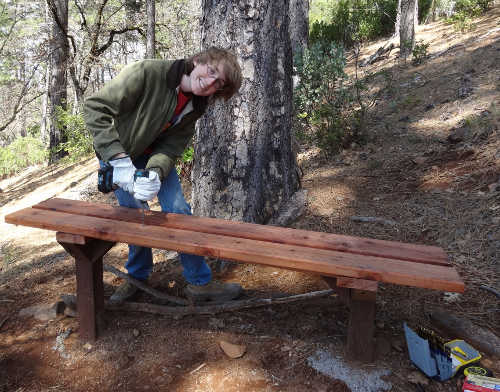
The first Eagle service project commenced in January, and received financial sponsorship by the Friends of Boggs Mountain (FOBM) for the construction of two redwood benches at Boggs Mountain State Forest.
Nathan McVay, 16, led the construction of the benches, pulling together a work crew of scouts and parents.
The late winter rains delayed progress, but eventually, man and horse were able to haul lumber, cement and power tools up and down steep trails.
One of the benches is located on Mac’s Trail, at a sharp bend on a steep switchback. The other bench is located in a shady grove near the creek on the Interpretive Trail.
Mike Kasper, FOBM board member who oversaw the project, was pleased with the outcome. “That bench on Mac’s Trail is at a great spot where you can catch your breath and enjoy views of Cobb Mountain, and the Interpretive Trail bench is a wonderful spot for quiet solitude and meditation,” he says.
Nathan was awarded his Eagle rank in May.
The second project was an even greater logistical challenge, requiring special equipment and expertise to transport and install a 40-foot flagpole at the newly-refurbished athletic field at Middletown High School.
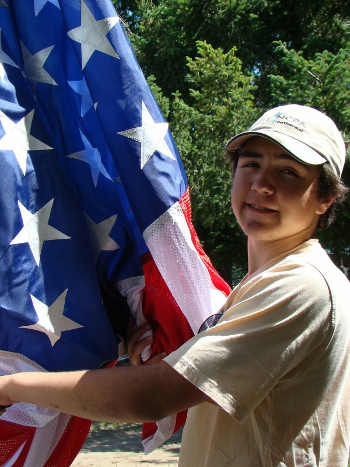
Newly-minted Eagle Scout, Charles Hoberg, who just recently turned 18, said the the idea to build the flagpole was originally proposed by Principal Bill Roderick.
“I thought it would be a great project,” Charles recollected, “but didn’t realize just how tough it was to get funding and even looking where to get a 40-ft. flagpole. It’s not the kind of thing people buy everyday.”
Fortunately, Charles was able to obtain generous support from Calpine, who donated more than $1,500 toward the purchase of the flagpole, as well as other community businesses such as Hardester’s Markets, Minudri Insurance, Twin Pine Casino, the Lions and Rotary Clubs, and many others including friends and family.
This ambitious undertaking was successfully completed in May, and adds a finishing touch to the MHS athletic stadium.
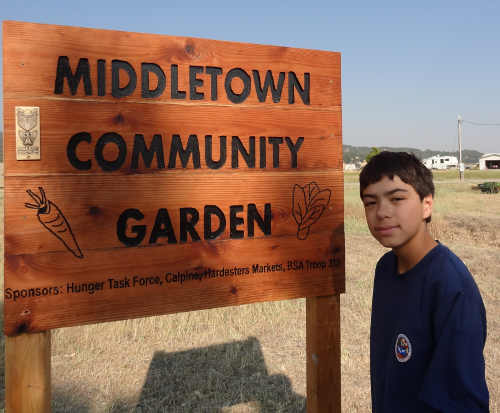
The most recently-completed Eagle service project was the construction of raised garden boxes for the Middletown Community Garden, led by a very young Eagle candidate, 14-year-old Liam Stahl.
The idea was suggested by Lake County Hunger Task Force board member Phyllis Kelsey, who shares part of her property in Butts Canyon to cultivate produce that would be harvested and donated to local food banks such as those organized by the Middletown United Methodist Church and Catholic Charities.
The project involved building four garden boxes, a shelter for the irrigation system, and posting a large sign off Loconomi Road to indicate the location of the garden for volunteers.
Once more, Calpine and Hardester’s Markets provided financial support, as did the good folks from the Hunger Task Force. Lake County Waste Solutions provided compost free of charge and Layne Paving delivered top soil at a discount.
As of the end of July, a good variety of veggies were thriving in these boxes, including zucchini, jalapeño peppers, cucumbers and melons.
The troop offers its sincere thanks to all the youth, adults, businesses and nonprofit organizations who’ve provided their time, expertise and financial support toward these worthy causes. And most of all, many thanks to the Boy Scouts who led these projects for a job well done.