 How to resolve AdBlock issue?
Thompson votes against House GOP health care repeal efforts
Congressman Mike Thompson (D-St. Helena) on Wednesday voted against H.R. 6079, the Patients’ Rights Repeal Act.
This legislation was the House Majority’s 31st bill in the last 18 months to repeal all or parts of the Affordable Care Act.
The repeal of health care reform would end patient protections and raise health care costs for millions of Americans, Thompson’s office reported.
The bill passed the House by a vote of 244-185. It will now go to the Senate.
The Senate is not expected to pass the bill and President Obama has said he would veto the legislation if it reached his desk.
“Today the House took its 31st vote to repeal all or part of health care reform,” said Thompson. “Health care reform was in response to a national crisis. Businesses and individuals couldn’t afford health care. Hospitals, doctors, and clinics provided billions in uncompensated care and those costs were then passed on to consumers. So, we passed legislation that saves money, saves lives and provides access to quality, affordable health care. Instead of staging these political games and voting to return to this national crisis, we should be strengthening the reforms made to our health care system and focusing on getting people back to work.”
In California’s 1st Congressional District, more than 6,000 seniors in the “donut hole” have received prescription drug discounts worth more than $3 million, an average of more than $500 per senior, according to Thompson’s office.
Also, under Medicare, seniors now receive a free annual wellness visit and important preventive services, such as mammograms and colonoscopies. Nationally, more than 16 million have taken advantage of this provision in the first six months of 2012.
In addition, women can no longer be dropped by their insurance company if they become pregnant, and young adults can now join or stay on their parents’ health plan until their 26th birthday, if they do not have coverage of their own. Thompson’s office said 7,600 young adults in the First District now have health insurance because of this change.
Children younger than age 19 can no longer be denied coverage by an insurance company for having a pre-existing condition. In the First district, 37,000 children with pre-existing conditions are now protected from discrimination.
Small business owners can receive tax credits if they choose to offer coverage to their employees, and privately-insured Americans can no longer be dropped from coverage by insurance companies because they get sick, and insurance companies can no longer place a lifetime limit on their coverage. In the First District, 460,000 residents are no longer at risk of their insurers dropping their coverage when they get sick.
By 2014, virtually all of the law will go into effect. This will result in more than 32 million uninsured Americans gaining access to affordable coverage.
The law also will end the hidden taxes that all insured individuals currently pay for emergency room visits by people without insurance. Women will no longer be charged substantially higher premiums than men for the same coverage, and being a woman can no longer be treated as a “pre-existing condition” by insurance companies.
On Tuesday Thompson spoke in the House Floor in opposition to the House Majority’s repeal legislation. The full text of his statement is below.
“I rise in opposition to this legislation that represents the 31st time that we have voted, or will vote, to repeal parts, or all, of the Affordable Care Act.
“Instead of staging these political games, we should be spending our time strengthening the reforms that were made in the Affordable Care Act, and working together to put people back to work.
“The Affordable Care Act was passed in response to a national crisis. Businesses and individuals could not afford to buy health insurance.
“Hospitals, doctors, and clinics provided more than $100 billion a year in uncompensated care -- $50 million in my district alone. Now the good fairy doesn’t come and reimburse them for their care. These costs are passed on to all of us who have health insurance in higher taxes and higher premiums, to the tune of $1,000 a year in higher health insurance premiums.
“People with preexisting conditions could not get coverage.
“People in my district were hitting their lifetime caps, or even annual caps, and being dropped by their insurance company.
“Others were self-employed and simply couldn’t afford to buy private insurance on the open market.
“This was a national crisis that we worked to try and fix, and this is the national crisis that the majority party would like to go back to.
“It’s not right, it’s not good for America, and it’s not good for Americans.
“So, on behalf of the millions of Americans who are already benefitting from the Affordable Care Act, I urge a ‘no’ vote on this legislation, and I yield back the balance of my time.”
Thompson represents California’s 1st Congressional District, which includes the Counties of Del Norte, Humboldt, Lake, Mendocino, Sonoma, Napa and Yolo.
Mill Fire increases to 16,000 acres; local strike team aids in firefighting effort
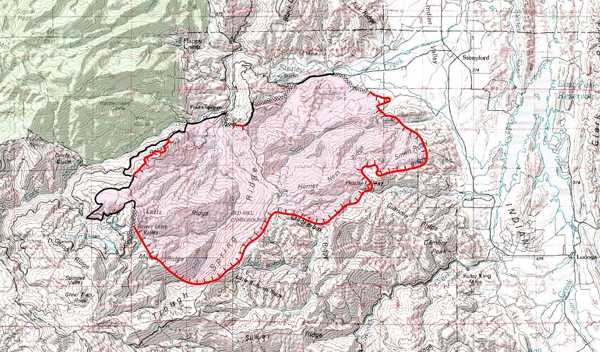
NORTHERN CALIFORNIA – As fire suppression efforts continued on the state’s largest wildland fire, local firefighters were called to assist and county residents were warned to take precautions due to smoke pouring into the air basin.
The Mill Fire has been burning since Saturday in the Colusa County side of the Mendocino National Forest, north and east of Upper Letts Lake.
By Tuesday night, the Mendocino National Forest reported that the Mill Fire – the largest wildland fire now burning in California – had scorched 16,000 acres of timber and brush in steep and rugged terrain, with 30 percent containment.
“We are pleased with the progress the team is making, but there is still a lot of active fire in the area. We appreciate your patience and support as we continue our work,” NorCal Type 2 Incident Commander Joe Molhoek said in a written statement.
It’s cost $2.2 million to fight the Mill Fire thus far, according to the Tuesday night report. The cause still is being investigated.
The Mill Fire has so far destroyed five outbuildings, with two injuries reported, officials said.
Lakeport Fire Chief Ken Wells said local firefighters are working on the Mill Fire.
He said a request for a Lake County type 3 strike team – composed of smaller engines with four-wheel drive capability, suited for rugged terrain – was submitted Monday afternoon.
Wells said the team of five engines, a strike team leader and assistant, and a total of about 17 personnel left Monday afternoon, staying overnight at the base camp at the Stonyford Rodeo grounds. They remained on scene Tuesday, and were helping with firing operations.
Altogether, 1,114 personnel were assigned to the incident on Tuesday, along with 15 Type 1 crews, five Type 2 crews, seven helicopters, 91 engines, 20 dozers and 12 water tenders.
Firefighters had continued to build and reinforce containment lines around the fire perimeter, with mop up and “cold-trailing” – physically checked for residual heat – was started on the northwest end of the fire, according to a forest report.
Challenged by steep terrain and fire spotting, firefighters weren’t able to build much line on the fire’s south flank, while officials said the north flank continued to burn out in heavy fuels with minimal fire spread.
Overnight Tuesday and into early Wednesday the Mill Fire is expected to burn actively at higher elevations because of moderate humidity recovery and nighttime winds. Steep terrain and wind are expected to contribute to more fire activity on the south and east flanks.
Firefighters are trying to protect the forest’s natural and cultural resources – including wet meadows, riparian areas, wildlife habitat and cultural properties, the forest reported.
Smoke from the fire has poured into Lake County’s air basin, leading on Tuesday evening to the Lake County Air Quality Management District issuing an air quality alert warning of the possibility of unhealthy conditions for sensitive populations as well as the rest of the county on Wednesday.
The Mendocino County Air Quality Management District also issued an air quality advisory for Covelo/Round Valley and the Mendocino County portion of the Mendocino National Forest due to smoke from the various fires in the region.
Hot, dry weather conditions with moderate south to southwest winds and low humidity are forecast for the remainder of the week, which will impact the effort.
Evacuation orders remain in effect for the communities of Fouts Springs, Bonnie View, Board Camp Springs and campgrounds within the Upper Letts Lake area. Voluntary evacuation covers a portion of Stonyford.
The Mendocino National Forest has issued a closure order for all roads and trails in the forest’s recreation area outside Stonyford on the south central portion of the Grindstone Ranger District. The closure order can be found at www.fs.usda.gov/alerts/mendocino/alerts-notices .
The Fouts Spring Road (The M10 Road) is closed at Stonyford, the Goat Mountain Road is closed at the Stonyford Lodoga Road and voluntary evacuation is in effect for the Lake View Loop Road to the Goat Mountain Road.
Email Elizabeth Larson at
Sites Complex nears 4,200 acres burned; containment increases
NORTHERN CALIFORNIA – Firefighters on Tuesday made more progress on a complex of fires in Colusa County.
The Sites Complex, which started Sunday along Sites Lodoga Road west of Maxwell, has burned 4,185 acres, and is 60 percent contained, according to Cal Fire’s Sonoma-Lake-Napa Unit.
The complex’s fires are all contained but the Grapevine Fire, which is 3,740 acres and 60 percent contained, Cal Fire said Tuesday night.
Crews continued to create and improve fire lines on Tuesday, with Cal Fire reporting that ground personnel made significant progress on the fire perimeter.
Five outbuildings remained threatened by the fire, based on the Tuesday report.
Assigned to the incident Tuesday were 1,339 personnel, 88 engines, 40 fire crews, six helicopters, 23 bulldozers and 12 water tenders, Cal Fire said.
No injuries have been reported.
A fire’s cause is under investigation.
Road closure information is available at www.countyofcolusa.org . Cal Fire will be evaluating the need for continued road closures on Wednesday morning.
Cooperating agencies include Cal Fire, Napa County Fire, Williams Fire Protection District, Maxwell Fire Protection District, Willows Fire Protection District, California Emergency Management Agency, California Highway Patrol, Colusa County Sheriff’s Office, Glenn County Sheriff’s Office, California Department of Corrections and Rehabilitation and Pacific Gas and Electric Co.
Email Elizabeth Larson at
Report: Back-to-back La Niñas cooled globe and influenced extreme weather in 2011
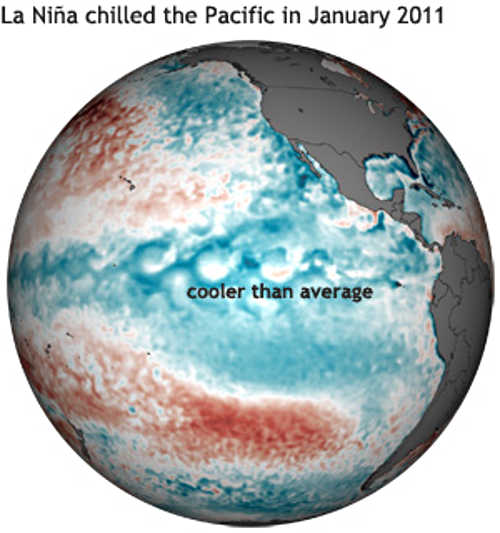
Worldwide, 2011 was the coolest year on record since 2008, yet temperatures remained above the 30 year average, according to the 2011 State of the Climate report released online Tuesday by the National Oceanic and Atmospheric Administration.
The peer-reviewed report, issued in coordination with the American Meteorological Society (AMS), was compiled by 378 scientists from 48 countries around the world.
It provides a detailed update on global climate indicators, notable weather events and other data collected by environmental monitoring stations and instruments on land, sea, ice and sky.
Deputy NOAA Administrator Kathryn D. Sullivan, Ph.D., said 2011 will be remembered “as a year of extreme events, both in the United States and around the world.”
She added, “Every weather event that happens now takes place in the context of a changing global environment. This annual report provides scientists and citizens alike with an analysis of what has happened so we can all prepare for what is to come.”
Two back-to-back La Niñas, each characterized by cooler-than-average water temperatures in the eastern equatorial Pacific, affected regional climates and influenced many of the world’s significant weather events throughout the year. These included historic droughts in East Africa, the southern United States and northern Mexico.
La Niña conditions contributed to an above-average tropical cyclone season in the North Atlantic hurricane basin and a below-average season in the Eastern North Pacific.
It also was associated with the wettest two-year period (2010-11) on record in Australia, which was particularly remarkable as the wet conditions followed a decade-long dry spell.
The Arctic continued to show more rapid changes than the rest of the planet. Sea ice shrank to its second smallest “summer minimum” extent on record during 2011, as older ice (four to five years old) reached a new record minimum at more than 80 percent below average.
Overall, glaciers around the world continued to lose mass. Loss from Canadian Arctic glaciers and ice caps were the greatest since measurements began in 2002.
The report used 43 climate indicators to track and identify changes and overall trends to the global climate system.
These indicators include greenhouse gas concentrations, temperature of the lower and upper atmosphere, cloud cover, sea surface temperature, sea level rise, ocean salinity, sea ice extent and snow cover. Each indicator includes thousands of measurements from multiple independent datasets.
Highlights of the report
Warm temperature trends continue
Four independent datasets show 2011 among the 15 warmest since records began in the late 19th century, with annually-averaged temperatures above the 1981-2010 average, but coolest on record since 2008.
The Arctic continued to warm at about twice the rate compared with lower latitudes. On the opposite pole, the South Pole station recorded its all-time highest temperature of 9.9°F on December 25, breaking the previous record by more than 2 degrees.
Greenhouse gases climb
Major greenhouse gas concentrations, including carbon dioxide, methane, and nitrous oxide, continued to rise.
Carbon dioxide steadily increased in 2011 and the yearly global average exceeded 390 parts per million (ppm) for the first time since instrumental records began. This represents an increase of 2.10 ppm compared with the previous year.
There is no evidence that natural emissions of methane in the Arctic have increased significantly during the last decade.
Arctic sea ice extent decreases
Arctic sea ice extent was below average for all of 2011 and has been since June 2001, a span of 127 consecutive months through December 2011.
Both the maximum ice extent (5.65 million square miles, March 7) and minimum extent (1.67 million square miles, September 9) were the second smallest of the satellite era.
Ozone levels in Arctic drop
In the upper atmosphere, temperatures in the tropical stratosphere were higher than average while temperatures in the polar stratosphere were lower than average during the early 2011 winter months.
This led to the lowest ozone concentrations in the lower Arctic stratosphere since records began in 1979 with more than 80 percent of the ozone between 11 and 12 miles altitude destroyed by late March, increasing UV radiation levels at the surface.
Sea surface temperature and ocean heat content rise
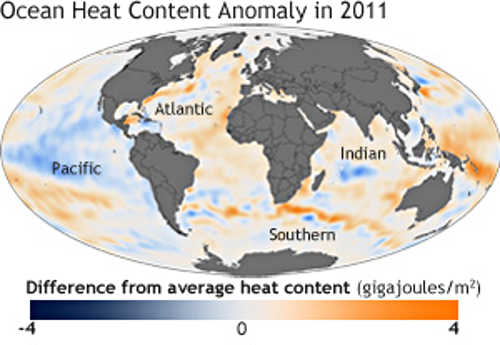
Even with La Niña conditions occurring during most of the year, the 2011 global sea surface temperature was among the 12 highest years on record. Ocean heat content, measured from the surface to 2,300 feet deep, continued to rise since records began in 1993 and was record high.
Ocean salinity trends continue
Continuing a trend that began in 2004 and similar to 2010, oceans were saltier than average in areas of high evaporation, including the western and central tropical Pacific, and fresher than average in areas of high precipitation, including the eastern tropical South Pacific, suggesting that precipitation is increasing in already rainy areas and evaporation is intensifying in drier locations.
The report also provides details on a number of extreme events experienced all over the globe, including the worst flooding in Thailand in almost 70 years, drought and deadly tornado outbreaks in the United States, devastating flooding in Brazil and the worst summer heat wave in central and southern Europe since 2003.
The 2011 State of the Climate report is peer-reviewed and published annually as a special supplement to the Bulletin of the American Meteorological Society.
The report is part of a suite of climate services NOAA provides government, business and community leaders so they can make informed decisions.
It was edited by Jessica Blunden, Ph.D., and Deke Arndt of NOAA’s National Climatic Data Center. The full report can be viewed online. The report highlights are available online.
Additionally, for the first time a complementary article has been published by AMS today examining the linkages between climate change and extreme events of 2011. The paper looks at six global extreme weather and climate events from last year.
The report found that determining the causes of extreme events remains difficult.
While scientists cannot trace specific events to climate change with absolute certainty, new and continued research help scientists understand how the probability of extreme events change in response to global warming.
La Niña-related heat waves, like that experienced in Texas in 2011, are now 20 times more likely to occur during La Niña years today than La Niña years fifty years ago.
The UK experienced a very warm November 2011 and a very cold December 2010. In analyzing these two very different events, UK scientists uncovered interesting changes in the odds. Cold Decembers are now half as likely to occur now versus fifty years ago, whereas warm Novembers are now 62 times more likely.
Climate change cannot be shown to have played any role in the 2011 floods on the Chao Phraya River that flooded Bangkok, Thailand. Although the flooding was unprecedented, the amount of rain that fell in the river “catchment” area was not very unusual.
Other factors, such as changes in reservoir policies and increased construction on the flood plain, were found most relevant in setting the scale of the disaster.




