 How to resolve AdBlock issue?
Five illegal marijuana cultivation sites reclaimed in Mendocino National Forest
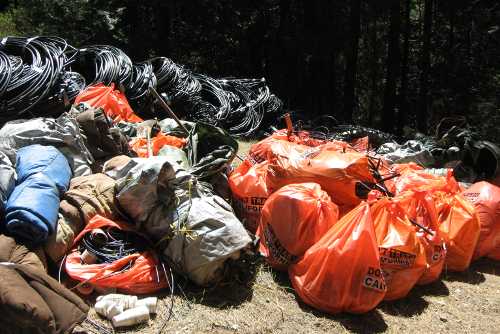
MENDOCINO NATIONAL FOREST, Calif. – The Mendocino National Forest, in cooperation with several organizations, recently cleaned up five illegal marijuana cultivation sites on the Covelo Ranger District.
Approximately 20 people, representing seven organizations, including the Mendocino National Forest, spent five days gathering trash, black plastic pipe, pesticides and other materials used for illegal marijuana cultivation.
“It’s great to see seven individual organizations come together to restore our shared National Forest system lands,” said Forest Supervisor Sherry Tune.
The Forest Service was joined by participants from California Department of Fish and Game, the High Sierra Volunteer Trail Crew, Conservation Corps North Bay, Willits Environmental Center, Mendocino County Sheriff and the Mendocino County Public Safety Foundation.
Participants collected 45 bags of trash, as well as an equal amount of trash that didn’t need to be bagged, including tarps and tents.
More than five miles of irrigation tubing and 350 pounds of dry fertilizer were also gathered at the site, along with various pesticides.
The area cleaned was 2.4 acres and appears to have been used by at least 10 individuals over the course of several years, according to a report from forest headquarters. There was evidence of at least 2,300 pounds of fertilizer being used at the site following the collection of remaining empty bags.
As part of the cleanup, soil specimens were collected and are awaiting analysis. This will help determine damage to the watershed from the marijuana cultivation at this site.
Since 2010, the Mendocino National Forest has been making a directed effort to address the environmental impacts of illegal marijuana cultivation on the Forest.
“It’s really nice to see the Mendocino National Forest be so proactive in cleaning up grow sites,” said High Sierra Volunteer Trail Crew Director Shane Krogen. “They are well on their way to being the second forest in California to have 100 percent reclamation.”
The average cost to clean a site on the Mendocino can be more than $3,000 per acre.
“The steep terrain, remote areas and seclusion of the Mendocino that are such a draw for forest visitors can pose a challenge to cleaning up the sites used for illegal marijuana cultivation,” Tune said. “Through the efforts of our employees, partner agencies and outside cooperators, we can work together to restore the fragile ecosystems and watersheds that are being impacted by pesticides, fertilizers, redirected water and trash.”
Space News: Titan’s underground ocean
Data from NASA’s Cassini spacecraft have revealed Saturn’s moon Titan likely harbors a layer of liquid water under its ice shell. The finding appears in today’s edition of the journal Science.
“Cassini’s detection of large tides on Titan leads to the almost inescapable conclusion that there is a hidden ocean at depth,” said Luciano Iess, the paper’s lead author and a Cassini team member at the Sapienza University of Rome, Italy. “The search for water is an important goal in solar system exploration, and now we’ve spotted another place where it is abundant.”
The evidence is tidal. Saturn’s powerful gravity stretches and deforms Titan as the moon moves around the gas giant planet. If Titan were composed entirely of stiff rock, the gravitational attraction of Saturn should cause bulges, or solid “tides,” on the moon only 3 feet (1 meter) in height.
Instead, the data show Saturn creates solid tides approximately 30 feet (10 meters) in height. This suggests Titan is not made entirely of solid rocky material.
At first, scientists were not sure Cassini would be able to detect the bulges caused by Saturn’s pull on Titan. Cassini succeeded, however, by measuring Titan’s gravitational field during six close flybys from Feb. 27, 2006, to Feb. 18, 2011.
These gravity measurements, collected with the aid of NASA’s Deep Space Network (DSN), revealed the size of Titan’s tides.
“We were making ultrasensitive measurements, and thankfully Cassini and the DSN were able to maintain a very stable link,” said Sami Asmar, a Cassini team member at NASA’s Jet Propulsion Laboratory in Pasadena, Calif. “The tides on Titan pulled up by Saturn aren’t huge compared to the pull the biggest planet, Jupiter, exerts on some of its moons. But, short of being able to drill on Titan’s surface, the gravity measurements provide the best data we have of Titan’s internal structure.”
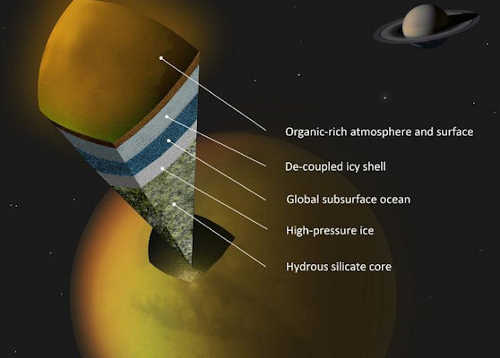
An ocean layer does not have to be huge or deep to create the observed tides. A liquid layer between the external, deformable shell and a solid mantle would enable Titan to bulge and compress as it orbits Saturn.
Because Titan’s surface is mostly made of water ice, which is abundant in moons of the outer solar system, scientists believe Titan’s ocean is likely mostly liquid water.
On Earth, tides result from the gravitational attraction of the moon and sun pulling on our surface oceans.
In the open oceans, those can be as high as two feet (60 centimeters). The gravitational pulling by the sun and moon also causes Earth’s crust to bulge in solid tides of about 20 inches (50 centimeters).
The presence of a subsurface layer of liquid water at Titan is not by itself an indicator for life. Scientists think life is more likely to arise when liquid water is in contact with rock, and these measurements cannot tell whether the ocean bottom is made up of rock or ice.
The results have a bigger implication for the mystery of methane replenishment on Titan. Methane is abundant in Titan’s atmosphere, yet researchers believe the methane is unstable, so there must be a supply to maintain its abundance.
“The presence of a liquid water layer in Titan is important because we want to understand how methane is stored in Titan’s interior and how it may outgas to the surface,” said Jonathan Lunine, a Cassini team member at Cornell University, Ithaca, N.Y. “This is important because everything that is unique about Titan derives from the presence of abundant methane, yet the methane in the atmosphere should be destroyed on geologically short timescales.”
A liquid water ocean, “salted” with ammonia, could produce buoyant ammonia-water liquids that bubble up through the crust and liberate methane from the ice. Such an ocean could serve also as a deep reservoir for storing methane.
For more information about Cassini’s mission to Saturn, visit: http://www.nasa.gov/cassini and http://saturn.jpl.nasa.gov .
Dr. Tony Phillips works for the National Aeronautics and Space Administration.
STATE: Governor Brown sends firefighting assistance to Colorado
SACRAMENTO – Governor Jerry Brown on Friday directed the California National Guard to provide specialized firefighting aircraft to help the state of Colorado combat its devastating wildfires.
Two C-130J airplanes from California Air National Guard’s 146th Airlift Wing in Port Hueneme are scheduled to depart Channel Islands Air National Guard Station on Saturday morning.
The C-130J aircraft are equipped with the Modular Airborne Fire Fighting System II (MAFFS II). Approximately 30 crewmembers will accompany the planes.
The entire cost of this mission will be reimbursed by the federal government.
“We’ve fought some of the nation’s most destructive wildland fires in California, and we are putting our personnel, equipment and experience to work in Colorado,” said Governor Brown. “Our thoughts are with everyone affected by this disaster.”
Colorado has helped California fight large-scale wildfires in the past. In 2008, when more than 2,000 fires burned across California, Colorado sent local government fire engines and firefighters to assist and the U.S. Air Force Reserve Command in Colorado provided two MAFFS-equipped aircraft.
“We know how devastating wildfires can be here in California,” said Maj. Gen. David S. Baldwin, Adjutant General of the California National Guard. “We bring skilled, highly trained pilots and ground crews with the latest in aerial firefighting equipment to the fight.”
There are eight MAFFS-equipped aircraft in the United States. Two are stationed in California, and all eight have been committed to California fires in the past. The aircraft that will be deployed to Colorado can drop up to 3,000 gallons of water or retardant in a single aerial pass.
The 146th Air Wing will join two other MAFFS-equipped aircraft working the fires in Colorado, which have so far conducted 37 drops of nearly 103,000 gallons of fire retardant.
Congress established the authority for the MAFFS program in the early 1970s to support wildland firefighting through an agreement with the U.S. Forest Service.
Hobergs Resort prepares for renovations; seeks crew to carry out work
COBB, Calif. – Renovations are set to begin next month at one of the county’s famed resorts, and community members with the right skills are being sought to fill the first wave of jobs to be created.
A group of investors purchased the resort in July 2010, as Lake County News has reported.
Hobergs is now bringing in a new round of financing to start phase one renovations in the middle of July.
The phase one renovations that are about to start will take five to eight weeks of full-time work, according to management.
Applications for the construction crew can be submitted by going to the careers page at www.hobergsclub.com/resort/ .
The resort needs at least 30 general laborers – preferably with construction, electrical, framing, carpentry and plumbing experience. Laborers without that experience are eligible for hire at a lower pay scale.
Hobergs also is looking for five to 10 skilled carpenters, plumbers and electricians, all with contractor’s licenses.
Many other positions will be opening soon, so the resort is encouraging everyone who is interested to apply.
Upon completion of the work, the resort will be hiring hotel, dining, spa and many other service positions. People are welcome to apply for those jobs now, also at www.hobergsclub.com/resort/ .
Email Elizabeth Larson at




