 How to resolve AdBlock issue?
Clearlake Oaks woman arrested for battery, resisting arrest

CLEARLAKE OAKS, Calif. – A Clearlake Oaks woman was arrested last week on battery charges, with additional charges of resisting arrest and battery on a peace officer added after she fought with the deputies arresting her.
Angela Carol Sanchez, 47, was taken into custody on the afternoon of Thursday, June 21, according to Sgt. Steve Brooks of the Lake County Sheriff’s Office.
Shortly after 2 p.m. that day sheriff’s deputies responded to the area of 9900 E. Highway 20 in Clearlake Oaks for a report of a battery, Brooks said.
Upon their arrival the deputies contacted the victim, who alleged that Sanchez had struck her in the back of the head. Brooks said the victim wanted Sanchez arrested for battery and signed a private persons arrest form.
Deputies contacted Sanchez in front of her residence, which is in close proximity to the victim’s home. As deputies went to take Sanchez into custody, she violently resisted and attempted to remove the arresting deputy’s firearm from its holster, Brooks said.
Even after Sanchez was placed in handcuffs, she continued to resist by lunging head first and spitting at the deputies, according to Brooks.
Sanchez was arrested for attempting to remove a firearm from a peace officer, battery on a peace officer, obstructing or resisting a peace officer, and battery on a person, Brooks said.
While being transported to the Lake County Hill Road Correctional Facility, Sanchez attempted to break the window out of the patrol vehicle by kicking it and causing damage, Brooks said. Upon Sanchez’s arrival to the facility, she also was charged with vandalizing the patrol vehicle.
Lake County residents sought for 2012-13 grand jury
LAKE COUNTY, Calif. – The Lake County Superior Court is seeking at least 30 applicants willing to serve as jurors and alternates on the 2012-13 Lake County Grand Jury panel.
The 19-person grand jury is selected from the different supervisorial districts in proportion to the population of each district.
The grand jury serves as the public’s “watchdog” by investigating and reporting upon the affairs of local government.
The term of service runs from July 1, 2012, to June 30, 2013, and may entail from 10 to 20 hours of work per week attending committee and general meetings, responding to citizens’ complaints, performing research, and investigating the operations of governmental agencies and allegations of wrongdoing by public officials or employees.
The court is looking for applicants in good health who are interested in community affairs, are objective and are able to work cooperatively with others.
Experience in researching, interviewing, writing and editing, and/or auditing is desirable and having a general knowledge of the responsibilities and functions of governmental and other public entities is helpful.
A grand juror must be a U.S. citizen, age 18 or older, speak English, be a resident of California and Lake County for at least one year prior to selection, and not hold an elected office or have any felony convictions.
Applications may be obtained at www.lake.courts.ca.gov , downloaded below or by mailing a letter with a self-addressed, stamped envelope to the Grand Jury Coordinator, 255 N. Forbes, fourth floor, Lakeport, CA 95453.
Applications also are available at each Superior Court Clerk’s Office; located at 255 N. Forbes, fourth floor, in Lakeport, or at 7000 A South Center Drive, in Clearlake.
Further information may be obtained by calling the grand jury coordinator at 707-263-2282.
Applications must be received by July 3, 2012.
Personal interviews will be scheduled prior to final selection.
If you are interested, please apply. If you are not interested, but know someone who may be, please let them know of this opportunity.
Lake County Grand Jury ApplicationFederal partners continue to support state and local partners as they fight wildfires
Federal partners are continuing to work closely with first responders and firefighters from local, state and tribal agencies to combat and monitor large wildfires throughout the West including those in Alaska, Arizona, California, Colorado, Nevada, New Mexico, Utah and Wyoming.
As of Monday, more than 450 federal, state and local firefighters and four heavy airtankers were fighting the most recent major outbreak, the aggressive Waldo Canyon fire in the hillsides west of Colorado Springs, Colo.
An additional two C-130 aircraft fitted with Modular Airborne Fire Fighting Systems will be operating in the next day from Peterson Air Force base in Colorado Springs.
“As we continue this fight, we’ve been able to fill every single order for more firefighters and aircraft to ensure we have everything we need to contain this fire,” said U.S. Forest Service Chief Tom Tidwell. “Our hundreds of brave men and women on the front line are battling dry conditions, a lack of snowpack, excessive dead trees, hot weather and complex terrain to try to get this fire and others throughout the west under control.”
The fire has consumed more than 3,600 acres of forested land since Saturday. With low humidity, high winds and temperatures in the 90s forecast for Monday, the situation remains challenging as firefighters work in what is described as very difficult terrain. The Waldo Canyon fire stretches in three directions across very dry forests.
Approximately 1,400 Forest Service personnel and 29 engines are currently assigned to the Rocky Mountain region, with the majority of those resources staged in Colorado. An additional 500 firefighters are assigned to Colorado from the Department of the Interior.
Through the National Interagency Fire Center, which coordinates resources from the US Forest Service, the Department of the Interior and other federal agencies, firefighters, incident management teams, airtankers, helicopters, fire engines and other resources are being provided to supplement state and local resources as teams continue to respond to fires across the West.
On Sunday, FEMA approved Fire Management Assistance Grants (FMAGs) that authorize the use of federal funds to help with firefighting costs for the Waldo Canyon Fire in El Paso County, Colorado; the Weber Fire in Montezuma County, Colorado; and the Hollow Fire in Sanpete County, Utah.
An FMAG makes FEMA funding available to pay 75 percent of the state’s eligible firefighting costs for managing, mitigating and controlling the fire. These grants do not provide assistance to individual home or business owners and do not cover other infrastructure damage caused by the fire.
On June 6, FEMA approved a FMAG for the High Park Fire in Larimer County, Colorado, and on June 22 approved a FMAG for the Eagle Mountain/Dump Fire in Utah County, Utah.
FMAGs are provided through the President's Disaster Relief Fund and made available by FEMA to assist in fighting fires that threaten to cause a major disaster. Eligible items can include expenses for field camps; equipment use, repair and replacement; mobilization and demobilization activities; and tools, materials and supplies.
The Western fire season is now, on average, 78 days longer than in the mid-1980s. Cumulative drought, a changing climate, extensive insect kill in western forests, and regional shifts of population into the wildland urban interface have resulted in an increased level of wildfire activity that is expected to continue into the future.
The U.S. Department of Agriculture and the Department of the Interior, in partnerships with states and local partners, have developed a cohesive strategy to respond to these trends by focusing on:
Restoring and maintaining resilient landscapes. Through forest restoration activities such as mechanical thinning and controlled burns, officials can make forests healthier and less susceptible to catastrophic fire.
Creating fire-adapted communities. The Forest Service and its partners are working with communities to reduce fire hazards around houses to make them more resistant to wildfire threats.
Responding to Wildfires. This element considers the full spectrum of fire management activities and recognizes the differences in missions among local, state, tribal and Federal agencies.
On average the USDA Forest Service and the Department of the Interior bureaus respond to more than 20,000 wildfires per year.
Federal firefighters, aircraft, and ground equipment are strategically assigned to parts of the country as the fire season shifts across the nation.
Firefighting experts will continuously monitor conditions and move these assets as necessary to be best positioned and increase initial attack capabilities.
In addition, federal agencies are conducting accelerated restoration activities nationwide aimed at healthier forests and reduced fire risks in the years to come.
Federal land managers are also helping communities prepare for wildfire. Federal partnerships with tribal, state, and local agencies strengthen preparedness programs, such as Firewise, http://www.firewise.org/ , and Ready Set Go!, http://www.iafc.org/readySetGo , that help families and communities prepare for and survive wildfire.
You can also visit FEMA's site http://www.ready.gov to learn more about steps you and your family can take now to be prepared for an emergency.
Lake County’s Relay for Life surpasses annual fundraising goal
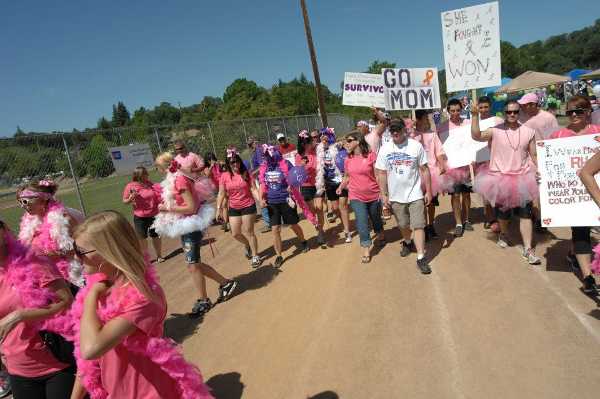
LAKE COUNTY, Calif. – With the final numbers now in, Lake County’s annual Relay for Life event passed its goals this year, gaining special recognition for its effort to recruit participants in the ongoing fight against cancer.
The 11th annual event – which began Saturday, May 19, and lasted until the following day at Clear Lake High School in Lakeport – raised nearly $106,000, passing its goal of $100,000, according to Lake County Relay for Life Co-Chair Racheal Harmon.
Harmon said the money is still coming in from the event.
“This year was such an amazing year for many reasons,” Harmon said.
Harmon said the relay had 764 participants this year, double that of the 2011 event.
In addition, there were 83 registered teams, 35 of them being newly recruited, she said.
Harmon said Lake County was recognized as being in the top three areas in all of California for newly recruited teams.
This year’s 83 teams raised funds for the American Cancer Society’s research, education, advocacy and service programs, Harmon said.
“This outstanding show of support proves that the people of Lake County are truly committed to the fight against cancer,” she said.
Lake County’s fundraising and participation numbers become all the more impressive when comparing the results to larger areas.
Harmon said the Studio City North Hollywood team raised $64,815, with 429 participants and 37 teams; West Sacramento brought in $27,020, with 305 participants and 37 teams; and South San Francisco had 155 participants and 24 teams, and raised $30,148.
Harmon said the event honored survivors and those who have died, and offered the opportunity to fight back against the disease by raising money.
She said it was a hit, and participants and the community enjoyed every moment of it.
Harmon said 118 cancer survivors took the relay’s first lap, officially kicking off the 2012 event.
“These survivors are the reason we continue the fight,” she said. “Their participation inspires hope in those currently battling cancer.”
Top individual participants were Jenny Bowen, $2,565; Angie DeMaria, $1,615; and Brenda Wesselhoff, $1,610, Harmon reported.

Top teams were Find a Penny, $8,660.75; Cell Smashers, $8,547.23; Pink Ladies, $8,223.55; Bella's Angels, $7,434; Envision a Cure, $6,677; Save the Tatas, $4.550; Super Suckers, $4,511.75; Angels Among Us, $3,978; St. Helena Hospital, $3,254; and PartyLite on Fire for a Cure, $3,046, according to Harmon.
Harmon said top youth teams were Middletown High School, $9,620.50; Kelseyville Cancer Kickers, $2,659; Cardinals For a Cure (Clear Lake High School), $2,363.75; and Team Cancer Kickers (Upper Lake High School), $1,914.
Three first time teams did exceptionally well, raising more money than is common for new groups entering the event, said Harmon. The top new 2012 teams were Bella's Angels, $7,434; Super Suckers, $4,475.75; and Angels Among Us, $3,978.
Harmon said Relay for Life would not be possible without its corporate sponsors.
Sponsors for this year’s relay included Reynolds Truck & Crane Inc.; Sutter Lakeside Hospital; St. Helena Hospital Clearlake; Meals on Wheels Thrift Store Inc.; Milan L. Hopkins M.D., A Medical Corporation; Early Lake Lions; Bottle Rock Power LLC; Patty Cake’s Preschool; Lake County Tribal Health Consortium Inc.; Quail Run Fitness Center; Hair Jordan Salon; The English Inn; Lakeview Super Market & Deli; Lake Events; PartyLite; Batter-Up Cupcakes; Perkos; Lakeport Disposal; Lake County Record-Bee; Ice Water; Upper Lake High School; RB Peters; Kelseyville Septic; Wine Country Gas; McDonald’s; The Party Store in Lakeport; Lake County News; Bruno’s Shop Smart; Lakeport Kiwanis; the Thompson Family; Hillside Honda; and the UPS Store in Lakeport.
Following the encouraging results from the fundraising portion of the event, the call for volunteers to participate in a Cancer Prevention Study has already received responses from 130,000 men and women across the country, with 15,000 from California.
This Cancer Prevention Study, known as CPS-3, will have the American Cancer Society asking for participants until December 2013. The final goal is 300,000 participants nationwide, from various racial/ethnic backgrounds.
They are looking for men and women between the ages of 30 and 65 who have no personal history of cancer.
For details on the program, contact the American Cancer Society at 1-888-604-5888 or email
While Relay for Life culminates in the May event, the effort to put it all together runs from September to August.
For information on how you can help in the fight against cancer, call 1-800-227-2345 or visit www.americancancerfund.org .




