 How to resolve AdBlock issue?
Mendocino College Foundation presents festive Gala on the Green June 23
UKIAH, Calif. – A festive atmosphere with music, auctions, a garden tour and an informative talk by a special guest will complement gourmet appetizers and dinner at this year’s Gala on the Green, the annual fundraiser of the Mendocino College Foundation.
The Saturday, June 23, event will take place at Campovida, 13601 Old River Road, Hopland.
The gala begins at 5:30 p.m. with a welcome reception featuring appetizers by Mendocino and Lake County food purveyors, including Stan’s Maple Café, Come to Your Senses Catering, and Nicholas Petti of the College’s Culinary Arts Program and wines from participating wineries including Weibel, Parducci, Nelson Family Vineyards, Campovida, Cesar Toxqui, and Terra Savia.
Information about the gala can be found on the event Web site, http://galaonthegreen.org .
Gala attendees interested in a tour of the Campovida gardens and an informational talk by Hubert Germain-Robin of Germain-Robin Distillery will want to arrive by 4 p.m., according to organizers. The tour and talk will precede the welcome reception.
Tickets for the event are still available and may be purchased online. The price is $100 per person. Tables, with seating for eight people each, may be reserved for $700.
A few tables are still left, according to Katie Fairbairn, the foundation’s executive director; individuals wishing to attend should purchase their tickets soon, she said.
Additional information about tickets and table reservations is available on the foundation’s Web site, http://foundation.mendocino.edu .
Proceeds from the event are used to fund scholarships for students and provide support for college programs as recommended by the administrators.
Last year’s Gala on the Green raised more than $66,000 for scholarships and educational programs.
Joining the pre-Gala activities, Germain-Robin is looking forward to discussing the differences between cognac and the wines of Northern California.
Invited by foundation board member Kit Elliott, the Redwood Valley resident said he plans to talk “a little” about himself but mostly about the different grapes, terroir and the microclimates used for producing cognac. His distillery is at the old Fetzer winery, “a good location,” he said.
While discussing cognac and distillation, Germain-Robin hopes to provide an “education about distillation,” he said, by having glasses of varietals for people to smell the differences in cocktails. “I educate the nose. I try to make it simple for people to understand,” he said. He invites people to join him for his discussion and demonstration, to be followed by a question-and-answer period.
During the gala, guests will enjoy live music by the George Husaruk Jazz Trio. Attendees will have the opportunity to make bids on nearly 30 silent auction items. Dinner by DK Catering will be followed by the live auction.
This year’s emcee for the event will be Mendocino County Sheriff Tom Allman, a member of the Mendocino College Foundation board.
Live auction items include an eight-day, seven-night vacation in Mazatlán, a Skunk Train private car trip for up to 40 guests, a four-night stay in a Squaw Valley Lake Tahoe condominium, an overnight luxury tent stay for two at Safari West, and a Jaxon Keys guest house getaway with dinner and music, a Hopland wineries tour and picnic with Sheriff Tom Allman and District Attorney David Eyster, and an assortment of neckties from the collection of John Bogner.
Additionally, one auction item will feature a progressive dinner around the West Side of Ukiah. The dinner will begin in the backyard garden at the home of Travis Scott and the Skunk Train’s Chief Skunk Robert Pinoli, followed by a meal hosted by Gary Nix and Tom East at a location overlooking the Ukiah Valley.
The evening will be completed with homemade dessert hosted by Jonathan Dooley and Mendo Lake Credit Union President Richard Cooper.
Mendocino College programs are supplying items for the silent auction, including lunch for six provided by Culinary Arts instructor Nicholas Petti, an auto service gift certificate from the Automotive Technology program, a sports fan package from the Athletic Department, and a basket of newborn baby items and supplies from nursing program.
Silent auction items include an original prints and paintings by Mendocino and Lake County artists, handmade quilts by Laura Fogg and Edelgard Smith, a Raku-fired sculpture by Gail Rushmore, and a specialty items pet basket.
Additional silent auction items include a dinner and overnight suite stay at Piazza de Campovida, a Home Inspection/Energy Audit by Tri County Certified Inspections, a hand-dyed scarf by fiber artist Holly Brackmann, hand-beaded items from Gautemala, Truett Hurst Wine gift baskets, framed photographs by Tom Liden, a photograph on canvas by Steve Eberhard, a Zoom! teeth whitening treatment, and a golf package for four at Sonoma Golf Club.
Several sponsors are lending their support to the foundation to present the Gala on the Green. Campovida LLC is a “Presenting Sponsor” for the event.
Platinum sponsors for this year’s event are Mendo Lake Credit Union and the Skunk Train.
Additional sponsors are bronze level: TLCD Architecture, Richard Cooper, and Wright Contracting; gold level: Wells Fargo Advisors John Goldsmith and Rand Rodgers, Frank R. Howard Memorial Hospital, the Lake County Friends of Mendocino College, Realtor Gary Nix, Savings Bank of Mendocino County, SHN Consulting Engineers, Gary and Edelgard Smith, State Farm Insurance agents Jay and Lisa Epstein, Ukiah Valley Medical Center; silver level: Jared Huffman for Congress, Midstate Construction, Kit Elliott and George Husaruk, and Weibel Family Vineyards and Winery. Caito Fisheries is donating crab for the event.
For more information about the annual Gala on the Green or about the Mendocino College Foundation, call the foundation office at 707-467-1018 visit the foundation’s Web site, http://foundation.mendocino.edu .
Earth News: Unprecedented blooms of ocean plant life
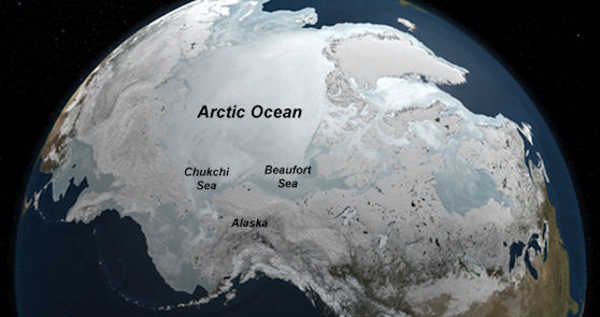
Scientists have made a biological discovery in Arctic Ocean waters as unexpected as finding a rainforest in the middle of a desert.
A NASA-sponsored expedition named ICESCAPE punched through three-feet of sea ice to find waters richer in microscopic marine plants, essential to all sea life, than any other ocean region on Earth.
"If someone had asked me before the expedition whether we would see under-ice blooms, I would have told them it was impossible," said Kevin Arrigo of Stanford University in Stanford, Calif., leader of the ICESCAPE mission and lead author of the new study. "This discovery was a complete surprise."
The microscopic plants, called phytoplankton, are the base of the marine food chain. Phytoplankton were thought to grow in the Arctic Ocean only after sea ice had retreated for the summer.
Scientists now think that the thinning Arctic ice is allowing sunlight to reach the waters under the sea ice, catalyzing the plant blooms where they had never been observed.
The finding reveals a new consequence of the Arctic's warming climate and provides an important clue to understanding the impacts of a changing climate and environment on the Arctic Ocean and its ecology.
The discovery was made during ICESCAPE expeditions in the summers of 2010 and 2011. Scientists onboard a U.S. Coast Guard icebreaker explored Arctic waters in the Beaufort and Chukchi seas along Alaska's western and northern coasts.
During the July 2011 Chukchi Sea leg of ICESCAPE, the researchers observed blooms beneath the ice that extended from the sea-ice edge to 72 miles into the ice pack.
Ocean current data revealed that these blooms developed under the ice and had not drifted there from open water, where phytoplankton concentrations can be high.
The phytoplankton were extremely active, doubling in number more than once a day. Blooms in open waters grow at a much slower rate, doubling in two to three days. These growth rates are among the highest ever measured for polar waters.
Researchers estimate that phytoplankton production under the ice in parts of the Arctic could be up to 10 times higher than in the nearby open ocean.
"Part of NASA's mission is pioneering scientific discovery, and this is like finding the Amazon rainforest in the middle of the Mojave Desert," said Paula Bontempi, NASA's ocean biology and biogeochemistry program manager in Washington. "We embarked on ICESCAPE to validate our satellite ocean-observing data in an area of the Earth that is very difficult to get to. We wound up making a discovery that hopefully will help researchers and resource managers better understand the Arctic."
The discovery has implications for the broader Arctic ecosystem, including migratory species such as whales and birds.
Phytoplankton are eaten by small ocean animals, which are eaten by larger fish and ocean animals. A change in the timeline of the blooms can cause disruptions for larger animals that feed either on phytoplankton or on the creatures that eat these microorganisms.
"It could make it harder and harder for migratory species to time their life cycles to be in the Arctic when the bloom is at its peak," Arrigo noted. "If their food supply is coming earlier, they might be missing the boat."
Previously, researchers thought the Arctic Ocean sea ice blocked most sunlight needed for phytoplankton growth.
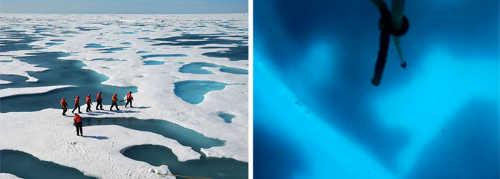
But in recent decades younger and thinner ice has replaced much of the Arctic's older and thicker ice. This young ice is almost flat and the ponds that form when snow cover melts in the summer spread much wider than those on rugged older ice.
These extensive but shallow melt ponds act as windows to the ocean, letting large amounts of sunlight pass through the ice to reach the water below, said Donald Perovich, a geophysicist with the U.S. Army Cold Regions and Engineering Laboratory in Hanover, N.H., who studied the optical properties of the ice during the ICESCAPE expedition.
"When we looked under the ice, it was like a photographic negative. Beneath the bare-ice areas that reflect a lot of sunlight, it was dark. Under the melt ponds, it was very bright," Perovich said. He is currently visiting professor at Dartmouth College's Thayer School of Engineering.
"At this point we don't know whether these rich phytoplankton blooms have been happening in the Arctic for a long time and we just haven't observed them before," added Arrigo. "These blooms could become more widespread in the future, however, if the Arctic sea ice cover continues to thin."
The findings were published in the journal Science.
Dr. Tony Phillips works for the National Aeronautics and Space Administration.
Braden jury hears closing arguments; deliberations to begin next week
LAKEPORT, Calif. – The second defendant charged in a June 2011 shooting in Clearlake that killed a child and wounded five adults was in court on Friday for the closing arguments in his trial.
Paul William Braden, 22, is facing 15 charges including first-degree murder, five counts of attempted murder, two counts of mayhem, six counts of assault with a firearm and discharge of a firearm at an inhabited dwelling, along with dozens of special allegations.
The shooting on June 18, 2011, killed 4-year-old Skyler Rapp, wounded his mother Desiree Kirby, her boyfriend Ross Sparks, his brother Andrew Sparks, Ian Griffith and Joseph Armijo.
Braden’s closing arguments coincided with deliberations by the jury for his codefendant, 24-year-old Orlando Joseph Lopez Jr., facing the same charges. The two men had separate juries.
Lopez’s jury heard closing arguments on Thursday and began deliberations on Friday morning, delivering guilty verdicts on all counts after only four hours of discussion.
District Attorney Don Anderson told Braden’s jury Friday that the evidence showed that Braden shot into the crowd at the home of Kirby and Ross Sparks.
In statements that mirrored those he gave Thursday, Anderson went over what the jury needed to consider in settling on the charges.
He also raised issues of testimony and evidence that he felt were key to connecting Braden to the shooting, including the testimony of jailhouse informant Daniel Loyd, who is himself in jail and awaiting prosecution for a 2011 homicide.
Loyd and Braden were housed together at one point, and Loyd testified that Braden spoke to him about the shooting, telling him that no one could identify him at the scene because he wore gloves and a mask.
Braden also allegedly told Loyd he drove the vehicle to the scene, that he furnished the shotguns that he and Lopez carried and that he was the gunman.
Anderson said Braden and Lopez went to the scene “for one reason – to kill.”
In his closing statements, which ran just under 45 minutes, Braden’s attorney, Doug Rhoades, told the jury, “This is the only opportunity I have to address you.”
He went over the jury instructions on reasonable doubt, which covers what jurors can and can’t consider in making a decision. Being arrested, charged or brought to trial are not evidence of guilt, he emphasized.
To convict Braden jurors must have an abiding conviction that he’s guilty. “When you’re convinced of it, you’re convinced of it next week, next month, and years to come,” Rhoades said.
While Rhoades said there were many contradicting statements among the witnesses, he wanted to focus on Kevin Stone, a former codefendant in the case who reached a plea agreement to lesser charges last fall.
“Who puts Paul at the scene of the shooting? There are only two people that do that,” said Rhoades.
One of those two is Loyd, who said he had an interest in the case because he was a friend to Jeremiah Rapp, Skyler’s father, according to Rhoades.
Rhoades said that the first thing that must happen is the acknowledgment that a tragedy took place and a child died. “I will never, ever minimize that.”
However, Rhoades continued, “We are not here to make right that particular thing.”
Raising issues with witness statements
During Loyd’s testimony at trial, a jury member sent up a note that Rhoades said insightfully asked why Braden would speak to no one but Loyd, who Rhoades said had given information in another homicide case to which he had a connection.
Rhoades put up a picture on a projector of Stone. The picture, which Stone took of himself by pointing his cell phone at a mirror, showed him wearing a ball cap with the brim pushed back, a handgun in one hand. The picture stayed up through most of Rhoades’ closing arguments.
Stone was the second person to put Braden at the scene with a gun, Rhoades said.
Braden had no reason to be mad at Ross Sparks and no motive for the shooting, according to Rhoades.
Rhoades faulted Stone’s testimony, which included statements that Braden was the only shooter – which conflicted victim accounts that they saw muzzle blasts coming from two different areas of the fence – and that he was standing and shooting left-handed. Witnesses saw fire coming from over the 6-foot fence, and Braden is left-handed, said Rhoades.
Rhoades said it wasn’t up to him or Anderson to ultimately decide who was responsible for the crimes. “It's your decision, and it's one of the greatest burdens we put on you,” he explained to jurors.
He told the jury a story, recounting a father watching each of his three sons going off to war, and not speaking out to stop each of them, who ultimately died.
“Do not hold your tongue,” he said. “You have an obligation, that is to participate and speak.”
Anderson said he’s also questioned the motive in the crime. “To this day, I have not figured out the motive and that's mainly because there is none.”
While there wasn’t a motive, there was a reason, said Anderson. “You have an extremely angry person. Not justifiably angry, but he was angry.”
Braden couldn’t control his anger and took the situation to the extreme, Anderson said.
Judge Doris Shockley read most of the jury instructions on Friday afternoon, but ordered the jury to return at 10 a.m. Tuesday, June 19, at which time she’ll complete instructions and their deliberations can begin.
Email Elizabeth Larson at
National Weather Service issues red flag warning for portions of Lake County
LAKE COUNTY, Calif. – The National Weather Service has issued an urgent fire weather message due to hot temperatures expected on Saturday.
The red flag warning, issued in response to conditions that could lead to explosive fire growth, is in effect through 9 p.m. Saturday for the southern portion of Lake County as well as all all or parts of several Sacramento Valley counties such as Glenn, Colusa, Yuba and Butte.
The National Weather Service said high pressure over the region will bring hot temperatures with humidity levels as low as 8 percent.
Winds over the northern Sacramento Valley and the eastern coastal mountains will be between 10 and 20 miles per hour, with gusts up to 30 miles per hour through midday Saturday.
Forecasters predict winds will begin to decrease Saturday afternoon and evening.
Temperatures in Lake County on Saturday are expected to hit near 100 degrees and 96 degrees on Sunday, with temperatures dropping into the high 80s on Monday and Tuesday, according to the forecast.
Email Elizabeth Larson at




