How to resolve AdBlock issue?
Purrfect Pals: A new bunch of cats and kittens
LAKE COUNTY, Calif. – There is a whole new group of fresh feline faces at the animal shelter this week.
Kittens plus older cats are awaiting the chance that someone will come along and choose to give thema new home.
Cats that are adopted from Lake County Animal Care and Control are either neutered or spayed and microchipped before being released to their new owner. License fees do not apply to residents of the cities of Lakeport or Clearlake .
If you're looking for a new companion, visit the shelter. There are many great pets there, hoping you'll choose them.
The following cats at the Lake County Animal Care and Control shelter have been cleared for adoption (other cats pictured on the animal control Web site that are not listed here are still “on hold”).

'Bobbie'
“Bobbie is a 1-year-old male tuxedo cat.
He has a short black and white coat, green eyes and is not yet neutered.
He can be found in cat room kennel No. 29, ID No. 32916.
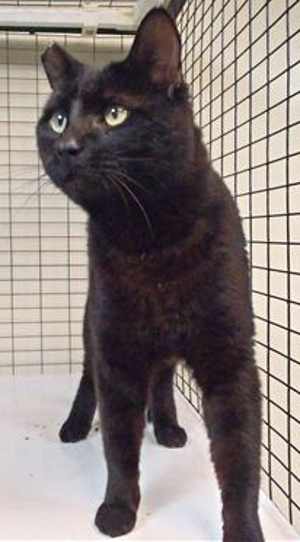
Male domestic short hair mix
This male domestic short hair mix is 2 years old.
He has a short, all-black coat and gold eyes, and has been neutered.
He has injured hindquarters so could use a home with an extra helping of tender loving care.
Find him in cat room kennel No. 47, ID No. 32894.
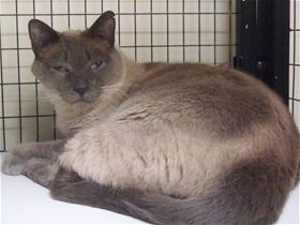
'Silver'
“Silver” is a 9-year-old male Siamese mix.
He has a short, multicolored coat, blue eyes and has been neutered.
Find Silver in cat room kennel No. 54, ID No. ID: 32995.
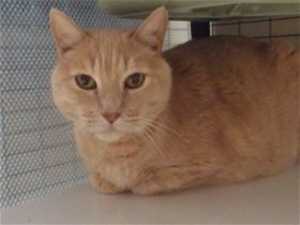
'Joey'
“Joey” is a 14-year-old male domestic short hair mix.
He has tan coloring, green eyes and a kinked tail. He has been neutered.
He's in cat room kennel No. 55, ID No. 32994.
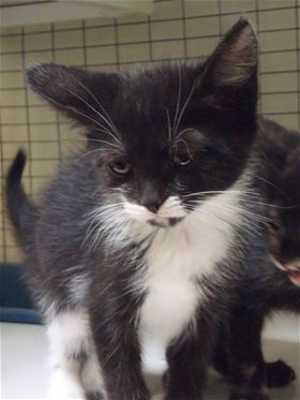
Black and white kitten
This male kitten is 10 weeks old.
He has black and white “tuxedo” coloring, including what looks like a stylish moustache.
He has a short coat and blue eyes, and has not yet been altered.
Find him in cat room kennel No. 64b, ID No. 32316.

Black male kitten
This male domestic short hair mix kitten is 10 weeks old.
He has a short black coat, blue eyes and has not yet been neutered.
He's in cat room kennel No. 64d, ID No. 32318.

Female tortie kitten
This female domestic short hair mix kitten is 10 weeks old.
She has tortoise shell coloring and blue eyes, and is not yet spayed.
She's in cat room kennel No. 64f, ID No. 32320.

Gray tabby kitten
This male gray tabby kitten is 11 weeks old.
He has a short coat, green eyes and has been neutered.
Find him in cat room kennel No. 65b, ID No. 32840.

Male domestic short hair mix
This male domestic short hair mix kitten is 11 weeks old.
He has gray and black coloring and green eyes, and has been neutered.
He's in cat room kennel No. 65c, ID No. 32841.

Brown tabby kitten
This male brown tabby kitten is 11 weeks old.
He has a short coat and green eyes, and has been neutered.
Find him in cat room kennel No. 65d, ID No. 32842.
Adoptable cats also can be seen at http://www.co.lake.ca.us/Government/Directory/Animal_Care_And_Control/Adopt/Cats_and_Kittens.htm or at www.petfinder.com .
Please note: Cats listed at the shelter's Web page that are said to be “on hold” are not yet cleared for adoption.
To fill out an adoption application online visit http://www.co.lake.ca.us/Government/Directory/Animal_Care_And_Control/Adopt/Dog___Cat_Adoption_Application.htm .
Lake County Animal Care and Control is located at 4949 Helbush in Lakeport, next to the Hill Road Correctional Facility.
Office hours are Monday through Friday, 8 a.m. to 5 p.m., and 1 p.m. to 3 p.m., Saturday. The shelter is open from 10:30 a.m. to 4:30 p.m. Monday through Friday and on Saturday from 1 p.m. to 3 p.m.
Visit the shelter online at http://www.co.lake.ca.us/Government/Directory/Animal_Care_And_Control.htm .
For more information call Lake County Animal Care and Control at 707-263-0278.
Prescribed fire planned June 12 on Mendocino National Forest
MENDOCINO NATIONAL FOREST, Calif. – The Mendocino National Forest Grindstone Ranger District is planning a prescribed fire starting Tuesday, June 12, above Alder Springs, conditions permitting.
If good conditions are sustained, the prescribed fire operation will continue for at least two days, possibly up to four days.
The Unit 74 burn is approximately 388 acres and is located between Forest Highway 7, Forest Road M3 and Glenn County Road 311.
The unit will be burned in three sections, with the first 217 acres anticipated for Tuesday and Wednesday.
The next section is 125 acres planned for Thursday, and the final 45 acres would be completed Friday, weather and conditions permitting.
The area is located between 4,500 feet and 5,500 feet elevation.
High temperatures are forecasted to be in the low- to mid-80s at the unit during the scheduled dates for the prescribed fire. Recent precipitation has raised fuel moisture levels at the unit enough to safely conduct prescribed fire activities.
The public may notice smoke in this area of the forest Tuesday, as well as residual smoke after ignitions are over.
“The forest is taking every precaution to maintain control over the fire and it will be suppressed if at any point conditions start to deteriorate,” said Forest Supervisor Sherry Tune. “Extreme care is also being used with the test fires, the ignitions and then subsequent holding that will take place. The prescribed fire unit will remain continuously staffed until the event is closed and there is no heat remaining in the unit.”
Staffing for the prescribed fire includes six fire engines, one water tender, one Type 1 Handcrew, six additional resources. Staging on site prepared for suppression activities will include a dozer and Type 1 Handcrew.
With the unit surrounded by roads, if suppression activities are called for, staff will be able to access the entire unit within minutes.
The unit is being treated to remove hazardous fuels, restore forest health and promote growth within a young pine plantation that is being choked by brush.
“We appreciate the public’s patience and understanding while we conduct prescribed fire operations as part of ecological restoration on the Forest,” Tune said.
Forest visitors are asked to be aware of their surroundings and watch for prescribed burning operations to maintain personal and fire fighter safety. Areas where prescribed burning operations are taking place will be well signed with increased fire personnel and agency traffic in the area.
Visitors are encouraged to contact the Forest at 530-966-4152 for more information. Confirmation and updates on prescribed fire activities can also be found on Twitter, @MendocinoNF.
Prescribed burning is an important tool for the forest to use for hazardous fuels reduction and forest health improvement, including wildlife habitat.
Prescribed fire is applied by trained professionals in a skillful manner under specific weather conditions in a defined location to achieve specific objectives.
Each prescribed fire can be different visually depending on the forest types, fuel load and how long fire has been absent from the area, including both wildfires and prescribed fires.
Prescribed burns are conducted when there is a window of opportunity and specific conditions and criteria are met before, and will be sustained during and after, the burn.
For more information, please contact the Mendocino National Forest at 530-934-3316, or visit www.fs.usda.gov/mendocino .
The Veggie Girl: Spectacular spices
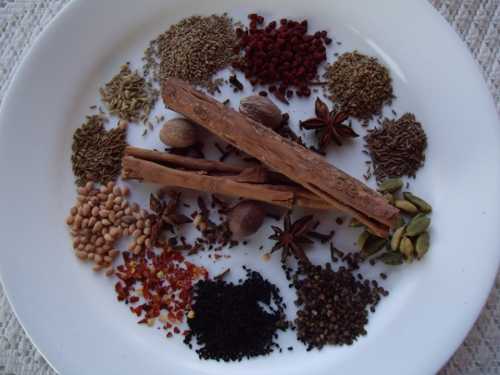
Unbeknownst to most of us (myself included until just a few days ago), today is National Herb and Spice Day, so let’s spice things up a bit in its honor!
I’m not sure who decided that the second Sunday in June would be designated as such, but I’m happy to honor the many amazing flavors that make the culinary world go round, not to mention propelling our taste buds into song.
But what makes an herb an herb and a spice a spice, you wonder?
It depends on the part of the plant used.
Herbs are the edible leaves or stems of plants, and spices are their dried seeds, pods, buds, roots, fruits or bark.
Online encyclopedia Wikipedia adds the phrase “vegetative substance” to their definition of spice, and truly spices are comprised of a wide variety of plant components.
Let’s look at a few examples to prove this point.
Ginger is a rhizome and turmeric a root. Mustard, fennel, caraway, fenugreek and cumin are seeds.
Cloves are dried buds, chili peppers are fruits, and cardamom and star anise are seed pods. Cinnamon is bark, and nutmeg is the kernel of a fruit, with mace being its lacy covering.
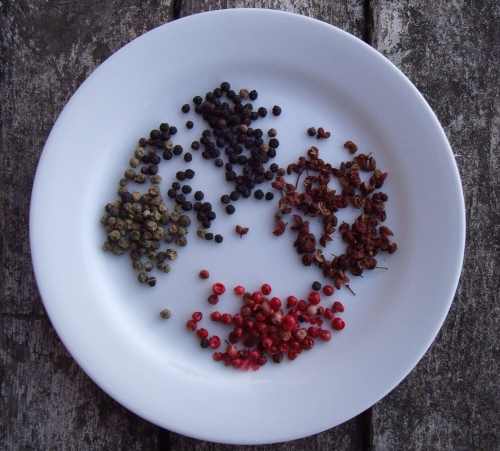
Black pepper and pink peppercorns are both dried berries, but are not related to each other.
I’m extremely grateful for the first folks who decided to taste bark, roots, seeds and the like so that the generations of humankind who followed them could eat their meals with blissful flavor.
Some plants bless us with both herbs and spices.
For example, dill weed is an herb since it’s comprised of the leaves of the dill plant, while the dill seed used in pickling or to flavor some rye bread is a spice.
Recent column topic cilantro (also known as coriander or Chinese parsley) is another example. When we use the leaves and stems, it’s considered an herb, while whole or ground coriander seeds are a spice.
Some spices, though not many, are known as being “hot” because of chemicals they contain. Capsaicin in chili peppers and piperine in black pepper berries irritate the tissues of our mouth, giving us the sensation we refer to as “hot” or “spicy.”
It’s estimated that spices have been used since about 50,000 B.C., with local spice trading developing as early as 2,000 B.C.
In the Middle East such trading was centered on cinnamon and pepper, and in East Asia, herbs and pepper. Ancient Egyptians used spices in embalming, and their need for them encouraged broad trade.
During the middle ages in Europe, spices were among the most expensive and sought after products. While some spices of this era – grains of paradise, spikenard and galangal, for example – have gone out of fashion, others, like black pepper, cinnamon, nutmeg, cumin and cloves, are still in popular use today.
Such flavorings were the source of bloody wars fought by Europeans for control of the lands where they grew. Command of this lucrative trade went back and forth over the centuries.
Today our spice shelves are easily stocked. We have a wide variety of herbs and spices at our fingertips, and more exotic spices are available with very little effort.
I love broadening my spice horizons by going to specialty shops that carry little-known flavors from around the world. I get excited learning while I browse.
Sometimes it’s tough not to bring something home.
Recent acquisitions include such things as mahlab from Turkey, used to add a sweet-sour, nutty taste to sweet breads and desserts; charnushka from India, tiny black seeds that top rye bread or flavor sausages; and ground Mediterranean sumac berries, popular as a tabletop condiment in that region, which add fruity sourness and a soft red color to foods.
Ground spices deteriorate far more quickly than those in whole form. About six months is the average “flavor life” of a ground spice, while whole spice holds its flavor for up to two years.
Whole spice may be ground just before use in a spice grinder or dedicated coffee grinder. For smaller batches, a fine grater (my favorite is a Microplane zester) may be used.
An old school method of grinding spices is crushing them via a mortar and pestle. Since this method has come into vogue in recent years, a well-stocked kitchen store will have a few different styles of this ancient implement from which to choose.
Some spices, like nutmeg, don’t lend themselves to grinding whole and will always need to be grated; however, it goes quickly and is easily done.
Toasting whole spices in a dry skillet just before grinding intensifies their flavor and, as an added bonus, makes your kitchen smell absolutely heavenly.
As to storage, keep dried herbs and spices in tightly closed containers in a relatively cool, dark, dry place. Humidity, heat, and light are their flavor enemies.
Spice blends have evolved in different areas of the world depending on what was grown or traded there, giving each region its own unique flavor profile.
In the African counties of Ethiopia and Eritrea, for example, superhot spice blend berbere is used to flavor dishes. It can be a powder or a puree, and is a blend of fenugreek, cardamom, lots of hot cayenne pepper, and an array of optional ingredients. (To tone down the heat, paprika can be substituted for much of the cayenne.)
Ras el hanout is an exotic spice blend from Morocco. It’s sweet and spicy-hot, containing up to as many as 50 flavors, including some rare items not found at the local grocery. Floral notes can come from such ingredients as dried rosebuds and aniseed.
The Indian spice blend we’re most familiar with is curry, despite the fact that premade curry powder is nonexistent in that country, being an invention of the west.
Instead, Indian cooks make their own blends for each recipe, grinding small batches frequently.
Garam masala, a standard Indian spice blend, is the inspiration for our curry powder; however, it’s made without the yellow color supplied by turmeric and nutty flavor from fenugreek in our versions of the blend.
It’s a somewhat sweet mix containing coriander, ginger, cardamom, cloves and cinnamon. Other spices are blended in according to the cook’s taste and whim, and it’s typically used in milder dishes that are often finished with yogurt to make a creamy sauce.
If you’d like to try your hand at making this popular seasoning, today’s recipe offerings are two versions of Indian-inspired garam masala. One version is traditional, using whole spices, and the other is a super easy “cheater” version using ground spices to save a few steps.
Treat your taste buds to something new today by making spice the variety of life! Enjoy.
Traditional Garam Masala
4 tablespoons coriander seeds
1 tablespoon cumin seeds
1 tablespoon black peppercorns
1 ½ teaspoons black cumin seeds (shahjeera)
1 ½ teaspoons dry ginger
¾ teaspoon black cardamom (approx. 3 to 4 large pods)
¾ teaspoon whole cloves
¾ teaspoon stick cinnamon (2-by-1-inch pieces)
¾ teaspoon crushed bay leaves
Heat a heavy skillet on a medium flame and gently roast all ingredients (leave cardamom in its pods till later) except the dry ginger, till they turn a few shades darker. Stir occasionally. Do not be tempted to speed up the process by turning up the heat as the spices will burn on the outside and remain raw on the inside.
When the spices are roasted turn off the heat and allow them to cool.
Once cooled, remove the cardamom seeds from their skins and mix them back with all the other roasted spices.
Grind them all together to a fine powder in a clean, dry coffee grinder.
Store in an airtight container in a cool, dark place.
Recipe courtesy of www.indiancooking.about.com .
Easy Garam Masala
1 tablespoon ground cumin
1 ½ teaspoons ground coriander
1 ½ teaspoons ground cardamom
1 ½ ground pepper
1 teaspoon ground cinnamon
½ teaspoons ground cloves
½ teaspoon ground nutmeg
Mix all ingredients together in a bowl. Store mixture in an airtight container in a cool, dry place.
This recipe is courtesy of www.allrecipes.com .
Esther Oertel, a freelance writer, cooking teacher, and speaker, is passionate about local produce and all foods in the vegetable kingdom. She welcomes your questions and comments and may be reached at
Saturday rollover crash sends six to hospitals
LOWER LAKE, Calif. – A two-vehicle crash near Lower Lake on Saturday afternoon sent six people to area hospitals, with three of the victims suffering serious injuries.
The California Highway Patrol’s Clear Lake Office reported that the crash occurred at 12:20 p.m. on Highway 29 south of Hofacker Lane near Lower Lake.
Hidden Valley Lake resident Annette Sykora-Finch, 47, was driving her 1999 Ford Explorer southbound on Highway 29 south of Hofacker Lane, according to the report.
For reasons still under investigation, Sykora-Finch lost control of her vehicle, skidded into the northbound lane and overturned directly in the path of a 2000 Ford F250 pickup driven by 39-year-old Matthew Elliott of Lakeport, the report stated.
The CHP said Elliott could not avoid the collision and the front of his pickup hit the top of Sykora-Finch’s Explorer as it was overturning.
Sykora-Finch, Elliott and one of Elliott’s passengers, 35-year-old Shana Smith of Middletown, were transported by air ambulance to Santa Rosa Memorial Hospital for treatment of moderate to major injuries, the CHP said.
Three other passengers who has been traveling with Elliott were transported by South Lake County Fire ambulance to St. Helena Hospital Clearlake for precautionary purposes, according to the CHP. They included a 22-year-old female and 15-year-old female, both of Clearlake, and a 2-year-old male from Lakeport, none of which were named in the report.
The CHP said all six individuals were wearing their seatbelts. Alcohol does not appear to be a factor in the wreck.
The collision remains under investigation, the CHP said.