How to resolve AdBlock issue?
Helping Paws: Lots of big dogs
LAKEPORT, Calif. – The county's animal shelter this week has a selection of mostly large dogs, including puppies.
Labrador Retriever, pointer and husky mixes make up the big dog contingent, while one male Chihuahua is available.
Thanks to Lake County Animal Care and Control’s new veterinary clinic, many of the animals offered for adoption already are spayed or neutered and ready to go home with their new families.
Dogs that are adopted from Lake County Animal Care and Control are either neutered or spayed, microchipped and, if old enough, given a rabies shot and county license before being released to their new owner. License fees do not apply to residents of the cities of Lakeport or Clearlake.
If you're looking for a new companion, visit the shelter. There are many great pets hoping you'll choose them.
The following dogs at the Lake County Animal Care and Control shelter have been cleared for adoption (additional dogs on the animal control Web site not listed are still “on hold”).

Male Labrador Retriever-pointer mix
This male Labrador Retriever-pointer mix is 14 weeks old.
He is not yet neutered, and has a black and white coat.
He is in kennel No. 7b, ID No. 32827.

Female Labrador Retriever-pointer mix
This female Labrador Retriever-pointer mix is 14 weeks old.
She has a black and white coat, brown eyes and floppy ears, and has not been altered.
Find her in kennel No. 7c, ID No. 32828.
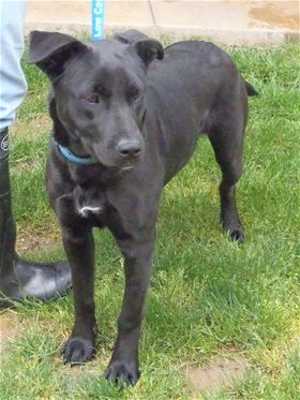
Labrador Retriever mix
This female Labrador Retriever mix is 1 year old.
She has a short black coat, weighs 44 pounds and has been spayed.
She is in kennel No. 26, ID No. 32639.

Male Chihuahua mix
This male Chihuahua mix is 10 months old.
He weighs 11 pounds, has been neutered and has a short coat.
He is in kennel No. 28, ID No. 32746.
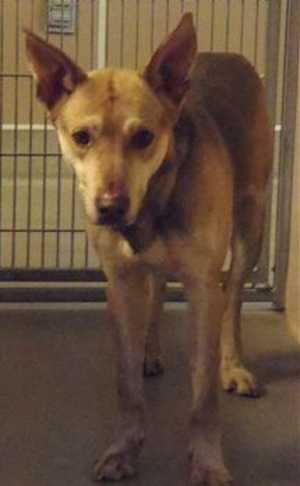
Male husky mix
This male husky mix is 4 years old.
He has red and tan coloring, weighs 56 pounds and has been neutered.
Find him in kennel No. 30, ID No. 32738.
Adoptable dogs also can be seen at http://www.co.lake.ca.us/Government/Directory/Animal_Care_And_Control/Adopt/Dogs_and_Puppies.htm or at www.petfinder.com .
Please note: Dogs listed at the shelter's Web page that are said to be “on hold” are not yet cleared for adoption.
To fill out an adoption application online visit http://www.co.lake.ca.us/Government/Directory/Animal_Care_And_Control/Adopt/Dog___Cat_Adoption_Application.htm .
Lake County Animal Care and Control is located at 4949 Helbush in Lakeport, next to the Hill Road Correctional Facility.
Office hours are Monday through Friday, 8 a.m. to 5 p.m., and 1 p.m. to 3 p.m., Saturday. The shelter is open from 10:30 a.m. to 4:30 p.m. Monday through Friday and on Saturday from 1 p.m. to 3 p.m.
Visit the shelter online at http://www.co.lake.ca.us/Government/Directory/Animal_Care_And_Control.htm .
For more information call Lake County Animal Care and Control at 707-263-0278.
Cal Fire gears up for fire season; season opens earlier than in 2011
LAKE COUNTY, Calif. – The California Department of Forestry and Fire Protection's Sonoma-Lake-Napa Unit is formally opening fire season in Northern California on June 4.
The opening of fire season this year is nearly two weeks earlier than it opened in 2011. Cal Fire reported last week that it already has handled nearly double the fires this year than it did last year, as Lake County News has reported.
The Sonoma-Lake-Napa Unit – which includes the counties of Sonoma, Lake, Napa, Solano, Colusa and Yolo – is ramping up unit staffing in preparation for deployment of resources to incidents locally and statewide.
On June 4, the unit will staff an engine at each of its 20 stations, as well as 11 fire crews, three dozers and one helicopter.
The Sonoma Air Attack Base will be opened on June 16, staffing one air tactical aircraft and two tankers, with a support ground crew.
On June 25, Cal Fire's Sonoma-Lake-Napa Unit will achieve peak staffing including 31 engines, five dozers, 11 fire crews, three fixed wing aircraft and one helicopter.
To meet peak staffing needs for the 2012 Fire Season, the unit augments its permanent work force with the hiring of seasonal firefighters. Seasonal firefighters receive training in wildland and structural fire firefighting, as well as, required certification in hazardous materials and emergency medical response.
Sonoma-Lake-Napa Unit Chief Tim Streblow reminded residents they also can prepare for fire season by making their properties fire safe by creating a 100 foot of defensible space zone around their homes and outbuildings.
“Creating a defensible space increases the survival of a home during a wildland fire incident, as well as providing fire fighting personnel the upper hand in battling a wildland fire on their property,” Streblow said.
California Public Resource Code 4291 addresses the mandatory maintain of 100 foot of defensible space around structures.
For information on how to create a fire safe home visit Cal Fire's Web site at www.fire.ca.gov or contact your nearest Cal Fire facility.
Space News: James Cook and the Transit of Venus
Every ~ 120 years a dark spot glides across the Sun. Small, inky-black, almost perfectly circular, it's no ordinary sunspot. Not everyone can see it, but some who do get the strangest feeling, of standing, toes curled in the damp sand, on the beach of a South Pacific isle ....
City odors drifted in from Plymouth, across the ship, shoving aside the salt air. Sea gulls fluttered upward, screeching, as the sails snapped taut. The wind had changed and it was time to go.
On August 12, 1768, His Majesty's Bark Endeavour slipped out of harbor, Lt. James Cook in command, bound for Tahiti.
The island had been "discovered" by Europeans only a year before in the South Pacific, a part of Earth so poorly explored mapmakers couldn't agree if there was a giant continent there or not. Cook might as well have been going to the Moon or Mars.
He would have to steer across thousands of miles of open ocean, with nothing like GPS or even a good wristwatch to keep time for navigation, to find a speck of land only 20 miles across. On the way, dangerous storms could (and did) materialize without warning. Unknown life forms waited in the ocean waters. Cook fully expected half the crew to perish.
It was worth the risk, he figured, to observe a transit of Venus.
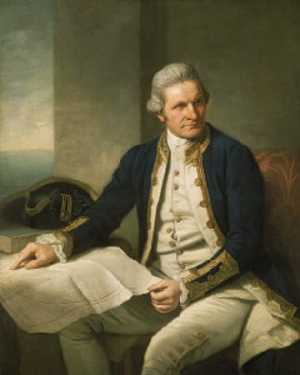
"At 2 pm got under sail and put to sea having on board 94 persons," Cook noted in his log. The ship's young naturalist Joseph Banks was more romantic: "We took our leave of Europe for heaven alone knows how long, perhaps for Ever," he wrote.
Their mission was to reach Tahiti before June 1769, establish themselves among the islanders, and construct an astronomical observatory. Cook and his crew would observe Venus gliding across the face of the Sun, and by doing so measure the size of the solar system. Or so hoped England's Royal Academy, which sponsored the trip.
The size of the solar system was one of the chief puzzles of 18th century science, much as the nature of dark matter and dark energy are today. In Cook's time astronomers knew that six planets orbited the sun (Uranus, Neptune, and Pluto hadn't been discovered yet), and they knew the relative spacing of those planets.
Jupiter, for instance, is five times farther from the Sun than Earth. But how far is that … in miles? The absolute distances were unknown.
Venus was the key. Edmund Halley realized this in 1716. As seen from Earth, Venus occasionally crosses the face of the sun. It looks like a jet-black disk slowly gliding among the sun's true spots.
By noting the start- and stop-times of the transit from widely spaced locations on Earth, Halley reasoned, astronomers could calculate the distance to Venus using the principles of parallax. The scale of the rest of the solar system would follow.
But there was a problem. Transits of Venus are rare. They come in pairs, eight years apart, separated by approximately 120 years. Halley himself would never live to see one.
An international team did try to time a Venus transit in 1761, but weather and other factors spoiled most of their data. If Cook and others failed in 1769, every astronomer on Earth would be dead before the next opportunity in 1874.
Cook's expedition is often likened to a space mission. "The Endeavour was not only on a voyage of discovery," writes Tony Horwitz in the Cook travelogue Blue Latitudes, "it was also a laboratory for testing the latest theories and technologies, much as spaceships are today."
In particular, the crew of the Endeavour were to be guinea pigs in the Navy's fight against "the scourge of the sea" – scurvy.
The human body can store only about six week's worth of vitamin C, and when it runs out seamen experience lassitude, rotted gums and hemorrhaging. Some 18th century ships lost half their crew to scurvy.
Cook carried a variety of experimental foods onboard, feeding his crew such things as sauerkraut and malt wort. Anyone who refused the fare would be whipped. Indeed, Cook flogged one in five of his crew, about average in those days, according to Horwitz.
By the time Cook reached Tahiti in 1769, he'd been sailing west for eight months – about as long as modern astronauts might spend en route to Mars.
Five crewmen were lost when the ship rounded stormy Cape Horn, and another despairing marine threw himself overboard during the 10-week Pacific passage that followed.
Endeavour was utterly vulnerable as it angled toward Tahiti. There was no contact with "Mission Control," no satellite weather images to warn of approaching storms, no help of any kind. Cook navigated using hourglasses and knotted ropes to measure ship's speed, and a sextant and almanac to estimate Endeavour's position by the stars. It was tricky and dangerous.
Remarkably, they arrived mostly intact on April 13, 1769, almost two months before the transit. "At this time we had but very few men upon the Sick list … the Ships compney had in general been very healthy owing in a great measure to the Sour krout," wrote Cook.
Tahiti was as alien to Cook's men as Mars might seem to us today. At least the island was comfortable and well provisioned for human life; the islanders were friendly and eager to deal with Cook's men.
Banks deemed it "the truest picture of an arcadia (idyllic and peaceful) … that the imagination can form." Yet the flora, fauna, customs and habits of Tahiti were shockingly different from those of England; Endeavour's crew was absorbed, amazed.
Perhaps that is why Cook and Banks had so little to say about the transit when it finally happened on June 3, 1769. Venus' little black disk, which could only be seen gliding across the blinding sun through special telescopes brought from England, had a powerful rival: Tahiti itself.
Banks' log entry on the day of the transit consists of 622 words; fewer than 100 of them concern Venus.
Mostly he chronicled a breakfast-meeting with Tarróa, the king of the island, and Tarróa's sister Nuna, and later in the day, a visit from "three handsome women."
Of Venus, he says, "I went to my Companions at the observatory carrying with me Tarróa, Nuna and some of their chief attendants; to them we shewd the planet upon the sun and made them understand that we came on purpose to see it. After this they went back and myself with them." Period. If the King or Banks himself was impressed, Banks never said so.
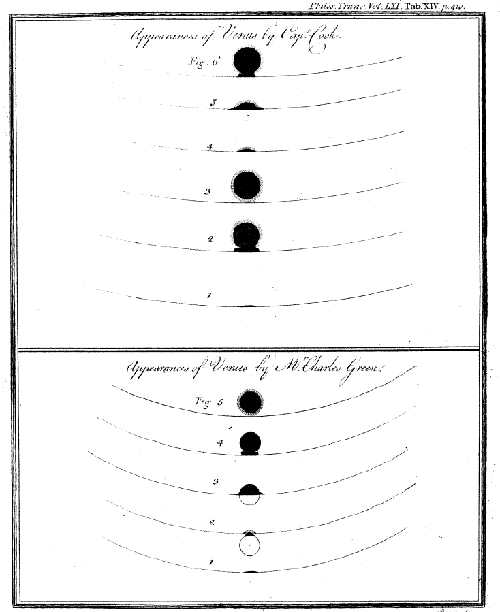
Cook was a little more expansive: "This day prov'd as favourable to our purpose as we could wish, not a Clowd was to be seen … and the Air was perfectly clear, so that we had every advantage we could desire in Observing the whole of the passage of the Planet Venus over the Suns disk: we very distinctly saw an Atmosphere or dusky shade round the body of the Planet which very much disturbed the times of the contacts particularly the two internal ones."
Cook also observed the "black drop effect."
When Venus is near the limb of the sun – the critical moment for transit timing – the black of space beyond the sun's limb seems to reach in and touch the planet. This makes it very difficult to say precisely when a transit begins or ends.
The effect was not fully understood until 1999 when a team of astronomers led by Glenn Schneider of the University of Arizona studied a similar black drop during a transit of Mercury. They proved the distortion is caused by a combination of solar limb darkening and the point-spread function of the telescope.
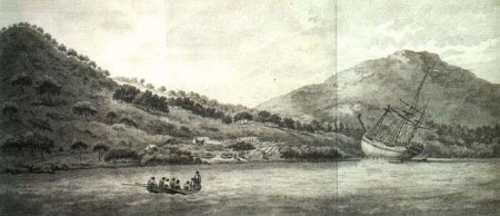
Cook's observations were clearly affected. Indeed, his measurements disagreed with those of ship's astronomer Charles Green, who observed the transit beside Cook, by as much as 42 seconds.
This was a problem for observers elsewhere, too. When all was said and done, observations of Venus' 1769 transit from 76 points around the globe, including Cook's, were not precise enough to set the scale of the solar system. Astronomers didn't manage that until the 19th century when they used photography to record the next pair of transits.
Cook wouldn't dwell on these matters; there was a lot more exploring to do. Secret orders from the Navy instructed him to leave the island when the transit was done and "search between Tahiti and New Zealand for a Continent or Land of great extent."
For much of the next year Endeavour and her crew scoured the South Pacific, searching for a continent that some 18th century scientists claimed was necessary to balance the great land masses of the Northern Hemisphere.
At one point they were out of sight of land for almost two months. But the terra australis incognita, the unknown "south land," didn't exist, just as Cook thought all along.
Along the way Cook met the fierce Maori of New Zealand and the Aborigines of Australia (encounters both races would lament in later years), explored thousands of miles of Kiwi and Aussie coastline, and had a near-disastrous collision with the Great Barrier Reef.
Later, during a 10-week stopover in Jakarta for repairs, seven seamen died of malaria. The port city was densely populated by people and diseases. Cook left as quickly as possible, but the damage was done.
Ultimately 38 of the Endeavour's original company (and eight who joined later) perished, including astronomer Charles Green.
"The ship's 40% casualty rate wasn't considered extraordinary for the day," writes Horwitz. "In fact, Cook would later be hailed for the exceptional concern he showed for the health of his crew."
On July 11, 1771, Cook returned to England at Deal. The survivors had circumnavigated the globe, cataloged thousands of species of plants, insects and animals, encountered new (to them) races of people, and hunted for giant continents. It was an epic adventure.
In the end, the transit was just a tiny slice of Cook's adventure, overshadowed by Tahiti and sabotaged by black drops. But because of the voyage Venus and Cook are linked. In fact, it might be said that the best reason to watch a transit of Venus is history.
Decide for yourself. On June 5-6, 2012, Venus is due to cross the face of the Sun again. The event will be Web cast, broadcast, and targeted by innumerable sidewalk telescopes. In other words, you can't miss it. See http://eclipse.gsfc.nasa.gov/OH/transit12.html for more information.
Look into the inky black disk. It can carry you back to a different place and time: Tahiti, 1769, when much of Earth was still a mystery and the eye at the telescope belonged to a great explorer.
Can you feel the sand between your toes?
Dr. Tony Phillips works for the National Aeronautics and Space Administration.
Friday night fire destroys garage, race cars
NOTE: The unedited footage of the fire scene has some graphic language in the background. The audio can be muted.
KELSEYVILLE, Calif. – A Friday night fire destroyed a garage and several race cars belonging to a popular local race car driver and his family.
The fire, reported at about 8:45 p.m., occurred in the 5100 block of State Street in Kelseyville, according to radio traffic.
Witnesses reported seeing thick plumes of black smoke and open flames, and hearing explosions in the area. Dispatch indicated people were inside the structure when the fire was first reported.
Firefighters at the scene reported that the garage was fully engulfed when they arrived.
Lakeport Fire Chief Ken Wells, whose agency responded along with Kelseyville Fire, said the garage belonged to Lauren Snider, a driver at Lakeport Speedway and a professional auto mechanic.
Wells confirmed there were people in the garage working on cars when the fire broke out. A cause was not immediately available.
“Nobody was hurt,” said Wells.
The explosions that were reported resulted from igniting fuel and exploding motors, said Wells.
One sprint car was backed out, but Wells said the garage was a total loss, along with its contents, which he said included race cars and boats.
“They lost a lot,” he said.
No other structures were damaged, Wells said.
Kelseyville Fire sent three engines, Lakeport Fire sent one and the California Highway Patrol assisted with traffic control, according to Wells.
Firefighters remained on scene late Friday. Engines were clearing the scene at around 11 p.m., and the incident was terminated at approximately 11:10 p.m.
Email Elizabeth Larson at