 How to resolve AdBlock issue?
Lake County residents capture images of annular eclipse

LAKE COUNTY, Calif. – Along with millions of others, Lake County residents were looking up on Sunday thanks to the annular eclipse.
For just over an hour – from about 5:30 p.m. to a little after 6:30 p.m. – the Moon passed in front of the sun, coving up to 94 percent of it.
While it wasn't safe to look directly at the eclipse, resourceful sky watchers used welding masks and special glasses to capture images of the event.
The effects of the eclipse also were noticeable in the crescent-shaped sunbeams on the sides of homes and on the ground, and an eerie dimming sky.






Annual Catfish Derby posts record turnout, record haul of fish

CLEARLAKE OAKS, Calif. – It was another big year for the annual Catfish Derby, with a record turnout and participants coming from nine states to take part.
The 29th annual derby – billed as the biggest event of its kind west of the Mississippi – took place this past Friday through Sunday, sponsored by the Clearlake Oaks-Glenhaven Business Association.
Dennis Locke, a member of the organizing team, said the derby was “a huge success,” with near-perfect weather and fishing conditions, and more than $8,500 in cash and merchandise awarded to derby contestants.
Carla Meza of Yuba City won the adult division and took home a $4,000 cash prize, according to Locke.

She brought in a 23.82-pound fish she caught at Clear Lake State Park using cut mackerel as bait, Locke said.
Meza would later return her fish to Clear Lake, according to derby records.
Triton Marlowe of Clearlake Oaks won the children's division – and took home a Nintendo Wii gaming system – for bringing in a 16.26-pound fish that he caught in the Clear Lake Keys using chicken livers, Locke reported.
Locke said there were 693 entries – 580 for the adult event and 113 for the children's derby – which he said was easily a record turnout.
This year's contestants weighed 276 fish totaling approximately 3,574.10 pounds, which Locke said also was a derby record.

He said some contestants reported catching and releasing as many as 10 to 15 smaller catfish in one day.
Visitors made up the largest number of participants, with 419 out-of-county entries – or 60 percent – coming from nine different states, and as far away as Massachusetts and Mississippi, to fish in Clear Lake, Locke said. Approximately 274 entries came from Lake County.
The annual catfish derby is the major fundraiser for the Clearlake Oaks-Glenhaven Business Association.
All proceeds are given back to the community in the form of donations, scholarships, grants and funding for the annual July 4 fireworks.
The list of winners in the two divisions follows.
ADULT DIVISION
1. Carla Meza, Yuba City; fish caught May 18 at 11:07 p.m., weighed 23.82 pounds
2. Joel Giusti, Yuba City; fish caught May 20 at 8:52 a.m., weighed 23.10 pounds
3. John Bybee, Yuba City; fish caught May 19 at 2:43 p.m., weighed 21.80 pounds
4. Bryan Van Lingen, Kelseyville; fish caught May 20 at 11:02 a.m., weighed 20.44 pounds
5. Joe Anderson, San Pablo; fish caught May 18 at 7:37 p.m., weighed 20.07 pounds
6. Matthew Ross, Clearlake; fish caught May 20 at 11:44 a.m., weighed 19.62 pounds
7. Tim Zanolini, Santa Rosa; fish caught May 19 at 1:25 p.m., weighed 19.42 pounds
8. Owen Sunke, Forestville; fish caught May 20 at 9:10 a.m., weighed 19.21 pounds
9. Cory West, Yuba City; fish caught May 20 at 8:03 a.m., weighed 18.46 pounds
10. Brandon Holt, Elk Grove; fish caught May 20 at 8:02 a.m., weighed 18.39 pounds
11. Jack Scott, Gerber; fish caught May 18 at 2:40 p.m., weighed 18.14 pounds
12. Kristal Harris, Clearlake; fish caught May 20 at 11:44 a.m., weighed 18.10 pounds
13. Tim G Bybee, Yuba City; fish caught May 19 at 9:49 a.m., weighed 18.01 pounds
14. Gregory Walker, Richmond; fish caught May 19 at 5:34 p.m., weighed 17.93 pounds
15. Alan Brobst, Napa; fish caught May 19 at 1:13 p.m., weighed 17.73 pounds
16. Frederick Stewart, West Sacramento; fish caught May 19 at 12:14 p.m., weighed 17.41 pounds
17. Mathew Reed, Taylorsville; fish caught May 18 at 10:26 p.m., weighed 17.20 pounds
18. Edward Black, Clearlake; fish caught May 20 at 11:44 a.m., weighed 17.18 pounds
19. Zack Zanolini, Santa Rosa; fish caught May 18 at 9:07 p.m., weighed 17.02 pounds
20. Robert Cummings, Lakeport; fish caught May 18 at 2:41 p.m., weighed 16.99 pounds

CHILDREN'S DIVISION
1. Triton Marlowe, Clearlake Oaks; fish caught May 19 at 9:41 p.m., weighed 16.36 pounds
2. Kaya Albrecht, Santa Rosa; fish caught May 20 at 12:10 p.m., weighed 15.89 pounds
3. Jason Meza, Yuba City; fish caught May 18 at 11:07 p.m., weighed 15.72 pounds
4. Parker Kenner, Lakeport; fish caught May 19 at 3:57 p.m., weighed 15.71 pounds
5. Dominic Lane, Hood River, Ore.; fish caught May 19 at 2:30 p.m., weighed 15.68 pounds
FISH STATISTICS
Friday, May 18
Total fish caught: 60
Total fish kept: 30
Total weight of fish caught: 768.80 pounds
Total weight of fish kept: 372.28 pounds
Largest fish released: 23.82 pounds (derby winning fish)
Largest fish kept: 17.93 pounds
Saturday, May 19
Total fish caught: 90
Total fish kept: 23
Total weight of fish caught: 1159.8 pounds
Total weight of fish kept: 287.64 pounds
Largest fish released: 19.42 pounds
Largest fish kept: 21.80 pounds
Sunday, May 20
Total fish caught: 53
Total fish kept: 20
Total weight of fish caught: 737.71 pounds
Total weight of fish kept: 247.82 pounds
Largest fish released: 23.10 pounds
Largest fish kept: 16.60 pounds

Local, state and national unemployment down slightly in April
LAKE COUNTY, Calif. – The latest reports on unemployment show some good news for Lake County, California and the nation.
The California Employment Development Department's Friday report showed that California’s unemployment rate decreased to 10.9 percent in April from 11 percent in March and 11.8 percent in April 2011.
The report also showed that nonfarm payroll jobs decreased by 4,200 in California in April for a total gain of 385,600 jobs since the recovery began in September 2009.
Lake County's April unemployment rate was 15.6 percent, down 1.3 percentage points from the revised March rate of 16.9 percent and down 1.7 percentage points from the year-ago April 2011 rate, according to Dennis Mullins of the Employment Development Department's North Coast Region Labor Market Information Division.
The April rate earned Lake County a ranking of No. 43 out of the state's 58 counties, the same ranking as in March.
The Bureau of Labor Statistics reported that the United States' unemployment rate decreased in April to 8.1 percent from 8.2 percent in March and was down from 9 percent in April 2011.
Neighboring Colusa County ranked No. 57 with 22.6 percent, while Glenn came in at No. 45 with 15.7 percent; Mendocino, No. 19, 10.5 percent; Napa, No. 8, 8.3 percent; Sonoma, No. 9, 8.6 percent; and Yolo, No. 30, 12.3 percent.
In April Marin County continued to hold onto its No. 1 ranking for lowest unemployment, 6.4 percent. Imperial County had the highest unemployment, 26.8 percent, according to the report.
Mullins said Lake County's total wage and salary employment increased by 10 jobs between March and April.
Lake is up 490 jobs over the year with eight industry sectors gaining or unchanged and three declining, he said.
Year-over job growth occurred in farm, 410; trade, transportation and utilities, 100; professional and business services, 10; other services, 20; government, 40, according to Mullins.
He said the information, financial activities, and leisure and hospitality had no change over the year.
Industry sectors that saw decline over the year included mining, logging and construction, and private educational and health services, which lost 40 jobs, and manufacturing, which was 10 jobs down, Mullins said.
The Employment Development Department said in its Friday report that there were 552,163 people receiving regular unemployment insurance benefits during the April survey week, compared with 570,089 in March and 584,141 in April 2011.
New claims for unemployment insurance were 63,212 in April, compared with 55,393 in March and 63,739 in April of last year, the agency said.
State, federal surveys offer unemployment pictures
Nonfarm jobs in California totaled 14,237,000 in April, a decrease of 4,200 jobs over the month, according to a survey of 42,000 California businesses.
That state survey showed a year-over-year change – from April 2011 to April 2012 – of 175,600 jobs, up 1.2 percent.
A federal survey of 5,500 California households showed an increase in the number of employed people.
It estimated the number of Californians holding jobs in April was 16,476,000, an increase of 20,000 from March, and up 296,000 from the employment total in April of last year, the Employment Development Department said.
The number of people unemployed in California was 2,007,000 – down by 24,000 over the month, and down by 164,000 compared with April of last year, based on the survey findings.
The Employment Development Department's report on payroll employment – wage and salary jobs – showed that jobs in the nonfarm industries of California totaled 14,237,000 in April, a net loss of 4,200 jobs since the March survey, following a gain of 22,100 jobs in March.
The report showed that four categories – mining and logging; trade, transportation and utilities; professional and business services; and other services – added jobs over the month, gaining 19,100 jobs. Professional and business services posted the largest increase over the month, adding 12,700 jobs.
Seven categories – construction; manufacturing; information; financial activities; educational and health services; leisure and hospitality; and government – reported job declines over the month, down 23,300 jobs, the report showed. Construction posted the largest decrease over the month, down 6,700 jobs.
In a year-over-year comparison – April 2011 to April 2012 – nonfarm payroll employment in California increased by 175,600 jobs, up 1.2 percent, the report showed.
Other findings in the report: Eight categories – mining and logging; construction; trade, transportation and utilities; information; financial activities; professional and business services; educational and health services; and leisure and hospitality – posted job gains over the year, adding 231,100 jobs.
Professional and business services posted the largest gain on both a numerical and percentage basis, adding 80,600 jobs, up 3.8 percent, according to the report.
Three categories – manufacturing; other services; and government – posted job declines over the year, down 55,500 jobs, the report said. Government posted the largest decline on both a numerical and percentage basis, down by 43,200 jobs, a 1.8 percent decrease.
Email Elizabeth Larson at
The Veggie Girl: Cilantro, herb of controversy
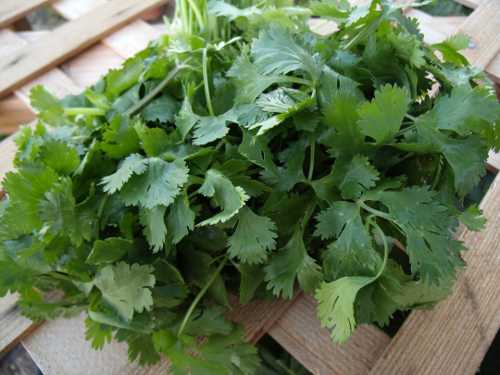
I didn’t realize cilantro was controversial until I did research for today’s column.
Apparently, cilantro haters abound. Blogs are devoted to their herbal disdain, as well as a Facebook page that boasts more than 10,000 members.
But I love the stuff. I even went to the cilantro fan page on Facebook and “liked” it, just to counteract the negatives.
I have to admit, though, that it was not love at first bite for me. My initial experience with cilantro was unexpected, a not-so-welcome twist to a restaurant salad.
Not being raised with its taste on our table, it took a while for me to acclimate to cilantro’s unique flavor. But now that I have, I use it broadly in my cooking.
This pungent herb grows freely in such a wide swath of territory (from southern Europe to North Africa and southwestern Asia) that experts have said it’s hard to define where the plant is native and where it recently established itself.
While most of us call it by its Spanish name, cilantro (pronounced sih-LAN-troh), this leafy green herb is also known as coriander and Chinese parsley.
As one of its monikers suggests, coriander seeds, and the corresponding ground version of the spice, are products of the same plant.
Ancient Egyptians cultivated coriander, as evidenced by remnants of the plant found in the tomb of King Tutankhamen, as did the ancient Greeks, who did so from at least the second millennium B.C., according to archaeological records.
Like us, these cultures consumed the leaves and seeds of the plants; however, unlike us, there is evidence the herb was also used for perfume, at least in Greece. As much as I like its taste, I can’t imagine desiring it as a fragrance for my body.
One of the things that draws me back to cilantro (the green, leafy herb) and coriander (the spicy seeds) time and time as I cook is that it influences so many world cuisines.
Mexico (and throughout all of Latin America), Portugal, Southeast Asia (Thailand, for example), India, China, parts of Africa, central Asia (places like Afghanistan and Mongolia), and the Caribbean islands are a diverse group of places where these flavors make themselves at home.
And while we don’t normally associate cilantro with Europe – other than, say, Portugal and Spain – European cooks used the leaves and seeds in cooking well into medieval times. Cilantro pesto, for example, has deeper roots in the Mediterranean region than those made with basil.
Coriander seeds are generally toasted before being ground to bring out their flavor. They’re a prime component of Indian curries, and are one of the five ingredients of the spice blend known as “Chinese Five Spice.”
All parts of the coriander plant are edible: leaves, stems, seeds, and even roots, which are sometimes used as a replacement for garlic in cuisine.
Smart supermarket produce managers typically stock bundles of fresh cilantro well away from the Italian parsley, as the two can be confused based on sight.
There is no confusion with its smell, however. Cilantro should have a pungent aroma, and I always do a “smell test” when shopping to be sure my cilantro is fresh.
In addition to a flavorful smell, fresh cilantro should have bright, evenly-colored green leaves, with no evidence of yellowing.
Cilantro is best stored in the fridge. Place stems in a glass of water (including root, if attached) and cover the top loosely with a plastic bag. Change the water every two to three days. To use, snip off leaves as needed.
I don’t recommend washing cilantro prior to its use, as excess moisture can turn the leaves to slime.
While I haven’t tried this, I’ve been told that fresh cilantro can be frozen, either whole or chopped in an airtight container. It’s said that it shouldn’t be thawed until just before use to preserve its texture.
Another method is to put fresh chopped cilantro in ice cube trays with just enough water or broth to cover. These frozen herbal cubes can then be added to soups or stews for flavor.
As to the seeds or ground spice, store in an air-tight container away from light and heat. Its flavor will begin to diminish in about six months, so be sure to use it within a year.
Coriander has long held a health-supporting reputation. For example, in Europe, it’s been traditionally referred to as an “anti-diabetic” plant, and in India the seeds have been used in traditional medicine as an anti-inflammatory.
Cilantro in herb and seed form contains an impressive array of beneficial phytonutrients, health-supporting plant compounds, which modern research has shown to be effective in controlling blood sugar and cholesterol, as well as cell-damaging free radicals.
To top it off, cilantro has antimicrobial properties, including, according to research, as an effective antibiotic against the Salmonella bacteria.
Whether you buy cilantro at the farmers’ market, grow it in your garden, or find it at your local supermarket, the two simple recipes offered today are delicious ways to add this herb to your culinary arsenal.
The first, cilantro-lime rice, is a wonderful accompaniment for Mexican or Thai-inspired dishes. Its spicy tang adds interest to an otherwise everyday side dish.
The second, cilantro pesto, may be used to dress up pasta, to spread on a pizza crust as a base for grilled prawns or chicken, or dropped into soups or sauces for a burst of flavor.
Before I go, I’d like to address the issue of why cilantro in its leafy form is so avidly hated by some. (If you’ve got a weak stomach, please avoid the next paragraph.)
I’ve seen aversion to cilantro’s taste described in terribly strong terms. One blogger said it tasted like “a decomposing armpit sprayed with liberal amounts of Brut,” and another “the acrid sweetness of death.”
Even in the ancient world there were cilantro haters.
The word coriander is derived from a Greek word for bedbug, purportedly because its smell was reminiscent of bug-infested bedclothes, though modern “cilantrophobes” would describe its smell as soapy, rather than buggy.
There’s a reason for this. Flavor chemists have determined that much of cilantro’s aroma is due to fragments of fat molecules called aldehydes, similar to those found – surprise! – in soap and the bug family of insects.
Some people are more sensitive to this smell than others, including, believe it or not, Julia Child, who was an avid cilantro hater.
There is a remedy, however. A Japanese study published a couple of years ago revealed that crushing the leaves will allow enzymes a chance to gradually convert aldehydes into other aroma-less substances, making dishes which utilize chopped or crushed cilantro (such as those below) more palatable than cilantro in its whole form.
Otherwise, you could hold your nose when eating this otherwise wonderful herb. Or not, if you’re a cilantro lover like me.
Cilantro-lime rice
1 cup long grain white rice
Coarse salt
½ cup fresh cilantro
2 tablespoons fresh lime juice
1 tablespoon olive oil
1 garlic clove
In a medium saucepan, bring 1½ cups water to a boil. Add rice and ¼ teaspoon salt; cover and reduce to a simmer. Cook until water is absorbed and rice is just tender, 16 to 18 minutes.
Meanwhile, in a blender, combine cilantro, lime juice, oil, garlic, and 2 tablespoons water; blend until smooth. Stir into cooked rice and fluff with a fork.
Esther’s note: Nearly every lime I’ve squeezed has contained about three tablespoons of juice, so it’s a safe bet that you can get all the juice you need from one plump lime.
Recipe by Martha Stewart and courtesy of www.marthastewart.com .
Cilantro pesto
¾ cup fresh cilantro leaves
¼ cup parsley leaves
2 garlic cloves, coarsely chopped
2 tablespoons pine nuts
¼ cup grated Parmesan cheese
½ cup olive oil
Salt and freshly ground black pepper to taste
Put all ingredients through olive oil in a bowl of a food processor and process until smooth. Season with salt and pepper to taste.
Esther’s note: Walnuts may be substituted for the pine nuts in the recipe, and if a food processor is not available, a blender may be used.
Recipe by Bobby Flay and courtesy of www.foodnetwork.com .
Esther Oertel, a freelance writer, cooking teacher, and speaker, is passionate about local produce and all foods in the vegetable kingdom. She welcomes your questions and comments and may be reached at




