 How to resolve AdBlock issue?
Chesbro bill to protect public and forests headed to Assembly Floor
AB 2284, a bill by Assemblymember Wesley Chesbro (D-North Coast) to crack down on offenders who pollute the environment and endanger the public by growing or manufacturing illegal drugs on forest lands, is headed to the Assembly Floor for a vote after it was approved by the Appropriations Committee.
After recent amendments, AB 2284 would increase the penalties for those convicted of production or cultivation of a controlled substance on resource lands and timberland preserve zones of more than 50,000 acres.
“To address concerns surrounding the broad timberland definition originally included in the bill, I have continued to work with various interested parties to narrow the definition, which I included in the Assembly Appropriations Committee amendments,” Chesbro said. “I want to make it make it clear that the focus of this bill is on large industrial timber and public resource lands, and not smaller property owners and homeowners.”
He added, “This bill is not about the legal production or use of medical marijuana under California law. This bill is about pollution and illegal diversion of waterways, and the increasing violence that is occurring in our forests. AB 2284 is the direct outgrowth of two hearings I held this year as chair of the Joint Committee on Fisheries and Aquaculture.”
At the hearings, fisheries experts, the Department of Fish and Game and environmental groups described the increasing threat that illegal drug production represents, especially to endangered species such as the Coho salmon, Chesbro said.
AB 2284 would also, under a very limited scope, allow law enforcement to stop and question drivers transporting irrigation piping, which must be in plain view.
The vehicles must be traveling on gravel or unpaved roads within public resource land or timber preserve zones of more than 50,000 acres.
Law enforcement would not be able to stop and question those transporting irrigation piping on timber preserve zone lands under 50,000 acres unless the landowner has filed a written statement giving law enforcement permission to so.
“On many occasions law enforcement officers have seen people entering these resource lands with irrigation supplies in plain sight,” Chesbro said. “They do not have the authority to pull them over and simply ask questions, possibly stopping a marijuana cultivation site before it is planted. Preventing a site from being established is the best way to protect the forests and watersheds, safeguard the public and reduce the risk to law enforcement officers, who often face armed suspects while investigating established sites.”
Estate Planning: Drafting flexibility into the living trust
Life is not static and neither should be anyone’s living trust.
Adjustments have to be made when compelling circumstances arise which necessitate alternative approaches.
For that reason a well drafted living trust should provide contingency planning alternatives.
Unforeseen circumstances could relate to the settlors themselves, to the trust assets, or to the beneficiaries.
Let us consider some possible scenarios and how a trust could be drafted to provide suitable alternative solutions.
First, the settlor's own circumstances could dramatically change.
A settlor might require admission into a skilled nursing home and wish to apply for Medi-Cal assistance to help pay the costs.
In that case, the settlor’s trust might authorize gifting of assets to family in order to accelerate his or her eligibility and/or to preserve the gifted assets against eventual estate recovery by Medi-Cal of assets exempt for eligibility purposes only after then settlor dies.
Second, the assets that are available to distribute to the beneficiaries could be significantly different than those the settlor owned when he or she drafted the trust.
Some or all of the important original trust assets that were specifically devised may have been given away, sold, and new ones acquired.
Also, debts owed by the decedent may wipe out a large portion of the estate leaving much less to be distributed to any beneficiaries who receive a percentage of the remaining trust estate.
For these reasons, a trust may provide alternative distribution schemes consistent with the decedent’s wishes should the estate be dramatically changed.
Third, the beneficiaries own life situations at the time of distribution may be significantly different.
That is, some beneficiaries may have died, may be receiving needs based SSI or Medi-Cal benefits, may have debt issues, may be involved in a divorce, may be incarcerated or otherwise incapable of managing their own affairs. Thus, the trust may authorize the trustee to pursue more appropriate alternatives.
Specifically, in the case of a deceased beneficiary, the trust may permit the trustee to distribute to alternative beneficiaries if a primary beneficiary, who survived long enough to inherit, has died prior to receiving the full inheritance – such alternative beneficiaries could either be named in the deceased settlor’s trust instrument or, if authorized, in the deceased beneficiary’s own will pursuant to a power of appointment.
In regards to a beneficiary receiving SSI/Medi-Cal, the trust could redirect the inheritance into a special needs trust to assist such beneficiary.
In the case of beneficiaries who have creditor or divorce issues, the trust could authorize the trustee to withhold all or part of distribution for any period of time up to an including the beneficiary’s entire lifetime and to utilize the withheld inheritance to assist the beneficiary.
Lastly, regarding a beneficiary who is incarcerated or otherwise incapable of managing an inheritance, the trust may authorize that the trustee either retain and manage the inheritance in further trust or use the inheritance to purchase a single premium annuity for the beneficiary (to stretch out the payments over the beneficiary’s lifetime or term of years).
As more time passes since when the trust was drafted the more changes occur and the more likely it becomes that the original plan as conceived will become either partially or completely inappropriate given the new circumstances.
It is, therefore, only good planning to draft flexibility into a trust to allow the trustee maneuvering room to respond to unforeseen circumstances.
Needless to say, the foregoing discussion underscores why one’s estate plan should be reviewed by an attorney periodically – at least every five years – and sometimes sooner if events necessitate in order to make necessary adjustments to ensure its continued appropriateness.
Dennis A. Fordham, attorney (LL.M. tax studies), is a State Bar Certified Specialist in Estate Planning, Probate and Trust Law. His office is at 55 First St., Lakeport, California. Dennis can be reached by e-mail at
Space News: NASA's Juno Spacecraft images Big Dipper

In England it is known as the "Plough," in Germany the "Great Cart," and in Malaysia the "Seven Ploughs." Since humanity first turned its eyes skyward, the seven northern hemisphere stars that compose the "Big Dipper" have been a welcome and familiar introduction to the heavens.
"I can recall as a kid making an imaginary line from the two stars that make up the right side of the Big Dipper's bowl and extending it upward to find the North Star," said Scott Bolton, principal investigator of NASA's Juno mission to Jupiter from the Southwest Research Institute in San Antonio. "Now, the Big Dipper is helping me make sure the camera aboard Juno is ready to do its job."
Launched on Aug. 5, 2011, the solar-powered Juno spacecraft is 279 days and 380 million miles (612 million kilometers) into its five-year, 1,905-million-mile (3,065-million-kilometer) journey to Jupiter.
Once there, the spacecraft will orbit the planet's poles 33 times and use its nine instruments to image and probe beneath the gas giant's obscuring cloud cover to learn more about Jupiter's origins, structure, atmosphere and magnetosphere, and look for a potential solid planetary core.
One of those instruments, JunoCam, is tasked with taking closeups of the gas giant's atmosphere.
But, with four-and-a-half years to go before photons of light from Jupiter first fill its CCD (charge-coupled device), and a desire to certify the camera in flight, Juno's mission planners took a page from their childhood and on March 21, aimed their camera at a familiar celestial landmark.
"I don't know if it's the first space-based image of the Big Dipper but, as it was taken when we were well beyond Mars orbit, it's probably from the farthest out," said Bolton. "But much more important than that is the simple fact that JunoCam, like the rest of this mission, works as advertised and is ready for its day in the sun – around Jupiter."
Juno's name comes from Greek and Roman mythology. The god Jupiter drew a veil of clouds around himself to hide his mischief, and his wife, the goddess Juno, was able to peer through the clouds and reveal Jupiter's true nature.
NASA's Jet Propulsion Laboratory, Pasadena, Calif., manages the Juno mission for the principal investigator, Scott Bolton, of Southwest Research Institute in San Antonio.
The Juno mission is part of the New Frontiers Program managed at NASA's Marshall Space Flight Center in Huntsville, Ala. JunoCam was developed and is operated by Malin Space Science Systems in San Diego. Lockheed Martin Space Systems, Denver, built the spacecraft. JPL is a division of the California Institute of Technology in Pasadena.
More information about Juno is online at http://www.nasa.gov/juno and http://missionjuno.swri.edu/ .
DC Agle is with NASA's Jet Propulsion Laboratory in Pasadena, Calif.
Lakeport woman arrested for allegedly stabbing boyfriend
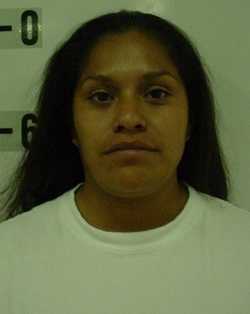
LAKEPORT, Calif. – A Lakeport woman was arrested early Friday for allegedly stabbing her boyfriend.
Krissandra Burrows, 26, was arrested for assault with a deadly weapon with great bodily injury and domestic violence, according to Sgt. Jason Ferguson.
On Thursday shortly before 6 p.m. a Lakeport Police Department sergeant responded to Sutter Lakeside Hospital to contact an assault victim, Ferguson reported.
The victim, a 42-year-old Lakeport man, reported he was stabbed multiple times in the left hand and right thigh by an unknown Hispanic male subject on the north side of Library Park, according to Ferguson.
Ferguson said the alleged victim was unable to provide any further information regarding the suspect who stabbed him.
A search of the parklands revealed no evidence to suggest a stabbing had in fact occurred at the location provided by the alleged victim, according to Ferguson.
During the course of the evening officers developed information which led to a potential suspect and location where the stabbing occurred, he reported.
Ferguson said officers responded to 250 15th St. and identified evidence of a crime scene outside the residence.
Officers contacted Burrows, the alleged victim’s girlfriend, and through followup investigation learned that Burrows allegedly stabbed the victim in a domestic violence disturbance, Ferguson said.
Ferguson arrested Burrows, who was transported to the Hill Road Jail where she was booked.
Bail was set at $25,000 and she remained in custody early Saturday, according to jail records.




