 How to resolve AdBlock issue?
Space News: NASA space telescope sees the light from an alien super-Earth
NASA's Spitzer Space Telescope has detected light emanating from a "super-Earth" beyond our solar system for the first time. While the planet is not habitable, the detection is a historic step toward the eventual search for signs of life on other planets.
"Spitzer has amazed us yet again," said Bill Danchi, Spitzer program scientist at NASA Headquarters in Washington. "The spacecraft is pioneering the study of atmospheres of distant planets and paving the way for NASA's upcoming James Webb Space Telescope to apply a similar technique on potentially habitable planets."
The planet, called 55 Cancri e, falls into a class of planets termed super Earths, which are more massive than our home world but lighter than giant planets like Neptune.
The planet is about twice as big and eight times as massive as Earth. It orbits a bright star, called 55 Cancri, in a mere 18 hours.
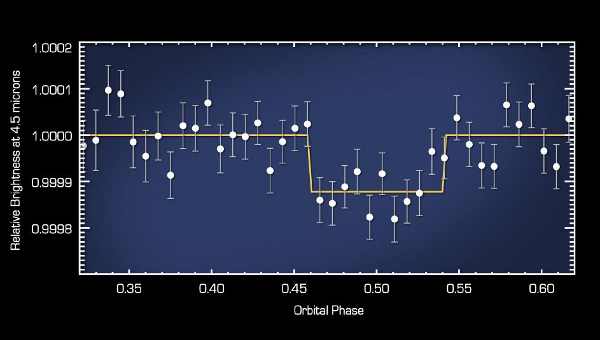
Previously, Spitzer and other telescopes were able to study the planet by analyzing how the light from 55 Cancri changed as the planet passed in front of the star.
In the new study, Spitzer measured how much infrared light comes from the planet itself. The results reveal the planet is likely dark, and its sun-facing side is more than 2,000 Kelvin (3,140 degrees Fahrenheit), hot enough to melt metal.
The new information is consistent with a prior theory that 55 Cancri e is a water world: a rocky core surrounded by a layer of water in a "supercritical" state where it is both liquid and gas, and topped by a blanket of steam: video.
"It could be very similar to Neptune, if you pulled Neptune in toward our sun and watched its atmosphere boil away," said Michaël Gillon of Université de Liège in Belgium, principal investigator of the research, which appears in the Astrophysical Journal. The lead author is Brice-Olivier Demory of the Massachusetts Institute of Technology in Cambridge.
The 55 Cancri system is relatively close to Earth, at 41 light-years away. It has five planets, with 55 Cancri e the closest to the star and tidally locked, so one side always faces the star.
Spitzer discovered the sun-facing side is extremely hot, indicating the planet probably does not have a substantial atmosphere to carry the sun's heat to the unlit side.
NASA's James Webb Space Telescope, scheduled to launch in 2018, likely will be able to learn even more about the planet's composition.
The telescope might be able to use a similar infrared method to Spitzer to search other potentially habitable planets for signs of molecules possibly related to life.
"When we conceived of Spitzer more than 40 years ago, exoplanets hadn't even been discovered," said Michael Werner, Spitzer project scientist at NASA's Jet Propulsion Laboratory in Pasadena, Calif. "Because Spitzer was built very well, it's been able to adapt to this new field and make historic advances such as this."
In 2005, Spitzer became the first telescope to detect light from a planet beyond our solar system. To the surprise of many, the observatory saw the infrared light of a "hot Jupiter," a gaseous planet much larger than the solid 55 Cancri e.
Since then, other telescopes, including NASA's Hubble and Kepler space telescopes, have performed similar feats with gas giants using the same method. This marks the first time, however, that light from a super-Earth has been detected.
Dr. Tony Phillips works for the National Aeronautics and Space Administration.
Lake County Office of Education gets $10,000 grant thanks to ‘Bright Ideas’
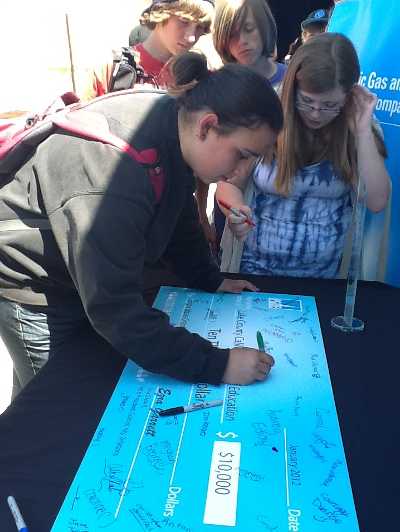
KELSEYVILLE, Calif. – The Lake County Office of Education has received a $10,000 grant to install solar panels at the Taylor Observatory-Norton Planetarium in an effort to turn the facility into a science center for students across the county.
On Friday afternoon, Lake County Superintendent of Schools Wally Holbrook, community members, Lake County Office of Education staffers board members, Kelseyville Unified School District Board members, members of the Friends of the Taylor Observatory and representatives from Pacific Gas & Electric Co. gathered at the planetarium for the presentation of the big check.
Holbrook said 70 students from Terrace Middle School and Mountain Vista Middle School also were at the observatory for the event, with all of the students getting to sign the big ceremonial check.
PG&E awarded the Lake County Office of Education the $10,000 “Bright Ideas” grant, which Holbrook said will be used to add 10 solar panels to the roof of the observatory, located at 5725 Oak Hills Lane in Kelseyville.
PG&E offers the grants – ranging from $1,000 up to $10,000 – for school renewable energy and environmental programs and projects, even science-related field-trips.
Holbrook said the solar installation project includes the use of monitoring software that will be a teaching tool, allowing students to track how much energy is generated or saved.
As such, the observatory will become an energy demonstration center for all of the county’s schools, he said.
“We're trying to have the observatory become the science center of Lake County,” he said.
The observatory location allows all county students to be connected to the facility online, Holbrook said.
The observatory and planetarium recently got a new $25,000 state-of-the-art projector, with the Friends of the Taylor Observatory paying for the project’s software, Holbrook said.
He said the quality of the shows – and the audience – has increased at the planetarium and observatory.
He said he and his staff hope to be able to pursue other grants, including one to install a demonstration wind turbine at the facility.
Visit the observatory online at www.lakecoe.org/programs/taylor_observatory .
Email Elizabeth Larson at

Lucerne woman injured in Thursday crash
CLEARLAKE OAKS, Calif. – A Lucerne woman was injured and had to be lifeflighted out of the county on Thursday after her vehicle went into the lake.
Christine Koschei, 41, was injured in the Thursday afternoon crash on Highway 20 near Island Drive, according to the California Highway Patrol.
CHP Officer Kory Reynolds said Friday that Koschei was driving a Ford Explorer with 46-year-old Stephanie Curtis-Kyle and a 6-year-old girl riding as passengers.
The vehicle went off the highway and into Clear Lake. Reynolds said investigators were not sure what led to the vehicle going into the water.
Koschei suffered major injuries and was flown out of the county, the CHP reported.
Her vehicle was recovered from the lake through the use of the Northshore Dive Team's heavy duty air bags, which lift sunken vehicles.
The Lake County Sheriff's Office's Marine Patrol then towed the vehicle to a spot along the lakeshore where it could be removed.
Email Elizabeth Larson at
Space News: Hubble to use Moon as mirror to see Venus transit
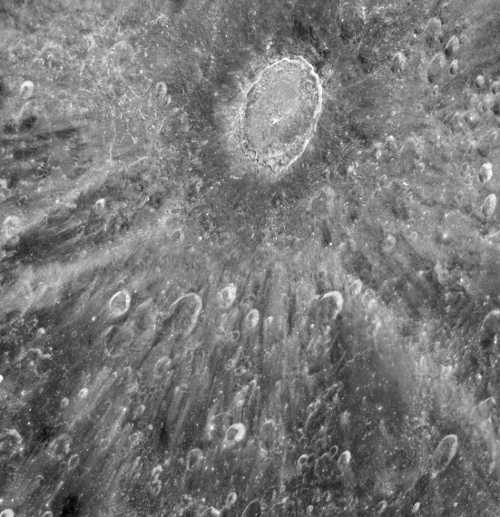
The mottled landscape pictured above that shows the impact crater Tycho is among the most violent-looking places on our moon.
Astronomers didn't aim NASA's Hubble Space Telescope to study Tycho, however. The image was taken in preparation to observe the transit of Venus across the sun's face June 5-6.
Hubble cannot look at the sun directly, so astronomers are planning to point the telescope at the Earth's moon, using it as a mirror to capture reflected sunlight and isolate the small fraction of the light that passes through Venus' atmosphere.
Imprinted on that small amount of light are the fingerprints of the planet’s atmospheric makeup.
These observations will mimic a technique that is already being used to sample the atmospheres of giant planets outside our solar system passing in front of their stars. In the case of the Venus transit observations, astronomers already know the chemical makeup of Venus' atmosphere, and that it does not show signs of life on the planet.
But the Venus transit will be used to test whether this technique will have a chance of detecting the very faint fingerprints of an Earth-like planet, even one that might be habitable for life, outside our solar system that similarly transits its own star.
Venus is an excellent proxy because it is similar in size and mass to our planet.
The astronomers will use an arsenal of Hubble instruments – the Advanced Camera for Surveys, Wide Field Camera 3 and Space Telescope Imaging Spectrograph – to view the transit in a range of wavelengths, from ultraviolet to near-infrared light.
During the transit, Hubble will snap images and perform spectroscopy, dividing the sunlight into its constituent colors, which could yield information about the makeup of Venus' atmosphere.
Hubble will observe the moon for seven hours, before, during, and after the transit so the astronomers can compare the data.
Astronomers need the long observation because they are looking for extremely faint spectral signatures. Only 1/100,000th of the sunlight will filter through Venus' atmosphere and be reflected off the moon.
The image above, taken with Hubble's Advanced Camera for Surveys, reveals lunar features as small as roughly 560 feet (170 meters) across.
The large "bulls-eye" near the top of the picture is the impact crater, caused by an asteroid strike about 100 million years ago.
The bright trails radiating from the crater were formed by material ejected from the impact area during the asteroid collision.
Tycho is about 50 miles (80 kilometers) wide and is circled by a rim of material rising almost 3 miles (5 kilometers) above the crater floor. The image measures 430 miles (700 kilometers) across, which is slightly larger than New Mexico.
Because the astronomers only have one shot at observing the transit, they had to carefully plan how the study would be carried out. Part of their planning included the test observations of the moon, made on Jan. 11, 2012, as shown in the release image.
Hubble will need to be locked onto the same location on the moon for more than seven hours, the transit's duration.
For roughly 40 minutes of each 96-minute orbit of Hubble around the Earth, the Earth occults Hubble's view of the moon.
So, during the test observations, the astronomers wanted to make sure they could point Hubble to precisely the same target area.
This is the last time this century sky watchers can view Venus passing in front of the sun. The next transit won't happen until 2117. Venus transits occur in pairs, separated by eight years. The last event was witnessed in 2004.
The Hubble Space Telescope is a project of international cooperation between NASA and the European Space Agency. NASA's Goddard Space Flight Center in Greenbelt, Md., manages the telescope.
The Space Telescope Science Institute (STScI) in Baltimore, Md., conducts Hubble science operations. STScI is operated by the Association of Universities for Research in Astronomy, Inc., in Washington, D.C.
For images and more information about Hubble’s view of the Moon and the Venus transit, visit http://hubblesite.org/news/2012/22 .
For more information about the Hubble Space Telescope, visit http://www.nasa.gov/hubble .
Cheryl Grundy works for the Space Telescope Science Institute (STScI) in Baltimore, Md.




