 How to resolve AdBlock issue?
Center for Biological Diversity sues U.S. Fish and Wildlife Service to secure protection for Clear Lake hitch

LAKEPORT, Calif. – The Center for Biological Diversity notified the U.S. Fish and Wildlife Service Tuesday that it intends to sue the agency for failing to finalize Endangered Species Act protection for the Clear Lake hitch – a rare fish found only in Lake County.
“It’s appalling that the Trump administration is sitting on its hands, leaving these iconic fish stranded in bureaucratic limbo,” said Meg Townsend, a freshwater attorney at the center. “Clear Lake hitch are vital to the health of their namesake lake and to the cultural legacy of the Pomo people. Only Endangered Species Act protections will keep these irreplaceable fish swimming safely into the future.”
Each spring, adult Clear Lake hitch migrate into tributary streams to spawn before returning to the lake.
Millions once surged through these waterways in spectacular spawning runs, sustaining the lake’s ecosystem and providing a critical food source for birds, fish and other wildlife.
Those abundant runs also made hitch a staple food and cultural cornerstone for the region’s original Pomo inhabitants. Today just a few thousand adult hitch spawn in a good year, with numbers plunging far lower in recent years.
The main threat to the hitch is a lack of water flowing in spawning tributaries, driven by chronic over-withdrawal, both legal and illegal, and worsening climate-driven drought.
The hitch are also threatened by fish-passage barriers, habitat degradation, pollution and predation, and competition from invasive species like carp and bass.
To survive the species urgently needs emergency measures, including captive rearing, enforcement against illegal water withdrawals, invasive fish control and adequate stream flows.
The hitch’s closest relative, the Clear Lake splittail, was driven to extinction by the 1970s after habitat alterations dried out spawning streams and blocked migration routes.
“If these fish are left without the strong protections of the Endangered Species Act they could vanish just like the lake’s splittail,” said Townsend. “We can’t let that happen.”
Clear Lake hitch are adapted to an increasingly narrow window of suitable stream conditions for their annual spawning runs, as streams dry earlier each year. With an estimated six-year life span, the species cannot withstand multiple consecutive years of failed spawning.
Habitat loss has been severe, including an 85% loss of wetlands critical for juvenile rearing, a 92% loss of historical spawning and rearing streams, and declining lake water quality.
Clear Lake tribes have led efforts to restore the hitch and protect spawning habitat. The California Department of Fish and Wildlife and the U.S. Geological Survey now conduct regular hitch surveys.
Fish passage projects have been completed, invasive carp are being removed and tribal advocacy has prompted state review of excessive water pumping. Tribal and state biologists continue rescuing adult and juvenile hitch stranded in drying streams.
In 2012 the Center petitioned California and the U.S. Fish and Wildlife Service to protect the Clear Lake hitch under state and federal law. California listed the hitch as threatened in 2014, but the service delayed action until 2020, when the Trump administration ignored the science and declined to protect the species.
The center challenged that decision in a 2021 lawsuit and as a result the service proposed listing the hitch as threatened with extinction in January 2025.
The agency’s overdue final rule forms the basis of the center’s current legal action.
- Details
- Written by: Lake County News Reports
Thompson introduces bill to prevent president from profiting off lawsuits against the U.S. government
On Tuesday, Rep. Mike Thompson (CA-04), Ranking Member of the House Ways and Means Subcommittee on Tax, announced legislation to prevent a sitting president from profiting from lawsuits against the United States government.
“President Trump continues to use the office of the presidency for personal gain, including by suing the federal government to line his own pockets. That's unacceptable,” said Thompson. “That is why I am introducing legislation that ensures if a sitting president sues our government while in office, they get taxed 100 percent on any money paid to them through a trial or settlement.”
Thompson added, “The president holds immense responsibility and influence. It is unacceptable for a president to use that position to financially benefit from the very government they were elected to lead."
This legislation would add a new provision to the Internal Revenue Code imposing a 100 percent tax on any civil judgment or settlement paid by the United States to a sitting president or the president’s immediate family, if the legal action was filed while the president was in office.
It will be formally introduced to the House of Representatives this week.
Thompson represents California’s Fourth Congressional District, which includes all or part of Lake, Napa, Solano, Sonoma and Yolo counties.
- Details
- Written by: Lake County News Reports
Governor appoints Langan as new Lake County Superior Court judge
LAKE COUNTY, Calif. — The governor announced that Lake County will have a new judge for the new year.
On Monday, Gov. Gavin Newsom’s office said John Langan will be the newest member of the Lake County Superior Court bench.
Langan has a lengthy record of service in the legal profession in Lake County. Most recently, he has served as a commissioner at the Lake County Superior Court since 2019.
In that position, Langan has handled cases involving the Department of Child Support Services, traffic, small claims and unlawful detainers.
The court commissioner job is a good preparation for a judicial appointment — while not a judge, it has similar powers and the ability to carry out judicial functions as directed by the court.
Langan received his Juris Doctor degree from the University of San Francisco School of Law.
He went on to serve as deputy public defender at the Sonoma County Public Defender’s Office from 1999 to 2001.
From there, he came to Lake County, where he’s spent the majority of his career.
Langan served in several roles in the Lake County District Attorney’s Office, beginning as a deputy district attorney from 2001 to 2004.
From 2004 to 2019, he served as a senior deputy district attorney in Lake County before he was selected to be the Superior Court commissioner in January of 2019.
The newly appointed Judge Langan succeeds Judge Andrew Blum, who retired before the end of his term. Blum’s last day on the bench as a full-time judge was July 3. In the months since, Blum has begun hearing cases as a retired judge, a common practice at a time when judges are needed not just locally — as Lake County has a high case rate — but throughout the state.
The last time a Lake County Superior Court judicial vacancy was filled by a gubernatorial appointment was when Judge J. David Markham was appointed to succeed Judge Richard Martin by then-Gov. Jerry Brown in December 2017.
Langan’s appointment was among 10 new Superior Court judges Newsom’s office announced on Monday.
The other new judges appointed this week — all Democrats like Langan — include Alameda Superior Court judges Novella Coleman and Kathleen Vermazen Radez; Fresno Superior Court Judge David Chiappetta; Los Angeles Superior Court Judge Alma D. Puente; Orange Superior Court Judge Allison Chan; San Francisco Superior Court judges Christopher Hu and Dane Reinstedt; San Mateo Superior Court Judge Jennifer M. Frost; and Shasta Superior Court Judge Ryan Birss.
Email Elizabeth Larson at

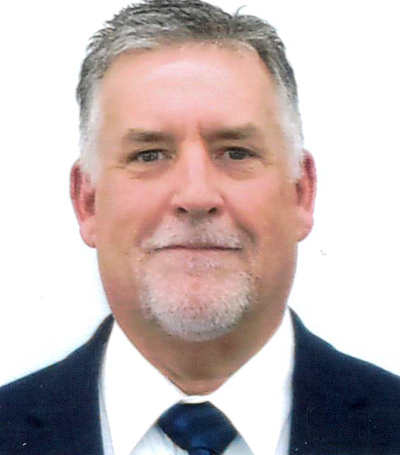
John Langan with retiring Judge Andrew Blum at Blum’s retirement party on Friday, July 3, 2025. Langan has been appointed by Gov. Gavin Newsom to succeed Blum on the Lake County Superior Court bench. Photo by Elizabeth Larson/Lake County News.
- Details
- Written by: Elizabeth Larson
Sewer spill incident command releases new update, plans next town hall meeting
CLEARLAKE, Calif. — Water tank installation resumed Monday for residents impacted by the Robin Lane sewer spill, as well testing continues and officials prepare for another town hall later this week.
After a pause over the weekend, the total number of water tanks installed rose from 25 to 29, with 22 installed by the incident management team and seven by the Lake County Social Services Department.
An additional 22 water samples were collected Monday, bringing the total to 441, up from 419 the previous day.
These samples have been drawn from 151 sites, a number that has remained unchanged since Jan 29, which covers at most three quarters of the properties impacted, according to public data released by officials.
The spill began more than three weeks ago, on Sunday, Jan. 11, when a 16-inch force main operated by the Lake County Sanitation District ruptured on Robin Lane, releasing nearly three million gallons of sewage over a 38-hour period.
The incident led to temporary relocations for some residents who rely on private well water, as dozens of wells were found to be contaminated amid ongoing testing.
The city of Clearlake declared a local emergency on Jan. 12, while the spill was still active, and announced that 58 properties were impacted in the area enclosed by Robin Lane, Pamela Lane, Pond Road and Rumsey Road.
Since Jan. 26, the city of Clearlake and the Lake County Sheriff’s Office of Emergency Services have started leading the recovery operation, establishing a “joint command,” following more than two weeks of immediate response led by the Special Districts.
That day, the city announced that more than 200 properties relying on a private well were impacted by the spill — a significant increase from the initially cited 58.
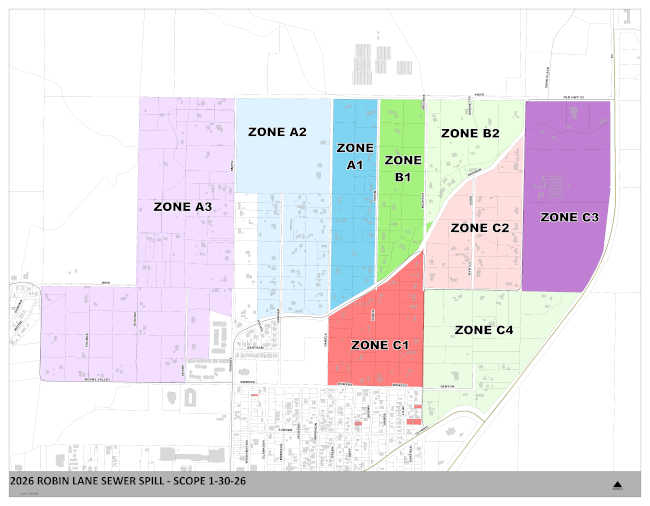
On Jan. 31, an updated map was released showing nine impact zones totaling an estimated 550 acres — an increase of about 250 acres — on the northern end of Clearlake. The update did not indicate the number of properties affected within the expanded area.
The city’s most recent Frequently Asked Questions document states, “As a precautionary measure, 151 properties that rely on private wells are now included in the monitoring and testing area." This number has remained unchanged since Thursday.
For the first time, the incident management team also reported on Monday the number of wells sanitized, which totaled 65.
After sanitization, a well is deemed safe for use once it receives two negative test results — taken 24 hours apart — for E. coli and coliform, according to City Manager Alan Flora and Undersheriff Corey Paulich, who also is the deputy director for the Office of Emergency Services at last week’s town hall.
At that point, the property owner will be notified with test results and information on how to treat the well going forward.
So far, the city has not publicly released any notices or aggregated data on contaminated wells that have been cleared for safe use in the impacted area.
At the same meeting, Flora said the city has hired a hydrologist to assist with studying the aquifer and understanding the spill’s impact on it.
The fourth in a series of town halls on the spill is scheduled for 6 p.m. Wednesday, Feb. 4, at Clearlake City Hall, 14050 Olympic Drive.
“The hydrologist will be there to speak,” Clearlake Councilmember Tara Downey wrote in a Facebook group called “Robin Ln sewage spill & contamination,” where impacted residents share information.
Water tanks offered to assist affected households
For the past 23 days, households in the impacted areas have not had safe access to their private water wells. Some of them — 29 so far — have had a water tank installed for them that is large enough to provide clean water of a minimum of 60 gallons per person per day as recommended by Public Health Officer Dr. Robert Bernstein.
On Jan. 21, the Board of Supervisors approved an allocation of $750,000 to the Lake County Special Districts to cover costs of purchasing and installing water tanks for impacted residents, as well as refilling the tanks.
“We are out of money; we've depleted our reserves in that district,” Special Districts Administrator Robin Borre said of its disaster response funding at that meeting.
The 34-minute special meeting revolved mostly around water tanks including their quantity, size and costs.
“This money would purchase an extra, I believe, 60 tanks,” District 2 Supervisor Bruno Sabatier said of the initial $500,000 requested at the meeting. “We have a number of the amount of wells that are out there. We're hoping 60, and the program that Social Services is providing will provide what is needed.”
To cover water refilling, “It would need to be raised a little bit, at least to $600,000,” said Assistant County Administrative Officer Stephen Carter.
Sabatier suggested a bigger amount.
“So why not make it $750,000 and if we don't spend it, we don't spend it,” he said. “If we have to spend it, at least it's available so we don't have to have an urgent situation of money.”
At the last town hall, a resident asked how many water tanks out of the 60 had been ordered.
“I'm not sure where that number came from,” said Undersheriff Paulich. “There was never a number put to — we're going to buy 60 tanks.”
Paulich said he did not watch the entire board meeting but he was briefed by the County Administrative Office.
“Five hundred thousand dollars was the original. There was a request for $250,000 more, and that was for the testing and for water supply,” said Paulich. “That's why I've been advised by our County Admin.”
Use of these funds in water testing was neither specifically mentioned during the meeting nor in the resolution document.
Email staff reporter Lingzi Chen at
- Details
- Written by: Lingzi Chen