How to resolve AdBlock issue?
California communities can reduce wildfire damage by half. Here’s how.
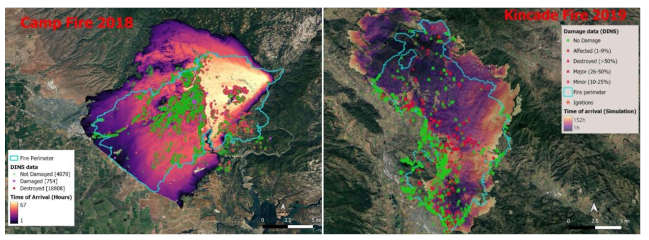
A new UC Berkeley-led study demonstrates how two mitigation strategies — home hardening and defensible space — can have a major impact on wildfire destructiveness.
Since January’s wildfires flattened entire neighborhoods in Los Angeles, displacing 12,900 households and causing an estimated $30 billion in losses, California’s many other fire-prone communities have been eager for solutions to better protect themselves.
A new UC Berkeley-led study provides these communities and their lawmakers with actionable data on how wildfire mitigation strategies can reduce the destructiveness of wildfires by as much as 50%.
One option to reduce wildfire damage is home hardening, which describes a variety of structural modifications that homeowners can use to make their houses less susceptible to fire.
These include using fire-resistant siding and roofing materials, covering vents to prevent embers from entering the home, and upgrading to double-paned tempered glass windows that are less likely to break in a fire.
Another strategy, defensible space, refers to a vegetation-free “buffer zone” around a home or structure. Because renovating existing homes is not always easy or cheap, data on the effectiveness of these measures is key to justifying future investment.
In the study, the researchers used state-of-the-art wildfire simulation tools, combined with real-world data from five of the most destructive fires that occurred in California before 2022, to quantify the impact of these strategies.
It found that home hardening and defensible space together can double the number of homes and other structures that survive a blaze. Notably, they also demonstrated that just removing the vegetation within a 5-foot perimeter of homes — the subject of California’s proposed Zone Zero regulations — could reduce structure losses by 17%.
“I view this as really powerful evidence that the mitigation measures that are available to us, hardening and defensible space, actually have some real-world effectiveness,” said study senior author Michael Gollner, associate professor of mechanical engineering at Berkeley.
These strategies may further prevent loss and death by slowing the spread of fire, giving residents more time to evacuate and emergency responders more time to arrive at the scene, Gollner said.
“We can’t always change the spacing between structures or the exposure from flames and embers,” Gollner said. “But even within those limitations, we still have the power to cut the destruction in half, if not more. That is very powerful.”
The study was published online today (Aug. 28) in the journal Nature Communications, and was supported by grants from the California Department of Forestry and Fire Protection (CAL FIRE) through the Forest Health program, the Gordon and Betty Moore Foundation and the National Science Foundation.
Investment in mitigation pays off
To measure the impact of wildfire mitigation strategies, a research team led by Gollner and Berkeley postdoctoral scholar Maryam Zamanialaei took advantage of Cal Fire’s unique damage inspection database, or DINS, which includes data from on-the-ground surveys of all structures that were damaged or destroyed in major California wildfires since 2013.
The study focused on the 2017 Tubbs and Thomas fires, 2018 Camp fire, 2019 Kincade fire and 2020 Glass fires. To build a comprehensive data set, researchers then added information from a variety of other geospatial sources to better define the spacing between each building, the construction materials used and the density of vegetation surrounding each structure.
A unique aspect of the study was the use of state-of-art simulation tools to model how wildfire might have spread through each community, allowing researchers to account for fire exposure to each structure.
By applying advanced machine learning techniques to the combined dataset, they developed a data-driven model that predicts structure survivability with 82% accuracy and disentangles how factors such as structure spacing, fire exposure, construction materials and defensible space combine to influence risk.
“We wanted to identify the risk factors that make a structure susceptible to loss,” Zamanialaei said.
“It’s possible that a well-protected home may have a low chance of survival because of everything around it,” Gollner added. “The model allows us to tune in to see the impact of each factor and how they interplay.”
Their research identified structure separation distance as the most influential factor driving structure loss, especially in densely built areas where wildfire is spread from building to building. Flame length also emerged as a critical contributor.
In addition, construction features such as exterior siding and window materials substantially contributed to the vulnerability of structures. The findings highlight how building arrangement and exposure to flames, combined with ignition resistance, all contribute to wildfire risk.
However, for mitigation strategies to work best, they need to be adopted by everyone in a fire-prone community, Gollner said. As the fierce debates over Zone Zero regulations illustrate, it can be challenging to cultivate the social and political will to implement these changes on a large scale.
“Much of what you can do to prevent these fires from spreading through the whole community happens on an individual’s property and depends on what your neighbor does,” Gollner said. “This is a really challenging social, economic and political problem that requires a lot of groups working together.”
He hopes that the study further highlights the importance — and positive impact — of this challenging work.
“We need to justify the investments we’re making in mitigation, and I was glad to see that for many of them, we do see significant payback in terms of risk reduction,” Gollner said.
Additional co-authors of the study include Daniel San Martin of the Universidad Técnica Federico Santa María; Maria Theodori and Dwi Purnomo of UC Berkeley; Ali Tohidi, Arnaud Trouvé and Yiren Qin of the University of Maryland; and Chris Lautenberger of Cloudfire.
Kara Manke writes for the UC Berkeley News Center.
Vehicle crash knocks out power in Lucerne
LUCERNE, Calif. — A vehicle crash in Lucerne late Sunday night resulted in a power outage in the town.
The crash involving an SUV and a power pole occurred shortly before 11:20 p.m. Sunday at Highway 20 and Ogden Road.
The power went out in town at 11:17 p.m., according to Pacific Gas and Electric’s online outage map.
The California Highway Patrol reported that two women were in the vehicle. Information on injuries was not immediately available.
The person who reported the crash told authorities the vehicle had hit more than one pole.
Fire units arriving at the scene reported that power lines were down. A hard closure of the roadway was set up while PG&E worked on repairs.
Initially, PG&E reported that 3,212 customers were out of power. Within an hour, that was reduced to 1,461 customers.
Shortly before 2 a.m., PG&E said 184 customers still had the lights out, with power expected to be restored by 6:30 a.m. Monday.
Email Elizabeth Larson at
Purrfect Pals: More new adoptable kittens
LAKE COUNTY, Calif. — Lake County Animal Care and Control has many new kittens waiting to be adopted.
The kittens and cats at the shelter that are shown on this page have been cleared for adoption.
Call Lake County Animal Care and Control at 707-263-0278 or visit the shelter online for information on visiting or adopting.
The shelter is located at 4949 Helbush in Lakeport.
Email Elizabeth Larson at








Woodland Community College ranked No. 1 in California
LAKE COUNTY, Calif. — A recent ranking placed Woodland Community College first among California community colleges and fourth nationwide.
On Aug. 12, WalletHub, a personal financing consultant firm, released its 2025 community colleges ranking, which considers factors including affordability, education and career outcomes.
Out of 653 community colleges across the country, Woodland Community College ranked 64th in cost and financing, 94th in education outcomes and 91st in career outcomes.
While it did not lead in individual categories, its healthy overall performance placed it at the top in California and fourth in the nation.
The analysis uses data from the National Center for Education Statistics, Campaign for Free College Tuition, U.S. Department of Education, and Council for Community and Economic Research.
The national top community college in the ranking, State Technical College of Missouri, delivers one of the best education and career outcomes. However, it ranks 367 in cost and financing.
“As a college, our staff, faculty, and students are honored to be recognized for their mission-focused and student-centered efforts,” Woodland Community College President Lizette Navarette told Lake County News in an email.
“This achievement reflects our dedication to affordability, academic excellence, and advancing student success while fostering a caring and supportive campus culture,” said an email from Korinda Ebenhack, dean of the college’s Lake County campus and Colusa County Center.
Woodland Community College has three campuses: the main campus in Woodland, the Colusa County Center in Williams, and the Lake County campus, which has been located in Clearlake since 1974.
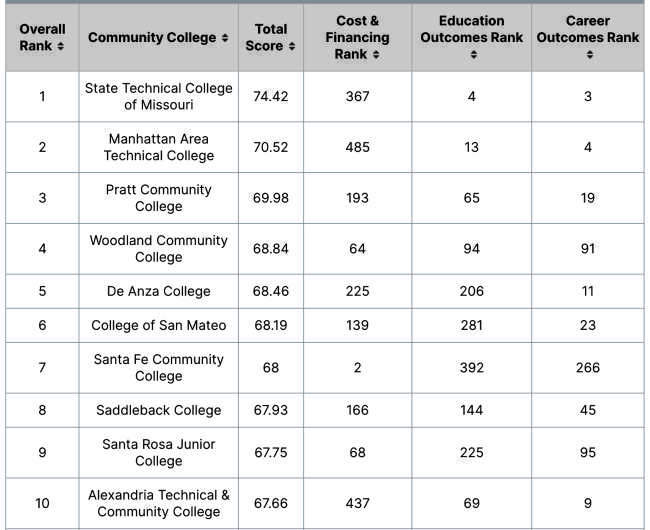
While California is among the most expensive states, Woodland Community College is ranked more affordable than over 80% of all community colleges analysed in the study.
Typically, the college charges residents a state-mandated enrollment fee of $46 per unit, plus a $10 student health fee except for high school dual enrolled students. For nonresidents or foreign students, it would be $365 per unit.
Various financial aid programs are available to help students in need pay for school.
“Many students wind up paying no tuition, because almost every student is eligible for financial aid or for the Cal Grant,” Ebenhack told Lake County News in a late-2024 phone interview. “If they qualify for a support program like EOP [Education Opportunity Program], they get extra funding so they can get books paid for.”
In the school year 2024-25, the total amount of financial aid disbursed is reported to be $7,569,048, with over $5.5 million coming from grants. Some 567 degrees and 415 certificates are awarded, with 208 degrees for transfer for the school year.
The school now has a 7,655-student headcount with an average age of 23. Among all students, 2,278 are high school students, and 2,540 are full-time equivalent students.
The student body consists mostly of minority ethnicities: 52% Latinx, 23% White, 11% Asian and 3% Black.
Woodland offers programs and credentials across five fields of study: arts, communication and culture; business, hospitality and entrepreneurship; natural resources and the environment; social justice and public service; and science and technology.
Find out more about the college at their official website.
Email staff reporter Lingzi Chen at