How to resolve AdBlock issue?
Refresh this page
How to resolve AdBlock issue?
Refresh this page
Lake County News,California
  • Home
    • Registration Form
  • News
    • Community
      • Obituaries
      • Letters
      • Commentary
    • Education
    • Veterans
    • Police Logs
    • Business
    • Recreation
    • Health
    • Religion
    • Legals
    • Arts & Life
    • Regional
  • Calendar
  • Contact us
    • FAQs
    • Phones, E-Mail
    • Subscribe
  • Advertise Here
  • Login

Space News: Radioisotope generators − inside the ‘nuclear batteries’ that power faraway spacecraft


Voyager 1, shown in this illustration, has operated for decades thanks to a radioisotope power system. NASA via AP

Powering spacecraft with solar energy may not seem like a challenge, given how intense the Sun’s light can feel on Earth. Spacecraft near the Earth use large solar panels to harness the Sun for the electricity needed to run their communications systems and science instruments.

However, the farther into space you go, the weaker the Sun’s light becomes and the less useful it is for powering systems with solar panels. Even in the inner solar system, spacecraft such as lunar or Mars rovers need alternative power sources.

As an astrophysicist and professor of physics, I teach a senior-level aerospace engineering course on the space environment. One of the key lessons I emphasize to my students is just how unforgiving space can be. In this extreme environment where spacecraft must withstand intense solar flares, radiation and temperature swings from hundreds of degrees below zero to hundreds of degrees above zero, engineers have developed innovative solutions to power some of the most remote and isolated space missions.

So how do engineers power missions in the outer reaches of our solar system and beyond? The solution is technology developed in the 1960s based on scientific principles discovered two centuries ago: radioisotope thermoelectric generators, or RTGs.

RTGs are essentially nuclear-powered batteries. But unlike the AAA batteries in your TV remote, RTGs can provide power for decades while hundreds of millions to billions of miles from Earth.

Nuclear power

Radioisotope thermoelectric generators do not rely on chemical reactions like the batteries in your phone. Instead, they rely on the radioactive decay of elements to produce heat and eventually electricity. While this concept sounds similar to that of a nuclear power plant, RTGs work on a different principle.

Most RTGs are built using plutonium-238 as their source of energy, which is not usable for nuclear power plants since it does not sustain fission reactions. Instead, plutonium-238 is an unstable element that will undergo radioactive decay.

Radioactive decay, or nuclear decay, happens when an unstable atomic nucleus spontaneously and randomly emits particles and energy to reach a more stable configuration. This process often causes the element to change into another element, since the nucleus can lose protons.

A graphic showing a larger atom losing a particle made of two protons and two neutrons and transforming into a smaller atom.
Plutonium-238 decays into uranium-234 and emits an alpha particle, made of two protons and two neutrons. NASA

When plutonium-238 decays, it emits alpha particles, which consist of two protons and two neutrons. When the plutonium-238, which starts with 94 protons, releases an alpha particle, it loses two protons and turns into uranium-234, which has 92 protons.

These alpha particles interact with and transfer energy into the material surrounding the plutonium, which heats up that material. The radioactive decay of plutonium-238 releases enough energy that it can glow red from its own heat, and it is this powerful heat that is the energy source to power an RTG.
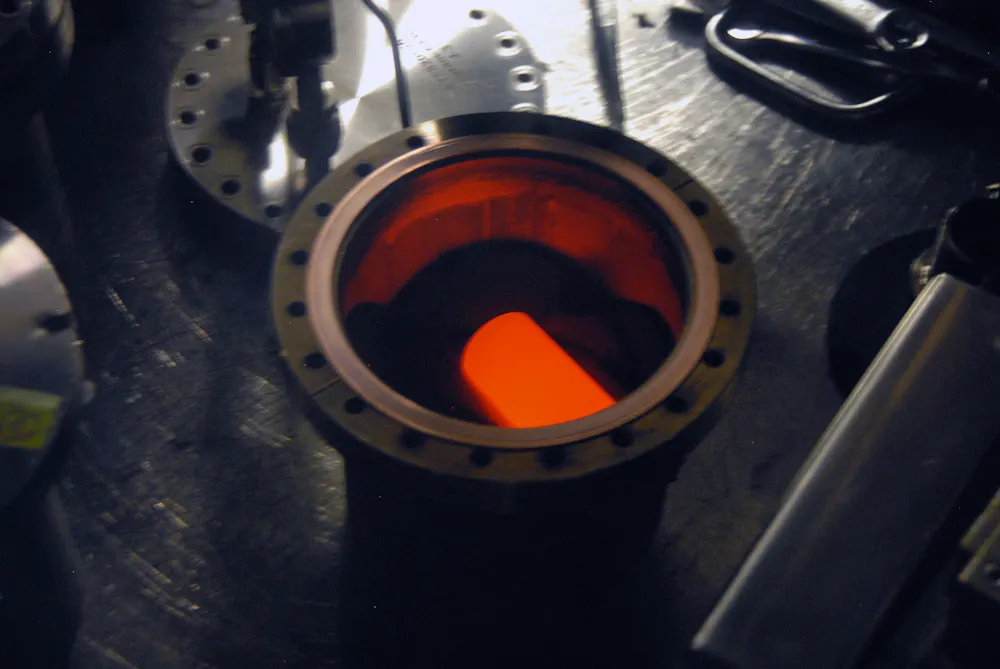
A circular metal container with a glowing cylinder inside.
The nuclear heat source for the Mars Curiosity rover is encased in a graphite shell. The fuel glows red hot because of the radioactive decay of plutonium-238. Idaho National Laboratory, CC BY

Heat as power

Radioisotope thermoelectric generators can turn heat into electricity using a principle called the Seebeck effect, discovered by German scientist Thomas Seebeck in 1821. As an added benefit, the heat from some types of RTGs can help keep electronics and the other components of a deep-space mission warm and working well.

In its basic form, the Seebeck effect describes how two wires of different conducting materials joined in a loop produce a current in that loop when exposed to a temperature difference.

The Seeback effect is the principle behind RTGs.

Devices that use this principle are called thermoelectric couples, or thermocouples. These thermocouples allow RTGs to produce electricity from the difference in temperature created by the heat of plutonium-238 decay and the frigid cold of space.

Radioisotope thermoelectric generator design

In a basic radioisotope thermoelectric generator, you have a container of plutonium-238, stored in the form of plutonium-dioxide, often in a solid ceramic state that provides extra safety in the event of an accident. The plutonium material is surrounded by a protective layer of foil insulation to which a large array of thermocouples is attached. The whole assembly is inside a protective aluminum casing.

A piece of machinery, which looks like a metal cylinder with fan-like structures outside it.
An RTG has decaying material in its core, which generates heat that it converts to electricity. U.S. Department of Energy

The interior of the RTG and one side of the thermocouples is kept hot – close to 1,000 degrees Fahrenheit (538 degrees Celsius) – while the outside of the RTG and the other side of the thermocouples are exposed to space. This outside, space-facing layer can be as cold as a few hundred degrees Fahrenheit below zero.

This strong temperature difference allows an RTG to turn the heat from radioactive decay into electricity. That electricity powers all kinds of spacecraft, from communications systems to science instruments to rovers on Mars, including five current NASA missions.

But don’t get too excited about buying an RTG for your house. With the current technology, they can produce only a few hundred watts of power. That may be enough to power a standard laptop, but not enough to play video games with a powerful GPU.

For deep-space missions, however, those couple hundred watts are more than enough.

The real benefit of RTGs is their ability to provide predictable, consistent power. The radioactive decay of plutonium is constant – every second of every day for decades. Over the course of about 90 years, only half the plutonium in an RTG will have decayed away. An RTG requires no moving parts to generate electricity, which makes them much less likely to break down or stop working.

Additionally, they have an excellent safety record, and they’re designed to survive their normal use and also be safe in the event of an accident.

RTGs in action

RTGs have been key to the success of many of NASA’s solar system and deep-space missions. The Mars Curiosity and Perseverance rovers and the New Horizons spacecraft that visited Pluto in 2015 have all used RTGs. New Horizons is traveling out of the solar system, where its RTGs will provide power where solar panels could not.

However, no missions capture the power of RTGs quite like the Voyager missions. NASA launched the twin spacecraft Voyager 1 and Voyager 2 in 1977 to take a tour of the outer solar system and then journey beyond it.

A diagram of a Voyager probe, with its parts labeled and a cylinder broken into three parts coming off its side labeled 'RTGs'.
The RTGs on the Voyager probes have allowed the spacecraft to stay powered up while they collect data. NASA/JPL-Caltech

Each craft was equipped with three RTGs, providing a total of 470 watts of power at launch. It has been almost 50 years since the launch of the Voyager probes, and both are still active science missions, collecting and sending data back to Earth.

Voyager 1 and Voyager 2 are about 15.5 billion miles and 13 billion miles (nearly 25 billion kilometers and 21 billion kilometers) from the Earth, respectively, making them the most distant human-made objects ever. Even at these extreme distances, their RTGs are still providing them consistent power.

These spacecraft are a testament to the ingenuity of the engineers who first designed RTGs in the early 1960s.The Conversation

Benjamin Roulston, Assistant Professor of Physics, Clarkson University

This article is republished from The Conversation under a Creative Commons license. Read the original article.
Details
Written by: Benjamin Roulston, Clarkson University
Published: 15 March 2025

Mental competency issues raised for man charged in February forcible rape case

LAKE COUNTY, Calif. — A man arrested last month after two break-ins, assaults and an attempted sexual assault is facing numerous charges, but his mental competency to stand trial has been questioned.

Markel David Plummer, 36, is facing 13 counts — eight felonies and five misdemeanors — for the forcible rape case, which involves two separate incidents hours apart, one in which he assaulted a woman and the second involving a commercial break-in, for which he was arrested on Feb. 28.

Early that day, he entered a woman’s apartment on North Main Street through an unlocked door. The victim awakened to find him in her home and he assaulted her, with authorities concluding he was planning to sexually assault her.

The woman fought back and Plummer fled. Hours later, he was found inside a business in the 1100 block of North Main Street. There, he assaulted the employee and again attempted to flee the scene.

Lakeport Police officers responded to the scene and took Plummer into custody. He has remained in the Lake County Jail since his arrest. He is currently being held without bail.

The charges the District Attorney’s Office has filed against Plummer include felonies of first degree burglary with the intent to commit a sex crime such as rape, sodomy and oral copulation; assault with the intent to commit a sex crime; sexual battery while the victim is restrained; entering an inhabited dwelling with the intent to commit a felony; unlawful entry of a commercial building with intent to commit larceny and any felony; unlawful maliciously destroying a lap top computer; and two counts of threatening an executive officer.

Misdemeanors include sexual battery, unlawful entry to an apartment, assault and battery, prowling and giving false identification to a law enforcement officer.

There also is a special allegation relating to the victim’s vulnerability, Plummer’s violence, previous convictions and a prior prison term, as well as the fact that he was on post-release community supervision and his previous performance on probation or supervision was unsatisfactory.

Senior Deputy District Attorney Rachel Abelson is handling the prosecution.

Abelson told Lake County News that Plummer is on post-release community supervision — a type of supervision used for someone released from state prison to the jurisdiction of a county agency — on two felony convictions out of San Francisco County.

The first of the cases, for which he was convicted in July 2019, is for assault by means likely to produce great bodily injury, while the second conviction, from September 2021, is for false imprisonment.

Plummer entered a not guilty plea on March 4.

He was due to appear in court for preliminary hearing on Wednesday, but Abelson said a doubt was declared that day regarding Plummer’s competency to stand trial.

That competency issue appears in court records to have been raised by the Lake County Public Defender’s Office, which is representing Plummer.

“We handle the hearings on competency in Department 4 as part of the mental health court,” Abelson said.

Court records indicate a doctor’s report on Plummer’s mental competency is expected on April 8.

Email Elizabeth Larson at This email address is being protected from spambots. You need JavaScript enabled to view it.. Follow her on Twitter, @ERLarson, and on Bluesky, @erlarson.bsky.social. Find Lake County News on the following platforms: Facebook, @LakeCoNews; X, @LakeCoNews; Threads, @lakeconews, and on Bluesky, @lakeconews.bsky.social.
Details
Written by: Elizabeth Larson
Published: 14 March 2025

Lake County Sheriff’s Office, Office of Emergency Services urge caution during winter storms

LAKE COUNTY, Calif. — With an incoming winter storm expected to bring snow and more rain on Friday, county officials are urging community members to use care and caution in response to the weather conditions.

The Lake County Sheriff’s Office and Lake County Office of Emergency Services reported that the National Weather Service in Eureka has issued a Winter Weather Advisory and Winter
Storm Watch for Lake County.

Local agencies urge residents and travelers to prepare for hazardous road conditions and exercise extreme caution.

The advisory is in effect from 2 and 11 a.m. Friday.

Forecasters expect snow levels to drop to 1,500 feet overnight with 1 to 4 inches of accumulation possible. For areas over 3,000 feet, snowfall could total up to 7 inches.

Also in the forecast are wind gusts up to 35 miles per hour, along with rain and continued higher elevation snow through Sunday.

Drivers are urged to expect icy roads, reduced visibility, downed trees and power lines that may cause travel hazards.

Officials urge people to avoid non-essential travel in affected areas; to expect slippery roads, and slow down and use caution, especially at night; carry chains if traveling at higher elevations; prepare for road closures or delays; and report emergencies, including road hazards or stranded motorists, by dialing 911.

County agencies are monitoring the weather and prepared to respond. Conditions are expected to improve by Monday.

For real-time updates, follow these sites:

• Highway conditions: Caltrans QuickMap
• County Road Conditions: Genasys Protect
• Emergency alerts, preparedness, weather and other information: Ready.LakeCountyCA.gov
Details
Written by: LAKE COUNTY NEWS REPORTS
Published: 14 March 2025

Citizen Science Program needs your help observing the weather


LAKE COUNTY, Calif. — Do you ever wonder how much rainfall you received from a recent thunderstorm? How about snowfall during a winter storm?

If so, you can help an important volunteer weather observing program.

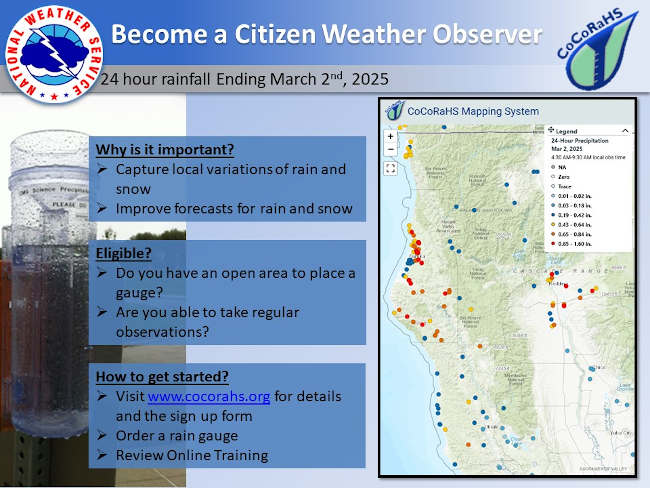
The Community Collaborative Rain, Hail, and Snow network, or CoCoRaHS, is looking for new volunteers across northwest California.

This grassroots effort is part of a growing national network of home-based and amateur rain spotters with a goal of providing a high density precipitation network that will supplement existing observations.

CoCoRaHS came about as a result of a devastating flash flood that hit Fort Collins, Colorado, in July 1997. A local severe thunderstorm dumped over a foot of rain in several hours while other portions of the city had only modest rainfall. The ensuing flood caught many by surprise and caused $200 million in damages.

CoCoRaHS was born in 1998 with the intent of doing a better job of mapping and reporting intense storms. As more volunteers participated, rain, hail and snow maps were produced for every storm showing fascinating local patterns that were of great interest to scientists and the public.

Recently, drought reporting has also become an important observation within the CoCoRaHS program across the nation. In fact, drought observations from CoCoRaHS are now being included in the National Integrated Drought Information System.

How does one become a CoCoRaHS observer? Go to the CoCoRaHS website and click on the “Join CoCoRaHS” emblem on the upper right side of the main website.

After registering, take the simple online training, order your 4 inch rain gauge and start reporting.

To obtain a rain gauge, volunteers can order through the CoCoRaHS website for $42 plus shipping. They have a limited number of rain gauges to give out if you are able to be a regular observer and there is a limited number of observers currently in your area. Apply with this form.

Observations are available on maps and reports for the public to view within five minutes of submitting them.

The process takes only five minutes a day, but the impact to the community is tenfold: By providing high quality, accurate measurements, the observers are able to supplement existing networks and provide useful results to scientists, resource managers, decision makers and other users.

The CoCoRaHS program also has an extensive list of short YouTube videos at www.youtube.com/user/cocorahs. 

If you have any questions, feel free to email Matthew Kidwell at the NWS in Eureka at This email address is being protected from spambots. You need JavaScript enabled to view it. or call at 707-443-6484.
Details
Written by: National Weather Service
Published: 14 March 2025
  • 339
  • 340
  • 341
  • 342
  • 343
  • 344
  • 345
  • 346
  • 347
  • 348

Public Safety

  • Lakeport Police Department celebrates long-awaited new headquarters

  • Lakeport Police Department investigates flag vandalism cases

  • Lakeport Police Department thanks Kathy Fowler Chevrolet for donation

Community

  • Hidden Valley Lake Garden Club installs new officers

  • 'America's Top Teens' searching for talent

  • 'The Goodness of Sea Vegetables' featured topic of March 5 co-op talk

Community & Business

  • Annual 'Adelante Jovenes' event introduces students, parents to college opportunities

  • Gas prices are dropping just in time for the holiday travel season

  • Lake County Association of Realtors installs new board and presents awards

  • Local businesses support travel show

  • Preschool families harvest pumpkins

  • Preschool students earn their wings

How to resolve AdBlock issue?
Refresh this page