How to resolve AdBlock issue?
Refresh this page
How to resolve AdBlock issue?
Refresh this page
Lake County News,California
  • Home
    • Registration Form
  • News
    • Community
      • Obituaries
      • Letters
      • Commentary
    • Education
    • Veterans
    • Police Logs
    • Business
    • Recreation
    • Health
    • Religion
    • Legals
    • Arts & Life
    • Regional
  • Calendar
  • Contact us
    • FAQs
    • Phones, E-Mail
    • Subscribe
  • Advertise Here
  • Login

Clearlake crime drops in 2024, traffic collisions down

CLEARLAKE, Calif. — New police data shows an overall drop in crime in Clearlake in 2024 and the number of traffic collisions falling to their lowest number since 2016.

Clearlake Police Chief Timothy Hobbs presented police statistics for 2024 at the Clearlake City Council meeting on Thursday.

The data shows less crime and fewer traffic collisions in Clearlake. At the same time, police made fewer traffic stops but issued more traffic citations.

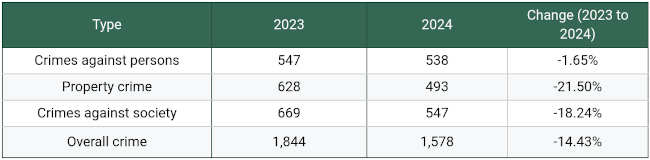
In 2024, Clearlake recorded a total of 1,578 crime incidents, a 14.43% decrease from 1,844 in 2023. While crimes against persons decreased only slightly, property crime dropped by 21.5%.

Hobbs also reported positive traffic statistics.

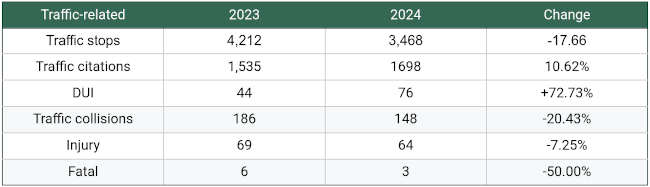
Traffic citations increased by more than 10%, totaling 1,698 cases. However, traffic collisions decreased by 20.43%, from 186 incidents in 2023 to 148 in 2024. Fatal collisions also declined, from six in 2023 to three in 2024.

“The overall traffic collision number is pretty significant. The last time we had that few traffic collisions was in 2016,” Hobbs said during his presentation.

“Hopefully next year they'll remain at this level, or hopefully even get lower,” he added.

“You guys have been doing a great job this year. Crime statistics are down. That's always good,” Clearlake Mayor Russ Cremer commented.

Mayor Russell Cremer said he sees police cars all over the city “to catch unsuspecting drivers like me. Fortunately, they haven't,” Cremer joked, prompting a chuckle from Hobbs.

In a more detailed report Hobbs provided to Lake County News, Clearlake police made 3,468 traffic stops throughout 2024, a 17.66% drop compared to 4,212 in 2023.

Hobbs also reported 34 incidents of use of force in 2024, including 30 incidents that involved the use of physical force and four cases of Taser use. Similar to 2023, none of the cases was required to be reported to the California Department of Justice, according to Hobbs.

In almost every data set Hobbes discussed, he made comparisons between 2023 and 2024, remarking the percentage of change between the two years. However, statistics prior to 2023 were not available.

Chief Hobbs said the department used another reporting system before 2023.

“You can’t look at the numbers and get a comparison because it’s a different reporting system,” he told Lake County News during a phone call, explaining why only two years of data were compared.

Apart from crime and traffic, code enforcement cases declined sharply in property and vegetation cases, while administrative citations were up.

“We were short one code enforcement person about 10 months of the year,” Hobbs said of an officer who was moved to another department as part of explaining the reasons behind the numbers.

He added that for each of the cases, code enforcement officers took more time to do “more focused work on trying to solve and clear up some of these properties versus kind of just targeting places all across the city and not putting that time in work.”

In addition, the Clearlake Police Department made nine new hires in 2024.

“The council has done a lot for the police department in the city as a whole over the last several years, and with that help, we've been able to get a lot more staff hired, and especially retain the staff,” Hobbs said.

Lake County News has put together five most important data sets, drawing data Hobbs provided during and after the council meeting.

To note, the data sets display “change” in percentage from 2023 to 2024. A plus sign marks an increase in value while a minus sign indicates a decrease.

General police statistics

While the number of incidents stayed relatively consistent with the previous year, Clearlake police made 1,830 arrests in 2024 — a 13.6% decrease from 2,118 in 2023.

In 2024, officer-initiated incidents declined whereas calls for service became more frequent.


Response time

The police response time measures the time used from the moment the call comes in till the moment the officer arrives at the scene, according to Hobbs.

In 2024, Clearlake police were 36 seconds quicker in responding to Priority 1 calls, which means “emergency calls that require officers to go to immediately,” Hobbs said.


Crime

Hobbs said Clearlake has been using the National Incident-based Reporting System, or NIBRS, for crime reporting since 2023, which categorizes crimes into three broad groups:

• Crimes against persons, including assault, homicide, human trafficking, kidnapping, and sex offenses;
• Crimes against property, such as arson, bribery, burglary, vandalism, and embezzlement;
• Crimes against society, including animal cruelty, drug offenses, and gambling violations.

While property crimes and crimes against society saw significant drops of 21.5% and 18.24%, respectively, crimes against persons remained relatively unchanged from the previous year.


Traffic-related

In 2024, Clearlake police made fewer traffic stops but issued more citations. In the meantime, fewer collisions occurred, especially fatal ones.

Apart from all the improvement, drive-under-influence offences, or DUI offences, surged by 72.73% from 44 in 2023 to 76 in 2024.


Code enforcement

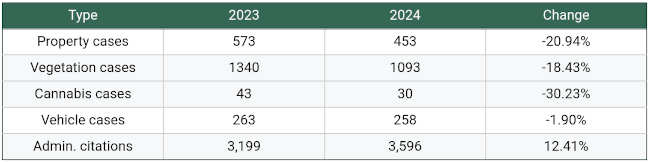
Code enforcement cases dropped across all types but administrative citations grew.

The biggest changes took place in property and cannabis cases, which declined by 20.94% and 30.23% respectively. Citations grew from 3,199 cases in 2023 to 3,596 in 2024, an increase by 12.41%.


Email staff reporter Lingzi Chen at This email address is being protected from spambots. You need JavaScript enabled to view it.. 
Details
Written by: LINGZI CHEN
Published: 25 February 2025

State releases new online tool to measure local progress in tackling homelessness

As part of the state’s ongoing efforts to address the national homelessness crisis, Gov. Gavin Newsom on Monday announced strong accountability measures for local jurisdictions to demonstrate results to continue receiving state homelessness funding.

Gov. Newsom is also launching a new online tool, accountability.ca.gov, which brings together thousands of locally reported data points to provide a clear picture of local communities’ work on California’s most pressing issues, including homelessness, housing, and behavioral health.

“No one in our nation should be without a place to call home. As we continue to support our communities in addressing homelessness, we expect fast results, not excuses. While we are pleased by the progress many communities have made to address the homelessness crisis, there is more work to do,” said Newsom.

Newsom announced additional accountability measures for communities that receive state funding. The announcement comes alongside new Homeless Housing, Assistance and Prevention, or HHAP, funding to support local homelessness efforts, tied to performance benchmarks and the ability for the state to withhold funding allocations if local communities do not make progress.

The funding also comes with flexibility for communities that need to modify their plans in the case of natural disasters, such as the recent Los Angeles area firestorms.

Communities that receive awards through the newest round of HHAP funding must adhere to increased accountability, transparency, and compliance measures. These include an increased focus on resolving encampments, requirements that recipients have a compliant housing element to obtain future funding, and requirements that grantees obligate and expend past awards before receiving new funds. These strengthened measures will better ensure real, measurable results and will improve the tracking of data and outcomes.

As part of the proposed 2025-2026 budget, the governor has called for even stronger accountability measures as a condition on any additional state funding, including requirements that grantees have and maintain a compliant housing element, prioritization for communities designated as “pro-housing,” and mechanisms to claw back funding from local governments that fail to demonstrate progress.

Dashboard shows how communities are doing

Monday’s announcement comes alongside the debut of a new online tool accountability.ca.gov, which brings together thousands of locally reported data points to provide an accurate picture of local communities’ work to address homelessness, create housing, and create behavioral health supports.

The new accountability tool will allow Californians to quickly and clearly assess the progress being made by their local governments on these pressing issues, and learn more about the process and funding provided to communities by the state.

In the case of Lake County, the dashboard shows it as having the second-highest increase statewide in unsheltered individuals, at 68%. Based on the available data, San Joaquin had the highest increase, with 156% increase. Fifteen counties did not provide new data on their unsheltered populations.

Lake County created a total of 123 housing units between 2019 and 2023. There are 10 counties, all in rural Northern California, that created fewer units, the smallest being Modoc, with five.

The dashboard also showed 35 people in Lake County being in full-service partnerships with Behavioral Health.

Lake’s neighboring counties reported the following statistics:

• Colusa: 95 housing units created; unsheltered down 28.3%.
• Glenn: 118 housing units created; unsheltered down 28.3%.
• Mendocino: 780 housing units created; unsheltered up 34.6%.
• Napa County: 718 housing units created; unsheltered down 41.8%.
• Sonoma County: 6,364 housing units created; unsheltered up 22.2%.
• Yolo County: 1,541 housing units created; unsheltered up 67.5%.

State is slowing growth of homelessness

As states throughout the nation continue to see ever-higher increases in homeless populations, Newsom’s office reported that California has dramatically slowed the growth in homelessness and reduced the number of veterans and youth experiencing homelessness — more than any other state.

Homelessness continues to increase nationwide, increasing in 2024 by more than 18%, but California is bucking the national trend by holding the statewide increase to 3%. This is a lower rate than in 40 other states.

California is also one of the few states that have dramatically blunted the increases in unsheltered homelessness, holding it to 0.45%. By comparison, in 2024, nationwide unsheltered homelessness grew by nearly 7%. Unsheltered homelessness growth in other large population states like Illinois, Florida, New York, and Texas surpassed California’s in terms of percentage and number.

Newsom’s administration reported that it is making significant progress in reversing decades of inaction on homelessness.

Between 2014 and 2019, unsheltered homelessness in California increased by approximately 37,000 people — more than double the increase seen during the Newsom Administration.
Details
Written by: LAKE COUNTY NEWS REPORTS
Published: 25 February 2025

New state legislative bill package includes focus on tribal issues

A new legislative package in the California Legislature includes several bills focusing on tribal issues.

The package is being put forward by Assemblymember James C. Ramos (D-San Bernardino), the first and only California Native American serving in the state’s legislature.

Some of the key bills in Ramo’s package focus on confronting the Missing and Murdered Indigenous People crisis and “furthering acceptance and knowledge of state tribes,” Ramos said.

The bills in the package focusing on tribal issues are as follows.

AB 31 (Tribal Peace Officer Status) authorizes the state Department of Justice to grant tribal police from three California tribes state peace officer status if they meet the same California requirements and standards as other police officers in the state. Enactment of AB 31 would assist all law enforcement by clarifying jurisdiction and permitting tribal police to assist communities close to reservations. The bill would also allow participating tribes to enter into agreements to share liability and collaborate on MMIP cases. Sponsor: Yurok Tribe. Referred to the Assembly Committee on Public Safety.

AB 221 (Tribal Nation Grant Fund) would streamline the existing Tribal Nation Grant Fund process to provide annual equal distribution grants, upon application, to all federally recognized tribes that either have no gaming or operate less than 350 Class III gaming devices. Federally recognized Indian tribes pay for the grant funds that exclusively benefit eligible federally recognized nongaming and limited gaming tribes. Sponsors: California Nations Indian Gaming Association and Tribal Alliance of Sovereign Nations. Referred to the Assembly Committee on Governmental Organization.

AB 362 (Shingle Springs Water) would add tribal water uses as a beneficial use of water in the state. AB 362 would also require the State Water Quality Control Board or a regional water quality control to describe, with both quantitative and qualitative information, how the project or regulatory program will impact tribal water uses. Sponsor: Shingle Springs Band of Miwok Indians. Not yet referred to a policy committee.

AB 977 (California State University Burial Sites) would require the California State University, or CSU, system, in consultation with Native American tribes to develop a policy to identify available CSU-owned land for the burial of Native American human remains and establish three tribal burial sites — one in the Northern, Central and Southern regions of the state. Sponsor: Tachi Yokut Tribe. Not yet referred to committee.

AB 989 (Native American Day State Holiday) would make the state Native American Day holiday — the fourth Friday in September — a paid holiday for state employees. Not yet referred to committee.

AB 1369 (Tribal Regalia at High School Graduations) would add clarification to students’ right to wear traditional tribal regalia as determined by the pupil and the pupil’s family at high school graduations. AB 1369 also reaffirms that a local educational agency cannot require a preapproval process to exercise this right or demand that the student wear a cap if the adornment is incompatible with the adornment. Sponsor: California Indian Legal Services. Bill not yet referred to committee.
Details
Written by: LAKE COUNTY NEWS REPORTS
Published: 25 February 2025

CDC layoffs strike deeply at its ability to respond to the current flu, norovirus and measles outbreaks and other public health emergencies


The CDC played an instrumental, if imperfect, role in the response to COVID-19. JHDT Stock Images LLC/iStock via Getty Images

In just a few short weeks, the Trump administration has brought drastic changes to the Centers for Disease Control and Prevention and public health. Beginning with the removal of websites and key public health datasets in January 2025, the Trump administration has taken actions to dismantle established public health infrastructure as part of its second-term agenda.

In addition, the administration has begun a widespread purge of the federal public health workforce. As of Feb. 19, around 5,200 employees at the CDC and the National Institutes of Health had been let go. About 10% of the CDC’s staff have been removed, with plans for additional firings.

As a teaching professor and public health educator, I, like thousands of other health professionals, rely on CDC data and educational resources throughout my work. CDC websites are the first stop for health information for my students and for health care practitioners, and are vital to protecting the U.S. from infectious diseases, like avian flu and COVID-19, as well as noninfectious health conditions, such as diabetes and heart disease.

Here’s a quick look at what the CDC does to protect Americans’ health, and how it’s likely to be affected by the Trump administration’s actions:

Gutting the CDC’s capacity

Prior to the February cuts, the CDC employed over 10,000 full-time staff in roles spanning public health, epidemiology, medicine, communications, engineering and beyond to maintain this critical public health infrastructure.

In addition to the centers’ wide variety of functions to protect and promote public health in the U.S., a vast amount of research in the U.S. relies on CDC data. The CDC obtains data from all 50 states, territories and the District of Columbia, which is collated into widely utilized databases such as the National Health and Nutrition Examination Survey, National Health Interview Survey and Behavioral Risk Factor Surveillance System.

Several of these datasets and CDC websites were removed at the start of the second Trump term, and while they are currently back online due to a federal court order, it remains to be seen if these important sources of information will remain accessible and updated going forward.

The CDC also publishes the Morbidity and Mortality Weekly Report, which allows for ongoing and timely surveillance of key health conditions. The reports cover a wide range of topics, including wildfires, motor vehicle accidents, autism, asthma, opioids, mental health and many others. The CDC plays a central role in monitoring and reporting the spread of flu in winter months through its FluView, which informs clinical practice as well as public health interventions.

Physicians are reporting that their ability to respond to the surges in respiratory viruses they are seeing has been hobbled by the missing data and by prohibitions on CDC staff communicating outside the agency.

The CDC’s famed “disease detectives,” part of the Epidemic Intelligence Service, appear to have been spared following public outcry after more than half of its members were initially told they would be let go as part of the Feb. 14 mass layoffs.

It remains to be seen if this group will remain intact long term. Concerns are growing that shakeups to the nation’s infectious disease surveillance teams will hamper the government’s ability to respond effectively at a time when avian flu and measles are growing concerns in the U.S.

A photo of the CDC headquarters.
The CDC’s headquarters are in Atlanta. Nathan Posner/Anadolu Agency via Getty Images

History of the CDC

The CDC began as a small branch of the U.S. Public Health Service in 1946 as an outgrowth of successes fighting malaria in southern states during World War II and before. Its founder, Dr. Joseph W. Mountin, envisioned that it would come to serve all states, addressing all communicable diseases. Since that time, the CDC has evolved into the nation’s premier public health organization, leveraging both clinical and population health sciences to prevent and mitigate challenges to the nation’s health.

In its first 40 years, the CDC helped eradicate smallpox and identify the causes of Legionnaires’ disease, toxic shock syndrome and HIV.

As the country’s primary health challenges have shifted from communicable diseases to noncommunicable ones over recent decades, the organization has adapted, expanding its reach and priorities to meet changing public health needs. The CDC also has the ability to flex and scale up efforts rapidly when needed to respond to novel outbreaks, which is essential for containing infectious diseases and preventing escalation.

CDC’s global reach

Recognizing that health does not exist in a vacuum, the CDC also operates internationally to mitigate health challenges that could threaten health in the U.S. over time. The agency is active in addressing diseases that are endemic in certain areas, such as tuberculosis and HIV. It also responds to outbreaks from emerging threats, like Ebola and Marburg virus disease.

The CDC played a crucial role in responding to the COVID-19 pandemic, coordinating with the World Health Organization, domestic health agencies and others to plan and execute a robust response.

In 2024, the CDC worked with the WHO to respond to a Marburg virus outbreak in Rwanda that lasted for several months. On average, about half of people infected with Marburg virus do not survive, so early detection and effective response are essential to prevent loss of life and contain outbreaks before they spread widely.

On Jan. 20, 2025, the White House announced President Donald Trump’s plans to withdraw from the WHO. This move further weakens the country’s ability to manage and mitigate threats to Americans’ health and national security.

Not only does the WHO do essential work to protect children around the world from needless death due to starvation, but it monitors and responds to infectious diseases. The U.S. has been the largest contributor to the WHO, with approximately 12%-15% of its operating costs coming from the U.S. That means that removal of U.S. support will also affect the WHO’s capacity to respond to international public health issues.

As the COVID-19 pandemic made plain, a delayed response to infectious disease outbreaks can exponentially increase long-term costs and consequences. It remains to be seen what impact the established relationships between the CDC and the WHO will have on their ability to coordinate effectively during times of crisis.

The CDC’s work around the world helps to stop outbreaks before they spread – and reach the U.S.

Future health care workforce threatened

The reach, flexibility, adaptability and robust foundation of relationships developed over the past eight decades enable the CDC to respond to threats quickly, wherever in the world they arise. This is important for protecting health, and it plays a vital role in global and national security as well.

In addition to its direct actions to promote public health, the CDC provides workforce development and training to help create an enduring public health infrastructure in the U.S. and abroad. This is more important than ever, as systemic factors have placed pressure on health professionals. The domestic public health workforce has shrunk drastically, losing 40,000 workers since the start of the Great Recession in 2009 due to economic constraints and social pressures during the pandemic. The CDC’s workforce development efforts help counteract these trends.

Public health workers were reporting high rates of burnout and stress even before the COVID-19 pandemic, which the pandemic worsened. Cuts to the federal workforce, as well as funding for public health programs, will no doubt add to these strains.The Conversation

Jordan Miller, Teaching Professor of Public Health, Arizona State University

This article is republished from The Conversation under a Creative Commons license. Read the original article.

Details
Written by: Jordan Miller, Arizona State University
Published: 25 February 2025
  • 357
  • 358
  • 359
  • 360
  • 361
  • 362
  • 363
  • 364
  • 365
  • 366

Public Safety

  • Lakeport Police Department celebrates long-awaited new headquarters

  • Lakeport Police Department investigates flag vandalism cases

  • Lakeport Police Department thanks Kathy Fowler Chevrolet for donation

Community

  • Hidden Valley Lake Garden Club installs new officers

  • 'America's Top Teens' searching for talent

  • 'The Goodness of Sea Vegetables' featured topic of March 5 co-op talk

Community & Business

  • Annual 'Adelante Jovenes' event introduces students, parents to college opportunities

  • Gas prices are dropping just in time for the holiday travel season

  • Lake County Association of Realtors installs new board and presents awards

  • Local businesses support travel show

  • Preschool families harvest pumpkins

  • Preschool students earn their wings

How to resolve AdBlock issue?
Refresh this page