How to resolve AdBlock issue?
Refresh this page
How to resolve AdBlock issue?
Refresh this page
Lake County News,California
  • Home
    • Registration Form
  • News
    • Community
      • Obituaries
      • Letters
      • Commentary
    • Education
    • Veterans
    • Police Logs
    • Business
    • Recreation
    • Health
    • Religion
    • Legals
    • Arts & Life
    • Regional
  • Calendar
  • Contact us
    • FAQs
    • Phones, E-Mail
    • Subscribe
  • Advertise Here
  • Login

Spring forecast expects a cooler start to the season, strong water storage

LAKE COUNTY, Calif. — As spring approaches, forecasters are expecting conditions across Northern California and Lake County that include a colder start to the season and decent water levels in lakes and reservoirs.

AccuWeather reported that meteorological spring starts on March 1, while astronomical spring begins during the March equinox at 5:01 a.m. Eastern Standard Time on March 20.

Forecasters said last month was the coldest January overall in the U.S. since 2011.

AccuWeather long-range experts say a colder start to spring is expected across the Pacific Northwest due to a persistent pattern of stormy weather which has brought rain and some high elevation snow to Lake County in recent weeks.

Paul Pastelok, senior meteorologist and lead long range forecaster for Accuweather, spoke to Lake County News about the local weather outlook.

Pastelok noted that Northern California had quite a bit of rain last year to start off the spring.

This year, February again has had a wet start, and Pastelok expects that there will be more weather systems grazing Northern California in March.

Those systems are expected to come south from the Pacific Northwest and bring near to average rainfall in March.

He noted that the state’s reservoirs are doing well for storage. “We’re slightly above average” in the major reservoirs’ levels, he said.

In Lake County, Clear Lake was just under 7.70 feet Rumsey, the special measure for the lake, early Thursday morning. The lake is full at 7.56 feet Rumsey gauge.

As is typical, later in the spring — in April and May — Pastelok anticipates a normal dropoff in rainfall. He said the May rainfall totals may be below average.

“We’re going to see this big area of higher pressure develop quite quickly” across the Southwest and expand northward, Pastelok said. That will cause a block to precipitation and not allow many significant weather systems to come in, leading to drier conditions.

Pastelok said the higher pressure starts to build quicker across the Four Corners and expands westward.

“People shouldn’t fear, we’re still good for water levels,” he said, explaining he doesn’t see it getting really warm, especially in late April or early May, but that there will be a gradual rise in temperatures.

He said there have been near average temperatures this year so far, and those may rise above average in May and June, but conditions are not expected to be severe.

When he did the long range forecast, he said he classified Northern California as having a “more typical transition” into spring, with that slow retreat from the northern storm track and a gradual drop off of precipitation.

Late spring isn’t expected to have major warming, but summer looks like it could be hotter, said Pastelok.

Regarding agriculture, Pastelok said there could be a chilly few days in late March, when forecasters are looking at frost potential in a worst case scenario.

He doesn’t see a lot of atmospheric river activity in the region later in the spring. There will be some weather systems in March but he doesn’t expect to see persistent heavy rain.

Weak La Niña in play

Forecasters said water temperatures in the equatorial Pacific Ocean play a major role in weather patterns around the world, as well as where storms track over the United States.

AccuWeather long-range experts say La Niña is currently underway. Water temperatures reached official La Niña status in late December.

“The La Niña pattern occurs when sea surface temperatures in the central and eastern Pacific Ocean drop to lower-than-average levels for an extended amount of time. This process is the exact opposite of El Niño, a phase in which sea surface temperatures rise to above-average levels,” AccuWeather reported.

La Niña, which translates to “little girl” in Spanish, and El Niño, which translates to “little boy” in Spanish, are two phases of a three-pronged natural climate pattern that occurs across a large portion of the tropical Pacific Ocean known as the El Niño-Southern Oscillation, or ENSO, according go to an AccuWeather report.

AccuWeather said ENSO's three phases are broken down into La Niña's cool phase, El Niño's warm phase and a phase that is neither warm nor cool, known as neutral.

Last week, the annual La Niña official statement came out forecasting a weak system for this year.

“It’s still a weak La Niña,” Pastelok said.

He added, “It never got strong anyway, which we didn’t expect.”

AccuWeather said meteorologists often refer to the effects of climate patterns using a concept known as teleconnections. Teleconnections are a series of factors, like sea surface temperatures, that can have implications on weather conditions in areas far from the origin of those factors.

La Niña can shift where the core of severe weather erupts over the U.S. during the spring, what part of the West Coast is the focal point of storms from the Pacific and what parts of the country have more cooldowns than dramatic warmups, AccuWeather said.

“We are looking at a weak La Niña setup as we go into the start of the spring season,” Pastelok explained. “Even if La Niña ends during the spring, there is a lag where it can have a continual influence on the atmosphere and the overall storm track across North America.”

Pastelok said water temperatures are slightly below average offshore which is keeping the region from getting really warm very quickly this spring.

He said La Niña may be neutral in the spring. “The La Niña always has a lag,” he said.

Looking at past La Niñas, Pastelok said they can cause lingering conditions. He expects conditions to remain active until early spring, then weaken.

Pastelok said there is a spring barrier time period when forecasts don’t do well with predicting El Niño and La Niña. Last year’s forecast showed that, when predictions of conditions did not come true until December.

How our warming climate is impacting the spring season

AccuWeather Senior Meteorologist and Climate Expert Brett Anderson said the overall trend for the spring season in the U.S. is getting warmer.

Climatological records show that average spring temperatures have increased roughly 2 degrees Fahrenheit across the contiguous U.S. since 1970, AccuWeather said.

“The AccuWeather 2025 U.S. Spring Forecast for the Southwest favors warmer and drier conditions compared to the historical average, which is in line with the longer-term spring trends that we are seeing for precipitation and average temperature. Many areas, especially across Arizona and New Mexico, are warming an average of 0.5 to 1 degree Fahrenheit per decade during the spring season,” Anderson explained. “Large portions of Southern California and Arizona are losing an average of 0.5 to 1.5 inches of precipitation per decade during the spring. There has also been a notable decrease in the frequency of spring river flooding across large portions of the Southwest during the spring season since the mid-1960s.”

AccuWeather said the overall trend of warmer spring seasons in the U.S. can mean an earlier and more intense seasonal allergy season, earlier mountain snowmelt, and a longer growing season for farmers and gardeners.

Warmer springs can also lead to more problems with pests like fleas, ticks and mosquitoes becoming active and reproducing earlier in the season. That also raises concerns about diseases like West Nile virus, which made an appearance in Lake County last year.

Email Elizabeth Larson at This email address is being protected from spambots. You need JavaScript enabled to view it.. Follow her on Twitter, @ERLarson, and on Bluesky, @erlarson.bsky.social. Find Lake County News on the following platforms: Facebook, @LakeCoNews; X, @LakeCoNews; Threads, @lakeconews, and on Bluesky, @lakeconews.bsky.social.
Details
Written by: Elizabeth Larson
Published: 27 February 2025

New U.S. Census Bureau and AmeriCorps research tracks virtual volunteering for first time


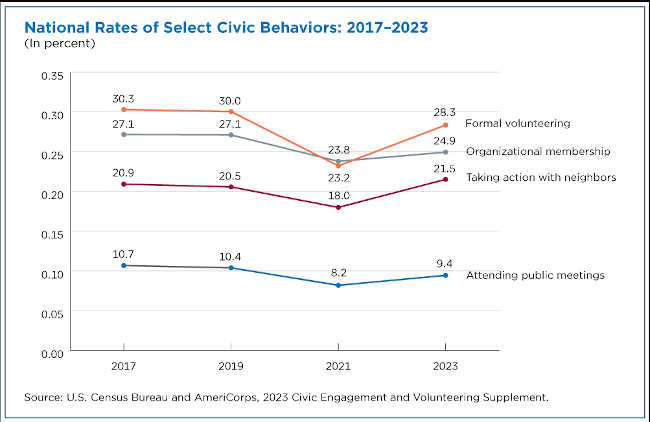
Over 75.7 million or 28.3% of the U.S. population age 16 and up formally volunteered through an organization between September 2022 and September 2023, approaching a return to pre-pandemic levels of volunteerism, according to joint research by the U.S. Census Bureau and AmeriCorps.

National rates of several other types of civic engagement similarly bounced back during that period, even surpassing pre-pandemic rates in some cases — a sign of renewed involvement in many aspects of civic life.

Although more Americans formally volunteered, the number of hours served per person has continued to decline.

Every two years, the Census Bureau partners with AmeriCorps to conduct a comprehensive survey of civic engagement across the United States and over time.

New data shows that formal volunteering is rebounding and informal helping is climbing.

Formal volunteering is helping others through organizations like food banks and other nonprofits. Informal helping includes activities like mowing a neighbor’s lawn or bringing them groceries.

According to AmeriCorps’ analysis of the Census Bureau’s Current Population Survey Civic Engagement and Volunteering Supplement (CEV) data collected in September 2023, formal volunteers served an estimated 4.99 billion hours and contributed over $167.2 billion in economic value between September 2022 and 2023.

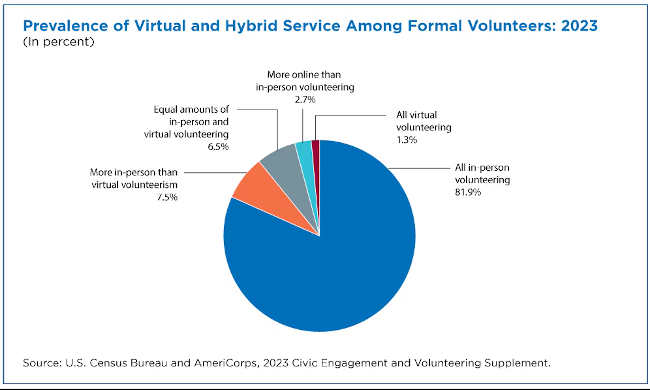
And for the first time, the survey is tracking virtual volunteering, which gained popularity during the pandemic. It shows that 18% of formal volunteers served completely or partially online.

An estimated 54.2% of Americans helped or exchanged favors with neighbors such as house sitting, running errands, or lending tools between September 2022 and 2023 compared to 51.7% in 2019.

Taking the pulse of our nation’s civic health

The Census Bureau has partnered with AmeriCorps to conduct the Current Population Survey Civic Engagement and Volunteering Supplement (CEV) biennially since 2017, with related supplements going back to 2002.

This collaboration has produced the nation’s most robust data about civic engagement, the constellation of activities individuals engage in to make a difference in their communities and promote the common good.

A growing body of work leverages the CEV to examine trends in civic engagement across the country and over time, provides insights into what drives civic health, and underscores the relationship between civic engagement and community well-being.

In September 2023, approximately 47,000 Americans age 16 and up answered CEV questions about their engagement with organizations, neighbors, politics, economic institutions, friends, family, and social issues.

The latest questionnaire also includes attitudinal measures of civic work introduced in 2021 and a first-of-its-kind measure of virtual volunteering launched in 2023, shedding light on the breadth and depth of contemporary volunteering and civic life in America.


Formal volunteering is rebounding

In many communities across the country, formal volunteering rates are rebounding from historic lows recorded during the COVID-19 pandemic.

The estimated 28.3% of Americans who reported volunteering through an organization in the previous year in the latest survey is up from 23.2% in 2021.

The 2023 national volunteering rate remains 1.7 percentage points below pre-pandemic levels but the 5.1 point jump over two years represents a growth rate of 22.1% — the largest expansion of formal volunteering since the Census Bureau and AmeriCorps began tracking it in 2002.

Although less pronounced, there were also rebounds in national rates of organizational membership, attending public meetings, and joining with neighbors to improve their community. Along with formal volunteering, these three measures of civic engagement experienced the largest relative declines of any in the CEV at the height of the pandemic.

Who is driving the increase in volunteerism?

Nationally, the largest relative gains in formal volunteering between 2021 and 2023 were among:

• Millennials (ages 27 to 42).
• People who identified as Asian, Native Hawaiian or Pacific Islander, or Hispanic.
• Those with less than a high school education.
• People with family incomes of less than $25,000.
• Rebounds in the formal volunteering rate were not equally distributed across states and the largest 12 metropolitan statistical areas (MSAs).

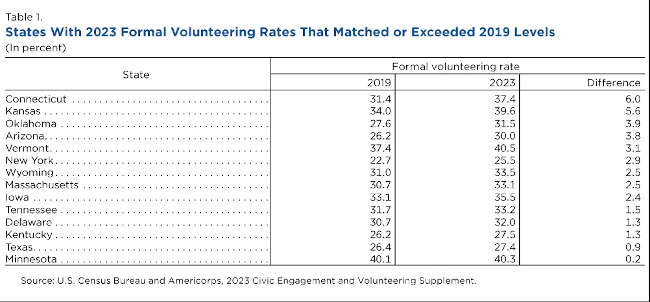
In 14 states and five of the largest 12 MSAs, rates of formal volunteering in the latest CEV data matched or exceeded 2019 levels.

In contrast, 2023 formal volunteering rates remained more than 5 percentage points below pre-pandemic levels in 11 states and the District of Columbia metropolitan area.

Although the share of Americans who formally volunteered through an organization rebounded since the pandemic officially ended, the latest data show ongoing declines in the amount of time each volunteer served.

Nationally, average hours served per volunteer in the previous year dropped from 96.5 hours when the CEV began in 2017 to 70 hours in 2023. Similarly, half of formal volunteers served 40 hours in 2017 compared to 24 hours in the latest data. These trends are consistent with other evidence suggesting recent growth in episodic volunteering.

Virtual volunteering

Another phenomenon attracting attention in the civic engagement world is virtual volunteering, or volunteer activities that are performed through an organization online.

Many organizations offered virtual or hybrid (a mix of in-person and online) volunteering opportunities during the COVID-19 pandemic when social distancing policies and other public health measures discouraged face-to-face interaction. Yet relatively little is known about the prevalence of virtual volunteering and characteristics of virtual volunteers across the United States and over time.

In 2023, the CEV introduced the first measure of virtual volunteering to be administered in a Census Bureau population survey. Developed in collaboration with experts at the University of Maine, the new question asks the following of respondents:

Volunteer survey

Data released today show that almost 1 out of 5 formal volunteers served either partially or completely online. While the majority of formal volunteers continued to serve in-person, over 13.4 million formal volunteers engaged in service that included at least some online activities.

A research brief summarizes insights from this new virtual volunteering measure. Highlights include:

• On average, virtual and hybrid volunteers reported engaging in more hours of service per year (95 hours) than those who volunteered solely in-person (64 hours).
• Six in 10 virtual and hybrid volunteers were under the age of 55.
• Ten percent of virtual and hybrid volunteers reported having a disability.


Informal helping on the rise

The national informal helping rate has been stable in previous waves of the CEV, with about half of Americans consistently reporting they helped out neighbors with various tasks between 2017 and 2021.

Since then, there has been a statistically significant increase of 3.4 percentage points in the national informal helping rate.

An estimated 137.5 million people — or 54.2% of Americans — helped their neighbors informally between September 2022 and 2023. About 1 in 10 engaged in informal helping a few times a week or more during this period.

Overall, data released today suggests that Americans continue to help each other both formally and informally, online or in person, in the wake of the COVID-19 pandemic.

Future waves of the CEV will allow policymakers, practitioners, and the public to see whether the renewed engagement in U.S. volunteering and civic life evident in 2023 is momentary or an ongoing trend.

Laura Hanson Schlachter is a survey statistician in the AmeriCorps Office of Research and Evaluation. Tim Marshall is a survey statistician in the Census Bureau’s Associate Directorate Demographic Programs Division.
Details
Written by: Laura Hanson Schlachter and Tim Marshall
Published: 27 February 2025

State Senate doubles down on Golden State commitment to stabilize insurance market and protect Californians

As Californians continue to face skyrocketing insurance rates in the aftermath of numerous deadly firestorms over the past decade, Senate Leader Mike McGuire (D-North Coast) and a coalition of senators are moving forward with solutions to help stabilize the state’s insurance market.

Just a few weeks ago, the Senate announced a sweeping legislative package — the Golden State Commitment — to expedite rebuilding of neighborhoods and communities destroyed by wildfires, invest in schools that have been impacted by wildfires and make communities more fire-safe.

Now, the Senate is advancing additional legislation focused on long-term stability of the state’s insurance market.

Specifically, these bills will:

• Develop an Insurance Community Hardening Commission to create statewide standards for wildfire mitigation across high-risk communities. By creating one set of bedrock standards (and the homeowner complying with those hardening standards), homeowners, developers, and builders can more easily comply with mitigations. This will finally allow homeowners a simpler path forward to access insurance or keep their standard homeowners insurance policy. (SB 616, Senators Rubio, Cortese, and Stern)

• Establish the nation’s first public catastrophic model for wildfires. This transparency tool evens the playing field and finally allows the public — not just insurance companies — access to their property’s risk score. If homeowners know what their risk score is, they can mitigate wildfire risk to bring down wildfire liability at their home and property. (SB 429, Senator Cortese)

• Expand the one-year non-renewal moratorium, which currently only covers residential policies, to include commercial policies to help small businesses recover. This will not only benefit small businesses, but multifamily residences like condominiums. (SB 547, Senators Perez, and Rubio)

• Require annual inspections to maintain defensible space requirements in Very High Fire Severity Zones. This will allow homeowners to keep up to date with defensible space requirements, both lowering their fire risk and helping them maintain their insurance policy. (SB 629, Senator Durazo)

• Require insurance companies to pay wildfire survivors 100% of their contents coverage (after their home is destroyed by wildfire) without needing a detailed inventory list. It also grants consumers additional time — at least 180 days — to provide proof of loss to their insurance company following a declared state of emergency. (SB 495, Allen)

“We have been sounding the alarm on the pending insurance crisis for years and it has become unsustainable,” said Pro Tem Mike McGuire. “This is why California is making historic investments to reduce fire risk, make our communities more fire safe, and aggressively respond to wildfire. There’s much more that needs to be done—and the Senate is doubling down on commonsense, effective measures that protect consumers, harden communities, hold insurers accountable, and ensure the market returns to stable ground.”

“This is a moment of clarity and purpose. We must implement necessary changes now to tackle climate challenges, incentivize insurers to expand in our state, and strengthen consumer protections. Our role is to assist people in recovering while preparing for future wildfires, ensuring that insurance companies remain stable and solvent to protect consumers and fulfill their claims,” said Insurance Commissioner Ricardo Lara. “These proposals advance our efforts to resolve the state’s insurance crisis, and I thank these Senators for collaborating with me on various bills. These measures build on my executive actions and complement my Sustainable Insurance Strategy, which was finalized last year. My goal remains unchanged: to enhance consumer protections, integrate insurance into our climate strategy, and stabilize our market.”

“It’s time to get smarter about how we build in the state,” said Sen. Susan Rubio (D-Baldwin Park), Chair of the Senate Insurance Committee. “California families are struggling to afford insurance and making impossible choices between safety and groceries. That’s unacceptable. The Insurance Community Hardening Commission will bring together the best and brightest to take lessons from past wildfires to ensure we build safer and stronger to mitigate future catastrophes. By strengthening building standards and improving efficiency, we can protect communities, lower insurance costs, and put money back in the pockets of hardworking Californians.”

“Small businesses need our help and this is exactly what our bill does,” said Sen. Sasha Renée Pérez (D-Pasadena). “SB 547 implements the same insurance protections provided to residential homeowners within the wildfire zones. This commonsense bill expands the one-year moratorium to prevent insurance cancellations or notices of nonrenewal. Our small businesses and nonprofits are vital members of our community and deserve to have this protection during the disaster recovery.”

“We need to be making it easier for Californians who lost their homes during these catastrophic wildfires,” said Sen. Ben Allen (D-Los Angeles). “By guaranteeing full coverage of their contents inventory, we are reducing the mental and logistical hurdles homeowners currently have to jump through to receive their insurance claims that they’ve been paying for through their policies. SB 495 would also extend deadlines for homeowners to provide proof of loss, providing needed flexibility while they try to get back on their feet.”

“California’s nation-leading public wildfire catastrophe model will forever change how we plan and prepare for future wildfires,” said Sen. Dave Cortese (D-San Jose). “This transparent, data-driven approach will provide insight for state and local emergency planners, aid wildfire safety efforts that protect lives and property of homeowners, increase research on the effectiveness of wildfire prevention efforts, and ultimately consumer relief.”

McGuire represents the North Coast of California, which stretches from the Golden Gate Bridge to the Oregon border, including Del Norte, Trinity, Humboldt, Lake, Mendocino, Sonoma and Marin counties.
Details
Written by: LAKE COUNTY NEWS REPORTS
Published: 27 February 2025

Colleges’ career success stats don’t tell the whole story about how their graduates are doing after they get their degree


Prospective college students should know what questions to ask during a campus tour. Peathegee Inc. via Getty Images

When high school students and their families investigate which college is the best fit, they will inevitably be inundated with various facts and figures. Brochures and websites might highlight the school’s dining halls or student-led clubs and activities. But one of the most important statistics for students and families to consider when choosing a college is the career outcomes of its graduates.

This is, perhaps, the greatest selling point for any institution of higher education. Students consistently say that finding a good-paying job is among the top reasons why they go to college.

As scholars of career education, we believe it’s important for students and families to know there may be more under the surface to those career outcome statistics.

Why career placement matters

What does “career success” even mean, and why should students or their parents care? How do colleges measure it? And most importantly, how are those statistics verified?

These are all questions that should be on the minds of prospective students and their families. It’s worth asking these questions during college visits.

Put simply, career success or career outcomes refer to a graduate’s employment or academic enrollment status within a period of time after graduating college. By industry standards, a graduate may achieve career success if they are employed or continuing their education within six months of graduation. So when we at Champlain College tout a 90% career success rate for our class of 2023, what we mean is that 90% of the class was either employed or continuing their education within six months of graduation.

Sounds good, right? But compared with what?

The National Association of Colleges and Employers releases annual reports with national career success outcomes. Their latest report, released in October 2024, showed that the national average for career success rates in the class of 2023 was nearly 85%. So, yes, it is good.

Critical to this career success rate, however, is another number – one that’s less discussed but also very telling. That’s the knowledge rate, or the percentage of graduates who shared their outcomes with their college after graduating and that the college can reasonably verify. Think of it this way: If a college boasts 100% career success for a graduating class, but their knowledge rate is only 50%, then that “100% career success” becomes a lot less impressive, as it represents only half the class.

All of these numbers are part of the First-Destination Survey, designed by the National Association of Colleges and Employers and distributed by more than 300 universities and colleges across the country, including Champlain College.

According to the organization’s most recent annual report, which reflects data collected from the class of 2023, the national knowledge rate for bachelor’s degree students was only 56%. That means that the national career success average of 85% reported by the class of 2023 represents just over half of all graduates.

That means that when it comes to the career success outcomes touted by any given college or university – even those that make annual “best of” rankings – it’s safe to assume that the numbers reflect only 56% of the institution’s students. Say a college reports a 90% career success rate of its 1,000 graduates, then we would expect 900 of those students to be employed or pursuing a further degree. But if the knowledge rate for that institution is 50%, then the college is claiming a very high level of overall success while having data for only half of its graduating class.
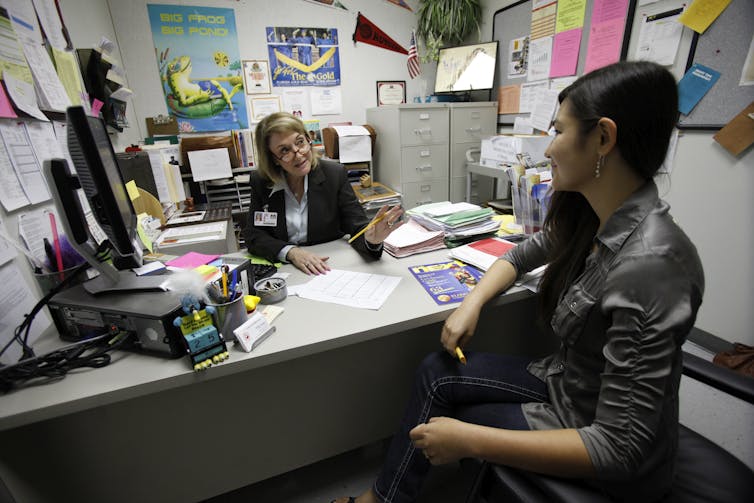
A woman behind a desk cluttered with lots of stuff talks to a female student
High school guidance counselors play an important role in helping college-bound students learn about universities and ask the right questions. AP Photo/Wilfredo Lee

Data is public

Most colleges and universities release career success and knowledge rates to the public in annual reports. If you’re a prospective student considering a college, you can and should really delve into these statistics.

For example, if you look at some of the colleges on The Wall Street Journal’s best value list, you can see some low knowledge rates. Baruch College earned the top spot for best value, and the school’s success rate for the class of 2022 was 96%. However, its knowledge rate was only 49%.

Similarly, Bowdoin College reported for its class of 2022 a 92% career success rate, with a response rate of 35%.

That is not to say these schools are doing anything wrong. The point is that prospective students can educate themselves more on career success rates and corresponding knowledge rates.

Of course, knowledge rates also vary widely. Babson College, which ranked second on WSJ’s best colleges of 2025, reported an impressive career success rate of nearly 99%, with a knowledge rate of 83%. Davidson College reported a 91% career success rate for 2023, with a knowledge rate of 82%.

At Champlain College, where we serve as career coaches, our class of 2023 reported a career success rate of 90%, with a 81% knowledge rate.

Questions to ask

When prospective students are on college tours or interacting with admissions counselors, they should come prepared with probing questions regarding career success. Here are some questions that we think prospective students should ask college admissions counselors about the institution’s career success:

1. What is the process for tracking career success? You should learn the full process – how the school collects data and reports out on the statistics, and what trends, if any, the institution has noticed in its graduates’ career success over the years.

2. What is the school’s knowledge rate? If it’s low, it may be a reflection on either the institution’s career services or the quality of the overall student experience at that institution. If so, ask whether faculty are involved in the process to get a better idea of where the weakness lies.

3. When does the data collection process start and how long does it take? It should be an ongoing process, allowing for students to share career success both prior to and following graduation.

4. What kinds of additional questions did the school ask in its First-Destination Survey? Beyond relevant career information, is the institution asking about students’ internship experience? Did they study abroad? What other types of experiential learning or leadership opportunities did they undertake? What kind of advice do they have for prospective students? And, importantly, how do you verify student career success?

Equipped with these questions – and the understanding that career success rates are critical in the college selection process – students can feel more confident than they would otherwise that they have a good understanding of how well the institution prepares them for success after graduation.

Many schools publish their career outcomes directly on their website, but you can always speak with an admissions counselor to learn more.The Conversation

Kerry Shackett, Co-Director of the Career Collaborative and Career Coach, Champlain College and Patricia Boera, Co-Director of the Career Collaborative, Champlain College

This article is republished from The Conversation under a Creative Commons license. Read the original article.

Details
Written by: Kerry Shackett, Champlain College and Patricia Boera, Champlain College
Published: 27 February 2025
  • 355
  • 356
  • 357
  • 358
  • 359
  • 360
  • 361
  • 362
  • 363
  • 364

Public Safety

  • Lakeport Police Department celebrates long-awaited new headquarters

  • Lakeport Police Department investigates flag vandalism cases

  • Lakeport Police Department thanks Kathy Fowler Chevrolet for donation

Community

  • Hidden Valley Lake Garden Club installs new officers

  • 'America's Top Teens' searching for talent

  • 'The Goodness of Sea Vegetables' featured topic of March 5 co-op talk

Community & Business

  • Annual 'Adelante Jovenes' event introduces students, parents to college opportunities

  • Gas prices are dropping just in time for the holiday travel season

  • Lake County Association of Realtors installs new board and presents awards

  • Local businesses support travel show

  • Preschool families harvest pumpkins

  • Preschool students earn their wings

How to resolve AdBlock issue?
Refresh this page