How to resolve AdBlock issue?
News
What’s Up for February? The Moon's many engagements, what's the right term for a planetary rendezvous, and the goddess of love draws near.
Starting with the Moon's journey across the sky this month, you'll find the slim crescent of Earth's natural satellite cozied up to the planet Venus on the 1st. It then visits the
Pleiades on the 5th, and hops over Jupiter on the 6th, looking increasingly fuller, before arriving right next to Mars on February 9th.
Jupiter and Mars rule the sky on February nights. You'll find them high overhead in the evening, together with the winter constellations of Orion, Taurus, and Gemini.
Astronomers sometimes get picky about their terminology. For instance, the apparent close approaches of objects on the sky, like two planets, or the Moon and a planet, are commonly called "conjunctions," and we often use that term in this video series.
However, most of the time, the technically correct term is an "appulse." Conjunctions technically occur when two objects have the same right ascension, and they don't have to appear close together in the sky. (Right ascension is a way of indicating where an object is along the sky from east to west, similar to how we measure longitude on Earth's surface.)
Appulses are simply the times when two objects appear at their closest in the sky, regardless of whether they have to have the same "space coordinates." The term comes from a Latin word meaning "brought near" or "driven toward."
And now that you know the distinction, you can choose to keep it casual or impress others with some next-level astronomy knowledge. Either way, it’s all about enjoying the view.
February is a month for love, so what better time to spotlight Venus, which is associated with the Roman goddess of love? This month, Venus shines at its brightest for the year. It'll remain dazzling through the start of March as it slowly descends from its late-January high point in the sky. By mid-March, it will disappear into the glare of sunset, only to reappear as a morning object in April.
Now, you may have heard that Venus goes through phases, just like the Moon. You can see these phases with a modest telescope. But there’s a surprising twist: unlike the Moon, Venus isn’t at its brightest when it’s "full." Instead, it shines most brilliantly in our skies when it’s a thinner crescent! It all comes down to distance. See, Venus only appears fuller when it’s on the far side of the Sun, and much farther from Earth. As it comes closer to us, its phase becomes a crescent, but the planet also looks much larger in the sky. Even as a crescent, the light from its closer position more than makes up for the smaller phase.
So, remember this Valentine's proverb: "The goddess of love is at her most radiant when nearby!"
Stay up to date on all of NASA's missions exploring the solar system and beyond at science.nasa.gov.
Preston Dyches works for NASA's Jet Propulsion Laboratory.
THIS STORY HAS BEEN UPDATED.
LAKE COUNTY, Calif. — The Lakeport Police Department is continuing its investigation into a Friday night shooting at Library Park that claimed the life of a Lakeport resident, with the police chief reporting that the suspect directly responsible for the shooting was not yet in custody as of Saturday afternoon.
The fatal shooting occurred at Library Park shortly before 9:20 p.m. Friday, as Lake County News has reported.
Lakeport Police and firefighters arrived minutes after being dispatched to the scene to find the victim, a 32-year-old Lakeport man, lying unconscious next to the seawall near the gazebo.
The shooting victim was declared dead a short time later, according to reports from the scene.
In an update released shortly after 2 p.m. Saturday, the Lakeport Police Department said it is continuing its investigation with the assistance of the Lake County Sheriff’s Office and Clearlake Police Department.
Lakeport Police Chief Dale Stoebe on Saturday told Lake County News that the suspect who had committed the shooting had not been arrested, despite there being one subject in custody at the Lake County Jail, Parker John Coggins, with a murder charge on his booking sheet.
Lake County News has not been able to get further information on Coggins’ involvement in the case from the Lakeport Police Department.
The name of the victim is not yet being released pending the notification of his family.
The police department said Saturday afternoon that, “Initial information at the scene indicated that this was not an act of random violence. Rather the deceased was the specific focus of the
violence that took his life.”
Police also reported that none of the additional information they have developed during the ongoing investigation has suggested that the public at large “is in danger of similar acts by the suspect or suspects in this matter.”
The police department said it will offer additional updates when new information can be released in the case.
Anyone with information regarding this incident is asked to contact Det. Juan Altamirano at 707-263-5491, Extension 102, e-mailThis email address is being protected from spambots. You need JavaScript enabled to view it. or message the Lakeport Police Department on Facebook.
Email Elizabeth Larson atThis email address is being protected from spambots. You need JavaScript enabled to view it. . Follow her on Twitter, @ERLarson, and on Bluesky, @erlarson.bsky.social. Find Lake County News on the following platforms: Facebook, @LakeCoNews; X, @LakeCoNews; Threads, @lakeconews, and on Bluesky, @lakeconews.bsky.social.
LAKE COUNTY, Calif. — The Lakeport Police Department is continuing its investigation into a Friday night shooting at Library Park that claimed the life of a Lakeport resident, with the police chief reporting that the suspect directly responsible for the shooting was not yet in custody as of Saturday afternoon.
The fatal shooting occurred at Library Park shortly before 9:20 p.m. Friday, as Lake County News has reported.
Lakeport Police and firefighters arrived minutes after being dispatched to the scene to find the victim, a 32-year-old Lakeport man, lying unconscious next to the seawall near the gazebo.
The shooting victim was declared dead a short time later, according to reports from the scene.
In an update released shortly after 2 p.m. Saturday, the Lakeport Police Department said it is continuing its investigation with the assistance of the Lake County Sheriff’s Office and Clearlake Police Department.
Lakeport Police Chief Dale Stoebe on Saturday told Lake County News that the suspect who had committed the shooting had not been arrested, despite there being one subject in custody at the Lake County Jail, Parker John Coggins, with a murder charge on his booking sheet.
Lake County News has not been able to get further information on Coggins’ involvement in the case from the Lakeport Police Department.
The name of the victim is not yet being released pending the notification of his family.
The police department said Saturday afternoon that, “Initial information at the scene indicated that this was not an act of random violence. Rather the deceased was the specific focus of the
violence that took his life.”
Police also reported that none of the additional information they have developed during the ongoing investigation has suggested that the public at large “is in danger of similar acts by the suspect or suspects in this matter.”
The police department said it will offer additional updates when new information can be released in the case.
Anyone with information regarding this incident is asked to contact Det. Juan Altamirano at 707-263-5491, Extension 102, e-mail
Email Elizabeth Larson at
THIS STORY HAS BEEN UPDATED.
LAKE COUNTY, Calif. — Authorities are investigating an apparent homicide that took place in downtown Lakeport late Friday night.
The incident was first reported as an assault victim with a gunshot wound at 9:18 p.m., the Lakeport Police Department said in a statement released shortly after 3 a.m. Saturday.
Lakeport Police officers were dispatched to Library Park, where they arrived at 9:20 p.m., according to the report.
Upon their arrival at the scene, officers located an unconscious adult male victim that had been struck by gunfire.
The shooting victim was found near the seawall closest to the park’s gazebo, based on radio reports.
A request was made over the air for an air ambulance but it was reported that REACH was grounded due to weather.
Lakeport Police officers and firefighters with the Lakeport Fire Protection District performed life saving measures on the victim, however, the victim was pronounced deceased at the scene just after 9:30 p.m.
Officers blocked off an area around Library Park that included the intersection of First and Park streets shortly after the victim died, radio reports indicated.
Meantime, the suspect was reported to have fled north toward Xabatin Park.
Additional Lakeport Police officers, Lake County Sheriff’s deputies and California Highway Patrol officers were summoned to the scene to assist with the investigation and search for the suspect responsible for the shooting, the Lakeport Police Department said.
Officers went to Xabatin Park as well as a nearby bar where a fight had been reported shortly before the shooting, according to radio reports.
The Lakeport Police statement on the incident said information from witnesses indicated this was not a random act and that the victim and suspects were previously known by each other.
The investigation is still ongoing, police said.
Police said the name of the victim is not being released pending notification to next of kin.
If you have any information regarding this incident, please contact Det. Juan Altamirano at 707-263-5491 EXT 102 or e-mail atThis email address is being protected from spambots. You need JavaScript enabled to view it. you can also message our agency on Facebook.
Email Elizabeth Larson atThis email address is being protected from spambots. You need JavaScript enabled to view it. . Follow her on Twitter, @ERLarson, and on Bluesky, @erlarson.bsky.social. Find Lake County News on the following platforms: Facebook, @LakeCoNews; X, @LakeCoNews; Threads, @lakeconews, and on Bluesky, @lakeconews.bsky.social.
LAKE COUNTY, Calif. — Authorities are investigating an apparent homicide that took place in downtown Lakeport late Friday night.
The incident was first reported as an assault victim with a gunshot wound at 9:18 p.m., the Lakeport Police Department said in a statement released shortly after 3 a.m. Saturday.
Lakeport Police officers were dispatched to Library Park, where they arrived at 9:20 p.m., according to the report.
Upon their arrival at the scene, officers located an unconscious adult male victim that had been struck by gunfire.
The shooting victim was found near the seawall closest to the park’s gazebo, based on radio reports.
A request was made over the air for an air ambulance but it was reported that REACH was grounded due to weather.
Lakeport Police officers and firefighters with the Lakeport Fire Protection District performed life saving measures on the victim, however, the victim was pronounced deceased at the scene just after 9:30 p.m.
Officers blocked off an area around Library Park that included the intersection of First and Park streets shortly after the victim died, radio reports indicated.
Meantime, the suspect was reported to have fled north toward Xabatin Park.
Additional Lakeport Police officers, Lake County Sheriff’s deputies and California Highway Patrol officers were summoned to the scene to assist with the investigation and search for the suspect responsible for the shooting, the Lakeport Police Department said.
Officers went to Xabatin Park as well as a nearby bar where a fight had been reported shortly before the shooting, according to radio reports.
The Lakeport Police statement on the incident said information from witnesses indicated this was not a random act and that the victim and suspects were previously known by each other.
The investigation is still ongoing, police said.
Police said the name of the victim is not being released pending notification to next of kin.
If you have any information regarding this incident, please contact Det. Juan Altamirano at 707-263-5491 EXT 102 or e-mail at
Email Elizabeth Larson at
LAKE COUNTY, Calif. — Forecasters are warning that the amount of rain expected over the next several days due to an intensive atmospheric river could bring flooding, landslides and travel disruptions across Northern California.
“This atmospheric river will unleash the most rainfall Northern California has seen so far this year. Rounds of intense rain could trigger landslides and rockslides,” AccuWeather Chief On-Air Meteorologist Bernie Rayno said. “This is tropical moisture with warmer air, so snow levels will be much higher than we typically see. The heavy rain could melt some of the snowpack in the lower elevations, which could contribute to flooding problems.”
Accuweather said the moisture is flowing into the West via a “pineapple express” atmospheric river, which funnels rich tropical moisture from near Hawaii directly into the West Coast.
“An atmospheric river is essentially a river of moisture that can stretch thousands of miles,” Rayno explained. “Atmospheric rivers can transport tremendous amounts of moisture. There could be up to two feet of rainfall in the coastal ranges and western slopes of the northern Sierra.”
AccuWeather expert meteorologists are forecasting between 2 and 4 inches of rain for San Francisco, 4 to 8 inches for the North Bay, and a zone of 6 to 12 inches of rain in parts of Northern California through Tuesday, with an AccuWeather Local StormMax of 24 inches in the mountains.
The National Weather Service’s updated forecast shows that showers are expected for the coming week, with the potential for snow showers in Lake County’s lower elevations late Tuesday, Wednesday and Thursday.
The forecast said snow levels could drop to between 1,000 and 2,000 feet in elevation, which the National Weather Service said could be the lowest elevation snowfall of the season.
As a result, there could be impacts along Highway 20, forecasters said.
Email Elizabeth Larson atThis email address is being protected from spambots. You need JavaScript enabled to view it. . Follow her on Twitter, @ERLarson, and on Bluesky, @erlarson.bsky.social. Find Lake County News on the following platforms: Facebook, @LakeCoNews; X, @LakeCoNews; Threads, @lakeconews, and on Bluesky, @lakeconews.bsky.social.
“This atmospheric river will unleash the most rainfall Northern California has seen so far this year. Rounds of intense rain could trigger landslides and rockslides,” AccuWeather Chief On-Air Meteorologist Bernie Rayno said. “This is tropical moisture with warmer air, so snow levels will be much higher than we typically see. The heavy rain could melt some of the snowpack in the lower elevations, which could contribute to flooding problems.”
Accuweather said the moisture is flowing into the West via a “pineapple express” atmospheric river, which funnels rich tropical moisture from near Hawaii directly into the West Coast.
“An atmospheric river is essentially a river of moisture that can stretch thousands of miles,” Rayno explained. “Atmospheric rivers can transport tremendous amounts of moisture. There could be up to two feet of rainfall in the coastal ranges and western slopes of the northern Sierra.”
AccuWeather expert meteorologists are forecasting between 2 and 4 inches of rain for San Francisco, 4 to 8 inches for the North Bay, and a zone of 6 to 12 inches of rain in parts of Northern California through Tuesday, with an AccuWeather Local StormMax of 24 inches in the mountains.
The National Weather Service’s updated forecast shows that showers are expected for the coming week, with the potential for snow showers in Lake County’s lower elevations late Tuesday, Wednesday and Thursday.
The forecast said snow levels could drop to between 1,000 and 2,000 feet in elevation, which the National Weather Service said could be the lowest elevation snowfall of the season.
As a result, there could be impacts along Highway 20, forecasters said.
Email Elizabeth Larson at
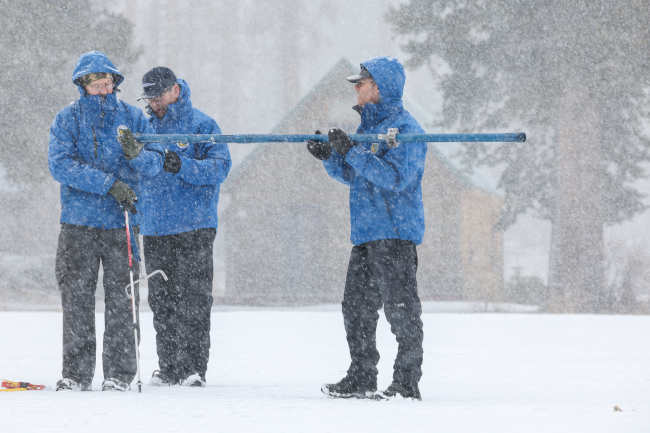
California’s snowpack has dwindled due to a dry January, according to the latest manual measurement conducted by the state.
The Department of Water Resources, or DWR, on Friday conducted the second snow survey of the season at Phillips Station.
The manual survey recorded 22.5 inches of snow depth and a snow water equivalent of 8 inches, which is 46 percent of average for this location.
The snow water equivalent measures the amount of water contained in the snowpack and is a key component of DWR’s water supply forecast. Statewide, the snowpack is 65 percent of average for this date.
On January 1, the statewide snowpack was 108 percent of average after a series of large storms in November and December boosted snow totals in the Northern Sierra, but significant regional differences kept the Central Sierra just below average and the Southern Sierra well below average.
An excessively dry January has pushed the Northern Sierra back to near average, the Central Sierra to 58 percent of average, and has led the Southern Sierra Nevada to fall to under 50 percent of average.
“Despite a good start to the snowpack in the Northern Sierra in November and December, we can look back as recently as 2013 and 2021 to show how quickly conditions can change for the drier,” said DWR Director Karla Nemeth. “California missed out on critical snow-building storms in January which has pushed the state down below average for this time of year. While we are excited to see some storm activity in the coming days, sustained periods of no precipitation can dry the state out very quickly. For each day it’s not snowing or raining, we are not keeping up with what we need.”
DWR’s electronic readings from 130 stations placed throughout the Sierra Nevada indicate that the statewide snowpack’s snow water equivalent is 10.5 inches, or 65 percent of average for this date.
While forecasts show storm activity may pick up in February, California has seen several years in recent history with large early season snow totals, only for predominantly dry conditions to dominate the rest of the season.
California has effectively managed its reservoirs to keep storage above average for this time of year. Lake Oroville, the State Water Project’s largest reservoir, is currently at 126 percent of average for this time of year. San Luis Reservoir, which is jointly operated by the U.S. Bureau of Reclamation, is at 101 percent of average for this time of year. Reservoirs in Southern California are also near or above their historical averages.
Measuring California’s snowpack is a key component that guides how California’s water supplies are managed. The data and measurements collected help inform water supply and snowmelt runoff forecasts, known as Bulletin 120, that help water managers plan for how much water will eventually reach state reservoirs in the spring and summer. This information is also a key piece in calculating State Water Project allocation forecasts each month.
Despite some recent rain, Southern California is still well below average for yearly precipitation.
To prepare for any weather the region may see the rest of the season, DWR has deployed over 30 Watershed Protection Specialists to assist with the Watershed and Debris Flow Task Force organized by the California Office of Emergency Services, or CalOES.
Members of this task force, including DWR, CalOES, CAL FIRE and over 400 members of the California Conservation Corps, have been working around the clock to protect watersheds around burn scars, place materials to mitigate the risk of debris flows and ensure regional infrastructure including debris flow basins are prepared for incoming storm activity.
On average, California’s snowpack supplies about 30 percent of California’s water needs. Its natural ability to store water is why California’s snowpack is often referred to as California's “frozen reservoir.” Data from these snow surveys and forecasts produced by DWR’s Snow Surveys and Water Supply Forecasting Unit are important factors in determining how DWR manages the state’s water resources.
DWR conducts four or five media-oriented snow surveys at Phillips Station each winter near the first of each month, January through April and, if necessary, May. The next survey is tentatively scheduled for February 28.
For California’s current hydrological conditions, visit https://cww.water.ca.gov.
On Friday, U.S. Rep. Mike Thompson (CA-04) and Senator Jeff Merkley (D-OR) introduced the Smoke and Heat Ready Communities Act — legislation to protect communities across the country from the hazardous health, economic, and environmental impacts of severe wildfire smoke and extreme heat events.
Thompson introduced the bill in the House and Merkley introduced the companion bill in the Senate.
“Californians know firsthand the impact breathing wildfire smoke can have on our health,” said Rep. Thompson. “As wildfire smoke and extreme heat become more and more common, the Smoke and Heat Ready Communities Act will help experts better research the impact of wildfire smoke on our communities and provide communities the resources they need to keep Americans safe.”
“When the 2020 Labor Day fires broke out, I drove over 600 miles across Oregon and never once escaped the thick layer of dark smoke that blanketed the state, which threatened public health and dampened everyday life for those under its hazardous plumes,” said Sen. Merkley. “We must ensure Americans are prepared in the face of dangerous smoke and heat that ravage our communities during these deadly disasters. As climate chaos continues to worsen the impacts of natural disasters like wildfires, I’ll keep pushing for research and resources — like the millions in federal funding I secured for smoke readiness last year — to combat this crisis.”
Wildfire smoke contains hazardous pollutants that pose serious health risks, especially for children, the elderly, and individuals with pre-existing heart or lung conditions.
Exposure can cause immediate symptoms — like wheezing, burning eyes, and difficulty breathing — while also aggravating chronic respiratory and cardiovascular diseases.
The effects of this toxic smoke can linger long after the fires are extinguished, with some studies illustrating that major wildfires are followed by more severe flu seasons.
The Smoke and Heat Ready Communities Act provides federal grant funding to states and their efforts to improve air quality. This funding would invest in measures that protect against the harmful effects of wildfire smoke and extreme heat.
The bill also encourages research, development and implementation of strategies to mitigate the impacts of these environmental hazards and support healthy communities.
“People with asthma and COPD are at risk for breathing emergencies after exposure to wildfire smoke or dangerous heat,” said Lynda Mitchell, CEO of Allergy & Asthma Network. “If you inhale particles of wildfire smoke or breathe in hot and humid air filled with allergens or irritants, it can cause your airways to become inflamed and lead to coughing, wheezing and shortness of breath. More than 25 million people have asthma and 24 million live with COPD in the United States – these are life-threatening chronic diseases that are worsened by poor air quality. Allergy & Asthma Network supports the Smoke and Heat Ready Communities Act to improve our country’s air quality and readiness for wildfire smoke and extreme heat.”
“Extreme heat and wildfire smoke are among the most impactful environmental air quality factors in many communities. Poor air quality makes it more difficult for allergists to manage our patients who suffer from asthma. This legislation will make it easier for the EPA to support state and local government in their management of these issues which will make it easier for us to care for our patients. ACAAI endorses this legislation and applauds Congressman Thompson and Senator Merkley for their leadership on this important issue,” said Todd Mahr, MD, executive medical director, American College of Allergy, Asthma and Immunology.
“Smoke and extreme heat are dangerous threats to health that are unfortunately becoming much more common for communities across the country. Providing states and communities funding to prepare for and communicate timely information about the impacts of wildfire smoke and heat will help protect peoples’ health. These extreme weather events are a reality that necessitate the health-focused response this legislation provides,” said Harold Wimmer, president and CEO, American Lung Association.
“There is an urgent and desperate need for funding for research on how wildfire smoke impacts our health and particularly the health of our children, who are uniquely vulnerable to air and chemical pollution. When wildfires consume entire houses, cars, and businesses, everything in them burns and goes into the air. Much of our lives is made up of plastics now, from the clothes we wear to the materials we use in construction. Think PVC pipes and vinyl siding. They contain toxic chemicals, and when they burn, people breathe them in during and after fires — and that air drifts. We cannot fix problems without proper data. We need to know what’s in wildfire smoke — besides, potentially, everything,” said Dominique Browning, director and co-founder, Moms Clean Air Force.
The bill is currently endorsed by the Allergy and Asthma Network; the American College of Allergy, Asthma and Immunology; the American Lung Association; and Moms Clean Air Force.
Thompson represents California’s Fourth Congressional District, which includes all or part of Lake, Napa, Solano, Sonoma and Yolo counties.
Thompson introduced the bill in the House and Merkley introduced the companion bill in the Senate.
“Californians know firsthand the impact breathing wildfire smoke can have on our health,” said Rep. Thompson. “As wildfire smoke and extreme heat become more and more common, the Smoke and Heat Ready Communities Act will help experts better research the impact of wildfire smoke on our communities and provide communities the resources they need to keep Americans safe.”
“When the 2020 Labor Day fires broke out, I drove over 600 miles across Oregon and never once escaped the thick layer of dark smoke that blanketed the state, which threatened public health and dampened everyday life for those under its hazardous plumes,” said Sen. Merkley. “We must ensure Americans are prepared in the face of dangerous smoke and heat that ravage our communities during these deadly disasters. As climate chaos continues to worsen the impacts of natural disasters like wildfires, I’ll keep pushing for research and resources — like the millions in federal funding I secured for smoke readiness last year — to combat this crisis.”
Wildfire smoke contains hazardous pollutants that pose serious health risks, especially for children, the elderly, and individuals with pre-existing heart or lung conditions.
Exposure can cause immediate symptoms — like wheezing, burning eyes, and difficulty breathing — while also aggravating chronic respiratory and cardiovascular diseases.
The effects of this toxic smoke can linger long after the fires are extinguished, with some studies illustrating that major wildfires are followed by more severe flu seasons.
The Smoke and Heat Ready Communities Act provides federal grant funding to states and their efforts to improve air quality. This funding would invest in measures that protect against the harmful effects of wildfire smoke and extreme heat.
The bill also encourages research, development and implementation of strategies to mitigate the impacts of these environmental hazards and support healthy communities.
“People with asthma and COPD are at risk for breathing emergencies after exposure to wildfire smoke or dangerous heat,” said Lynda Mitchell, CEO of Allergy & Asthma Network. “If you inhale particles of wildfire smoke or breathe in hot and humid air filled with allergens or irritants, it can cause your airways to become inflamed and lead to coughing, wheezing and shortness of breath. More than 25 million people have asthma and 24 million live with COPD in the United States – these are life-threatening chronic diseases that are worsened by poor air quality. Allergy & Asthma Network supports the Smoke and Heat Ready Communities Act to improve our country’s air quality and readiness for wildfire smoke and extreme heat.”
“Extreme heat and wildfire smoke are among the most impactful environmental air quality factors in many communities. Poor air quality makes it more difficult for allergists to manage our patients who suffer from asthma. This legislation will make it easier for the EPA to support state and local government in their management of these issues which will make it easier for us to care for our patients. ACAAI endorses this legislation and applauds Congressman Thompson and Senator Merkley for their leadership on this important issue,” said Todd Mahr, MD, executive medical director, American College of Allergy, Asthma and Immunology.
“Smoke and extreme heat are dangerous threats to health that are unfortunately becoming much more common for communities across the country. Providing states and communities funding to prepare for and communicate timely information about the impacts of wildfire smoke and heat will help protect peoples’ health. These extreme weather events are a reality that necessitate the health-focused response this legislation provides,” said Harold Wimmer, president and CEO, American Lung Association.
“There is an urgent and desperate need for funding for research on how wildfire smoke impacts our health and particularly the health of our children, who are uniquely vulnerable to air and chemical pollution. When wildfires consume entire houses, cars, and businesses, everything in them burns and goes into the air. Much of our lives is made up of plastics now, from the clothes we wear to the materials we use in construction. Think PVC pipes and vinyl siding. They contain toxic chemicals, and when they burn, people breathe them in during and after fires — and that air drifts. We cannot fix problems without proper data. We need to know what’s in wildfire smoke — besides, potentially, everything,” said Dominique Browning, director and co-founder, Moms Clean Air Force.
The bill is currently endorsed by the Allergy and Asthma Network; the American College of Allergy, Asthma and Immunology; the American Lung Association; and Moms Clean Air Force.
Thompson represents California’s Fourth Congressional District, which includes all or part of Lake, Napa, Solano, Sonoma and Yolo counties.