How to resolve AdBlock issue?
Refresh this page
Lake County News,California
  • Home
    • Registration Form
  • News
    • Education
    • Veterans
    • Community
      • Obituaries
      • Letters
      • Commentary
    • Police Logs
    • Business
    • Recreation
    • Health
    • Religion
    • Legals
    • Arts & Life
    • Regional
  • Calendar
  • Contact us
    • FAQs
    • Phones, E-Mail
    • Subscribe
  • Advertise Here
  • Login
How to resolve AdBlock issue?
Refresh this page

News

Is AI dominance inevitable? A technology ethicist says no, actually


AI is powerful technology, but that doesn’t mean we should adopt it unquestioningly. SIphotography/iStock via Getty Images

Anyone following the rhetoric around artificial intelligence in recent years has heard one version or another of the claim that AI is inevitable. Common themes are that AI is already here, it is indispensable, and people who are bearish on it harm themselves.

In the business world, AI advocates tell companies and workers that they will fall behind if they fail to integrate generative AI into their operations. In the sciences, AI advocates promise that AI will aid in curing hitherto intractable diseases.

In higher education, AI promoters admonish teachers that students must learn how to use AI or risk becoming uncompetitive when the time comes to find a job.

And, in national security, AI’s champions say that either the nation invests heavily in AI weaponry, or it will be at a disadvantage vis-à-vis the Chinese and the Russians, who are already doing so.

The argument across these different domains is essentially the same: The time for AI skepticism has come and gone. The technology will shape the future, whether you like it or not. You have the choice to learn how to use it or be left out of that future. Anyone trying to stand in the technology’s way is as hopeless as the manual weavers who resisted the mechanical looms in the early 19th century.

In the past few years, my colleagues and I at UMass Boston’s Applied Ethics Center have been studying the ethical questions raised by the widespread adoption of AI, and I believe the inevitability argument is misleading.

History and hindsight

In fact, this claim is the most recent version of a deterministic view of technological development. It’s the belief that innovations are unstoppable once people start working on them. In other words, some genies don’t go back in their bottles. The best you can do is harness them to your good purposes.

This deterministic approach to tech has a long history. It’s been applied to the influence of the printing press, as well as to the rise of automobiles and the infrastructure they require, among other developments.

vintage cars mix with traffic in a small city street
The dominance of automobiles and the infrastructure that supports them over many decades only seems inevitable in hindsight. Bbeachy2001/Wikimedia Commons, CC BY

But I believe that when it comes to AI, the technological determinism argument is both exaggerated and oversimplified.

AI in the field(s)

Consider the contention that businesses can’t afford to stay out of the AI game. In fact, the case has yet to be made that AI is delivering significant productivity gains to the firms that use it. A report in The Economist in July 2024 suggests that so far, the technology has had almost no economic impact.

AI’s role in higher education is also still very much an open question. Though universities have, in the past two years, invested heavily in AI-related initiatives, evidence suggests they may have jumped the gun.

The technology can serve as an interesting pedagogical tool. For example, creating a Plato chatbot that lets students have a text conversation with a bot posing as Plato is a cool gimmick.

But AI is already starting to displace some of the best tools teachers have for assessment and for developing critical thinking, such as writing assignments. The college essay is going the way of the dinosaurs as more teachers give up on the ability to tell whether their students are writing their papers themselves. What’s the cost-benefit argument for giving up on writing, an important and useful traditional skill?

In the sciences and in medicine, the use of AI seems promising. Its role in understanding the structure of proteins, for example, will likely be significant for curing diseases. The technology is also transforming medical imaging and has been helpful in accelerating the drug discovery process.

But the excitement can become exaggerated. AI-based predictions about which cases of COVID-19 would become severe have roundly failed, and doctors rely excessively on the technology’s diagnostic ability, often against their own better clinical judgment. And so, even in this area, where the potential is great, AI’s ultimate impact is unclear.

In retrospect, using AI to help diagnose COVID-19 patients was problematic.

In national security, the argument for investing in AI development is compelling. Since the stakes can be high, the argument that if the Chinese and the Russians are developing AI-driven autonomous weapons, the United States can’t afford to fall behind, has real purchase.

But a complete surrender to this form of reasoning, though tempting, is likely to lead the U.S. to overlook the disproportionate impact of these systems on nations that are too poor to participate in the AI arms race. The major powers could deploy the technology in conflicts in these nations. And, just as significantly, this argument de-emphasizes the possibility of collaborating with adversaries on limiting military AI systems, favoring arms race over arms control.

One step at a time

Surveying the potential significance and risks of AI in these different domains merits some skepticism about the technology. I believe that AI should be adopted piecemeal and with a nuanced approach rather than subject to sweeping claims of inevitability. In developing this careful take, there are two things to keep in mind:

First, companies and entrepreneurs working on artificial intelligence have an obvious interest in the technology being perceived as inevitable and necessary, since they make a living from its adoption. It’s important to pay attention to who is making claims of inevitability, and why.

Second, it’s worth taking a lesson from recent history. Over the past 15 years, smartphones and the social media apps that run on them came to be seen as a fact of life – a technology as transformative as it is inevitable. Then data started emerging about the mental health harms they cause teens, especially young girls. School districts across the United States started to ban phones to protect the attention spans and mental health of their students. And some people have reverted to using flip phones as a quality of life change to avoid smartphones.

After a long experiment with the mental health of kids, facilitated by claims of technological determinism, Americans changed course. What seemed fixed turned out to be alterable. There is still time to avoid repeating the same mistake with artificial intelligence, which potentially could have larger consequences for society.The Conversation

Nir Eisikovits, Professor of Philosophy and Director, Applied Ethics Center, UMass Boston

This article is republished from The Conversation under a Creative Commons license. Read the original article.


Helping Paws: Great Pyrenees, mastiffs, shepherds and terriers

Kennel#3's preview photo
Kennel#3


LAKE COUNTY, Calif. — Lake County Animal Care and Control is looking for new homes for many deserving dogs this week.

The dogs available for adoption this week include mixes of Anatolian shepherd, boxer, bull terrier, cane corso, cattle dog, Dogo Argentino, German shepherd, Great Pyrenees, husky, Labrador Retriever, pit bull terrier, Newfoundland and terrier.

Dogs that are adopted from Lake County Animal Care and Control are either neutered or spayed, microchipped and, if old enough, given a rabies shot and county license before being released to their new owner. License fees do not apply to residents of the cities of Lakeport or Clearlake.

Those dogs and the others shown on this page at the Lake County Animal Care and Control shelter have been cleared for adoption.

Call Lake County Animal Care and Control at 707-263-0278 or visit the shelter online for information on visiting or adopting.

The shelter is located at 4949 Helbush in Lakeport.

Email Elizabeth Larson at This email address is being protected from spambots. You need JavaScript enabled to view it.. Follow her on Twitter, @ERLarson, or Lake County News, @LakeCoNews.

 
Kennel#32b's preview photo
Kennel#32b

Kennel#31b's preview photo
Kennel#31b

Kennel#31a's preview photo
Kennel#31a

Kennel#32a's preview photo
Kennel#32a

 
Kennel#12's preview photo
Kennel#12

Kennel#5's preview photo
Kennel#5

Kennel#10's preview photo
Kennel#10

Kennel#16(Caney)'s preview photo
Kennel#16(Caney)

Kennel#20's preview photo
Kennel#20

Kennel#30's preview photo
Kennel#30

Kennel#33's preview photo
Kennel#33

Kennel#14's preview photo
Kennel#14

Kennel#7's preview photo
Kennel#7

Kennel#26(Ben)'s preview photo
Kennel#26(Ben)

Kennel#25(Jerry)'s preview photo
Kennel#25(Jerry)

 
Kennel#17's preview photo
Kennel#17

Kennel#34's preview photo
Kennel#34
 
 
Kennel#19's preview photo
Kennel#19

Kennel#24(Diesel)'s preview photo
Kennel#24(Diesel)


Kennel#27's preview photo
Kennel#27

 
Kennel#15's preview photo
Kennel#15


Kennel#6's preview photo
Kennel#6
Kennel#8(Buddy)'s preview photo
Kennel#8(Buddy)

Kennel#21's preview photo
Kennel#21
 

California reports first known U.S. case of emerging mpox strain

The California Department of Public Health has identified through laboratory testing the first known case of clade I mpox in the United States.

This case was confirmed in an individual who recently traveled from Africa and is related to the ongoing outbreak of clade I mpox in Central and Eastern Africa.

Historically, clade I has caused more severe illness than clade II, however, recent infections from clade I mpox may not be as clinically severe as in previous outbreaks, especially when cases have access to quality medical care.

The affected individual received health care in San Mateo County based on their travel history and symptoms. The individual is isolating at home and recovering.

People who had close contact with this individual are being contacted by public health workers, but there is no concern or evidence that mpox clade I is currently spreading between individuals in California or the United States.

The mpox specimens from the traveler are being sent to the CDC for further laboratory testing.

Preventing mpox infection

It appears clade I mpox spreads in a similar manner as clade II mpox, through close (skin-skin), intimate and sexual contact.

The identification of a potentially more severe mpox version in the United States is a good reminder for individuals who have certain risk factors to take preventive action, including:

• Getting vaccinated if you may be at risk for mpox. For the greatest protection, make sure you get both doses of the vaccine.

• Taking precautions if you were exposed to mpox. Get the mpox vaccine before symptoms develop and consider avoiding intimate contact with others for 21 days. Watch yourself for symptoms and get tested if they develop.

• Preventing spread if you have been told you have mpox. Avoid contact with others until the rash is healed, clean and disinfect shared areas in the home, and notify people who may have been exposed.

• Talking to your sexual partner(s).

• Avoiding skin-to-skin contact with those who have a rash or sores that look like mpox.

• Not sharing items with someone who has mpox.

• Washing your hands often.

• Protecting yourself when caring for someone with mpox by using masks, gowns and gloves.

Mpox prevention information is also available on CDPH’s Sexual Health Toolkits and Campaign Materials Page. Casual contact, like one might have during travel, in an office, classroom or store, is unlikely to pose significant risks for transmission of mpox.

In late September, CDC issued enhanced precautions for travelers to countries in Central and Eastern Africa experiencing outbreaks.

More information about mpox and clade I and clade II strains is available on the CDC website.

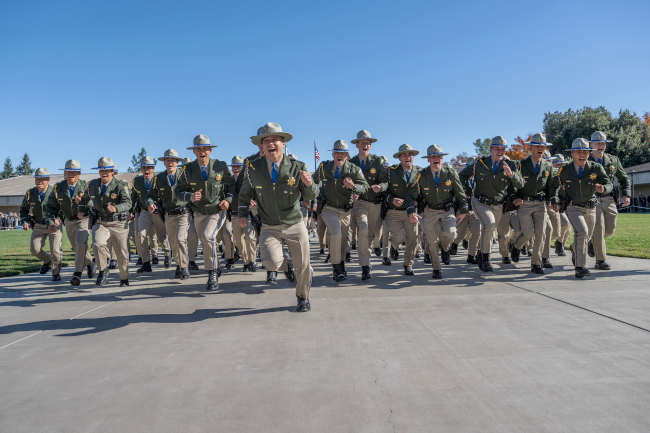
CHP graduation realizes multiyear administration goal of hiring 1,000 new officers

The newest class of California Highway Patrol cadets graduated on Friday, Nov. 15, 2024, in West Sacramento, California. Photo courtesy of the CHP.

On Friday, the California Highway Patrol graduated 121 cadets — the largest graduating class in two years — realizing the administration's multiyear campaign to hire 1,000 new CHP officers to protect and serve communities throughout California.

As part of California’s efforts to improve public safety, California funded a multiyear CHP recruitment campaign to fill 1,000 officer positions by hiring qualified individuals across the state.

In June of 2022, the CHP embarked on a multiyear recruiting campaign and has seen an outpouring of interest in joining the ranks, receiving more than 11,700 cadet applications in the first six months of 2024 alone — a 58% increase from the same period in 2022.

A new CHP officer has his badge pinned on by a family member. Photo courtesy of the CHP.

California has additionally invested more resources and personnel since 2019 to fight crime, help local governments hire more police, and improve public safety.

In 2023, as part of California’s Real Public Safety Plan, the Governor announced the largest-ever investment to combat organized retail crime in state history, an annual 310% increase in proactive operations targeting organized retail crime, and special operations across the state to fight crime and improve public safety.

You can join the CHP officers ready to make a difference. The next CHP officer hiring seminar is Tuesday, Nov. 26. Learn more here.


The newest CHP officers are ready to take off on their assignments. Photo courtesy of the CHP.

Strength training early in life can set up kids and adolescents for a lifetime of health and well-being


An age-appropriate strength training program can have significant benefits for children and adolescents. The Good Brigade/DigitalVision via Getty Images

“Aren’t they a little young for that?”

This is a question I used to hear regularly from parents when I’d recommend strength training for the kids I worked with, whose ages ranged from 6 to 18 years old, in youth sports. During my four years as a strength and conditioning coach, I often received questions from parents about the pros and cons of strength training – that is, training that involves weight-bearing exercises – for children.

Some of the most common questions: Is strength training safe for children and adolescents? At what age is it appropriate for them to begin strength training? What are the benefits of strength training for this age group? Is strength training beneficial even for kids who are not involved in organized sports?

Simply put, it is safe and appropriate for kids of all ages to perform strength training.

I am an exercise physiologist, certified strength and conditioning specialist and certified performance and sport scientist. My research focuses on how muscle develops from childhood to adolescence, with the goal of understanding how young people can get the most benefit out of exercise training programs, particularly strength training programs.

My experience and research has shown that strength training can help to improve sports performance for youth, and that there are significant health benefits for youth participating in strength training beyond sports performance.

Safety first

The question I receive most often, for good reason, is whether strength training is safe for youth. In a study examining injury rates in numerous sports, researchers found that, when done correctly, strength training had a lower risk of injury than nearly all other sports. This is not only true for adults but also for children.

That being said, it is important to consider a young person’s emotional maturity before handing them a dumbbell. During my career, I have designed and implemented strength training programs for kids of all ages, even as young as 6 years old. But not every child in that age range is ready for strength training. For their own safety, participants need to be emotionally mature enough to listen to and follow instructions so that they don’t hurt themselves. For some kids, that’s as early as age 6, while others may not be ready until they are a few years older.

Because correct technique is key to doing these exercises safely, it is important that strength training programs for children be designed and implemented under the guidance of a qualified trainer or coach. This means someone with valid credentials and who has received higher education in exercise science.

It’s also important to seek out professionals who use scientific evidence to back up their training programs and philosophies.

Group of kids performing side planks on mats in a gym.
Building strength during childhood and adolescence can reduce the risk of injury in various activities and help prevent falls and fractures later in life too. SDI Productions/E+ via Getty Images

The benefits of strength training

Research has shown that stronger muscles in kids reduce the likelihood of injuries during various types of activities.

One study we conducted found that lower muscle strength and size could lead to lower performance during different activities kids typically engage in, such as running and jumping. Not only this, but kids with lower strength tend to have worse neuromuscular efficiency, which means that they are not as proficient at activating their muscles. This translates to using more energy and feeling more worn out when they’re physically active.

While it’s easy to see how strength training is important for youth who play sports, there are also incredible health benefits for kids who may not be into organized sports. Studies have shown the positive effect that strength training can have on healthy bone development in kids, leading to a lower likelihood of fractures. Research has also shown that strength training in kids can have a positive influence on psychological well-being and academic performance.

Strength training can also affect overall health and well-being as it relates to childhood obesity.

Obesity rates in children and adolescents have been rising for decades. Previous research has suggested that youth who are categorized as obese tend to have lower muscle strength than those considered normal weight. Not only this, but other research has found that youth who are obese may have a greater likelihood of sarcopenic obesity, defined as obesity with low muscle mass and function, which can have significant, negative health ramifications.

Resistance training interventions in youth with obesity have shown to have positive impacts on metabolic health, body composition, psychological health and overall quality of life.

Creating an age-appropriate program

An effective strength training program starts with setting age-appropriate expectations.

Children and adolescents are not miniature adults, and not all young people will adapt to a strength training program the same way. For instance, research shows that during puberty, there are unique differences in how muscle develops in boys versus girls.

Specifically, girls may have more neuroplasticity, which is defined as the brain’s ability to recognize new movements and patterns. This means that they may adapt to more complex movements faster than boys, while boys will see more significant changes when their muscle mass starts increasing with puberty. This doesn’t necessarily mean that girls and boys need vastly different strength training programs. It simply means not all kids will have the same rate of progression for certain exercises.

Taking that into consideration, an age-appropriate program should focus on technique over results. How much weight a child can lift is far less important than teaching them good movement patterns. For example, if a child is having difficulty performing normal pushups, a qualified professional could modify the exercise so they start with wall pushups or incline pushups. This will help that child build good movement patterns and be better for their strength in the long run.

Building off this focus on technique, a good strength training program for youth should progress from simple movements to more complex movements and lighter weights to heavier weights, taking into consideration that not all youth will adapt at the same rate.

Focusing on the long term

Obviously, most kids won’t grow up to be professional athletes, but every child can develop athleticism. A good strength training program for kids will set them on a trajectory to a healthy lifestyle from childhood to adolescence to adulthood.

Research shows that beginning exercise in childhood tends to lead to continued exercise habits in adulthood. For this reason, the National Strength and Conditioning Association, a leading organization in the field of strength and conditioning and exercise science, has encouraged a focus on improving training habits in childhood that can then be maintained into adulthood for overall better health and well-being.

Starting young with an age-appropriate strength training program can help kids develop good movement patterns and incorporate exercise into their routine, which can have lasting benefits for their health into adulthood.The Conversation

Zachary Gillen, Assistant Professor of Exercise Physiology, Mississippi State University

This article is republished from The Conversation under a Creative Commons license. Read the original article.

Space News: Mining old data from NASA’s Voyager 2 solves several Uranus mysteries

NASA’s Voyager 2 captured this image of Uranus while flying by the ice giant in 1986. New research using data from the mission shows a solar wind event took place during the flyby, leading to a mystery about the planet’s magnetosphere that now may be solved. Photo by NASA/JPL-Caltech.

NASA’s Voyager 2 flyby of Uranus decades ago shaped scientists’ understanding of the planet but also introduced unexplained oddities. A recent data dive has offered answers.

When NASA’s Voyager 2 spacecraft flew by Uranus in 1986, it provided scientists’ first — and, so far, only — close glimpse of this strange, sideways-rotating outer planet.

Alongside the discovery of new moons and rings, baffling new mysteries confronted scientists. The energized particles around the planet defied their understanding of how magnetic fields work to trap particle radiation, and Uranus earned a reputation as an outlier in our solar system.

Now, new research analyzing the data collected during that flyby 38 years ago has found that the source of that particular mystery is a cosmic coincidence: It turns out that in the days just before Voyager 2’s flyby, the planet had been affected by an unusual kind of space weather that squashed the planet’s magnetic field, dramatically compressing Uranus’ magnetosphere.

“If Voyager 2 had arrived just a few days earlier, it would have observed a completely different magnetosphere at Uranus,” said Jamie Jasinski of NASA’s Jet Propulsion Laboratory in Southern California and lead author of the new work published in Nature Astronomy. “The spacecraft saw Uranus in conditions that only occur about 4% of the time.”

Magnetospheres serve as protective bubbles around planets (including Earth) with magnetic cores and magnetic fields, shielding them from jets of ionized gas — or plasma — that stream out from the Sun in the solar wind. Learning more about how magnetospheres work is important for understanding our own planet, as well as those in seldom-visited corners of our solar system and beyond.

That’s why scientists were eager to study Uranus’ magnetosphere, and what they saw in the Voyager 2 data in 1986 flummoxed them. Inside the planet’s magnetosphere were electron radiation belts with an intensity second only to Jupiter’s notoriously brutal radiation belts. But there was apparently no source of energized particles to feed those active belts; in fact, the rest of Uranus’ magnetosphere was almost devoid of plasma.

The missing plasma also puzzled scientists because they knew that the five major Uranian moons in the magnetic bubble should have produced water ions, as icy moons around other outer planets do. They concluded that the moons must be inert with no ongoing activity.

The first panel of this artist’s concept depicts how Uranus’s magnetosphere — its protective bubble — was behaving before the flyby of NASA’s Voyager 2. The second panel shows an unusual kind of solar weather was happening during the 1986 flyby, giving scientists a skewed view of the magnetosphere. Photo by NASA/JPL-Caltech.

Solving the mystery

So why was no plasma observed, and what was happening to beef up the radiation belts? The new data analysis points to the solar wind. When plasma from the Sun pounded and compressed the magnetosphere, it likely drove plasma out of the system.

The solar wind event also would have briefly intensified the dynamics of the magnetosphere, which would have fed the belts by injecting electrons into them.

The findings could be good news for those five major moons of Uranus: Some of them might be geologically active after all. With an explanation for the temporarily missing plasma, researchers say it’s plausible that the moons actually may have been spewing ions into the surrounding bubble all along.

Planetary scientists are focusing on bolstering their knowledge about the mysterious Uranus system, which the National Academies’ 2023 Planetary Science and Astrobiology Decadal Survey prioritized as a target for a future NASA mission.

JPL’s Linda Spilker was among the Voyager 2 mission scientists glued to the images and other data that flowed in during the Uranus flyby in 1986. She remembers the anticipation and excitement of the event, which changed how scientists thought about the Uranian system.

“The flyby was packed with surprises, and we were searching for an explanation of its unusual behavior. The magnetosphere Voyager 2 measured was only a snapshot in time,” said Spilker, who has returned to the iconic mission to lead its science team as project scientist. “This new work explains some of the apparent contradictions, and it will change our view of Uranus once again.”

Voyager 2, now in interstellar space, is almost 13 billion miles (21 billion kilometers) from Earth.
  • 360
  • 361
  • 362
  • 363
  • 364
  • 365
  • 366
  • 367
  • 368
  • 369

Community

  • Sheriff’s Activities League and Clearlake Bassmasters offer youth fishing clinic

  • City Nature Challenge takes place April 24 to 27

Public Safety

  • Lakeport Police logs: Wednesday, Feb. 11

  • Lakeport Police logs: Tuesday, Feb. 10

Education

  • Ramos measure requiring school officer training in use of anti-opioid drug moves forward

  • Lake County Chapter of CWA announces annual scholarships 

Health

  • California ranks 24th in America’s Health Rankings Annual Report from United Health Foundation

  • Healthy blood donors especially vital during active flu season

Business

  • Employment law summit takes place March 9

  • Two Lake County Mediacom employees earn company’s top service awards

Obituaries

  • Terry Knight

  • Ellen Thomas

Opinion & Letters

  • Who should pay for AI’s power? Not California ratepayers

  • Crandell: Supporting nephew for reelection in supervisorial race

Veterans

  • State honors fallen chief warrant officer killed in conflict in Iran

  • CalVet and CSU Long Beach team up to improve data collection related to veteran suicides

Recreation

  • April Audubon program will show how volunteers can help monitor local osprey nests

  • First guided nature walk of spring at Anderson Marsh State Historic Park April 11

  • Second Saturday guided nature walks continue at Anderson Marsh State Historic Park

  • Wet weather trail closure in effect on Upper Lake Ranger District

Religion

  • Kelseyville Presbyterian Church plans Easter service

  • Easter ‘Sonrise’ Service returns to Xabatin Community Park

Arts & Life

  • ‘CIA’ delves into the shadowy world of an espionage thriller

  • ‘War Machine’ shifts the battlefield into uncharted territory

Government & Politics

  • Lake County Democratic Central Committee endorses Falkenberg

  • Crandell launches reelection campaign plans March 15 event

Legals

  • April 23 hearing on Lake Coco Farms Major Use Permit

  • NOTICE OF 30-DAY PUBLIC COMMENT PERIOD & NOTICE OF PUBLIC HEARING

How to resolve AdBlock issue?
Refresh this page