 How to resolve AdBlock issue?
Purrfect Pals: New group of tabbies
LAKE COUNTY, Calif. – There is another group of hopeful cats – mostly tabbies – awaiting homes at the county’s animal shelter this week.
The five cats available for adoption range in age from 9 weeks old to 7 years, males and females, long hair and short hair – something for every family.
Cats that are adopted from Lake County Animal Care and Control are either neutered or spayed and microchipped before being released to their new owner. License fees do not apply to residents of the cities of Lakeport or Clearlake .
If you're looking for a new companion, visit the shelter. There are many great pets there, hoping you'll choose them.
The following cats at the Lake County Animal Care and Control shelter have been cleared for adoption (other cats pictured on the animal control Web site that are not listed here are still “on hold”).
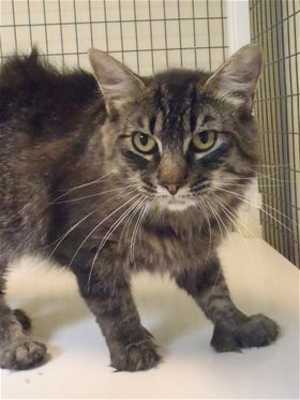
Adult gray tabby
This male gray tabby is 1 year old.
He weighs 7.4 pounds, has a long coat and has been neutered.
He’s in cat room kennel No. 11, ID 33504.

Male tabby kitten
This male brown tabby kitten is 9 weeks old.
He has a short coat and has not yet been neutered.
He’s in cat room kennel No. 23, ID No. 33506.
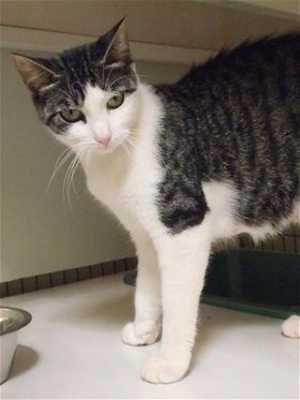
Female gray and white tabby
This female tabby is 2 years old.
She has a short gray and white coat, gold eyes and has not yet been spayed.
Find her in cat room kennel No. 46, ID No. 33740.

Domestic long hair mix
This female kitten is 16 weeks old.
She has a long black coat and green eyes. She has not yet been spayed.
She’s in cat room kennel No. 53, ID No. 33249.
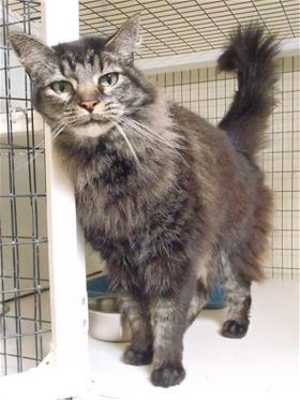
‘Flower’
“Flower” is a 7-year-old female gray tabby.
She has a long coat and has been spayed.
She’s in cat room kennel No. 57, ID No. 33708.
Adoptable cats also can be seen at http://www.co.lake.ca.us/Government/Directory/Animal_Care_And_Control/Adopt/Cats_and_Kittens.htm or at www.petfinder.com .
Please note: Cats listed at the shelter's Web page that are said to be “on hold” are not yet cleared for adoption.
To fill out an adoption application online visit http://www.co.lake.ca.us/Government/Directory/Animal_Care_And_Control/Adopt/Dog___Cat_Adoption_Application.htm .
Lake County Animal Care and Control is located at 4949 Helbush in Lakeport, next to the Hill Road Correctional Facility.
Office hours are Monday through Friday, 8 a.m. to 5 p.m., and 1 p.m. to 3 p.m., Saturday. The shelter is open from 10:30 a.m. to 4:30 p.m. Monday through Friday and on Saturday from 1 p.m. to 3 p.m.
Visit the shelter online at http://www.co.lake.ca.us/Government/Directory/Animal_Care_And_Control.htm .
For more information call Lake County Animal Care and Control at 707-263-0278.
Email Elizabeth Larson at
North Fire nears full containment; reaches 420 acres

NORTHERN CALIFORNIA – A fire burning since Saturday afternoon in Mendocino County is nearing full containment.
The North Fire was first reported shortly before 1:30 p.m. Saturday off Mill Creek Road near Cow Mountain, southeast of Ukiah.
On Sunday evening, Cal Fire’s Mendocino Unit said the fire had reached 420 acres and was 80 percent contained.
The cause remains under investigation, although officials received reports of a possible arson suspect.
According to the latest update, one injury was reported and no structures were threatened.
As a result of the fire, the Bureau of Land Management had closed the nearby recreation area, Cal Fire reported. Several roads east of the the city of Ukiah also were closed.
Approximately 536 personnel were on scene Sunday, 431 of them from Cal Fire, according to the end-of-day report.
There also were 19 engines, 17 fire crews, six airtankers, two dozers and six water tenders, Cal Fire said. Five of the engines and two of the fire crews came from assisting agencies.
Cooperating agencies in the fire suppression effort include the Mendocino County Sheriff, California Highway Patrol, California Department of Correction and Rehabilitation, Ukiah Valley Fire Protection District, Ukiah City Fire, Little Lake Fire Protection District, Redwood Valley Fire Protection District, Long Valley Fire Protection District, Hopland Fire District and Ukiah Ambulance Service.
Email Elizabeth Larson at
The Veggie Girl: Tarragon of virtue
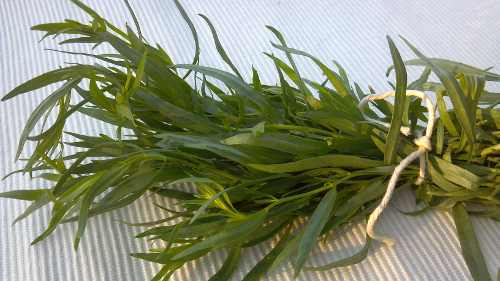
I had the good fortune to attend a cooking class the other night on sweet and savory tarts from the Provence region of France.
One particularly delicious offering, a beautifully colorful ratatouille tart, was topped with a mixture of chopped fresh parsley and tarragon while still warm from the oven. The dish was so elevated by the subtle licorice-like notes of tarragon that I was inspired to research and write about the herb.
As interesting an herb as it is, unless one was taught to cook by a French grandmother, it’s unlikely that tarragon is utilized much in the average American kitchen.
As intimated by the reference to a French grandmother, it’s beloved and well-used in France, and, among other things, is one of the four herbs that make up the classic “fines herbes” quartet from that country, along with chervil, parsley and chives.
It’s a unique herb, one that’s been described as being “strong and particular,” and because of this, using a light hand and employing caution in combining it with other herbs is wise.
The roots of tarragon – literally – go back long ago to Siberia, when a native perennial species of tarragon there produced a sterile subspecies with the scent and taste of anise.
Because the new plant produced no viable seed, it’s surmised that it was propagated by rooting stem cuttings or dividing its roots to replant.
The plant spread through human means, moving south to Arab lands, then west to North Africa and north to Spain, being finally brought from Spain to France during the Moorish invasion.
It was received enthusiastically in France, becoming an indispensable part of their cuisine and earning the name French tarragon.
The herb has been divided or stem-rooted thousands of times since then, making each French tarragon plant part of that original seedless plant in Siberia.
Tarragon is considered a good companion planting in the garden, being said to enhance the well-being of almost every other plant it’s near.
If buying French tarragon for the garden or an herb pot, be sure it’s true French tarragon and not the more mildly flavored Russian tarragon. Break off a leaf and crush it to be sure the characteristic smell and taste of anise with a resinous note is present.
A quaint recommendation for harvesting the leaves is “between midsummer and Michaelmas.” (I had to look up the meaning of Michaelmas, and this feast of the Archangel Michael is celebrated on Sept. 29.)
Tarragon is beautiful with salmon, sole and other fish, shellfish such as prawns and lobster, and meats such as chicken, other poultry and pork.
Since it works well with citrus flavors – all of them, including lime, orange, and even grapefruit – a sauce of tarragon, Meyer lemon juice, shallots and olive oil may be created to add bright flavor to most cooked vegetables and fish.
Just thinking of such a sauce sprinkled over fresh asparagus or a salad with shaved fennel (another good companion for tarragon) puts me in herbal heaven.
Spinach is enhanced by the flavor of tarragon, and the next time I put fresh leaves of spinach in a pot to steam, I’ll be sure to scatter scant bits of the herb among them.
French béarnaise sauce (a “child” of the mother sauce Hollandaise) is flavored with tarragon.
Speaking of sauces, Julia Child suggests making a reduction of white wine with tarragon to add to rich béchamel sauce, to which more butter is added. (In my opinion, the white-wine tarragon reduction alone – or perhaps with a little butter added - would be lovely drizzled over fish or vegetables.)
Adding tarragon to cold or warm salads of chicken or potatoes provides a creative means of flavoring them.
It’s delicious with tomatoes, mushrooms or peas, it can be tossed in a fresh green salad, it flavors Green Goddess and French salad dressings, and goes especially well with egg dishes.
Chopped fresh tarragon and a bit of lemon juice may be mixed with softened butter to make a flavorful compound butter.
Tarragon is popularly used to flavor vinegar, and the resulting product is a key ingredient when composing homemade tartar sauce. The French commonly use tarragon vinegar when making mustard, and it can be used to enhance vinaigrette salad dressings.
While tarragon vinegar is available commercially, making it at home is a simple process. There are numbers of variations on the recipe, and one version is included below for your use or for gift-giving.
Though there is some folklore related to tarragon (including that it reduces fatigue, prompting pilgrims of the Middle Ages to tuck the herb in their shoes prior to a long journey), there is little indication of its use throughout history as medicine, unlike most culinary herbs.
Even so, scientific studies show that tarragon reduces platelet adhesion and blood coagulation (possibly helping to prevent cardiovascular disease), improves digestion by increasing the secretion of bile and acids into the stomach, may help manage diabetes by improving insulin sensitivity, kills cancer-causing bacteria, and is an antiviral agent that helps rid the body of damaging free radicals.

The flavorful oils in tarragon (chemically identical to anise’s volatile oils) dissipate after drying, so the fresh herb is more pungent and intense than the dried version. This is atypical of herbs, since drying concentrates the flavor of most.
Thankfully, fresh tarragon may be preserved by freezing in airtight zipper-sealed bags. No defrosting is needed before use.
Since heat greatly intensifies the flavor of both dried and fresh tarragon, it’s best added at the last stages of cooking.
And it shouldn’t be too finely chopped, as cutting it causes the herb to oxidize, giving it a bad flavor. A few rough cuts should suffice.
The recipe I chose for tarragon vinegar is a basic one that doesn’t require heating the vinegar prior to pouring over the herb, although that’s an option to enhance the flavor infusion.
The recipe calls for white wine vinegar, but unseasoned rice vinegar or champagne vinegar are also nice choices.
In addition to the vinegar, I’ve included a simple and delicious recipe that utilizes France’s “fines herbes” combo in an omelet. Any two or three of the herbs would be fine if all four aren’t available.
Bon appétit! I hope you enjoy testing tasty tarragon.
Omelet aux fines herbes (omelet with fresh herbs)
6 eggs
1 tablespoon each chopped fresh tarragon, chives, chervil, and parsley
1 tablespoon unsalted butter
In a large mixing bowl, whisk the eggs until combined and season them lightly with salt and pepper. Mix the chopped herbs together in a separate bowl and then stir 1/4 of them into the eggs.
Heat one tablespoon of butter in a medium nonstick sauté pan over medium heat. When the butter has melted, pour in the eggs and let them set for a few seconds. As you tilt the pan to fill the space with uncooked egg, pull the cooked egg away from the sides of the pan. Put the pan back on the stove and let the omelet set again, another minute or so.
Sprinkle the surface of the omelet with the rest of the fresh herbs. Fold the omelet in half with a heatproof spatula. Cook one more minute for a slightly runny omelet.
This recipe courtesy of www.cookthink.com serves three or four.
Tarragon vinegar
2 cups fresh tarragon
2 cups white wine vinegar
Additional sprig tarragon for decoration
Container for steeping the vinegar
Decorative glass bottles with lids or stoppers
Bruise the tarragon leaves lightly to release the flavor.
Pack the leaves into a container. (A glass Mason jar with a screw-top lid works well.)
Pour the vinegar over the leaves in the container.
Cover the container and leave it for two to three weeks. This will draw out the flavor of the tarragon in the vinegar.
When flavor is as desired, strain the vinegar and pour into decorative glass bottles.
Add one sprig of tarragon per bottle, put on the lid or stopper, label, and date.
Recipe adapted from www.wikihow.com .
Esther Oertel, a freelance writer, cooking teacher, and speaker, is passionate about local produce and all foods in the vegetable kingdom. She welcomes your questions and comments and may be reached at
Helping Paws: Border collies, kelpies and terriers
LAKEPORT, Calif. – There’s a new group of hopeful canines at the county’s animal shelter this week.
Mixes of border collie, kelpie, boxer and terrier are available to join your family.
Thanks to Lake County Animal Care and Control’s new veterinary clinic, many of the animals offered for adoption already are spayed or neutered and ready to go home with their new families.
Dogs that are adopted from Lake County Animal Care and Control are either neutered or spayed, microchipped and, if old enough, given a rabies shot and county license before being released to their new owner. License fees do not apply to residents of the cities of Lakeport or Clearlake.
If you're looking for a new companion, visit the shelter. There are many great pets hoping you'll choose them.
The following dogs at the Lake County Animal Care and Control shelter have been cleared for adoption (additional dogs on the animal control Web site not listed are still “on hold”).

Border collie mix pup
This female border collie mix is 3 months old.
She has a short black and white coat and big brown eyes.
Find her in kennel No. 10, ID No. 33714.

Silky-wirehaired terrier mix
This male silky-wirehaired terrier mix is 3 years old.
He has a long brown and gray coat, a docked tail and has not been neutered.
He’s in kennel No. 12, ID No. 33681.
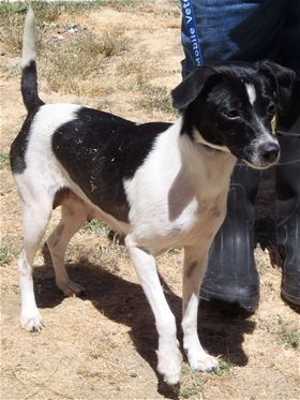
Fox terrier mix
The female fox terrier mix is 2 years old.
She has a short black and white coat, and has not been spayed.
Find her in kennel No. 15, ID No. 33604.

Chihuahua-terrier mix
This female Chihuahua-terrier mix is 8 years old.
She weighs 9 pounds, has a short tan coat and has been spayed.
Find her in kennel No. 18, ID No. 33273.

‘Slick’
“Slick” is a 3-year-old male Australian Kelpie mix.
He has a short tricolor coat and weighs just over 42 pounds.
Find him in kennel No. 22, ID No. 33397.

Male boxer mix
This male boxer mix is 2 years old.
He has a short brown coat and a short tail.
He’s in kennel No. 23, ID No. 33691.

Male mastiff mix pup
This male mastiff mix pup is 17 weeks old.
He has a short black coat with white markings, and has not yet been altered.
Find him in kennel No. 32a, ID No. 33551.

Male mastiff mix pup
This male mastiff mix pup is 17 weeks old.
He has a short black coat with white markings, and has not yet been altered.
Find him in kennel No. 32b, ID No. 33552.

Female mastiff mix pup
This female mastiff mix pup is 17 weeks old.
She has a short black coat with white markings, and has not yet been altered.
Find her in kennel No. 32c, ID No. 33551.

Female mastiff mix pup
This female mastiff mix pup is 17 weeks old.
She has a short black coat with white markings, and has not yet been altered.
Find her in kennel No. 33b, ID No. 33555.
Adoptable dogs also can be seen at http://www.co.lake.ca.us/Government/Directory/Animal_Care_And_Control/Adopt/Dogs_and_Puppies.htm or at www.petfinder.com .
Please note: Dogs listed at the shelter's Web page that are said to be “on hold” are not yet cleared for adoption.
To fill out an adoption application online visit http://www.co.lake.ca.us/Government/Directory/Animal_Care_And_Control/Adopt/Dog___Cat_Adoption_Application.htm .
Lake County Animal Care and Control is located at 4949 Helbush in Lakeport, next to the Hill Road Correctional Facility.
Office hours are Monday through Friday, 8 a.m. to 5 p.m., and 1 p.m. to 3 p.m., Saturday. The shelter is open from 10:30 a.m. to 4:30 p.m. Monday through Friday and on Saturday from 1 p.m. to 3 p.m.
Visit the shelter online at http://www.co.lake.ca.us/Government/Directory/Animal_Care_And_Control.htm .
For more information call Lake County Animal Care and Control at 707-263-0278.
Email Elizabeth Larson at




