 How to resolve AdBlock issue?
Fire burns near Upper Letts Lake in Mendocino National Forest
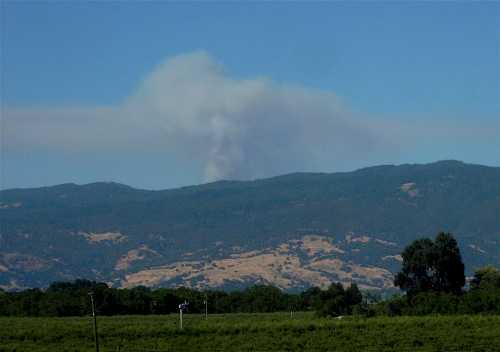
NORTHERN CALIFORNIA – State and federal firefighters responded Saturday afternoon to a fire burning in the Mendocino National Forest that resulted in campground evacuations.
The Mill Fire is located near Upper Letts Lake southwest of Stonyford, inside neighboring Colusa County, according to officials.
The U.S. Forest Service is leading the response, with Cal Fire reporting late Saturday that it was assisting with the effort.
The fire was first reported shortly before 3 p.m., at which point it was estimated to be about three to five acres with a moderate rate of spread, according to initial reports from the scene.
By about 6 p.m. the fire was confirmed at 100 acres, according to Tamara Schmidt, a Mendocino National Forest spokesperson.
“It’s still in initial attack,” Schmidt told Lake County News Saturday evening.
The cause is still under investigation, Schmidt said.
She said resources were continuing to come in Saturday night and Sunday.
Concerns about people in the canyon arose quickly after the fire was first reported, according to radio traffic.
“Mill Valley Campground was evacuated immediately,” Schmidt said.
Campers at Letts Lake Campground also were urged to evacuate as a precaution, said Schmidt.
Schmidt said they were advised to take Miner Ridge to Forest Road M5, as the way to Stonyford was unavailable due to the fire.
The fire was being hit hard from the air, with air tankers and copters at work, based on radio reports.
Cal Fire helicopters were reported to be using an area near Lake Pillsbury to land so they could refuel, according to California Highway Patrol reports.
Before 6 p.m. calls were put out on the radio for a fifth air tanker, because the terrain was too steep and dangerous for ground crews. Additional Type 2 helicopters for the effort weren’t available in the area, and a request was made for smokejumpers.
In one area, tankers were working to keep the fire from crossing a drainage of the Eel River, radio reports indicated.
Additional information on the fire will be posted as it becomes available.
Email Elizabeth Larson at
AMIA receives grant to repair boardwalk at Anderson Marsh State Historic Park

LOWER LAKE, Calif. – The Anderson Marsh Interpretive Association (AMIA) has received a $5,820 grant from the California State Parks Foundation (CSPF) ( www.calparks.org ) to support AMIA’s efforts to keep the Cache Creek Nature Trail boardwalk at Anderson Marsh State Historic Park accessible and in good repair.
“Many of our monthly Nature Walks and all of our school field trips include traveling over this part of the Anderson Marsh State Historic Park trail system,” said AMIA Secretary Gae Henry. “The Cache Creek Nature Trail and its boardwalk provide access to some of the best riparian habitats in the Park which could otherwise only be visited by water. The boardwalk is in need of repair and provides the only way for those with mobility issues to explore these fabulous habitats.”
“We appreciate everything that CSPF is doing to both assist the nonprofits that are working to prevent park closures as well as to help keep those Parks in good repair,” said AMIA President Roberta Lyons.
“The Anderson Marsh Interpretive Association is grateful for this financial support,” added AMIA Treasurer Henry Bornstein. “This grant will help us to meet our goal of keeping the park open and accessible to all members of the public.”
AMIA is a nonprofit association cooperating with the Department of Parks and Recreation (DPR) to promote educational and interpretive activities at Anderson Marsh State Historic Park.
AMIA is currently in negotiations with DPR to enter into an operating agreement that will allow Anderson Marsh State Historic Park to remain open during the state’s current budget crisis.
For information about Anderson Marsh State Historic Park, AMIA and how you can help, go to www.andersonmarsh.org or contact AMIA at either

‘Twisted Star’ joins Lake County Quilt Trail

KELSEYVILLE, Calif. – Over the tops of the steep hillside St. Olof vineyard and through the plush foliage of trees, hangs another Lake County Quilt Trail gem, titled “Twisted Star.”
Cindi and Eric Olof, 5615 Highland Springs Road, Lakeport, own the Olof Cellars and the barn holding the quilt block.
From a distance there is a slight view from Highland Springs Road. GPS location: N 38° 58´36¨ W 122° 53´40.¨ For a closer look-see, the owners prefer visitors call for an appointment at 707-391-7947.
Cindi Olof’s great-grandmother was of Norwegian ancestry and introduced her to the art of quilting.
Searching for a pattern that embraced Scandinavian appliquéd knot designs, she chose an enter-twined star and filled the block with very bright colors.
Olof said, “This is a wonderful community project. It makes people smile.”
Day to day information about the Lake County Quilt Trail can be found on Facebook. Pictures of the artists and projects in progress are posted frequently.
Information, history, and application forms to join this on-going project are found at www.lakecountyquilttrail.com .
Bethany Rose, 707-263-5744, is available for questions or visit Kerrie’s Quilting Shop at 1853 N. High Street, Lakeport, 707-263-8555.

Space News: Stellar flare blasts exoplanet

An international team of astronomers using data from NASA’s Hubble Space Telescope has made an unparalleled observation, detecting significant changes in the atmosphere of a planet located beyond our solar system.
The scientists conclude the atmospheric variations occurred in response to a powerful eruption on the planet’s host star, an event observed by NASA’s Swift satellite.
The stellar flare, which hit the planet like 3 million X-flares from our own sun, blasted material from the planet’s atmosphere at a rate of at least 1,000 tons per second.
“The multiwavelength coverage by Hubble and Swift has given us an unprecedented view of the interaction between a flare on an active star and the atmosphere of a giant planet,” said lead researcher Alain Lecavelier des Etangs at the Paris Institute of Astrophysics (IAP), part of the French National Scientific Research Center located at Pierre and Marie Curie University in Paris.
The exoplanet is HD 189733b, a gas giant similar to Jupiter, but about 14 percent larger and more massive.
The planet circles its star at a distance of only three million miles, or about 30 times closer than Earth’s distance from the sun, and completes an orbit every 2.2 days.
Its star, named HD 189733A, is about 80 percent the size and mass of our sun.
Astronomers classify the planet as a “hot Jupiter.” Previous Hubble observations show that the planet’s deep atmosphere reaches a temperature of about 1,900 degrees Fahrenheit (1,030 C).
HD 189733b periodically passes across, or transits, its parent star, and these events give astronomers an opportunity to probe its atmosphere and environment.
In a previous study, a group led by Lecavelier des Etangs used Hubble to show that hydrogen gas was escaping from the planet’s upper atmosphere. The finding made HD 189733b only the second-known “evaporating” exoplanet at the time.
The system is just 63 light-years away, so close that its star can be seen with binoculars near the famous Dumbbell Nebula. This makes HD 189733b an ideal target for studying the processes that drive atmospheric escape.
“Astronomers have been debating the details of atmospheric evaporation for years, and studying HD 189733b is our best opportunity for understanding the process,” said Vincent Bourrier, a doctoral student at IAP and a team member on the new study.
In April 2010, the researchers observed a single transit using Hubble’s Space Telescope Imaging Spectrograph (STIS), but they detected no trace of the planet’s atmosphere.
Followup observations in September 2011 showed a surprising reversal, with striking evidence that a plume of gas was streaming away from the exoplanet at 300,000 mph. At least 1,000 tons of gas were leaving the planet’s atmosphere every second.
This turn of events was explained by data from Swift’s X-ray Telescope. On Sept. 7, 2011, just eight hours before Hubble was scheduled to observe the transit, Swift was monitoring the star when it unleashed a powerful flare.
“The planet’s close proximity to the star means it was struck by a blast of X-rays tens of thousands of times stronger than the Earth suffers even during an X-class solar flare, the strongest category,” said co-author Peter Wheatley, a physicist at the University of Warwick in England. After accounting for the planet’s enormous size, the team notes that HD 189733b encountered about 3 million times as many X-rays as Earth receives from a solar flare at the threshold of the X class.
These findings will appear in an upcoming issue of the journal Astronomy & Astrophysics.
Dr. Tony Phillips works for the National Aeronautics and Space Administration.




