 How to resolve AdBlock issue?
California Heritage Council honors St. John’s Episcopal Church for historic restoration, preservation
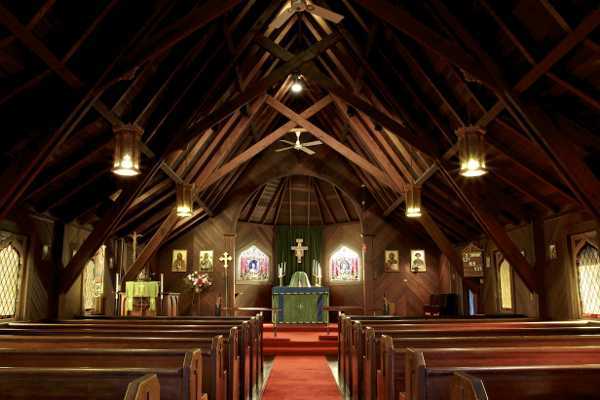
LAKEPORT, Calif. – St. John’s Episcopal Church earned an Award of Recognition for its restoration and preservation by the California Heritage Council, California Trust for Historic Preservation (CHC).
The award was be presented at the St. Francis Yacht Club in San Francisco last Thursday, June 28.
Other 2012 honorees are Edgehill Mansion a.k.a. Dominican Heritage & Alumni House, San Rafael; the Leland Stanford Mansion (interior), Sacramento; Luther Burbank Home & Garden Center, Santa Rosa; Murphy Windmill, San Francisco; and a 1934 Packard custom Dietrich convertible, Morgan Hill.
“The California Heritage Council is dedicated to preserving and honoring places and buildings which have given quality and distinction to the cultural life of California,” said President Christopher Layton of Calistoga.
St. John’s was nominated by CHC Lake County representatives Lynne and Bernie Butcher of Tallman Hotel in Upper Lake. Tallman Hotel earned the award in 2007.
Parish Priest Fr. Leo M. Joseph, O.S.F., of Kelseyville, and Senior Warden Barbara Knight and Vestry member Anne Barquist of Lakeport traveled to San Francisco to accept the award.
St. John’s building was recognized as a point of historical interest in Lake County by the State of California Historical Resources Commission in 1989.
Although the property, with its historic building, is owned by the parish and held in trust for the Diocese of Northern California and The Episcopal Church, it is solely maintained by the generous support of local parishioners and friends of the parish with annual pledges and proceeds of the thrift shop, St. John’s Basement Boutique.
Through the Collier family roots in San Francisco, Mary Blackwood Collier commissioned brilliant young architect, Willis Polk, who a decade later was a chief rebuilder of San Francisco after the 1906 earthquake and fire.
Since most of Lake County Episcopalians at that time were of English stock, Polk designed what he called an “English country church” in native redwood, which local residents called a “miniature cathedral.”
The church is a wood-framed, shingled exterior is a unique expression of 19th century carpenter Gothic style.
The lych gate was designed by Richard Duce, a retired set designer from a major Hollywood studio. The gate is patterned after the one at Saint Mary the Virgin Episcopal Church in San Francisco.
The pews are made of solid redwood planks. The redwood burl altar table is original, as are the baptismal font and brass lectern.
The altar cross is a hand-painted replica of the San Damiano Cross, beloved by St. Francis of Assisi.
The two stained glass windows on either side of the altar, depicting the Christ Child and St. John the Baptist as a young boy, are typical of the late Victorian era.
The most recent additions to the church are hand-painted icons of Christ, the Virgin Mary, St. John the Baptist and St. George, located on either side of the sanctuary arch. They were transferred to St. John’s from the chapel at Little Portion Hermitage, Kelseyville.
There are eight amber-leaded glass windows along both sides of the church, which have a Venetian Gothic arch-shaped frame popular in 14th century England.
The beautiful stained glass window depicting the Good Shepherd and symbols of the Four Evangelists at the west front of the church was created in 1965 by Carl Huneke, Century Stained Glass Studio, San Francisco.
The presence and ministry of The Episcopal Church in Lake County since 1877, St. John’s is a visible, welcoming family of Christ, resolved to deepen the relationship with God.
All are welcome at St. John’s Episcopal Church Sunday services at 10 a.m., 1190 N. Forbes Street, Lakeport.
Visit the church’s Web site at www.saintjohnslakeport.org .
NASA maps heat wave fueling wildfires in western United States
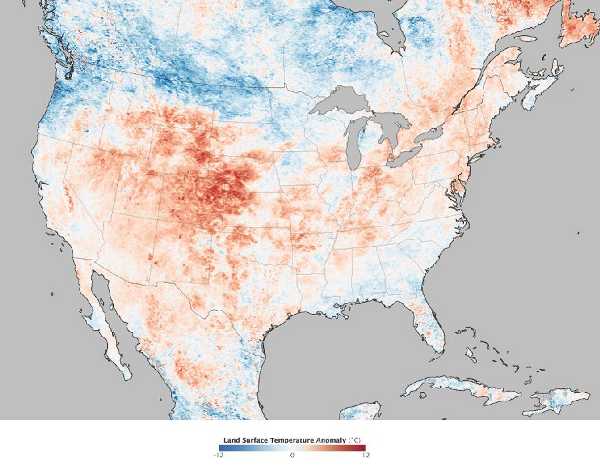
A newly released heat wave map created by the National Aeronautics and Space Administration is illustrating the heat wave that is contributing to fires that are raging in Colorado and other parts of the western United States.
Among the major fires, the Waldo Canyon fire in Colorado attracted the most attention after spreading into Colorado Springs and charring hundreds of homes, but large wildfires also burned throughout Utah, Wyoming, Montana, New Mexico and Arizona.
A lack of winter snow cover and ongoing drought primed vegetation in these states for ignition. But in recent weeks, another ingredient for extreme wildfire emerged: heat. High temperatures dry out vegetation and decrease the relative humidity, making it easier for fires to ignite and spread.
The intensity and scope of the heat wave in the western United States is visible in the map show above that illustrates land surface temperature anomalies for June 17-24, 2012.
Based on data from the Moderate Resolution Imaging Spectroradiometer (MODIS) on NASA’s Terra satellite, the map depicts temperatures compared to the 2000-11 average for the same eight day period in June.
Areas with warmer than average temperatures are shown in red; near-normal temperatures are white; and areas that were cooler than the 2000-11 base period are blue. Colorado experienced the brunt of the heat wave and had eight large wildfires burning on June 28, 2012.
Wyoming and Utah—other states that have seen unusually hot weather-- together had nine wildfires burning.
Land surface temperatures (LST) are distinct from the air temperatures that meteorological stations typically measure.
LSTs indicate how hot the surface of the Earth would feel to the touch. From a satellite vantage point, the “surface” includes a number of materials that capture and retain heat, such as desert sand, the dark roof of a building, or the pavement of a road.
As a result, daytime land surface temperatures are usually higher than air temperatures.
This heat wave, like all extreme weather events, has its direct cause in a complex set of atmospheric conditions that produce short-term weather.
However, weather occurs within the broader context of the climate, and there’s a high level of agreement among scientists that global warming has made it more likely that heat waves of this magnitude will occur.
CHP plans Independence Day Maximum Enforcement Period
LAKE COUNTY, Calif. – On this July 4, Californians will observe the occasion with parties, picnics, and outdoor activities.
The California Highway Patrol (CHP) reminds motorists to be mindful of the speed limit, designate a non-drinking driver and always buckle up.
Independence Day is a Maximum Enforcement Period (MEP) for the CHP.
Officers will monitor motorists who are a potential threat to themselves and others.
The MEP begins on Tuesday, July 3, at 6 p.m. and runs through Wednesday, July 4, at 11:59 p.m.
“When celebrating Independence Day, the CHP wants you to be safe. When driving be sure to leave plenty of time to get to your destination. Most importantly, before heading out, insist everyone in the vehicle is wearing a seat belt and children are secure in safety seats,” said CHP Commissioner Joe Farrow.
Last year during the Independence Day MEP, 34 people were killed in traffic collisions in California. This was a significant increase from the 23 people who died in 2010, the last full year for which statistics are available.
Sadly, many of those deaths may have been prevented with the simple click of a seat belt, according to the CHP.
“It is alarming to know that more than 80 percent of the people who were killed in vehicle collisions over the Independence Day holiday last year may have survived had they taken the time to buckle up,” added Commissioner Farrow.
Driving under the influence is always a major concern for the CHP.
Last year, over the Independence Day weekend, CHP officers made 1,562 arrests for driving under the influence.
Motorists are reminded to designate a non-drinking driver before they celebrate to ensure everyone’s safety while on the road.
REGIONAL: 3.6-magnitude quake reported near Covelo
NORTH COAST, Calif. – A 3.6-magnitude quake occurred near Covelo in Mendocino County early Sunday morning.
The US Geological Survey reported that the quake took place at the earth’s surface at 3:05 a.m. five miles west of Covelo, 11 miles northeast of Laytonville and 70 miles north northwest of Clearlake.
No shake reports were immediately available from the US Geological Survey.
Email Elizabeth Larson at




