How to resolve AdBlock issue?
Forest prepared for 2012 fire season, asking visitors to be careful with fire
MENDOCINO NATIONAL FOREST, Calif. – With temperatures heating up, fire danger in the Mendocino National Forest is starting to increase with the approach of summer.
As forest firefighters wrap up preparedness activities, visitors are asked to be careful with campfires, grills and anything that can throw a spark and start a wildfire.
The forecast for the weekend includes hot temperatures, as well as a red flag warning issued by the National Weather Service through 9 p.m. Saturday that affects the eastern side of the Mendocino National Forest.
In addition to rapidly drying out fuels, high winds can also carry wildfires quickly.
“We had a drier than normal winter and our fuels are drying out quickly,” said Forest Fire Management Officer Marc Nelson. “However, this is pretty close to normal for the Mendocino National Forest.”
As the summer recreation season starts, more visitors are traveling to the forest to enjoy camping, fishing, backpacking and other favorite activities. This frequently includes having a campfire, using a portable stove or charcoal grill, or operating recreational equipment.
“We would like to ask visitors to be careful when they are using anything with a flame or that can throw a spark,” Nelson said. “The forest has been very fortunate in not having a large wildfire since 2008. While we can’t prevent fires starting from lightning, visitors can make a difference by helping us prevent human-caused fires.”
Preventing wildfires can be done by making sure campfires are contained within a fire ring in an area that has been cleared of any fuels. Campfires should also be put completely out and be cold to the touch before leaving the site. Stoves should be on a stable surface and not left unattended.
Mechanical equipment, including off-highway vehicles and chainsaws, should be equipped with approved spark arresters.
The forest has not entered into fire restrictions yet, but as fuels continue to dry out and the threat of wildfire increases, the firefighters on the forest are prepared for the season.
A little more than half of the employees on the Mendocino National Forest during the summer are wildland firefighters.
Currently there are 11 engines staffed on the forest, with eight engines working seven days a week and three engines on a five-day schedule. Six of the 11 engines cover the western half of the forest, with five providing coverage for the eastern half of the Mendocino.
There are four water-tenders and four fire prevention technicians. The forest also staffs two fire lookouts, one at Anthony Peak, the other at High Glade.
The Mendocino National Forest has two 20-person handcrews – the Mendocino Hotshots, based out of Stonyford, and the Elk Mountain Hotshots based out of Upper Lake. Each of these crews has already had assignments this year in Arizona and New Mexico.
In addition to these resources, the forest hosts and provides support to nine organized crews, which are available on an as-needed basis. These crews can be activated when fire danger increases, when local resources are unavailable, or when there is a need nationally. Last season the organized crews worked on fires in Arizona, New Mexico, Nevada and Minnesota.
Each crew has 20 people staffing it. The forest hosts four crews out of Willits, five crews out of Davis, and also provides support and issues firefighting gear to the Guam, Samoa and Saipan Islander Organized Crews.
In partnership with the California Conservation Corps (CCCs), the Forest provides wildland firefighter training and support for a crew out of Ukiah.
“The Organized Crew Program is a huge asset for the Mendocino National Forest. Many of our permanent firefighters have come to the Forest Service as a result of their experience with the program,” Nelson said. “It’s a great opportunity for individuals to see if a career in wildland firefighting is something they want to pursue and, if they do want to continue, it provides them quality experience they can reflect when applying for jobs.”
Over the past few weeks, the forest has completed seasonal preparedness activities. This included firefighter training for the CCCs in Ukiah, fire readiness reviews and meetings with fire staff.
For more information, please contact the Mendocino National Forest at 530-934-3316, or visit www.fs.usda.gov/mendocino .
Five arrested during Wednesday marijuana raid
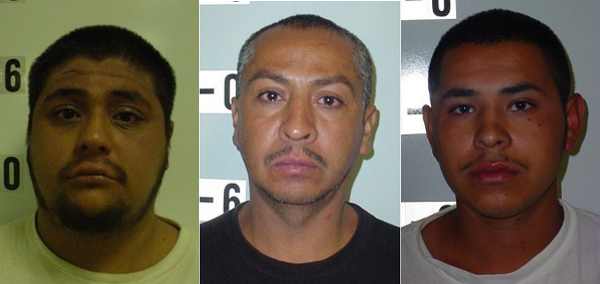
NICE, Calif. – The service of a search warrant by the Sheriff’s Narcotics Task Force Wednesday morning has resulted in five arrests and the seizure of 475 marijuana plants.
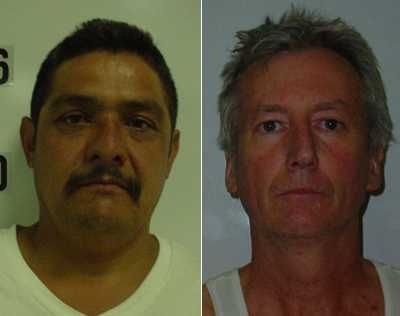
Sgt. Steve Brooks said officials arrested Aviel Islas Hernandez, 42, a transient; 22-year-old Fidel Avellaned Hernandez, a transient; 20-year-old Marco Antonio Martinez of Santa Rosa; William “Billy” Walls, 60, of Ukiah; and Telesforo Montejano Cornejo, 47, of Santa Rosa.
On Tuesday narcotics detectives secured a search warrant for several properties located on Harding Drive in Nice, Brooks said.
On Wednesday at approximately 8 a.m. narcotics detectives served the search warrant on the properties. Brooks said they located three male adults – Fidel Hernandez, Avellaned Hernandez and Martinez – inside a complex of marijuana grows, according to Brooks. All three subjects were detained without incident.
During the course of the investigation, narcotics detectives located and eradicated 475 marijuana plants located in several different plots, which were all connected together by a trail system, Brooks said.
Evidence collected at the scene revealed that the marijuana growing at the scene was not in compliance with Proposition 215. Brooks said the investigation also revealed that the suspects were killing birds they claimed were damaging their marijuana plants and dumping human waste in seasonal creek beds.
Detectives arrested Martinez, Fidel Hernandez and Aviel Hernandez for cultivation of marijuana and possession of marijuana for sales, Brooks said.
He said one of the subjects arrested provided information that “Billy” was responsible for the marijuana grow sites but was unable to provide any additional information regarding “Billy.”
While narcotic detectives were on scene, two additional subjects arrived at the location – Walls and Cornejo. Brooks said both subjects were detained without incident.
The investigation revealed that both Walls and Cornejo were part of the illegal marijuana growing operation. Brooks said Walls admitted that some of the plants at the grow site were his. He also admitted to selling marijuana to dispensaries.
Detectives arrested Walls and Cornejo for cultivation of marijuana and possession of marijuana for sales, Brooks said. All five suspects were transported to the Lake County Hill Road Correctional Facility and Booked.
The Sheriff’s Narcotics Task Force can be contacted through its anonymous tip line at 707-263-3663.
Space News: Why won't the supernova explode?
Somewhere in the Milky Way, a massive old star is about to die a spectacular death. As its nuclear fuel runs out, the star begins to collapse under its own tremendous weight. Crushing pressure triggers new nuclear reactions, setting the stage for a terrifying blast. And then ... nothing happens.
At least that's what supercomputers have been telling astrophysicists for decades. Many of the best computer models of supernovas fail to produce an explosion. At the end of the simulation, gravity wins the day and the star simply collapses.
"We don't fully understand how supernovas of massive stars work yet," said Fiona Harrison, an astrophysicist at the California Institute of Technology.
To figure out what’s going on, Harrison and colleagues would like to examine the inside of a real supernova while it's exploding. That's not possible, so they're doing the next best thing.
Using a telescope named "NuSTAR" – short for Nuclear Spectroscopic Telescope Array – they'll be scanning the debris from supernovas as soon as possible after the blast.
Launched over the Pacific Ocean on June 13 by a Pegasus XL rocket, NuSTAR is the first space telescope that can focus very high-energy X-rays, producing images roughly 100 times sharper than those possible with previous high-energy X-ray telescopes.
When NuSTAR finishes its check-out and becomes fully operational, scientists will use it to scan supernovas for clues etched into the pattern of elements spread throughout the explosion's debris.
"The distribution of the material in a supernova remnant tells you a lot about the original explosion,” says Harrison.
An element of particular interest is titanium-44. Creating this isotope of titanium through nuclear fusion requires a certain combination of energy, pressure, and raw materials.
Inside the collapsing star, that combination occurs at a depth that's very special. Everything below that depth succumbs to gravity and collapses inward to form a black hole.
Everything above that depth will be blown outward in the explosion. Titanium-44 is created right at the cusp.
So the pattern of how titanium-44 is spread throughout a supernova remnant can reveal a lot about what happened at that crucial threshold during the explosion. And with that information, scientists might be able to figure out what's wrong with their computer simulations.
Some scientists believe the computer models are too symmetrical. Until recently, even with powerful supercomputers, scientists have only been able to simulate a one-dimensional sliver of the star. Scientists just assume that the rest of the star behaves similarly, making the simulated implosion the same in all radial directions.
But what if that assumption is wrong?
"Asymmetries could be the key," Harrison said. In an asymmetrical collapse, outward forces could break through in some places even if the crush of gravity is overpowering in others. Indeed, more recent, two-dimensional simulations suggest that asymmetries could help solve the mystery of the "non-exploding supernova."
If NuSTAR finds that titanium-44 is spread unevenly, it would be evidence that the explosions themselves were also asymmetrical, Harrison explains.
To detect titanium-44, NuSTAR needs to be able to focus very high energy X-rays. Titanium-44 is radioactive, and when it decays it releases photons with an energy of 68 thousand electron volts. Existing X-ray space telescopes, such as NASA's Chandra X-Ray Observatory, can focus X-rays only up to about 15 thousand electron volts.
Normal lenses can't focus X-rays at all. Glass bends X-rays only a minuscule amount – not enough to form an image.
X-ray telescopes use an entirely different kind of "lens" consisting of many concentric shells. They look a bit like the layers of a cylindrical onion.
Incoming X-rays pass between these layers, which guide the X-rays to the focal surface. It's not a lens, strictly speaking, because the X-rays reflect off the surfaces of the shells instead of passing through them, but the end result is the same.
The NuSTAR team has spent years perfecting delicate manufacturing techniques required to make high-precision X-ray optics for NuSTAR that work at energies as high as 79 thousand electron volts.
Their efforts could end up answering the question, "Why won't the supernova explode?"
Patrick Barry and Dr. Tony Phillips work for the National Aeronautics and Space Administration.

Jury finds Lopez guilty of murder, 14 other counts for 2011 shooting that killed child
THIS STORY HAS BEEN UPDATED.
LAKEPORT, Calif. – After four hours of deliberating, a jury found a Clearlake Oaks man guilty of first-degree murder and 14 other counts, as well as dozens of special allegations for a Clearlake shooting a year ago that killed a child and wounded five others.
Orlando Lopez, 24, and his attorney, Stephen Carter, received the verdict late Friday afternoon, just days before the one-year anniversary of the shooting, the worst incident of its kind in Clearlake's history.
“There will be an appeal and we feel there are a great many significant appellate issues that higher courts will review,” Carter told Lake County News Friday night.
Lopez and codefendant Paul Braden, 22, also of Clearlake Oaks, have been on trial for several months for the fatal shooting on June 18, 2011, at the Lakeshore Drive home where Desiree Kirby and her boyfriend Ross Sparks lived with their baby daughter and her son, 4-year-old Skyler Rapp.
District Attorney Don Anderson alleged that Braden and Lopez shot into a crowd of friends and family at Sparks' and Kirby's home just before 11 p.m. on that Saturday, killing the little boy, wounding Kirby and Ross Sparks, his brother Andrew Sparks, and friends Ian Griffith and Joseph Armijo.
The jury agreed with Anderson's case, finding that Lopez was guilty of first-degree murder for Skyler Rapp's death; the attempted murder of Kirby, Ross Sparks, Andrew Sparks, Griffith and Armijo; two counts of mayhem for the shootings of Kirby and Andrew Sparks; six counts of assault with a firearm for all of the shooting victims; and a count of discharge of a firearm at an inhabited dwelling. All special allegations were found true.
Kirby, who was wounded and left with permanent injuries, sat in the front row of the gallery, accompanied to the verdict reading by a Victim-Witness Division advocate. Two rows of friends sat behind her.
Despite an admonition from Judge Doris Shockley that there should be no outbursts during the verdict's reading, when the guilty verdict was announced on the first-degree murder count, Kirby and her family and friends shrieked with joy before a bailiff warned them to stop.
Testimony in the case began in late February following a month of jury selection in which two juries – one for Lopez and one for Braden – were seated.
Lopez's jury – composed of four women and eight men – began deliberations Friday morning after closing arguments and jury instructions had been concluded early Thursday evening.
Also on Friday, at the same time as the Lopez jury's deliberations were taking place, their colleagues on Braden's jury were hearing closing arguments by Anderson and Braden's attorney, Doug Rhoades.
Throughout the day on Friday Lopez's jury sent Shockley, a visiting Yolo County judge, several notes with questions about evidence.
At one point Friday morning, Shockley called a brief break during Anderson's closing statements before the Braden jury in order to go into chambers with the attorneys to discuss the Lopez jury's communication.
Other notes followed and at around 2:30 p.m. the jury reported that it had reached a verdict.
Shockley scheduled Lopez's verdict reading to begin at 4:30 p.m. in order to give her time to continue instructing the Braden jury on how to handle its deliberations.
The Braden jury was ordered to return at 10 a.m. Tuesday, June 19, when Shockley will finish instructions and the jurors will begin deliberations.
Jury released, sentencing scheduled
Following the verdict in the Lopez case, Shockley asked Anderson and Carter if they wanted the jurors polled. Both said no.
Shockley then turned to the jury, thanking them for their service and patience. There had been a lot of challenges, she said. “You’ve been so very considerate.”
The judge, who said she works in 15 different counties as a visiting judge, said that the court staff in Lake County “is pretty amazing.”
She then excused the jury just before 5:15 p.m.
Lopez agreed to waive time for sentencing, which Shockley set for 1:30 p.m. Tuesday, Aug. 7. She ordered the full probation report to assist in sentencing be ready by Friday, July 27.
At sentencing Lopez is facing the potential for time equaling several life sentences, said Anderson.
As Kirby’s family and friends began leaving the courtroom, some stopped to hug and thank Anderson.
He told Lake County News after the verdict that he hopes the case will lead young people to realize how acting in anger before thinking can ruin lives forever.
Anderson said he had been concerned about Lopez’s case, as he felt it was not as strong as his case against Braden.
During trial Anderson had produced several witnesses who testified to seeing Braden with a gun before the shooting.
However, only one person – former codefendant Kevin Stone – testified to seeing a firearm, in this case a shotgun, in Lopez’s hands at the scene, where he admitted to driving Stone and Braden that night. He claimed Lopez had told him they were going to commit a robbery.
Stone reached an agreement with Anderson last fall to plead no contest to being an accessory to the murder after the fact, conspiracy to commit robbery and being a prohibited person with a firearm. Those charges will mean he’s looking at a total sentence of 10 years and four months in prison.
This was the first case Anderson – who is 18 months into his first term as district attorney – has prosecuted.
He’s taken heavy criticism from various quarters of the community for handling such a complicated case his first time out. Rhoades called attention to Anderson’s lack of experience as a criminal prosecutor in one of the case’s mistrial motions.
The case – which had Anderson squaring off against Rhoades and Carter – wasn’t without mistakes.
A question that Anderson should not have asked of a Clearlake Police officer in the presence of both juries led to one of several mistrial motions, which ultimately were denied.
He also misspoke about evidence during Lopez’s closing arguments – wrongly attributing comments by Lopez to Braden – which led to admonishments by Shockley to be more careful in his comments to the jury.
Asked why he took on the complex and emotionally charged case, Anderson told Lake County News, “It was the type of case that I had an extreme amount of interest in and wanted to follow through.”
He also has been with the case from the beginning. He said he was called to the scene the night of the shooting, and while there he met some of the people involved and decided he wanted to continue to be involved with the case.
Anderson said he also considered the potential backlash if he lost, but it ultimately wasn’t a major concern for him.
“I’m in this job to do things right and not worry about reelection,” he said.
Email Elizabeth Larson at