 How to resolve AdBlock issue?
Firefighters contain fires near Capay, Morgan Valley
NORTHERN CALIFORNIA – Fires in Yolo and Lake counties kept firefighters engaged on Saturday afternoon.
The largest of the fires, the Casino Fire, was first reported at 2:30 p.m. Saturday, according to Cal Fire.
The Casino Fire was located in Yolo County off of Highway 16, north of Capay and just south of the Cache Creek Casino, Cal Fire reported.
Engines, copters and tankers reportedly responded to fight the fire, which was burning in grassy oak woodland with structures threatened.
Cal Fire said the blaze burned 260 acres before it was contained at 7:30 p.m. No structures were reported to have been damaged.
Shortly after 2 p.m. some of the Cal Fire tankers working on the Casino Fire were reportedly sent to the 9100 block of Rocky Creek Road in Morgan Valley Road where a small vegetation fire was burning.
Specifics of the Morgan Valley fire – which was reported to have burned about five acres – were not immediately available Saturday evening.
Email Elizabeth Larson at
Helping Paws: Two working dogs
LAKEPORT, Calif. – Two working dogs are available for adoption this week at Lake County Animal Care and Control.
A border collie and Australian cattle dog are at the shelter and waiting for new homes.
Thanks to Lake County Animal Care and Control’s new veterinary clinic, many of the animals offered for adoption already are spayed or neutered and ready to go home with their new families.
Dogs that are adopted from Lake County Animal Care and Control are either neutered or spayed, microchipped and, if old enough, given a rabies shot and county license before being released to their new owner. License fees do not apply to residents of the cities of Lakeport or Clearlake.
If you're looking for a new companion, visit the shelter. There are many great pets hoping you'll choose them.
The following dogs at the Lake County Animal Care and Control shelter have been cleared for adoption (additional dogs on the animal control Web site not listed are still “on hold”).
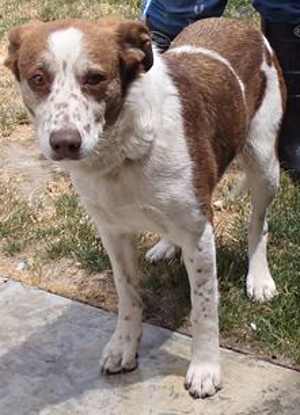
Australian cattle dog
This female Australian cattle dog/blue heeler mix is 5 years old.
She has a red and white coat and weighs nearly 43 pounds.
She is in kennel No. 20, ID No. 33061.
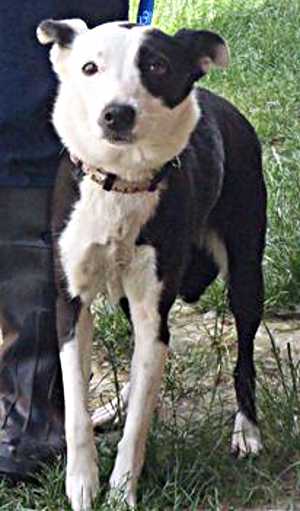
Border collie mix
This male border collie mix is 1 year old.
He has a short black and white coat and weighs 23 pounds.
Find him in kennel No. 22, ID No. 33062.
Adoptable dogs also can be seen at http://www.co.lake.ca.us/Government/Directory/Animal_Care_And_Control/Adopt/Dogs_and_Puppies.htm or at www.petfinder.com .
Please note: Dogs listed at the shelter's Web page that are said to be “on hold” are not yet cleared for adoption.
To fill out an adoption application online visit http://www.co.lake.ca.us/Government/Directory/Animal_Care_And_Control/Adopt/Dog___Cat_Adoption_Application.htm .
Lake County Animal Care and Control is located at 4949 Helbush in Lakeport, next to the Hill Road Correctional Facility.
Office hours are Monday through Friday, 8 a.m. to 5 p.m., and 1 p.m. to 3 p.m., Saturday. The shelter is open from 10:30 a.m. to 4:30 p.m. Monday through Friday and on Saturday from 1 p.m. to 3 p.m.
Visit the shelter online at http://www.co.lake.ca.us/Government/Directory/Animal_Care_And_Control.htm .
For more information call Lake County Animal Care and Control at 707-263-0278.
Space News: X-ray telescope to focus on hottest regions of black holes, supernovas
NASA is scheduled to launch an orbiting X-ray satellite on Wednesday, June 13, that will open a new window on the universe, allowing scientists to probe the roiling edges of black holes, the turbulent outflow from exploding stars, and the smallest, most frequent flares on the sun.
The Nuclear Spectroscopic Telescope Array, or NuSTAR, is the first orbiting satellite to produce sharp images of high-energy X-rays produced by explosive events and extreme objects such as black holes and neutron stars.
“We believe most, if not, all galaxies have a massive black hole at their center, but a lot of these are hidden from the view of optical and normal X-ray telescopes by gas and dust,” said Steve Boggs, University of California, Berkeley, professor of physics and a co-investigator for the NuSTAR mission. “This thwarts our ability to understand the nature of a majority of the black holes that are feeding from their host galaxy. By using high-energy X-rays, the properties of these black holes will be revealed.”
NuSTAR’s instruments were designed and built by scientists at the California Institute of Technology (Caltech), UC Berkeley and other institutions, and will be operated by scientists at UC Berkeley’s Space Sciences Laboratory.
The instruments can detect X-rays with energies up to 10 times those detectable by NASA’s orbiting Chandra X-ray Observatory, and do something no X-ray telescope currently does: focus these high-energy X-rays to form an image.
“NuSTAR will create images 10 times crisper and 100 times more sensitive than any other telescopes observing in this region,” said Fiona Harrison, principal investigator for the mission and a professor of physics and astronomy at the California Institute of Technology. “This will enable NuSTAR to study some of the hottest, densest, most energetic phenomena in the universe.”
NuSTAR, about the size of a refrigerator, is now loaded aboard a Pegasus XL rocket that is strapped beneath an L-1011 “Stargazer” carrier aircraft on Kwajalein Atoll in the central Pacific Ocean.
At about 8:30 a.m. PDT (11:30 a.m. EDT) on June 13, at a height of 39,000 feet, the plane will drop the rocket, which will ignite its engines to carry NuSTAR into an equatorial orbit about 375 miles above Earth.
While visible light is easily focused by mirrors, X-rays are not: they penetrate mirrors except at very glancing angles. NuSTAR scientists developed nested shells of 133 mirrors that are almost, but not quite, parallel to the incoming X-rays.
The X-rays skip off the mirrors and come to a focus on detectors about 33 feet away.
“This new type of X-ray telescope enables some truly exciting science,” said UC Berkeley’s Bill Craig, instrument manager for NuSTAR. “It took a large international team many years to perfect this technology, and it is great to finally get an instrument of this type in orbit.”
Because the satellite had to be compact for launch, it incorporates an extendable mast that is collapsed during launch but, after reaching orbit and following system checkout, will deploy in 56 locking stages to a length of 10 meters, providing a precise focal separation between the mirrors and the detectors.
NuSTAR has two nested sets of these mirrors to improve detection at the full range of high-energy X-rays. The mast will unfurl about seven days after launch; science operations will begin about 23 days later.
Aside from surveying massive black holes in the universe, NuSTAR also will focus on the remains of supernovas in the Milky Way Galaxy that exploded within the last several hundred years.
By analyzing the high-energy X-rays emitted by radioactive nuclei in the expanding debris, scientists hope to reconstruct the reactions that took place in the exploding star.
“The type and number of nuclei we see today are fingerprints of what happened deep in the core of the explosion, and they allow us to go back and deduce the underlying explosion physics that we don’t have access to in labs on Earth,” Boggs said.
NuSTAR’s unique ability to focus high energy X-rays will also allow solar physicists to study explosive events on the sun, such as coronal mass ejections and micro- and nanoflares that are believed to pepper the sun’s surface and heat its atmosphere.
NuSTAR, one of NASA’s Small Explorer missions, is led by Caltech and managed its Jet Propulsion Laboratory for NASA’s Science Mission Directorate in Washington.
The spacecraft was built by Orbital Sciences Corp. in Dulles, Va. Its instrument was built by a consortium including Caltech; the JPL; UC Berkeley; Columbia University in New York; NASA’s Goddard Space Flight Center in Greenbelt, Md.; the Danish Technical University in Denmark; Lawrence Livermore National Laboratory in Livermore, Calif.; and ATK Aerospace Systems in Goleta, Calif.
NuSTAR will be operated by UC Berkeley, with the Italian Space Agency providing its equatorial ground station located in Malindi, Kenya.
The mission’s outreach program is based at Sonoma State University in Rohnert Park, Calif. NASA’s Explorer Program is managed by Goddard.
Robert Sanders writes for the UC Berkeley News Center.
Two car accident on Coyote Grade
A two car accident involving five people occurred earlier today on Coyote Grade near Middletown between Hofacker and Spruce Grove on Hwy 29.
According to the investigating officer, Officer Norton of the CHP Clear Lake office, two vehicles and five individuals were involved.
At approximately 12:20 the female driver, age 58, and sinlge occupant of a maroon Ford Explorer heading Southbound on Coyote Grade drifted off the shoulder and lost control. Her Explorer then drifted across all lanes and overturned in the path of a maroon Ford F-250 heading Northbound, according to Norton.
The F-250 was carrying five individuals was unable to avoid colliding with the overturned Explorer.
Three people were flown to Santa rosa, the driver of the Explorer, the 38 year old male driver of the Ford F250 and his 35 year old female front seat passenger. Two minors, aged 17 and 2 as well as an adult aged 22 in the backseat went to St Helena Hospital Clear Lake as a precaution.
According to the CHP the three adults airlifted out had moderate to major injuries all were alert and talkative.
All occupants were wearing seatbelts, alcohol and drugs are not involved, according to Norton.




