How to resolve AdBlock issue?
Children learn about environment during 'In the Creek Day'
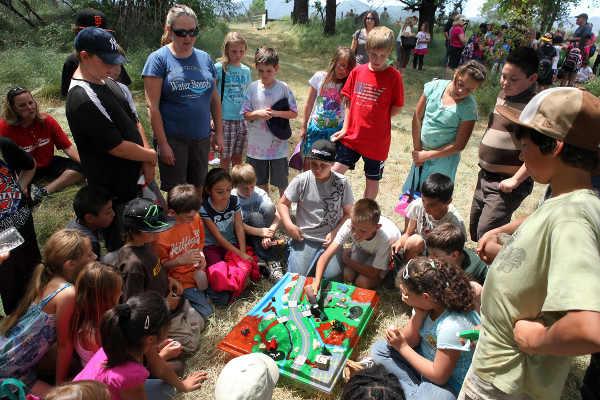
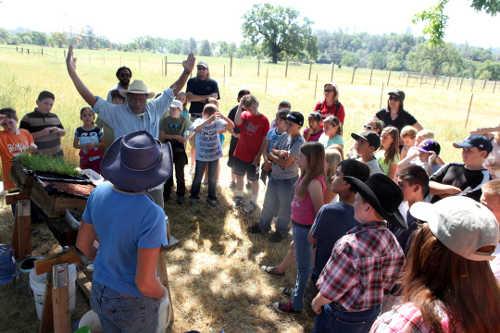
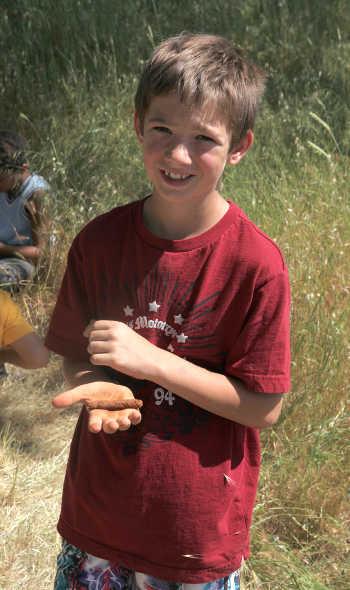
MIDDLETOWN, Calif. – Four elementary schools sent a total of 160 fourth graders to a natural setting by Putah Creek last Tuesday, May 8, for an “In the Creek Day” to learn about the environment and how to take care of it.
Coyote Valley Elementary sent three classes to the event, and Lake County International Charter School, Cobb and Minnie Cannon each sent one.
What these four schools have in common is that they all lie in the Upper Putah Creek watershed, which, as these children learned, is all the land from which water drains into Upper Putah Creek.
That’s the land that has been looked after by the Upper Putah Creek Stewardship (UPCS) since the nonprofit organization was formed in 1996.
Almost every year since then, it has organized In the Creek Day – a springtime event which gives children demonstrations of various aspects of the environment and how to be good stewards.
Organizers of the event in its early days included by Helen Whitney, Bill Reed, Chris Simon and Dwight Holford. After a one-year hiatus, Holford saw to it that the tradition was reinstituted this year.
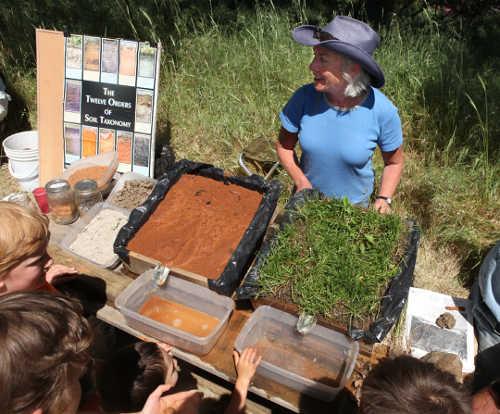
Educators were Jeff Tunnell of the Bureau of Land Management, who taught about fire safety; Kake O’Donnell and volunteer Joe Evans from the Natural Resources Conservation Service Lakeport office, who gave demonstrations related to soils; Larry Ray, president of the UPCS, who covered botany; Dean Enderlin, formerly chief geologist at the McLaughlin Mine, who led a creek side look at rocks; and Carrieann Lopez, an environmental scientist in the North Coast district of the State of California Water Board, who offered insights into sources of water pollution.
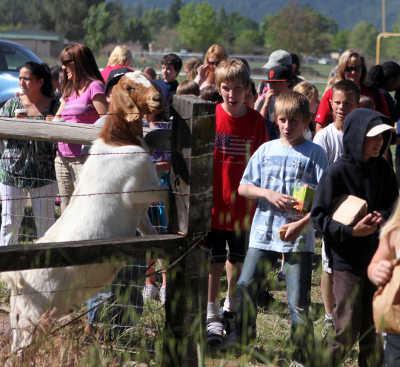
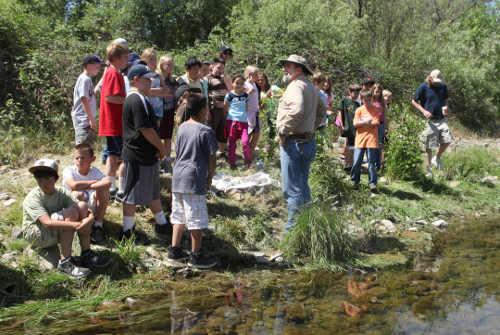
Nelsy, Trinity and Lucas of Coyote Valley Elementary all liked the creekside geology with Dean Enderlin best.
“You got to look at different types, and look at crystals inside it,” said Trinity about the rocks she found along the creek.
“I liked when we got to find rocks and he helped us identify them,” said Lucas, adding that he also learned about “fire safety and pollution.”
Nelsy liked that she could “find our own rocks.”
She learned that “there are three types of different rocks: igneous, sedimentary and metamorphic” and that important things to take care of in the environment are “water, soil, air.”
The event took place along Putah Creek, just behind Middletown High’s football field on property generously offered for the event by Michael Browning.
The Veggie Girl: Kiwi contemplation
An encounter with a kiwi fruit is a lesson learned: You can’t judge a book by its cover.
Who would’ve guessed that such exquisitely flavored fruit resides in scruffy brown guise?
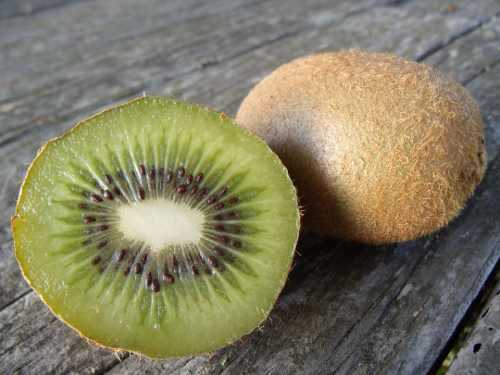
Kiwi’s burlap-like skin belies not only its flavor, but the translucent green and delicate patterns found within.
Cut crosswise, tiny black seeds scatter amidst a circular starburst of rays in juicy emerald flesh.
I’ve always loved exotic yet approachable kiwi, and I admit that I’m old enough to remember when it became a staple in U.S. supermarkets.
My children were raised with kiwi as common a breakfast food on their morning plates as oranges, and these fuzzy friends still have a prominent place in our fruit bowl.
Native to the Yangtze River Valley in southern China, the kiwi fruit was known there as yangtao. Its indigenous history goes back more than 700 years, where royalty cherished this fruit plucked from vines which grew wrapped around trees.
Word spread about delectable kiwi fruit in the 19th century, and plant cuttings were transported to the United States just after the turn of the 20th.
About the same time, kiwi vines were planted in New Zealand, where its popularity soared and the fruit was renamed the Chinese gooseberry.
Its current moniker, kiwi fruit (also spelled kiwifruit or shortened to kiwi), came in the early 1960s, when a savvy produce distributor felt the U.S. market would be receptive to the fruit. She renamed it to honor the kiwi, a bird native to New Zealand whose fuzzy brown coat resembled the fruit.
By the mid-1970s kiwi fruit was widely available in supermarkets here; prior to that it could only be found in specialty stores.
These days growers are developing other forms of kiwi, such as golden kiwi (which has a less fuzzy coat) and grape-sized versions of the fruit.
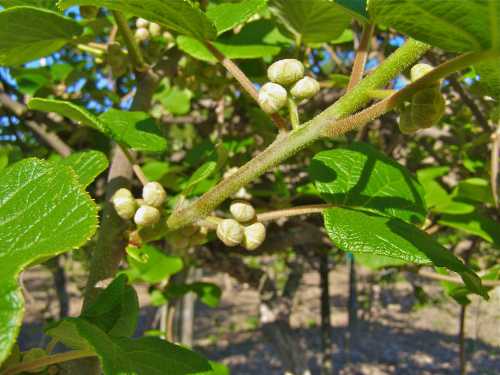
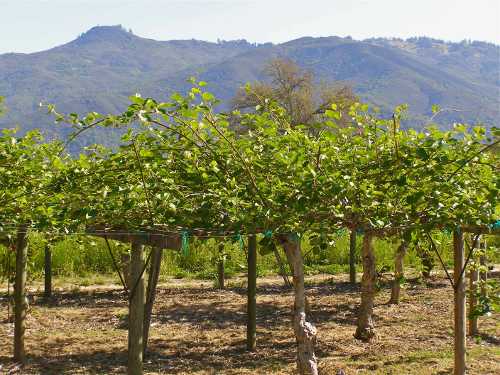
The vines on which kiwi fruit grow resemble grapevines, and like them, require vigorous pruning. They grow well in temperate climes which have a fairly warm summer, making Lake County a prime candidate for successful growth.
In fact, Lake County enjoys a bit of kiwi fruit history, something I found out only recently from Lake County resident, Haji Warf, which she, in turn, learned from an Upper Lake, Calif., kiwi grower.
According to Warf, the sprawling Mediterranean-style winery, Ceago del Lago, in Nice, Calif., was once the site of a 30-acre kiwi farm. When kiwi crops began flourishing in other parts of the world, the price bottomed out, forcing the owners to tear out the kiwi vines.
Apparently, the same fate occurred at a large kiwi orchard in Kelseyville, Calif., around the same time.
I’m happy to hear, however, that kiwi vines continue to thrive in Lake County, even if not on a commercial level.
Not surprisingly, kiwi fruit marries well with other fruits, both tropical and otherwise. Some favorite matches are bananas, strawberries, papayas and mangoes, as the sweetness of these fruits (and the smoothness of the banana) provide balance to the sweet-tart note of the kiwi.
Slices of bright kiwi fruit are often utilized for a splash of green in tarts filled with colorful fruit, and since they don’t brown when cut, they’re popular garnishes for a variety of pastries and cakes.
Kiwi fruit may be made into jam, and when combined with lime, a fine marmalade is produced. They’re a refreshing component of sorbets and ices, make great smoothie additions, and do well when juiced with greens.
Kiwi has also found its way into salads, whether with greens, chicken, seafood or grains such as quinoa, couscous or bulgur.
Kiwi is also paired with meat in glazes, marinades or even as a component of a stir-fry.
And speaking of meat, because of an enzyme present in kiwi fruit, it can serve as a natural tenderizer.
Simply rub a cut kiwi on the meat, or mash a bit of kiwi to spread over it and allow it to sit for 10 to 15 minutes.
Because of this, if kiwi is served with ice cream or other dairy products, it should be eaten right away, before the enzyme has a chance to break down the protein.
This egg-shaped fruit is rich in stores of vitamin C, with one kiwi providing well beyond our daily requirement, giving us antioxidant protection, immune system boosts, cardiovascular benefits, and protection against asthma and macular degeneration.
And because kiwi is high in fiber, it can help lower cholesterol and encourage digestive health.
If these fuzzy little ovals are not allowed to soften to ripeness before being eaten, they may make our mouths pucker.
The riper the kiwi, the sweeter its fruit. When they yield easily to a little pressure, they’re ready to eat.
Though kiwi fruit is often found firm and unripe at the grocery store, a few days at room temperature on the kitchen counter at home will remedy this. For faster ripening, place them in a paper bag with an apple or banana.
Once ripe, store fruit in the refrigerator for up to two weeks.
Between California (where 95 percent of the U.S. kiwi crop is grown) and New Zealand, kiwi fruit is available to us year-round.
I’ve provided two recipes for today, a refreshing lemon-mint cooler made with kiwi, and a fruity spin on spring rolls.
I’m a huge spring roll fan, and thankfully rice wrappers for this dish may be found in most supermarkets. If it’s a little intimidating to work with them the first time, don’t worry. With some practice you’ll have it down in no time.
The way I look at it, if I can do it, almost anyone can.
And before I go, did you know the skin of kiwi fruit is edible? Though most of us throw it away, it’s full of nutrients. If washed and rubbed with a paper towel, most of the fuzz will come off.
I’ve heard that in New Zealand they’re bitten into, skin and all, like a peach. I must admit that I haven’t had the courage to try it this way.
And last but not least, Happy Mother’s Day to all the moms out there. I hope you enjoy your day!
Kiwi mint lemonade
1 cup water
½ cup granulated sugar
½ cup packed fresh mint leaves
3 kiwi fruit
2 to 3 lemons
Sparkling water
In a medium saucepan, heat water with sugar over medium-high heat, stirring occasionally until sugar is dissolved. Simmer, uncovered, five minutes. Remove from heat and stir in mint leaves. Let stand 20 minutes
Meanwhile, peel kiwifruit and cut into chunks. Puree in a food processor. Place puree in a pitcher.
Strain cooled syrup into pitcher, pressing on mint, then discard leaves. Refrigerate until cold.
Squeeze juice from two lemons. Stir into kiwifruit mixture. Taste, squeeze in juice from remaining lemon for a more tart lemonade.
Pour into glasses. Top with sparkling water. Serve garnished with a slice of kiwifruit. Makes about 2¼ cups without sparkling water, enough for four drinks.
Recipe courtesy of the California Kiwifruit Commission at www.kiwifruit.org .
Fruity tropical spring rolls with kiwi
12 rice paper wrappers (found in most stores)
1 ½ cups chopped strawberries
2 firm yellow bananas, chopped
1 mango, cut into matchsticks
3 kiwi, peeled and chopped
1 bunch of fresh mint, chopped or whole leaf
If rolls are double wrapped, this recipe makes six rolls. If not, it makes 12.
Fill a large baking dish with warm water. Dip the rice paper wrap in the water quickly to soften (less than five seconds) and pat dry with paper towel. If using, repeat with a second wrap and lay atop the first one.
Add fruit in the middle of the wrap, beginning with mango (6-8 sticks) and adding the rest on top (about a tablespoon of strawberries, kiwi and banana each).
Be sure not to overfill, and adjust amount of fruit based on whether you’re making 6 or 12 rolls. Mint leaves may be chopped or left whole; add about two to three leaves to each roll.
Once the fruit is on the wrap, fold up the bottom and tuck under the fruit. Fold in each side as you would a burrito, then roll the wrap to the end. It should seal itself since it’s damp.
Serve wraps whole or slice in the middle at an angle. Serve with honey dipping sauce. (Recipe below.)
Vanilla lime honey dipping sauce
1/3 cup honey
¼ teaspoon vanilla extract
Contents of ½ vanilla bean (optional)
Zest of one lime
Combine all ingredients in a bowl, mix and serve.
Recipe adapted from “Vegetarian Times” magazine.
Esther Oertel, a freelance writer, cooking teacher, and speaker, is passionate about local produce and all foods in the vegetable kingdom. She welcomes your questions and comments and may be reached at
Helping Paws: Puppies, terriers, labs and shepherds
LAKEPORT, Calif. –Want a puppy or a mature dog? The Lake County animal shelter has a variety of critters to join your family.
A new group of puppies, along with adult dogs of various sizes, are waiting to be adopted.
Thanks to Lake County Animal Care and Control’s new veterinary clinic, many of the animals offered for adoption already are spayed or neutered and ready to go home with their new families.
Dogs that are adopted from Lake County Animal Care and Control are either neutered or spayed, microchipped and, if old enough, given a rabies shot and county license before being released to their new owner. License fees do not apply to residents of the cities of Lakeport or Clearlake.
If you're looking for a new companion, visit the shelter. There are many great pets hoping you'll choose them.
The following dogs at the Lake County Animal Care and Control shelter have been cleared for adoption (additional dogs on the animal control Web site not listed are still “on hold”).
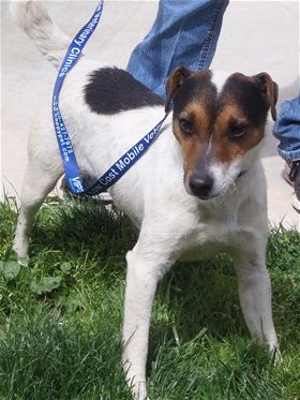
Male Jack Russell mix
This male Jack Russell terrier mix is 6 years old.
He has tricolor markings and a short coat, weighs 19 pounds and has not yet been neutered.
He is in kennel No. 24, ID No. 32483.
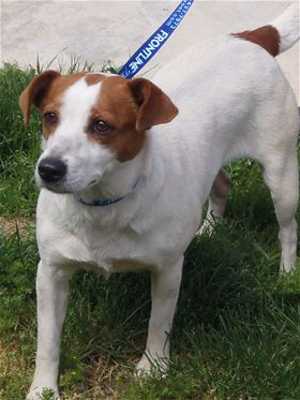
Female Jack Russell mix
This female Jack Russell terrier mix is 3 years old.
She has a short tan and white coat, weighs nearly 26 pounds and has not yet been spayed.
Find her in kennel No. 22, ID No. 32482.

Labrador Retriever-Great Dane
This male Labrador Retriever-Great Dane mix is 5 months old.
He weighs 41 pounds, has a short black and white coat, and has been neutered.
He is in kennel No. 33, ID No. 32600.

Female Labrador Retriever
This female Labrador Retriever is 1 year old.
She weighs 44 pounds, has a short black coat and has been spayed.
She is in kennel No. 26, ID No. 32639.

Female Australian Shepherd mix
This female Australian Shepherd mix is 1 year old.
She has a short red and tan coat, and bright, beautiful green eyes.
She weighs 65 pounds and has been spayed.
Shelter staff said she is quiet and mellow. She is good with other dogs and would be good with kids.
Find her in kennel No. 19, ID No. 32589.

Male Labrador Retriever-shepherd mix pup
This male Labrador Retriever-shepherd mix pup is 11 weeks old.
He has a short brown coat and floppy ears, weighs 13 pounds and has been neutered.
He is in kennel No. 29a, ID No. 32676.
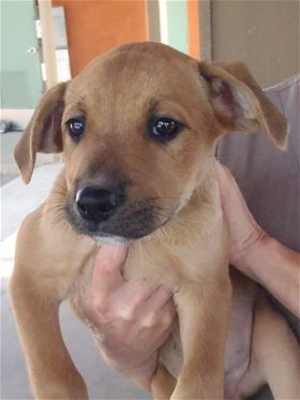
Male Labrador Retriever-shepherd mix pup
This male Labrador Retriever-shepherd mix pup is 11 weeks old.
He has a short brown coat and floppy ears, weighs 13 pounds and has been neutered.
Find him in kennel No. 29e, ID No. 32680.

Female Labrador Retriever-shepherd mix pup
This female Labrador Retriever-shepherd mix pup is 11 weeks old.
She has a short brown and black coat and floppy ears, weighs nearly 15 pounds and has been spayed.
She is in kennel No. 30a, ID No. 32673.
Adoptable dogs also can be seen at http://www.co.lake.ca.us/Government/Directory/Animal_Care_And_Control/Adopt/Dogs_and_Puppies.htm or at www.petfinder.com .
Please note: Dogs listed at the shelter's Web page that are said to be “on hold” are not yet cleared for adoption.
To fill out an adoption application online visit http://www.co.lake.ca.us/Government/Directory/Animal_Care_And_Control/Adopt/Dog___Cat_Adoption_Application.htm .
Lake County Animal Care and Control is located at 4949 Helbush in Lakeport, next to the Hill Road Correctional Facility.
Office hours are Monday through Friday, 8 a.m. to 5 p.m., and 1 p.m. to 3 p.m., Saturday. The shelter is open from 10:30 a.m. to 4:30 p.m. Monday through Friday and on Saturday from 1 p.m. to 3 p.m.
Visit the shelter online at http://www.co.lake.ca.us/Government/Directory/Animal_Care_And_Control.htm .
For more information call Lake County Animal Care and Control at 707-263-0278.
Lake County recognizes 2012 Early Childhood Educator of the Year Award recipients

LAKEPORT, Calif. – The Lake County Child Care Planning Council recognized some of the county's best educators at its annual Early Childhood Educator of the Year Award Dinner on Friday, May 4.
The dinner, at The Lodge at Blue Lakes, offered recognition and valuable award packages to 11 exceptional early childhood educators.
Approximately 200 attendees and many Lake County organizations, businesses and individuals offered significant support to make this event possible.
Lake County Department of Social Services; Lake Family Resource Center; North Coast Opportunities; Lake County Office of Education, Child Development Division; Nurturing Parenting Program; Redwood Empire Association for the Education of Young Children and Yuba College were significant supporters, along with many others.
Many local dignitaries, including Supervisors Anthony Farrington and Denise Rushing, Lake County Superintendent of Schools Wally Holbrook and Lakeport Police Chief Brad Rasmussen attended the event and presented awards to the honorees.
“It is encouraging to see our community’s organizations and leaders unite in recognition of the valuable contribution early childhood educators make throughout Lake County,” said Shelly Mascari, director of the Lake County Child Care Planning Council.
Approximately 60 nominations were received for Lake County providers in recognition of commitment to excellence by their peers, community members and the families they serve.
Winners were selected based on a detailed interview and evaluation process that took into consideration education, commitment to their profession, answers to specific interview questions and effectiveness in their role as educators.
Early childhood educators contribute significantly to our communities.
Quality early childhood education dramatically impacts high school graduation rates, keeps our communities working, and helps Lake County develop productive, effective, happy citizens of the future.
“Many of these educators have dedicated decades to their profession, in the face of dramatic budget cuts and statewide funding priorities that work in opposition to consistent, quality care,” said Mascari. “Their education, in many cases, equals that of the K-12 educator, and this program provides a forum to recognize that commitment and the important work they do.”
The 2012 Early Childhood Educators of the Year include the following.
Lifetime Achievement Award
Cindy Adams, Lake County Office of Education
Leading the Field Award
Sara Brucker, The Learning House
Special Needs Advocate of the Year
Jami White, Lake Family Resource Center
Provider of the Year: Infant/Toddler
Sarah Solgat, Early Head Start
Provider of the Year: Preschool
Sajeanne Burgoyne, Early Connection Preschool, Kelseyville
Provider of the Year: School Age
Nicole Schnabl, Kid Connection After School Program, Lower Lake Elementary
Provider of the Year: Family Child Care
Sarah Hanson
Volunteer of the Year
Lourdes Aguirre, AmeriCorps Member, Early Connection Preschool, Lakeport
Sparkle Award Recipients
Kim Beale, Family Child Care Provider
Jody Mederos, Pearl Head Start
Maryellen Bowman, Meadowbrook/Pearl Head Start